Pentagon AI tools are set to roll out fast. Learn what’s coming, where they’ll land, and the practical steps teams should take to deploy securely.
Pentagon AI Rollouts: What’s Coming and What to Do
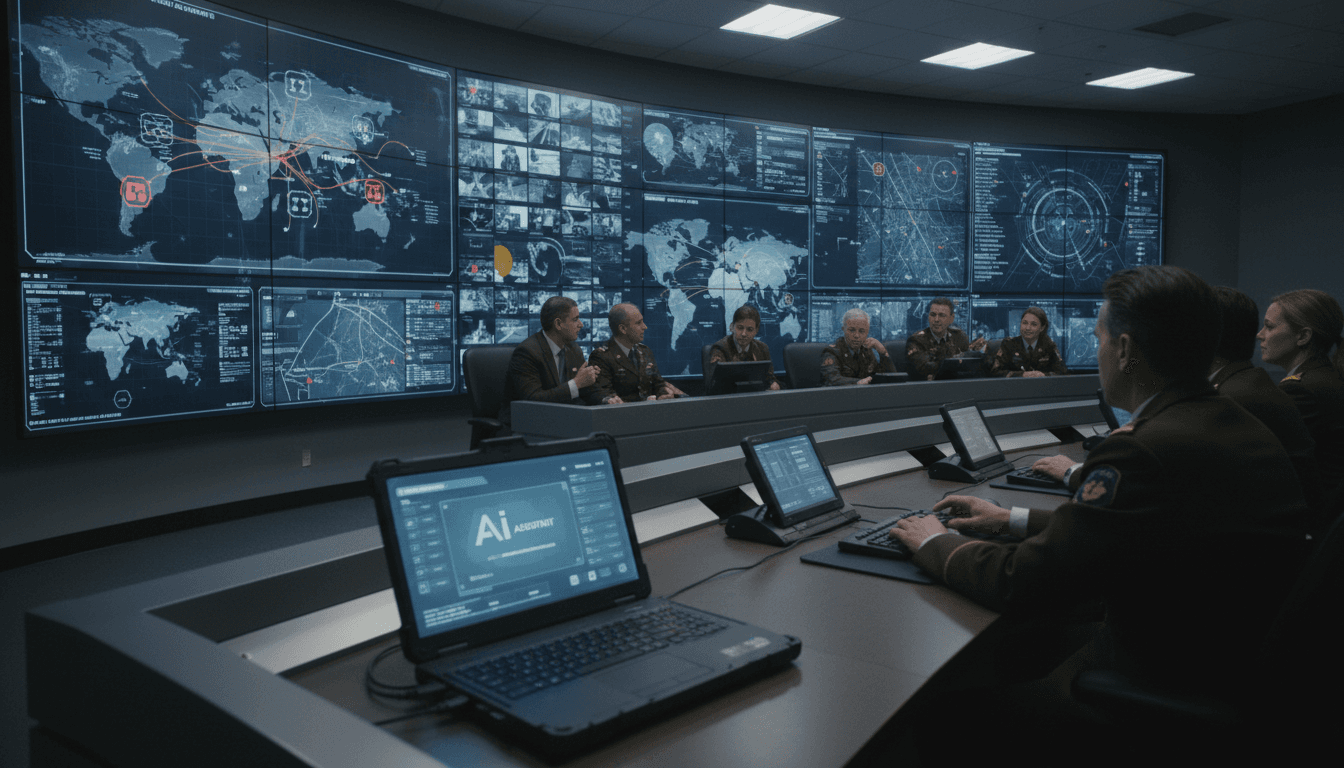
A Pentagon-wide rollout of new AI tools for logistics, intelligence analysis, and combat planning isn’t a “someday” project anymore. The Department of Defense says the next set of tools is expected in days or weeks, and it’s backing that deployment with a department-wide platform choice: Gemini for Government.
If you work in defense tech, national security, or government IT, this matters for a simple reason: the center of gravity is shifting from AI pilots to AI operations. The hard part won’t be building prototypes. It’ll be scaling adoption across a 3-million-person enterprise, without creating new cyber risk, new fragility in mission planning, or new acquisition bottlenecks.
I’m going to take a clear stance: the Pentagon’s success here will be determined less by model performance and more by data readiness, workflow fit, and governance discipline. The organizations that win contracts and earn renewals will be the ones that make AI boring—reliable, auditable, and integrated into real work.
What the Pentagon is signaling: “deployment beats demos”
The direct signal is that wide AI deployment is now treated as a top “critical technology” priority—not just an R&D curiosity. Emil Michael, the Undersecretary of Defense for Research & Engineering, has tied his agenda to pushing AI into actual use cases across the Department.
That’s a big shift in emphasis. For years, DOD’s AI story often looked like:
- a promising demo,
- a constrained pilot,
- and a long pause while policy, security, and procurement caught up.
Now the message is different: get capability in users’ hands, train them, support it, and let innovation emerge from usage. That “learn by doing” approach is closer to how commercial AI programs scale.
Why consolidating AI organizations is a forcing function
The consolidation of the Defense Innovation Unit (DIU), the Chief Digital and Artificial Intelligence Office (CDAO), and related efforts under one senior leader is a structural move aimed at speed. Whether you agree with the org chart or not, the intent is obvious: reduce handoffs, reduce duplicated programs, and ship more capability per quarter.
Michael has also said he plans to reduce the number of technology areas DIU pursues. That’s a mature move. When an organization has “14 priorities,” it’s really saying it has none. A shorter list creates clearer budget signals, cleaner contracting lanes, and fewer internal knife fights.
The platform choice: why “Gemini for Government” matters
Choosing a department-wide AI platform does two things at once:
- Standardizes how people access AI (identity, logging, policy controls, endpoints).
- Centralizes procurement gravity, making it easier to deploy at scale.
The upside is speed. The downside is concentration risk—operational, vendor, and security.
What “department-wide AI” actually means in practice
Most people picture a chatbot. That’s the smallest part of it.
In real defense environments, department-wide AI usually expands into:
- Knowledge work acceleration: drafting, summarizing, translating, briefing support
- Analytic augmentation: triage, clustering, entity extraction, and hypothesis generation
- Decision support: courses of action, constraints checking, and planning templating
- Back-office modernization: contracting workflows, HR actions, acquisition documentation
The highest ROI tends to come from two places:
- high-volume, repeatable workflows (ticketing, logistics actions, routine reporting)
- high-stakes workflows with high friction (intel fusion, targeting-adjacent analysis support, operational planning documentation)
The non-negotiables: auditability, access control, and data boundaries
If you’re selling into DOD AI programs—or building them internally—three requirements dominate everything:
- Provenance and traceability: Who asked what, what data was used, what was returned, and when.
- Role-based access control (RBAC): AI must respect classification, compartments, and mission roles.
- Data boundary enforcement: Prevent “helpful” tools from becoming accidental exfiltration paths.
In other words: the most valuable AI in defense is often the least flashy. It’s the system that can answer “how did you get this?” with logs, citations, and controls that survive inspection.
Where the first wave of AI tools will land: logistics, intel, planning
The Pentagon’s near-term focus areas—logistics, intelligence analysis, and combat planning—aren’t random. They’re the three places where speed and complexity collide daily.
Logistics AI: readiness is a math problem hiding inside a data problem
Logistics is full of decisions that look simple but aren’t:
- Which part shortages will ground the most aircraft next week?
- Which depot constraints create cascading delays?
- Which substitute items are safe, compliant, and available?
AI helps when it can forecast, prioritize, and recommend actions. But it fails quickly when data is fragmented across systems, mislabeled, or missing context.
What works best in early deployments is a two-layer approach:
- Predictive models for demand and bottlenecks.
- LLM-based copilots that explain the “why” in plain language and generate action paperwork.
That combination matters because many logistics organizations don’t need “a model.” They need an operational workflow: prediction → explanation → action → feedback.
Intelligence analysis AI: speed is useless without trust
Intel teams already face an overload problem: more sensors, more intercepts, more open-source material, more reporting. AI can reduce time-to-insight by:
- summarizing and translating large volumes
- extracting entities and relationships
- clustering related events
- flagging contradictions and gaps
But here’s the hard truth: analysts will reject AI that can’t show its work. In national security settings, “sounds right” is not a standard.
A practical design pattern is:
- AI produces a draft assessment
- it attaches citations to source snippets (even if internal)
- it marks confidence and missing evidence
- a human signs the final product
If your AI can’t support that workflow, it’s not ready for scaled intelligence analysis.
Combat planning AI: acceleration without authority
Combat planning is a natural target for AI because it’s document-heavy, constraint-heavy, and time-sensitive. AI can help by:
- generating initial course-of-action templates
- checking constraints (timelines, assets, rules of engagement references)
- proposing branches and sequels
- automating brief formats and annex generation
The line that must not blur: AI can accelerate planning, but it can’t become the authority. The most defensible posture is “AI as staff work,” not “AI as commander.”
A useful internal rule: if an AI recommendation can’t be explained in two minutes to a commander, it doesn’t belong in the decision path.
The Ukraine lesson: AI is now part of the tempo of war
Michael referenced Russia’s war on Ukraine as a lens on future conflict, including a “robot on robot” dynamic on the frontline. That phrase is memorable because it’s pointing at something deeper: automation is compressing decision cycles.
In high-tempo environments, the competitive edge often comes from:
- faster sensor-to-shooter loops
- more resilient communications and targeting processes
- rapid adaptation when adversaries change tactics
AI supports that—but only when it’s operationally integrated. A standalone tool that lives outside the mission workflow is dead weight.
The China driver: compute, chips, and the supply chain fight
Another core theme is that AI capability is increasingly constrained by compute access and the chip supply chain. Michael’s remarks about China attempting to replicate advanced chip ecosystems highlight a blunt reality:
- AI superiority is partly a model problem.
- It’s also a manufacturing capacity, supply chain integrity, and allied access problem.
For defense leaders, this links AI adoption to broader initiatives like:
- trusted microelectronics
- secure-by-design hardware supply chains
- allied partnerships for testing ranges and advanced development
This also affects vendors: if you can’t explain how your AI system performs under compute constraints—or how it degrades gracefully—you’re going to lose to someone who can.
What defense and government teams should do now (a practical checklist)
If you’re a program office, a mission owner, or an industry partner trying to be relevant to this rollout, focus on execution basics. Most teams get this wrong by starting with “Which model?” instead of “Which workflow?”
1) Pick three workflows, not thirty
Choose workflows that are:
- high volume (daily/weekly)
- measurable (time saved, error reduction)
- safe to start (low chance of catastrophic misuse)
Examples that tend to work early:
- maintenance action summarization and routing
- intelligence report triage with citations
- planning document drafting with constraint checklists
2) Build governance that speeds adoption instead of blocking it
Governance fails when it becomes a ticket queue.
Good governance looks like:
- clear data handling rules by classification and mission role
- pre-approved prompt and tool patterns for common tasks
- logging and red-team testing as default, not special events
3) Train users like operators, not like “AI hobbyists”
The Pentagon is talking about training and deployed engineer support, and that’s exactly right. Training should be:
- scenario-based (“write a maintenance brief from these notes”)
- focused on failure modes (hallucinations, missing citations, unsafe assumptions)
- paired with escalation paths (“who do you call when outputs look wrong?”)
4) Measure outcomes that commanders and SES leaders care about
If you want renewals, measure outcomes that translate:
- time-to-brief reduced (minutes/hours)
- backlog reduced (cases/tickets)
- mission planning cycle time reduced (days)
- rework rates reduced (percent)
The organizations that show credible metrics in Q1 will set the standard for everyone else.
Where this is heading in 2026: AI as default infrastructure
As this series on AI in Defense & National Security keeps tracking, the next phase is predictable: AI stops being “a program” and becomes infrastructure—like identity, networking, and cloud.
That creates a real opportunity for teams that can deliver:
- secure AI gateways and policy enforcement
- model monitoring and drift detection
- evaluation harnesses tied to mission outcomes
- data readiness and labeling pipelines
If you’re building for defense AI, aim for systems that can survive audits, cyber scrutiny, and operational stress—not just a demo day.
If you want help mapping the right workflows, governance model, and evaluation plan for your organization’s AI rollout, that’s exactly what we work on with defense and national security teams. The smartest move is to get your deployment architecture and adoption plan right before the first wave becomes the default expectation.
What’s the one workflow in your organization where a reliable AI copilot would save the most time without increasing mission risk?