Opponent-aware AI helps models stay stable when adversaries adapt. Learn how LOLA-style thinking strengthens defense, cyber, and U.S. digital services.
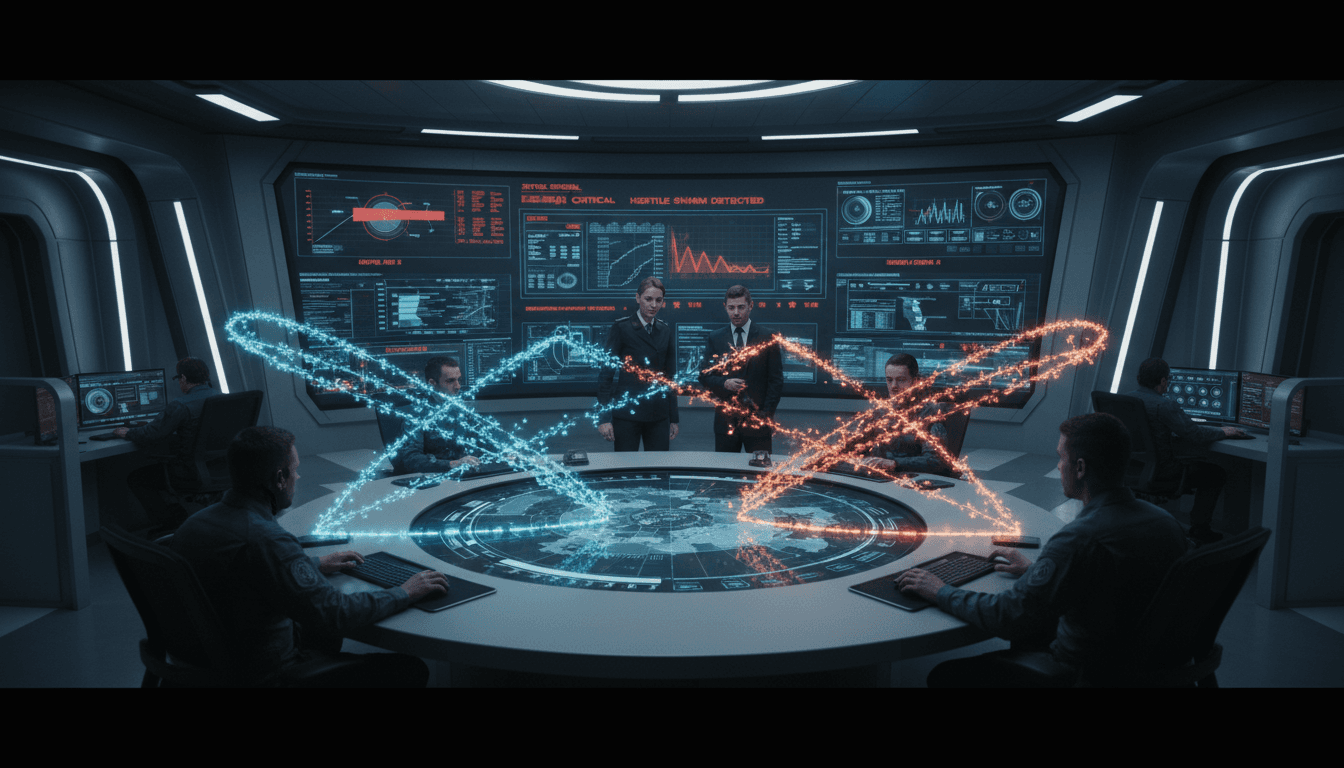
Opponent-Aware AI: Smarter Decisions in Defense Tech
Most AI systems fail the moment the environment starts fighting back.
That’s not a metaphor—it's a real technical failure mode. In defense and national security, your “environment” includes adversaries who observe, adapt, and deliberately change tactics. If your model assumes the world is stable, you end up with brittle automation: tools that look great in tests and disappoint in deployment.
This is why a 2017 research idea from OpenAI—Learning with Opponent-Learning Awareness (LOLA)—still deserves attention in 2025. LOLA tackles a simple problem with big consequences: when multiple learning agents interact, training becomes non-stationary, and naive reinforcement learning can spiral into instability, exploitation, or pointless arms races. In adversarial settings (cybersecurity, electronic warfare, influence operations, autonomous systems), that’s the default condition.
Why “opponent learning” breaks standard AI
Answer first: Standard reinforcement learning assumes the world’s dynamics don’t change just because your agent is learning. Multi-agent settings violate that assumption immediately.
In a single-agent RL setup, the environment is usually treated as fixed. Your policy improves against a stable reward landscape. But in multi-agent reinforcement learning, every agent’s learning step changes the environment for everyone else.
In defense and national security, this shows up everywhere:
- A red team changes malware signatures after your detector retrains.
- A jamming strategy shifts as soon as your communications policy adapts.
- An influence campaign adjusts narratives when your counter-messaging model updates.
- An autonomous drone swarm changes formation in response to observed pursuit behaviors.
The result is a moving target problem: training can oscillate, collapse, or converge to “bad peace” outcomes where both sides choose strategies that are safe but inefficient.
The practical risk: you train a model that teaches the adversary
Here’s a non-obvious failure mode I’ve seen teams underestimate: your learning dynamics become an information channel.
If an opponent can observe how your system updates—what it reinforces, what it penalizes, what it ignores—they can shape your future behavior. In cyber terms, this resembles adversarial drift: the attacker doesn’t just evade detection; they steer the defender’s retraining process.
This matters for U.S. digital services too. Fraud rings, bot operators, and scalpers are “opponents” in exactly the LOLA sense: they learn.
What LOLA actually changes (and why it’s still relevant)
Answer first: LOLA trains an agent to account for how its current action will influence the other agent’s next learning update, not just the immediate payoff.
LOLA’s core idea is strategic and slightly uncomfortable: don’t only respond to the opponent’s current behavior—shape how they will learn.
Instead of optimizing expected reward against a fixed opponent policy, LOLA adds a term that considers the effect of your policy on the opponent’s future parameter update. In plain English:
A LOLA agent chooses actions that make the opponent’s next learning step more favorable to the LOLA agent.
This is exactly the kind of reasoning humans use in competitive settings:
- “If I retaliate now, they’ll back off later.”
- “If I cooperate first, they might reciprocate.”
- “If I show restraint, it reduces escalation risk.”
LOLA formalizes that intuition in gradient-based learning.
What the OpenAI results showed
The OpenAI paper demonstrated several behaviors that map cleanly to security contexts:
- Iterated Prisoner’s Dilemma: Two LOLA agents tend to develop tit-for-tat-like cooperation, while independent learners often don’t.
- Matching Pennies: LOLA agents converge toward the Nash equilibrium in a competitive zero-sum setting.
- Robustness claims: LOLA performed well in tournaments against a range of other multi-agent learners and resisted certain higher-order gradient exploitation.
Even though this work is from 2017, the underlying lesson is current: you can’t build reliable autonomous decision-making for adversarial domains without modeling learning-on-learning effects.
Where opponent-aware learning fits in defense and national security
Answer first: Opponent-aware learning helps in any mission area where adversaries adapt faster than traditional model update cycles.
LOLA is not a turn-key defense product. It’s a design pattern: treat adversaries as learning systems and optimize accordingly.
1) Cybersecurity: adversarial adaptation and “training-time deterrence”
In cyber defense, attackers don’t just probe; they iterate. A defender that retrains on yesterday’s attacks can still lose tomorrow.
Opponent-aware approaches can support:
- Adaptive deception: honeytokens/honeypots that don’t merely catch attackers, but encourage attacker behaviors that are easier to attribute or contain.
- Deterrence by shaping cost: defensive actions that push attackers toward higher-effort techniques (which are rarer, noisier, and slower).
- Stability in automated response: avoiding oscillations where a defender overreacts, triggers attacker adaptation, then overcorrects again.
A concrete example: if an automated email defense blocks too aggressively, adversaries shift to low-volume, high-quality spear phishing, reducing detection data. A more opponent-aware policy may accept limited exposure to gather intelligence—but only if the longer-term payoff is clear and bounded.
2) Autonomous systems: escalation control and predictable interaction
Multi-agent autonomy is no longer a research curiosity. Drones, sensors, decoys, and electronic warfare nodes increasingly coordinate.
Opponent-aware learning can help produce policies that:
- Avoid accidental escalation (e.g., overly aggressive pursuit behaviors that provoke countermeasures)
- Maintain mission stability under adversarial adaptation
- Encourage predictable “rules-of-the-road” dynamics—not because the adversary is nice, but because cooperation can be the rational equilibrium
That last point is important: LOLA-style cooperation is self-interested, not altruistic. In national security, that’s often the only cooperation that lasts.
3) Intelligence analysis and counter-influence: second-order effects
Influence operations are a feedback loop. You message, they react, you update. Models that optimize only for immediate engagement metrics can make the long-run situation worse.
An opponent-aware approach encourages planners to ask:
- If we respond publicly now, how does that change their next campaign?
- If we suppress content aggressively, do we drive it to harder-to-monitor channels?
- If we deploy detection, do we create an adaptation pressure that causes a more dangerous strategy shift?
LOLA doesn’t answer those questions by itself, but it gives a formal framework for planning under opponent adaptation.
The real lesson for U.S. digital services: your “opponent” is often a user
Answer first: In many U.S. technology and digital services, the opponent isn’t a nation-state—it’s a fast-learning ecosystem of users, competitors, bots, and fraud rings.
This is where the campaign angle becomes practical. U.S. AI companies have pushed multi-agent research not just for games, but because the economy runs on dynamic interaction:
- marketplaces
- ad auctions
- pricing and inventory
- customer support automation
- anti-fraud systems
In each case, once you deploy an AI policy, other actors change behavior in response.
A simple business translation of LOLA
If you run a digital service, opponent-learning awareness maps to:
- Policy updates that anticipate customer adaptation (refund abuse, promo gaming)
- Fraud controls that shape attacker incentives (forcing expensive tactics)
- Support bots that de-escalate strategically (reducing repeat contacts over time)
One stance I’ll take: If your AI roadmap doesn’t include adversarial adaptation, you’re budgeting for yesterday’s threats.
How to apply opponent-aware thinking without rebuilding your stack
Answer first: You can adopt LOLA-style benefits by changing your evaluation, simulation, and deployment loops before changing your model architecture.
Most organizations don’t need to implement LOLA gradients tomorrow. But you can bring opponent-learning awareness into your AI governance and engineering in practical steps.
1) Evaluate against adaptive adversaries, not static test sets
Static benchmarks reward models that “solve the past.” For defense tech and security analytics, you need tests where the adversary adapts.
Practical options:
- Red-team RL agents that learn to evade your detector over episodes
- Generative adversary simulation that mutates tactics based on failures
- Online/offline split testing where attacker behavior is modeled as non-stationary drift
A useful internal metric: performance under adaptation, measured as area-under-curve across successive attacker policy updates, not one snapshot.
2) Favor stable policies over greedy ones
If your policy improvements cause large behavioral shocks, opponents learn faster.
Techniques that help:
- conservative policy updates
- explicit constraints on action changes
- “cost of change” penalties (especially in automated response)
In national security contexts, stability isn’t softness—it’s control.
3) Build incentive maps, not just classifiers
Classifiers tell you “what is happening.” Incentive maps tell you “what they’ll do next.”
Even a lightweight model that estimates:
- attacker cost
- attacker payoff
- adaptation speed
will improve decision-making. You start selecting actions that reshape the opponent’s feasible set rather than whack-a-mole blocking.
4) Use multi-agent simulation for procurement and requirements
A procurement-friendly way to use this research: require vendors to demonstrate multi-agent robustness.
Ask for:
- performance under adaptive red teaming
- evidence of non-stationary training stability
- documented failure modes (oscillation, collapse, exploitation)
If a system can’t explain how it behaves when the adversary learns, it’s not ready for high-stakes environments.
People also ask: Is LOLA “manipulation,” and is it safe?
Answer first: LOLA is strategic influence over learning dynamics; whether it’s acceptable depends on context, constraints, and oversight.
The word “shape” can sound like manipulation—and sometimes it is. In defense, shaping an adversary’s behavior can mean deterrence or escalation control. In consumer settings, it can cross into dark patterns.
What makes it safer is explicit governance:
- clear objectives (including safety constraints)
- bounded action spaces
- auditability of policy updates
- red-team evaluation focused on long-run harm
In the “AI in Defense & National Security” series, this is a recurring theme: capability without control is liability.
What to do next if you build AI for adversarial domains
Opponent-learning awareness is one of those ideas that changes how you see the whole field. Once you internalize it, a lot of common failures stop being surprising.
If you’re deploying AI in cybersecurity, autonomous systems, or intelligence workflows, take these next steps:
- Rewrite your success metric to include performance under adaptive opponents.
- Invest in multi-agent simulation as a core engineering asset, not a research toy.
- Design for stability and governance so your system can adapt without spiraling.
The question worth carrying into 2026: when your adversary updates their strategy weekly (or daily), how fast can your AI learn—without training the enemy at the same time?