Myanmar’s coup shows how fast instability spreads. Learn how AI helps defense teams detect escalation signals early and track arms networks.
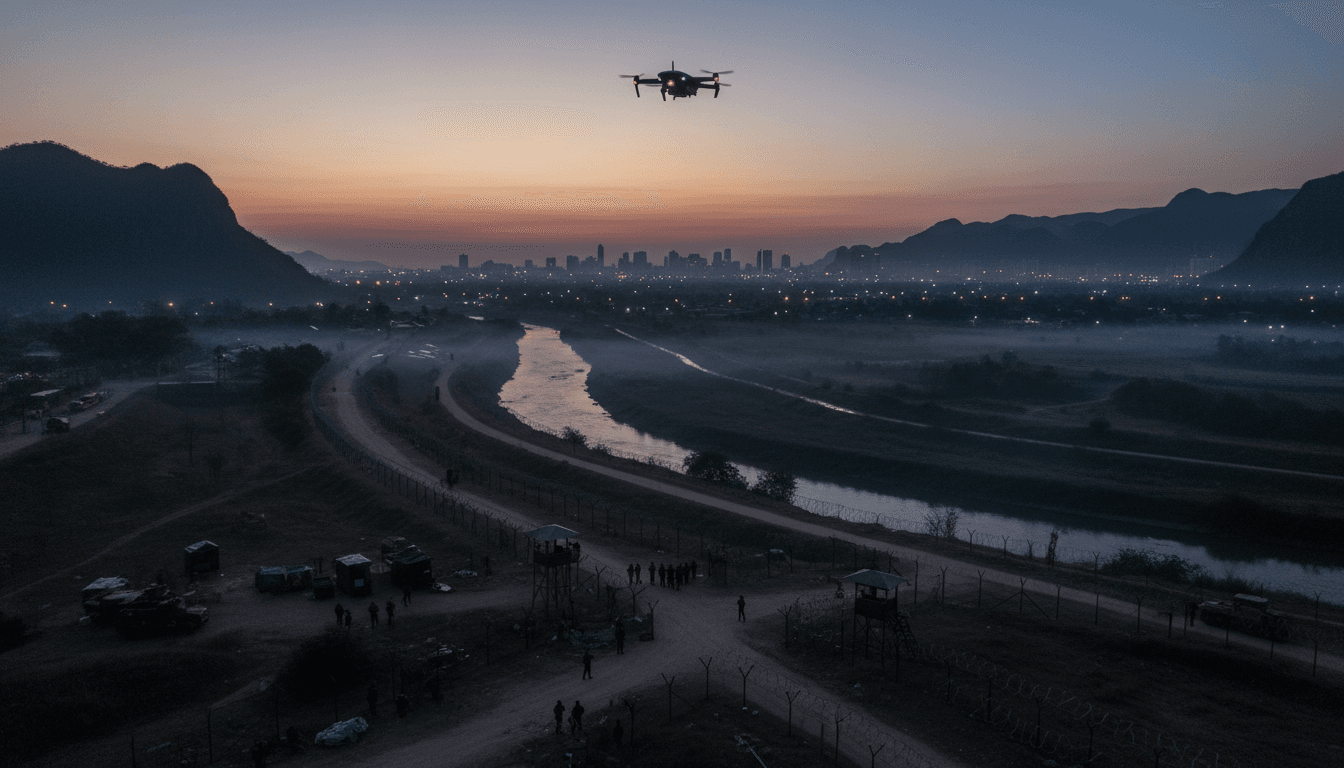
Myanmar Coup Signals: How AI Spots Instability Early
Myanmar’s military has killed more than 6,000 civilians since the February 2021 coup, according to UN estimates, and over 62% of verified civilian deaths have been attributed to airstrikes and artillery. That’s not just a humanitarian catastrophe—it’s a clear indicator of how fast a country can shift from “political crisis” to “regional security problem” when a military decides it can outlast pressure.
For defense and national security teams, Myanmar isn’t a distant tragedy; it’s a live case study in how authoritarian consolidation works, how external patrons keep regimes afloat, and how quickly instability creates knock-on effects: refugee flows, illicit arms markets, maritime risk, and opportunities for outside powers to reshape the balance of influence in Southeast Asia.
This is where the “AI in Defense & National Security” conversation gets concrete. Analysts don’t lack information on Myanmar—they drown in it. The real constraint is time: fusing fragmented signals into an actionable picture before violence escalates or an “election” becomes a legitimacy trap. AI doesn’t replace judgment, but it can compress the timeline from “we should look into this” to “we need to brief leadership now.”
What happened in Myanmar—and why it matters for defense planning
Myanmar’s story is straightforward in its sequence and brutal in its consequences: democratic openings created political competition, the military judged that competition as existential risk, and a coup restored direct control under Senior General Min Aung Hlaing. The result has been mass arrests, lethal force against civilians, and a widening civil conflict involving People’s Defense Forces (PDFs) and multiple ethnic armed organizations (EAOs).
Strategically, three implications matter for defense and intelligence planning.
Instability in Myanmar doesn’t stay inside Myanmar
When violence spikes, displacement follows. The UN estimates more than 3.5 million people have been displaced internally since the coup, with many more seeking refuge across borders. That creates:
- Border security stress for neighbors managing irregular crossings
- Humanitarian logistics challenges that can be exploited by armed groups
- Trafficking and illicit finance opportunities in contested corridors
- Information operations openings as narratives compete across languages and platforms
Even if your organization isn’t focused on Southeast Asia, Myanmar becomes relevant the moment it affects maritime routes, regional basing politics, or partner-nation stability.
External arms pipelines are sustaining the junta
The UN has assessed that since the coup, Myanmar’s military has imported over $1 billion in weapons, raw materials, and dual-use goods, with Russia and China among the top suppliers. Russia has reportedly provided hundreds of millions of dollars in equipment—aircraft, missiles, drones, radar—and has conducted visible military engagement like naval port calls and exercises.
From a national security lens, this is less about Myanmar alone and more about the pattern: authoritarian regimes under pressure often survive by internationalizing their logistics. That means the true center of gravity may be procurement networks, shipping routes, transshipment hubs, and finance—precisely the kind of complex system where machine-assisted analysis helps.
“Elections” can be used as an operational milestone, not a democratic milestone
The junta’s announced phased elections (December 2025 to January 2026) raise a familiar risk: electoral processes used to manufacture legitimacy while narrowing participation, restricting monitoring, and criminalizing opposition.
For analysts, elections in this context aren’t a feel-good calendar event. They’re a forecasting anchor: repression frequently intensifies before and after staged votes, and armed actors recalibrate operations around that timeline.
The hard part: detecting escalation early enough to matter
Most organizations get coup monitoring backwards. They focus on the headline moment—the seizure of power—instead of the lead-up signals that were visible but scattered.
A practical early-warning model looks for convergence across multiple domains:
- Force posture changes: unusual deployments, curfews, checkpoints, air activity patterns n- Information control moves: internet throttling, platform blocks, narrative synchronization
- Legal/administrative pressure: emergency decrees, court actions, party bans
- Procurement anomalies: spikes in aviation fuel, spare parts, dual-use imports
- Violence signatures: increasing use of stand-off fires (artillery/air) vs. ground raids
The problem isn’t that humans can’t track these signals. It’s that each signal may live in a different place: shipping records, local-language posts, satellite imagery, budget lines, or incident logs. AI is useful because it’s good at triage and correlation at scale.
Where AI actually helps: three high-value workflows for Myanmar-style crises
AI adds the most value when it reduces analyst time spent on sorting and increases time spent on interpretation. Here are three workflows that consistently pay off in real-world geopolitical monitoring.
1) AI-driven OSINT fusion for “weak signals”
Answer first: AI can surface escalation indicators by fusing multilingual OSINT into consistent event timelines.
Myanmar is a multilingual information environment, and conflict reporting often appears first in local channels, not international media. Natural language processing (NLP) can:
- Cluster incident reports that describe the same event with different spellings and place names
- Translate and normalize references to units, locations, and weapons systems
- Flag “newness” (first-time mentions of a platform, tactic, or commander)
A simple, high-impact implementation is a daily anomaly brief generated from filtered sources, with human review for credibility and context. The goal isn’t automated truth; it’s faster discovery.
What I’ve found works: treat AI summaries as a starting hypothesis, then require a second-source confirmation step before anything enters the analytic record.
2) Pattern-of-life detection from imagery and geospatial data
Answer first: Computer vision can spot operational changes—airfield tempo, new fortifications, convoy activity—before they show up in narrative reporting.
Because UN reporting highlights heavy reliance on airstrikes and artillery, geospatial monitoring becomes central. AI-assisted imagery analysis can:
- Count aircraft on aprons and track changes in airbase utilization
- Detect new revetments, berms, or hardened positions
- Identify shelling patterns through damage detection and change analysis
In Myanmar, where air operations are a decisive tool for the junta, monitoring runway activity, logistics depots, and aviation fuel movements can provide earlier warnings than social reporting alone.
A practical approach is to define watchlists of sites (airfields, depots, choke points) and apply automated change detection with thresholds that trigger human review.
3) Network analysis for arms and dual-use supply chains
Answer first: Graph analytics can map the relationships that keep a regime supplied—suppliers, brokers, front companies, shippers—so policy and enforcement can target the network, not just the headline actor.
When imports include weapons, raw materials, and dual-use goods, the supply chain becomes a network problem. AI-assisted entity resolution helps unify:
- Company names with multiple spellings
- Individuals tied to multiple firms
- Shipping patterns that suggest transshipment
Once you have a graph, you can answer operationally useful questions:
- Which nodes are most central to the network (highest “disruption value”)?
- Where are the chokepoints: insurers, ports, payment rails, freight forwarders?
- Which routes change after sanctions or diplomatic pressure?
This is how you shift from “we know they’re importing arms” to “here are the five most actionable intervention points.”
Why ASEAN’s limits are an intelligence problem, not just a diplomatic one
Answer first: When regional mechanisms can’t enforce compliance, intelligence has to focus on capability and intent—because diplomacy alone won’t constrain the actor.
ASEAN’s “Five-Point Consensus” (adopted in April 2021) has been ignored by the junta, despite ongoing engagement that can inadvertently confer legitimacy. Malaysia’s proactive posture as 2025 chair is meaningful, but the structural reality remains: ASEAN decisions often require consensus, and member states have divergent priorities.
For defense planners, that means you should assume:
- Prolonged conflict rather than rapid settlement
- Persistent external support from patrons with veto power at the UN
- Hybrid threat spillovers (crime, smuggling, disinformation) as the conflict drags on
AI-supported monitoring becomes even more valuable in this setting because the situation won’t resolve on a neat diplomatic timetable. You need sustained, low-friction collection and alerting.
A field checklist: what to monitor around the 2025–2026 election window
Answer first: The most predictive indicators are operational, not rhetorical—air activity, detention patterns, internet controls, and new procurement.
As Myanmar moves through the announced election period (December 2025–January 2026), a monitoring plan should prioritize indicators that correlate with coercion and manufactured legitimacy.
Operational indicators (high signal):
- Airbase tempo changes (sorties, redeployments, maintenance surges)
- Telecom disruptions (regional throttling, selective blackouts)
- Detentions and legal actions targeting election administrators, journalists, and opposition
- Checkpoint density and movement restrictions on key road networks
- Arms/dual-use import anomalies (spare parts, radar components, aviation-related items)
Narrative indicators (useful but noisy):
- Coordinated messaging across state media and aligned channels
- “Stability” framing paired with criminalization of dissent
- Claims of broad participation without verifiable access for monitors
If you’re building an AI-enabled watch capability, this is where to start: define the above as measurable features, set alert thresholds, and ensure every alert has a human validation path.
Snippet-worthy truth: The fastest way to miss escalation is to treat an authoritarian “election” like a democratic milestone instead of an operational timeline.
What this means for AI in Defense & National Security teams
Myanmar highlights a reality that shows up across many theaters: the world doesn’t provide clean, structured data. It provides fragments—imagery, rumors, logistics traces, legal notices, and casualty reports—often in the wrong language and the wrong format.
AI is most defensible (and most useful) when it’s deployed as decision support:
- Automate collection, de-duplication, translation, and clustering
- Use anomaly detection to prioritize analyst attention
- Keep humans accountable for judgments on intent, credibility, and consequences
If your organization is evaluating AI for intelligence analysis, Myanmar offers a clear test case: build a prototype that tracks escalation indicators, validates against known reporting (like the UN casualty and displacement figures), and measures whether your team reaches high-confidence assessments faster.
The question isn’t whether AI can “predict” coups perfectly. The question is whether AI can help your analysts see the pattern earlier, brief leaders with confidence, and identify intervention points—before a crisis becomes a grinding, years-long conflict.
If you’re building or buying AI for geopolitical monitoring, what would you rather explain to leadership: why the warning came late, or how you caught the first signals while there was still room to act?