Europe’s multipolar reality demands faster decisions. Here’s how AI-driven intelligence, cyber defense, and autonomy can help Europe close its security gap.
Most Europeans didn’t wake up one morning and decide to become dependent on someone else’s satellites, intelligence pipelines, air defense, and logistics. It happened quietly—because for roughly 30 years, the bill didn’t come due.
Now it has.
Europe is operating in a multipolar security environment where the United States is stretched, China is economically indispensable and politically assertive, and Russia remains a persistent military and hybrid threat. In that setting, “strategic relevance” isn’t a slogan. It’s the difference between shaping outcomes and absorbing them.
Here’s my take: Europe can’t buy its way out of this only with bigger defense budgets. Money matters, but the real constraint is speed—how fast Europe can sense, decide, and act across domains. That’s where AI in defense and national security stops being a futuristic sidebar and becomes the practical toolset for closing Europe’s agency gap.
Europe’s core problem: power without agency
Europe’s problem isn’t a lack of assets; it’s a lack of conversion. The EU has enormous economic weight, serious industrial capacity, and regulatory power—but it often struggles to translate those advantages into timely geopolitical action.
In a multipolar world, agency is measured in decision cycles. If you can’t detect changes early, fuse intelligence fast, and coordinate responses across nations, you’re left reacting to other people’s moves.
Why multipolar competition punishes slow decision-making
Multipolarity increases the number of actors that can set the agenda—states, proxies, non-state groups, and commercial players. That produces:
- More signals to interpret (military movements, cyber campaigns, influence operations, economic coercion)
- More ambiguity (intent is harder to read; attribution is contested)
- More simultaneous crises (Ukraine + Middle East spillover + Indo-Pacific pressure + domestic resilience)
The result is a harsh reality: the side that manages complexity faster gets strategic leverage.
The EU’s structural drag (and why it shows up in AI programs too)
The same fragmentation that slows foreign policy also slows technology adoption:
- Unanimity culture encourages lowest-common-denominator solutions
- National procurement silos create incompatible systems and duplicated spending
- Data-sharing barriers reduce the training data and operational integration AI systems need
AI doesn’t fix politics. But it can reduce the operational penalty of fragmentation—if Europe designs for interoperability from day one.
The threat mix is changing—and AI is built for it
Europe isn’t only facing tanks and missiles. It’s facing hybrid pressure: cyber sabotage, disinformation, coercive energy and trade tactics, gray-zone maritime activity, and proxy networks. These are “always on” problems.
AI is well-suited here because it excels at pattern detection at scale and rapid anomaly identification—especially when the adversary is trying to stay below conventional thresholds.
Russia: persistent military threat plus shadow war dynamics
Russia remains a structural challenge for Europe because it blends conventional force with hybrid disruption:
- Battlefield adaptation (learning cycles compress over time in drone warfare and electronic warfare)
- Cyber and sabotage aimed at infrastructure, logistics, and public confidence
- Influence operations that exploit social fractures and election cycles
AI can materially improve Europe’s posture in this environment by enabling:
- Automated OSINT triage (flagging coordinated narratives, synthetic media clusters, and bot amplification patterns)
- Cyber threat detection using behavior-based models that spot lateral movement and abnormal authentication flows
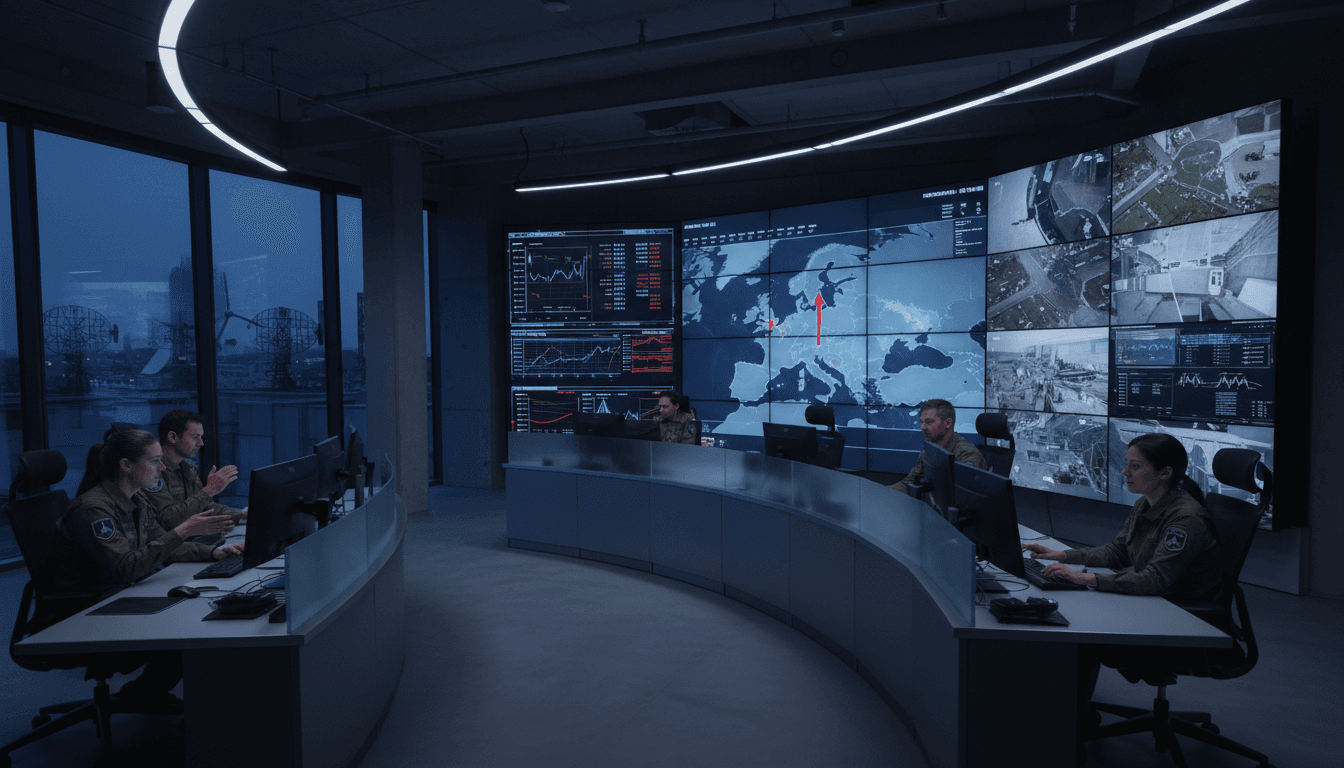
- ISR fusion that correlates satellite imagery, drone feeds, SIGINT metadata, and ground reports into one operational picture
Snippet you can quote internally: Hybrid warfare is an analytics contest—who connects weak signals first wins.
China: economic entanglement meets security competition
Europe’s relationship with China isn’t a clean “enemy” frame; it’s strategic ambiguity. China is tied to European supply chains (EVs, batteries, pharmaceuticals, rare earth processing, manufacturing equipment). But China also exports industrial policy pressure, technology influence, and political leverage.
AI intersects here in two ways:
- Supply chain intelligence: AI models can forecast disruption risk, map supplier dependencies, and flag unusual trade patterns that suggest coercion.
- Technology security: AI-enabled security monitoring is increasingly necessary for complex systems (telecom networks, ports, smart grid components) where traditional auditing can’t keep up.
Europe’s strategic posture isn’t just about “decoupling.” It’s about making dependencies visible, measurable, and governable.
The U.S.: indispensable ally, less predictable bandwidth
The U.S. remains central to European deterrence, especially in intelligence, strategic lift, missile defense, and command-and-control. But American attention is divided across theaters, and domestic politics injects uncertainty into long-term commitments.
That pushes Europe toward a blunt question: If U.S. support is delayed, constrained, or conditional, what can Europe still execute on its own within 30 days? 7 days? 72 hours?
AI can’t replace alliance depth, but it can shrink the operational gap by improving:
- Targeting support and ISR throughput (faster sensor-to-shooter loops)
- Logistics optimization (predictive maintenance, spare parts forecasting, contested supply routing)
- Force readiness analytics (training pipeline health, unit-level equipment readiness)
Where AI actually helps Europe build strategic autonomy
“Strategic autonomy” often gets framed as a political aspiration. Operationally, it’s simpler:
Strategic autonomy is the ability to generate credible options without waiting for someone else’s data, approvals, or platforms.
AI contributes when it’s tied to concrete mission outcomes.
1) AI-enabled situational awareness across borders
Europe doesn’t need 27 different versions of “common operational picture.” It needs one interoperable approach where nations can contribute and consume data at different classification levels.
What works in practice:
- Federated data architectures so sensitive data stays national, but insights can be shared
- Cross-domain fusion that blends civilian and military sensors (critical infrastructure, maritime tracking, border security)
- Event-driven alerting that reduces analyst overload and speeds escalation decisions
If you want a simple KPI: time-to-first-action (from initial indicator to a coordinated response decision).
2) Cyber defense that assumes constant contact
Most organizations still treat cybersecurity as a compliance program. Defense organizations can’t afford that. They need a contact sport mentality.
AI strengthens cyber resilience through:
- Anomaly detection tuned to mission systems (not just enterprise IT)
- Automated incident prioritization that links technical events to operational impact
- Deception and honeytoken strategies guided by AI to increase adversary cost
A hard truth: Europe’s deterrence credibility is partly a cyber resilience story. If logistics hubs, rail scheduling, airfield operations, or energy distribution can be disrupted cheaply, conventional deterrence erodes.
3) Autonomous systems and counter-autonomy
Europe is watching the evolution of drone warfare in real time. Mass, low cost, and rapid iteration are shifting the balance.
AI’s role isn’t only in building drones—it’s in the full loop:
- Autonomous navigation and target recognition (within strict rules of engagement)
- Swarm coordination for ISR and decoys
- Counter-UAS detection using multi-sensor AI (RF, acoustic, optical)
- Electronic warfare adaptation where models classify jamming and suggest frequency agility
If Europe wants a credible deterrent posture, it needs affordable autonomy and scalable counter-autonomy.
4) Defense industrial speed: the hidden battleground
Europe’s defense industry fragmentation is a strategic vulnerability. AI can reduce that by improving design-to-production cycles:
- Predictive quality in manufacturing
- Demand forecasting for munitions and spare parts
- Digital twins for maintenance and lifecycle cost control
This matters because in a prolonged contingency, production capacity becomes combat power.
The governance trap: how AI can fail in European defense
AI programs in defense fail for predictable reasons, and Europe is especially exposed because of its institutional complexity.
Data-sharing and classification friction
AI systems are hungry for data, but defense data is sensitive, siloed, and inconsistently labeled.
Practical fixes:
- Common data schemas and labeling standards
- “Share insights, not raw data” via federated learning
- Tiered classification pipelines (train at high classification, deploy distilled models at lower levels)
Procurement that rewards paperwork over outcomes
If requirements documents are built around legacy procurement habits, AI becomes a checkbox.
Better approach:
- Procure against mission metrics (detection rates, false positives, response time)
- Require red-teaming and adversarial testing as deliverables
- Fund transition-to-operations, not just pilots
Ethics and rules of engagement as operational design constraints
Europe’s democratic legitimacy is an advantage—if it’s implemented as engineering requirements rather than press releases.
Operationally, that means:
- Human-in-the-loop for lethal decisions
- Audit logs for model outputs
- Clear confidence thresholds and fallback modes
AI that can’t be governed can’t be fielded. And AI that can’t be fielded doesn’t deter anyone.
A practical 90-day blueprint for European defense leaders
If you’re advising a ministry, a defense prime, a NATO-aligned command, or a critical infrastructure operator, here’s what I’d do in the next 90 days to make “AI-enabled defense” real.
-
Pick three mission problems (not 30):
- ISR fusion for border/maritime awareness
- Cyber anomaly detection for logistics and mobility systems
- Counter-UAS detection around key bases and infrastructure
-
Create a shared evaluation harness across nations or agencies:
- Same test datasets (or federated equivalents)
- Same scoring metrics
- Same red-team playbooks
-
Stand up a cross-border data trust:
- Define what can be shared, at what level, and how fast
- Build a “minimum viable data agreement” rather than a perfect one
-
Design for degraded operations:
- Assume GPS disruption, comms constraints, and partial sensor loss
- Require models to perform under jamming and spoofing conditions
-
Commit to operational rollout:
- Name the receiving unit
- Allocate training time
- Budget for sustainment and model retraining
The reality? Europe doesn’t need a single moonshot. It needs repeatable AI delivery at scale.
Europe can survive multipolarity—but it has to choose speed
Europe’s multipolar challenge is ultimately a choice between comfort and capability. The continent can remain economically powerful while strategically reactive, or it can build the operational muscle to act with confidence when crises stack up.
For this AI in Defense & National Security series, this post lands on one point: AI is the most realistic near-term way for Europe to compress decision cycles, harden resilience, and reduce dependence—without waiting a decade for perfect political alignment.
If you’re shaping strategy for 2026 budgets, procurement, or partnerships, focus on one question: Where would better sensing, faster fusion, and tighter coordination change the outcome in the first 72 hours of a crisis?
That’s where AI belongs. And that’s where Europe can start turning power into agency.