Stove-piped military AI slows decisions and weakens defense. Learn how open standards and interoperable AI agents enable secure, mission-ready integration.
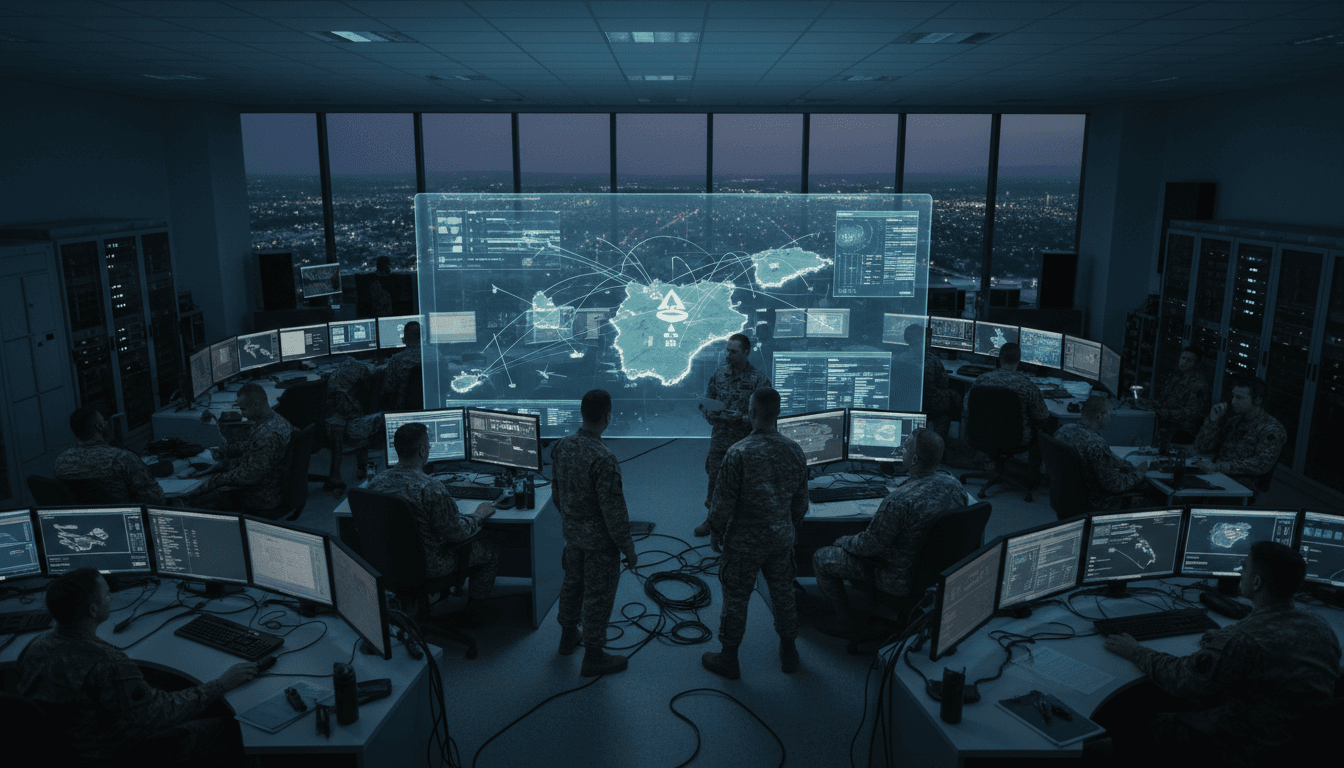
Interoperable Military AI: Stop Stove-Pipes Now
In modern defense operations, minutes are long and seconds are decisive. A drone swarm doesn’t care that your sensor feeds sit in one enclave, your fires workflow lives in another, and your “AI pilot” is trapped inside a vendor’s closed interface. If your systems can’t share data and intent fast enough, you don’t have “advanced AI.” You have a collection of impressive demos that fail under pressure.
That’s why stove-piped military AI systems are a national security risk. They throttle interoperability, slow commanders’ decisions, and make it harder to verify what an AI system is actually doing. The fix isn’t mysterious: build defense AI around open standards, shared protocols, and composable AI agents that can collaborate across systems—without creating a cybersecurity mess.
This post is part of our AI in Defense & National Security series, where we focus on practical paths to trustworthy AI for mission planning, autonomous systems, cybersecurity, and intelligence analysis.
Stove-piped AI fails where military AI matters most
Answer first: Stove-piped systems make AI less useful in combat because they block the two things commanders need most—speed and coordination.
A stove-piped AI system can be genuinely good at a narrow task: detect objects on ISR imagery, summarize chat logs, flag anomalous network behavior, or predict likely drone approach routes. The trouble starts when the mission demands cross-domain integration:
- Sensors have to cue effectors
- Cyber has to inform emissions control
- Intel has to feed mission planning
- Logistics has to update operational constraints
When each AI model or application is trapped behind proprietary interfaces, you force humans to become the “API.” Operators end up copying alerts across tools, reformatting data for different workflows, and manually stitching together a coherent story. That’s slow. It also introduces errors at the exact moment you can least afford them.
Here’s the blunt truth: fragmentation doesn’t just reduce performance; it changes outcomes. A swarm attack or coordinated strike package is designed to compress your decision cycle. If your AI can’t collaborate, your human teams absorb the integration burden—until they can’t.
The hidden tax: trust, testing, and auditability
Stove-pipes don’t only block interoperability; they also damage trust.
Closed systems tend to be opaque: limited telemetry, restricted model insight, and unclear data lineage. That creates real problems for national security organizations that must answer questions like:
- What data shaped this recommendation?
- What changed since last deployment?
- Can we reproduce the result in a test environment?
- Who has access to the data, the model, and the logs?
If you can’t inspect behavior and trace decisions, you can’t operationalize AI responsibly—especially in environments where rules of engagement, safety constraints, and legal oversight are non-negotiable.
AI agents only work at scale when they can collaborate
Answer first: AI agents are most valuable when they can coordinate tasks across tools and teams, which requires shared standards for data, messaging, and control.
Think of an AI agent as software that can pursue an objective—monitoring, planning, coordinating, and acting—rather than merely producing an output like a classification label or a text summary. In defense contexts, that objective might be:
- “Maintain airbase survivability against UAS threats.”
- “Reduce time-to-target while minimizing collateral risk.”
- “Detect and contain lateral movement on mission networks.”
The agent’s job isn’t to be a single super-model. It’s to orchestrate: pull from the right sensors, call the right analytic models, request clarification from humans, and trigger actions through command-and-control workflows.
But orchestration collapses if each component speaks a different language.
A practical scenario: defending a base against drone swarms
Consider the operational vignette raised in the source article: a contested island base facing coordinated aerial and maritime drone swarms. Teams on the ground use a common operating picture and mobile workflows (the Tactical Assault Kit ecosystem is a widely known example of this approach). The defenders need AI support that can:
- Fuse sensor tracks from multiple sources
- Identify swarm behaviors early (before the visual horizon)
- Predict likely tactics (including decoys, saturation, and evasive routing)
- Recommend layered responses (EW, kinetics, directed energy, deception)
- Coordinate tasking across units and authorities
In a stove-piped environment, each of those steps may exist—but not as a coherent chain. A detection model can’t automatically cue an EW planner. A language model’s forecast can’t be injected into the fires workflow. And a course-of-action recommendation can’t be translated into machine-readable tasks for other agents.
In an interoperable environment, the agent can do what humans struggle to do at speed: correlate, prioritize, and coordinate—while still keeping a human in the loop for approvals and safety constraints.
One-liner worth remembering: If your AI can’t hand off work to other AI, you don’t have autonomy—you have automation silos.
Open standards are the foundation—not an “IT nice-to-have”
Answer first: Open standards and protocols are how defense organizations avoid vendor lock-in, enable mission-scale AI, and keep security controls consistent.
“Open” doesn’t mean “anyone can access it.” In defense, it means the interfaces, data contracts, and messaging patterns are published, testable, and substitutable—so components can be swapped without rewriting the entire stack.
What “open” should mean in military AI systems
At a minimum, open standards for interoperable military AI should cover:
- Data schemas and metadata: common definitions for tracks, events, confidence, timestamps, geospatial frames, and provenance
- Identity and access control: consistent authentication, authorization, and attribute-based access across domains
- Model and agent interfaces: standard ways to request inference, provide context, and return structured outputs
- Event and message protocols: publish/subscribe patterns so one system can cue another in near-real time
- Telemetry and audit logs: standardized logs for monitoring, debugging, red-teaming, and compliance
This matters because AI in defense doesn’t live in one system. It lives across mission planning, C2, ISR, cybersecurity, and autonomous systems—often across multiple classification levels and coalition boundaries.
Interoperability beats “single-vendor integration” every time
Most companies get this wrong: they treat interoperability as a procurement feature rather than a mission requirement.
A single vendor can integrate a lot—until you need to insert a new sensor, a coalition partner’s feed, a new counter-UAS technique, or a better model trained on updated threat behavior. In late 2025, this is not hypothetical. The pace of UAS iteration, electronic warfare adaptation, and AI model churn is relentless.
A composable architecture built on open interfaces means:
- You can swap underperforming models without ripping out workflows
- You can add new agents for niche missions (EW, logistics, deception)
- You can scale from exercises to operations without changing the approach
Interoperable AI has to be secure—or it’s unusable
Answer first: Interoperability increases the attack surface unless you design security and governance into the architecture from day one.
Open protocols don’t automatically create safety. They create connectivity, and connectivity attracts adversaries. The right posture is: connect systems intentionally, with guardrails.
The security pattern that works: “zero trust, mission-aware”
If I’m advising a defense team implementing AI agent interoperability, I push for a blend of zero trust fundamentals and mission context:
- Strong identity for users, services, and agents (every agent is a principal)
- Least-privilege authorization with attribute-based access control
- Signed model artifacts and provenance (what model is this, who approved it, what data was it trained on)
- Policy enforcement points between enclaves and across networks
- Continuous monitoring of agent actions, tool calls, and data access
In practice, you want an agent that can ask for what it needs (“I need tracks from these sensors at this resolution for 90 seconds”), and a policy layer that can answer automatically (“approved,” “approved with redactions,” or “denied”).
Transparency is operational, not academic
For AI in national security, transparency isn’t about publishing model weights. It’s about operational explainability:
- What inputs were used?
- What tool calls did the agent make?
- What alternatives were considered?
- What constraints were applied (ROE, safety, collateral limits)?
That level of traceability is hard in stove-piped systems because each tool logs differently (or not at all). It’s achievable when standards define telemetry and audit trails as first-class requirements.
A field-ready roadmap to break stove-pipes in defense AI
Answer first: You don’t fix fragmentation by launching a giant “AI platform” program. You fix it by standardizing interfaces, proving value in one mission thread, then scaling.
Here’s a pragmatic sequence that defense programs can execute without waiting for perfection.
1) Pick one mission thread and design for end-to-end flow
Choose a thread where AI interoperability clearly matters, such as counter-UAS base defense, dynamic targeting, or cyber incident response. Define the end-to-end chain:
- ingest → fuse → infer → recommend → approve → act → assess
If you can’t draw the chain, you can’t integrate it.
2) Standardize the “contracts” first
Before you argue about models, standardize:
- event formats
- track schemas
- confidence fields
- time synchronization assumptions
- geospatial reference frames
- audit log requirements
This is where open standards earn their keep.
3) Treat AI agents like operators with permissions
Agents should have:
- identities
- scoped permissions
- rate limits
- tool allowlists
- mandatory logging
If an agent can call tools freely with no policy layer, you’ve built an insider threat with excellent uptime.
4) Build a plug-and-play model bench
Create a controlled environment where teams can evaluate models against shared test sets and red-team scenarios. Your goal is to answer operational questions fast:
- Does this model reduce false alarms?
- Does it generalize to new conditions?
- How does it behave when sensors degrade?
Interoperability means you can replace models without redoing the entire integration.
5) Scale through federation, not centralization
Defense organizations don’t need one monolith. They need federated interoperability: consistent protocols across units, domains, and partners, with local control where required.
That approach aligns directly with national security realities: coalition operations, cross-domain constraints, and disconnected or degraded communications.
Where this fits in the broader “AI in Defense & National Security” story
The series theme is straightforward: AI only improves national security when it’s operationally integrated, governed, and trusted. Interoperable AI agents sit at the intersection of mission planning, autonomous systems, cybersecurity, and intelligence analysis.
Stove-pipes block all of that. They slow the decision cycle, limit cross-domain awareness, and make it harder to enforce consistent security and oversight.
The next step for most organizations isn’t “buy more AI.” It’s to make existing AI work together—through open standards, secure protocols, and mission-focused agent orchestration.
If you’re building or procuring defense AI right now, ask one question before anything else: Can this system share data, intent, and audit logs with other systems fast enough to matter in combat? If the answer is no, it’s not ready for the missions it’s being sold for.