Intent-aware military drones could cut manpower, speed decisions, and scale sensing. Here’s what the Army’s autonomy push means for AI in defense.
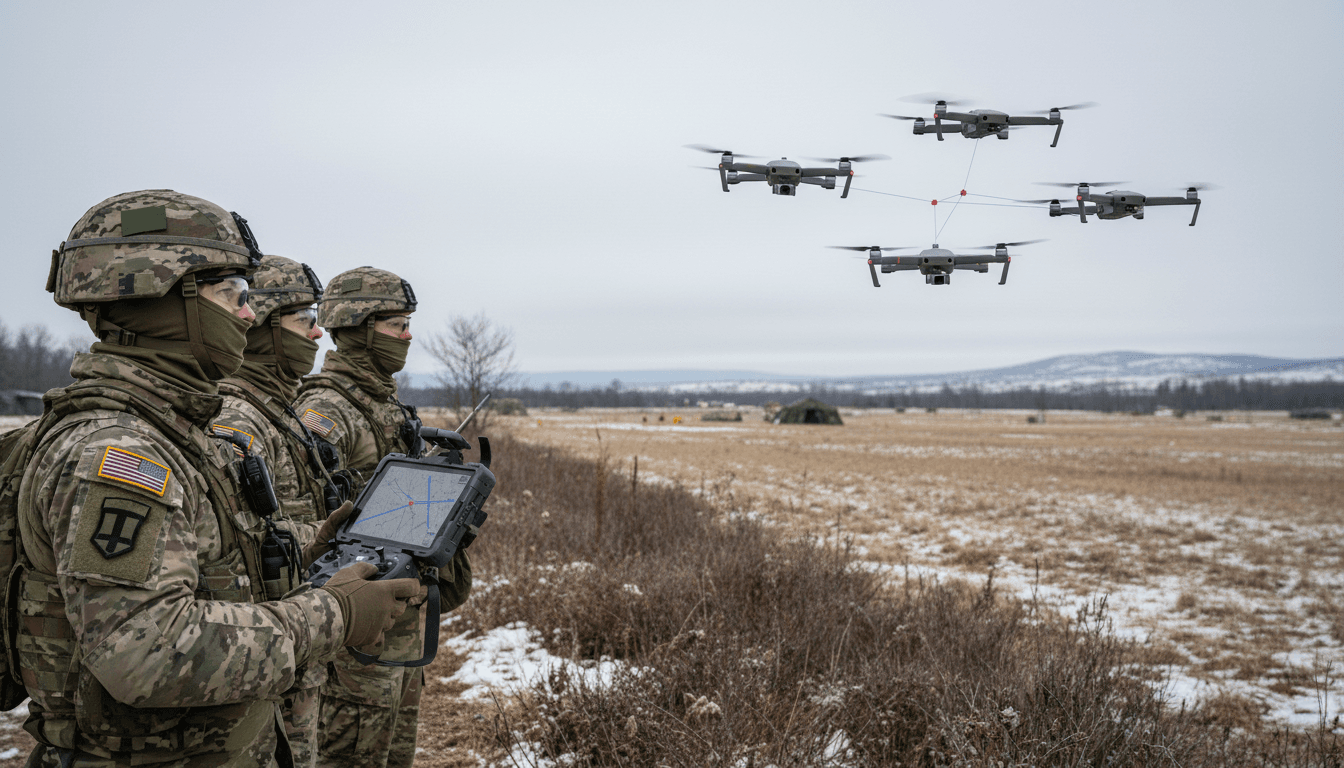
Intent-Aware Military Drones: What the Army’s Plan Means
A platoon shouldn’t need four soldiers just to put a small drone in the air. Yet that’s the current reality in many units: one soldier pilots, another provides security, someone hauls gear, and someone wrestles antennas into position. That’s not a tactics problem. It’s a systems design problem.
The U.S. Army’s emerging push for intent-aware military drones—drones that can take a tasking in plain language and execute it within constraints—signals a shift that matters far beyond unmanned aircraft. It’s a preview of how AI in defense and national security is maturing: away from “cool demos” and toward doctrine, training pipelines, interoperable software, and decision accountability.
The headline phrase from the Army is telling: drones that understand “commander’s intent.” That’s the threshold that turns drones from remote-controlled cameras into semi-autonomous teammates that reduce cognitive load, compress decision cycles, and scale to the volume modern battlefields demand.
“Commander’s intent” is the real autonomy milestone
Intent-aware autonomy means operators stop flying drones and start directing outcomes. The difference is subtle on paper and massive in practice.
Traditional small UAS operations tend to be procedural: take off, fly a route, look at a feed, manually adjust, manually return. Even when autopilot features exist, the human still “drives.” That design forces constant attention, and attention is the scarcest resource in combat.
When the Army talks about drones understanding commander’s intent, the operational model changes to something like:
- Goal: “Screen the treeline for movement for the next 12 minutes.”
- Constraints: “Don’t cross Phase Line Red. Stay below 120 meters. Avoid populated structures.”
- Preferences: “Prioritize thermal detections. Maintain comms relay if link degrades.”
- Actions authorized: “Cue an alert; don’t engage.” (or, in other contexts, “engage only under X conditions.”)
That’s not “free-roaming AI.” It’s bounded autonomy, where the human specifies the mission and rules of use, and the drone’s autonomy handles the mechanics.
A practical way to define intent-aware autonomy: humans choose objectives and constraints; machines choose the moment-to-moment actions that satisfy them.
For leaders, this matters because it scales. One trained operator (or even a maneuver squad leader) can task multiple drones if the drones don’t require constant piloting.
Why the Army is pushing this now (and why it’s overdue)
The Army is responding to a battlefield lesson that’s now impossible to ignore: drones are cheap, plentiful, and decisive—but only if you can employ them at tempo.
Across current conflicts, small UAS have become a default tool for:
- Short-range reconnaissance and route confirmation
- Target detection and adjustment of fires
- Rapid battle damage assessment
- Deception, decoys, and electronic warfare bait
The constraint isn’t imagination. It’s the human workload and the logistics of fielding enough drones, batteries, spares, and trained people.
The Army’s draft UAS strategy (as discussed publicly by senior aviation leaders) emphasizes universal interoperability and autonomy. Read that as a direct critique of the current ecosystem: many drones, many controllers, many stovepiped training paths, and not enough shared software.
The goal isn’t merely “more drones.” It’s more drones per soldier—because the unit that can sense faster and longer, without burning manpower, wins more engagements and takes fewer risks.
Interoperability: the unglamorous requirement that decides success
Common control software is the backbone of scalable autonomy. Without it, every new drone adds friction instead of capacity.
The Army is moving toward a common software interface and common control across UAS. This is the right priority, and I’ll take a stance: interoperability beats bespoke performance in the near term.
Here’s why:
The “one controller per drone family” trap
If each manufacturer ships a unique ground control station and training package, units end up with:
- Longer training time per system
- More failure modes under stress
- More spare parts and update pipelines
- More cybersecurity and patching complexity
In a contested environment, complexity doesn’t just annoy you—it breaks you.
Interoperability enables autonomy governance
Intent-aware autonomy needs enforceable constraints (“don’t cross this line,” “don’t engage,” “return if link drops”). Those constraints are easier to implement and audit when there’s a standardized control layer.
A shared interface also makes it easier to:
- Swap airframes as attrition happens
- Plug in new payloads (EO/IR, SIGINT-lite, mapping)
- Train soldiers on a way of operating rather than a specific brand UI
In other words, interoperability is what makes autonomy deployable at scale instead of trapped in prototypes.
The quiet big deal: a new drone career field and advanced training
Training and talent management will determine whether autonomy helps or hurts. The Army’s plan to create a new military occupational specialty (MOS) that merges operator and maintainer responsibilities is a straightforward response to field reality.
A combined operator/maintainer model works because small UAS are not like manned aviation. They’re closer to radios, sensors, and tactical computers that fly.
What changes when operators also maintain
- Availability improves: fewer drones sitting deadlined for simple issues
- Field repairs become normal: soldering, swaps, calibration, configuration
- Feedback loops tighten: maintainers see how systems fail in real missions
The Army is also developing an advanced lethality course intended to standardize how soldiers from different backgrounds (infantry, artillery, cyber, armor, SOF) employ UAS using the latest doctrine.
That cross-branch approach is exactly right. Drones aren’t an “aviation accessory” anymore. They’re part of maneuver, fires, and protection.
Soldier-built drones and “attritable” math that actually works
Cost matters because attrition is the business model of small drones in combat. If you plan for drones to survive like helicopters, you’ll underbuy and overprotect.
One of the most interesting details from the Army’s discussions is the emergence of soldier-built or unit-built drones designed for affordability. A unit prototype referenced publicly—a low-cost model around $740 versus $2,500 for common commercial options—illustrates the direction: good enough, available now, replaceable tomorrow.
That price delta changes decisions:
- Commanders become more willing to launch drones into risk
- Units can train realistically without treating drones like museum pieces
- Losses become expected, not catastrophic
The hard truth: autonomy only matters if you can afford enough airframes to exploit it.
Where large language models fit—and where they don’t
LLMs can be valuable at the “tasking and interpretation” layer, not as the final authority for lethal decisions. That’s the responsible architecture.
When senior leaders mention using large language models to “tell it what to do,” the best reading is this: LLMs can translate human intent into structured tasks.
Examples of realistic, near-term LLM roles in autonomous systems:
- Converting a spoken request into a mission plan template
- Generating checklists and confirming constraints (“You said ‘do not cross PL Red’—confirm?”)
- Summarizing sensor observations (“3 heat signatures near grid… moving west… confidence high”)
- Helping operators query logs and telemetry (“Show link drops in last 5 minutes”)
Where I draw the line: LLMs should not be the last-mile controller for flight safety or weapons release. Those functions should rely on deterministic or formally verified components, with explicit rules, test coverage, and auditable behavior.
A practical model is layered autonomy:
- Intent interface (LLM-assisted): human-friendly tasking and clarification
- Mission manager (rules + planning): converts intent into constraints and waypoints
- Autopilot/control (safety-critical): stable, predictable flight control
- Payload/engagement logic (policy-bound): strict authorization and logging
This layered approach also supports cybersecurity: it’s easier to harden and validate a bounded mission manager than a monolithic “AI brain.”
The security angle: autonomy reduces some errors—and introduces new risks
Autonomy can reduce human error in repetitive tasks, but it increases the importance of software assurance and data integrity. Both are true.
How autonomy helps operational security
- Fewer manual steps reduces configuration mistakes
- Less radio chatter and fewer controller interactions can lower signatures
- Standardized software can centralize patching and monitoring
What gets riskier
- Model exploitation: adversaries spoofing inputs or inducing misclassification
- Supply chain exposure: components, firmware, and updates at scale
- Control-layer compromise: if a common interface is breached, impact is broad
- Data poisoning: corrupted training or mission data causing systematic errors
Intent-aware drones amplify the stakes because they act on higher-level commands. That means the Army (and vendors) need disciplined practices: secure boot, signed updates, robust authentication, resilient navigation, logging that supports after-action review, and clear fail-safe behaviors.
If you’re building or buying in this space, ask one blunt question: “What happens when the drone is confused?” The answer should be specific, testable, and boring.
What buyers and builders should focus on in 2026 procurements
The fastest wins aren’t flashy autonomy demos—they’re reliability, interoperability, and training throughput. If you want intent-aware military drones to work in real units, focus on what breaks deployments.
Here’s a field-tested checklist I’ve found useful when evaluating autonomy-enabled UAS programs:
- Common control compatibility: Can it operate under a standard interface without feature loss?
- Mission constraint enforcement: Can you set geofences, altitude caps, no-go zones, and action limits?
- Degraded operations: What happens under jamming, GPS loss, or intermittent links?
- Human-on-the-loop design: How does a human supervise multiple drones without UI overload?
- Auditability: Are commands, sensor triggers, and actions logged in a usable format?
- Training time: How many hours to basic proficiency? How many to multi-drone supervision?
- Sustainment reality: Can soldiers replace key parts, update software, and troubleshoot in the field?
Notice what’s missing: buzzwords.
Where this fits in the “AI in Defense & National Security” story
Intent-aware military drones are one of the clearest examples of where AI in defense and national security is headed: decision advantage through scaled sensing and disciplined autonomy. Not autonomy for its own sake—autonomy that reduces workload and speeds mission execution.
The Army’s emphasis on intent, interoperability, and a reworked training pipeline is a sign of institutional learning. It also sends a message to industry: the winners won’t just build airframes. They’ll build trustworthy autonomy, common control, and sustainment models that survive contact with real units.
If your organization supports defense autonomy—through software, cybersecurity, networking, training, or systems integration—now is the time to align offerings around intent-based tasking, auditable control, and resilient operations. The next question procurement teams will ask isn’t “Can it fly itself?” It’s “Can it execute commander’s intent safely, securely, and repeatedly under stress?”