Fast image geolocation AI can place photos on the map in milliseconds. See how smaller models help utilities and security teams manage grid assets faster.
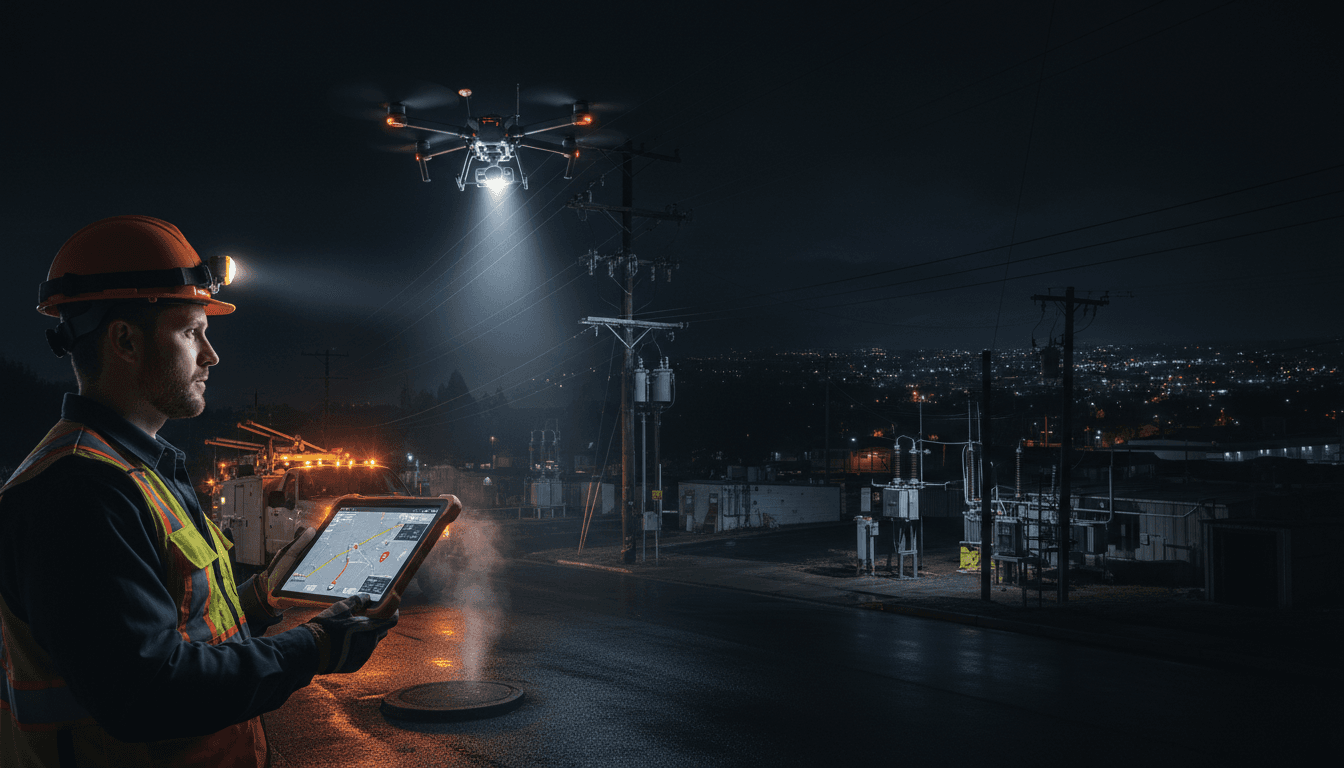
Fast Image Geolocation AI for Grid & Security Teams
A 35 MB model that can guess where a photo was taken in about 0.0013 seconds doesn’t sound like an energy-and-utilities story. It is.
Utilities and critical infrastructure operators are moving into 2026 with a familiar problem: we have more imagery than we can operationalize. Drone flyovers, vehicle patrol photos, pole-top camera snapshots, satellite tiles, and incident-response images pile up faster than teams can tag, route, and act on them. When you can’t trust location metadata—or it’s missing entirely—everything downstream slows: work orders, damage triage, vegetation management, and even security investigations.
Recent research reported by IEEE Spectrum highlights a new approach to image geolocation that’s both faster and smaller than many comparable models, while staying highly accurate in benchmark testing. In the context of our AI in Defense & National Security series, the big takeaway is straightforward: geolocating images without GPS is becoming an edge-ready capability, and that matters for both grid resilience and infrastructure protection.
What “image geolocation” really means (and why utilities should care)
Image geolocation is the ability to estimate where a photo was taken by comparing what’s visible in the image to a reference database—often aerial or satellite imagery with known coordinates.
For defense and national security, the value is obvious: faster intelligence analysis when metadata is stripped or unreliable. For utilities, the same capability shows up in more practical (and frequent) scenarios:
- Storm response: field crews submit photos from areas with poor connectivity, wrong device time, or missing GPS.
- Wildfire and extreme weather operations: smoke, clouds, and emergency routing create gaps in normal telemetry.
- Rural asset inspection: long feeders and low signal make “where exactly is this?” a recurring time sink.
- Security incidents: suspicious activity photos from contractors or public reports often lack trustworthy location info.
A blunt opinion: most organizations treat image location as “nice to have.” That’s a mistake. If you’re serious about operational speed, location is the index key for almost everything you do.
The breakthrough: deep cross-view hashing (fast, compact, accurate)
The IEEE Spectrum piece describes a research team that built a lightweight model to match street-level photos to aerial images using a method called deep cross-view hashing.
Here’s the core idea in plain language:
- Instead of comparing every pixel of a ground photo to every satellite tile (slow and memory-heavy), the model converts each image into a compact numeric “fingerprint.”
- Those fingerprints are designed so that a street photo and the correct overhead view end up close together in “fingerprint space,” even though the perspectives differ.
- At runtime, the system searches for the nearest fingerprints in the aerial database, returns a small set of candidates, and estimates the most likely location.
The reported performance is what makes it interesting for real operations:
- Stage-one narrowing accuracy: up to 97% (under best conditions like 180° field of view).
- Exact-location accuracy: around 82%.
- Model size: 35 MB (compared to a next-smallest baseline of 104 MB).
- Speed: roughly 0.0013 seconds per match in their tests (faster than comparable approaches).
That combination—small + fast + accurate enough—is the difference between a lab demo and something you can deploy on an edge device in a vehicle, substation, drone dock, or ruggedized tablet.
Why “hashing” matters more than the neural network details
A lot of AI coverage gets stuck on architecture buzzwords. Here, the operational win is the retrieval strategy.
Hashing turns high-dimensional model outputs into compact codes that are cheap to store and compare. For critical infrastructure and defense use cases, that translates into:
- Lower memory footprint on edge hardware
- Faster search across large aerial libraries
- Less bandwidth needed if you sync codes rather than raw features
If you’re building AI surveillance, geospatial intelligence, or asset monitoring workflows, retrieval efficiency is often the hidden bottleneck. Hashing attacks that bottleneck directly.
Where this fits in “AI in Defense & National Security” (beyond GeoGuessr)
The original article compares the model to a GeoGuessr expert, but the security implications are the real headline.
In national security workflows, analysts often need to place an image on the map when:
- Metadata is absent, scrubbed, or intentionally falsified
- GPS is denied or jammed
- Imagery is collected by third parties with unknown provenance
This same reality shows up in critical infrastructure protection. Utilities are increasingly part of the national security conversation—because the grid is a high-impact target, and because extreme weather turns into a public safety event fast.
A useful way to frame it:
Image geolocation is a resilience capability. It helps you keep operating when your “normal” positioning tools fail.
Practical energy-and-utility applications you can act on
Answer first: the best near-term utility use cases are the ones where missing/incorrect location data creates delays, rework, or safety risk.
1. Faster storm triage and work order routing
After ice storms and wind events, operations centers get flooded with photos. Many are duplicated, poorly described, or not reliably tagged.
A compact geolocation model can support:
- Auto-suggesting the feeder/segment likely associated with a photo
- Grouping photos that map to the same area (deduplication)
- Prioritizing sites near critical loads (hospitals, water systems)
Even if the model is “only” 82% correct on exact coordinates, it can still be highly valuable if it narrows the search from county-scale to neighborhood-scale.
2. Critical infrastructure security investigations
When a suspicious photo is reported—fence damage, tampering, copper theft indicators—the first question is where it happened.
Geolocating images can:
- Speed up dispatch of security patrols
- Correlate the incident with nearby cameras or access logs
- Support chain-of-custody and reporting when metadata is missing
This sits squarely inside AI in defense & national security themes: fusing imagery with geospatial context to reduce time-to-action.
3. Vegetation management and right-of-way audits
Utilities increasingly use aerial imagery plus field photos to verify encroachment and compliance.
Cross-view matching (ground-to-aerial) can:
- Confirm that a reported encroachment is on the correct span
- Catch “wrong pole” photo submissions in contractor workflows
- Reduce repeat truck rolls caused by location ambiguity
4. Renewable site assessment and operations
Wind, solar, and storage sites generate huge inspection image sets. Geolocation helps when:
- Photos are taken on perimeter roads (ground view) but need to map to pad/array location (overhead view)
- Remote sites have inconsistent GPS due to device policies or low signal
For site selection and planning, the same techniques can support geospatial tracking of terrain features, access roads, and nearby infrastructure constraints.
The hard part: reliability, seasonal variation, and “wrong is worse than none”
One comment in the IEEE Spectrum thread nails a real operational truth: in localization, a confident wrong answer can be worse than no answer.
And the article points out a key limitation: the research did not fully test realistic conditions like:
- Seasonal changes (snow cover, leaf-on vs leaf-off)
- Clouds or smoke obscuring overhead imagery
- Construction changes (new roofs, new roads, temporary structures)
For utilities and defense users, you should treat geolocation as a decision-support layer, not an oracle.
What good deployment looks like
If you’re evaluating image geolocation for grid monitoring or security operations, design for these controls from day one:
- Confidence gating: only auto-assign a location when confidence exceeds a threshold; otherwise propose candidates.
- Top-k workflows: show the top 3–5 likely matches on a map for a human to confirm.
- Fusion with constraints: filter candidates using known service territory boundaries, road network proximity, feeder topology, or last-known crew location.
- Drift monitoring: track when match confidence degrades over time (often a sign your aerial basemap is stale).
This is how you avoid the “wrong-but-confident” failure mode in mission-critical environments.
A simple evaluation checklist (use this before you buy or build)
Answer first: you don’t need a perfect benchmark score—you need predictable performance in your operating conditions.
Use this shortlist to run a serious pilot:
- Territory match: Is your aerial reference imagery current, and does it reflect seasonal variety across your service area?
- Latency target: Do you need sub-second matching on edge devices, or is cloud acceptable during normal ops?
- Model footprint: Can your vehicle tablets / drone stations / substations support a ~35 MB model (plus dependencies)?
- Error tolerance: What’s the operational cost of mislocation—missed dispatch, safety risk, compliance exposure?
- Human-in-the-loop design: Where will confirmation happen, and how will corrections feed retraining?
- Security posture: How will you protect the aerial reference database and the model outputs (which are geospatially sensitive)?
I’ve found that teams skip the “error tolerance” question and regret it later. Decide upfront whether you’re optimizing for speed, certainty, or coverage.
What this means going into 2026
The most important shift isn’t that AI can geolocate images. It’s that efficient models are making geolocation practical at the edge, where utilities and security teams actually operate.
A 35 MB model that runs fast changes the architecture conversation:
- You can geolocate in the field without uploading sensitive photos.
- You can run in low-connectivity areas.
- You can scale to thousands of devices without huge GPU budgets.
For the energy sector, that’s not a novelty—it’s a path to faster restoration, fewer truck rolls, and better infrastructure protection. For defense and national security, it’s another step toward robust geospatial intelligence when metadata is unreliable.
If you’re exploring AI for infrastructure monitoring, start with one operational workflow where location ambiguity hurts—storm photo triage is a good candidate—and test whether lightweight image geolocation reduces cycle time without introducing risky false certainty.
What would change in your organization if every field photo arrived with a credible map pin—even when GPS didn’t? That’s the practical question worth answering next.