Military AI is only as good as its inputs. Here’s how to defend against synthetic deception with provenance controls, agentic AI, and structured ground truth.
Ground Truth for Military AI in a Fake News Battlespace
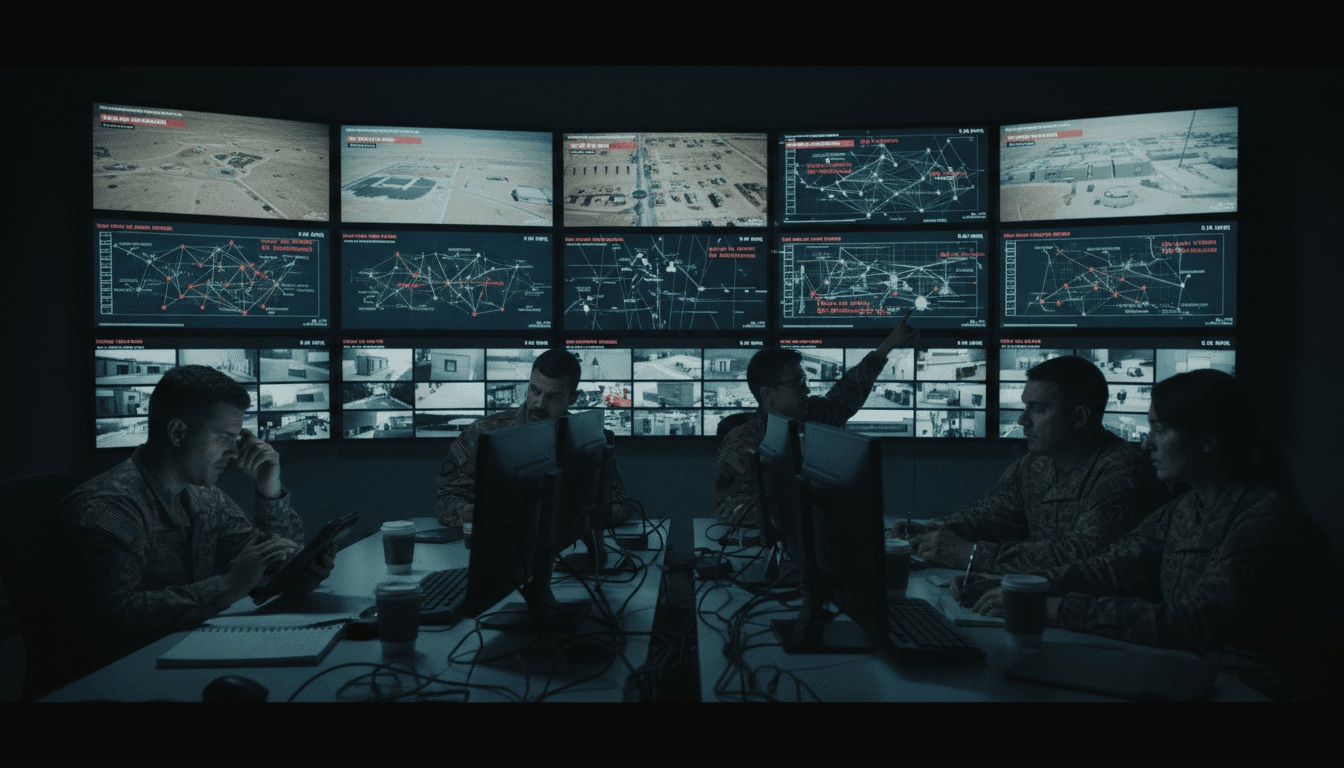
A modern targeting cell can pull in drone video, SIGINT, OSINT feeds, logistics status, and a map full of “tracks” in minutes—then ask an AI-enabled platform to suggest the next action. That speed is real. The danger is also real: if the inputs are synthetic, poisoned, or context-free, the output becomes fast wrong.
This is the core problem facing AI in defense & national security as 2025 closes out. Agentic AI is scaling influence operations—especially in U.S.-China competition—at a pace human analysts can’t match. Meanwhile, many military AI systems are being built to understand forces (equipment, locations, networks) better than they understand people (the social terrain where wars are won or lost).
The fix isn’t “more AI” or “more humans.” It’s AI that can fight AI and a disciplined pipeline of ground truth that anchors models, analysts, and commanders in reality.
Synthetic deception is breaking the OSINT bargain
Open-source intelligence used to come with an implicit bargain: most of what you saw online was noisy, biased, and incomplete—but it usually came from real people reacting to real events. That bargain is collapsing.
Agentic AI changes the economics of deception. Instead of paying people to run a bot farm, an operator can deploy autonomous systems that:
- Generate thousands of synthetic personas with believable posting histories
- Write in multiple languages and match local slang and cultural cues
- Monitor real-time trends and inject tailored narratives within minutes
- Coordinate engagement (likes, replies, quote-posts) to simulate consensus
- Produce convincing synthetic images, audio, and video to “prove” a claim
The operational consequence is blunt: OSINT can become an attack surface instead of a source. When a planning staff pulls “what the population thinks” from channels that are being actively simulated, the staff isn’t just misinformed—it’s being steered.
Why this matters for AI-enabled intelligence analysis
AI-enabled intelligence analysis is hungry. It thrives on volume and pattern. That’s exactly what synthetic campaigns produce: high-volume, high-consistency signals that look like patterns.
If your platform optimizes collection, correlation, and confidence scoring—but can’t reliably verify provenance—you get an “illusion of understanding.” The dashboards look cleaner. The network graphs look complete. The recommendations come faster.
And you can still lose the war.
“Machine versus machine” is necessary—and not enough
Defense teams are right to invest in agentic AI to counter adversary agentic AI. At minimum, militaries need automated systems that can:
- Detect coordinated inauthentic behavior across platforms
- Flag media likely to be synthetic or manipulated
- Attribute campaigns to infrastructure, tooling, or known clusters
- Prioritize human review where stakes are highest
- Push counter-messaging fast enough to matter
This is the machine-versus-machine layer: an AI security problem applied to the information environment.
But here’s the catch. Even if you perfectly filter synthetic media, you still face two problems that pure detection doesn’t solve:
- Context isn’t truth. Real posts can be misleading, coerced, or strategically framed.
- Meaning isn’t metadata. “What happened” doesn’t tell you “what it will do” in a specific community.
So yes—build the filters. Field the detectors. Harden the pipelines.
Then do the harder thing: build ground truth as a first-class input to the military AI stack.
Ground truth is the missing input to mission planning AI
Ground truth isn’t a vibe. It’s structured, consistent, human-generated insight from people with direct access to conditions on the ground—paired with a method that makes it comparable across units and time.
Most forces already treat personnel as collectors (“every soldier is a sensor”). That’s helpful, but incomplete. Sensors capture data points. Wars are shaped by interpretations: motives, fears, power structures, informal economies, legitimacy, grievance networks, and the social consequences of force.
Here’s the stance I’ll take: If ground truth isn’t structured, it won’t scale—and if it won’t scale, it won’t shape AI-assisted decisions.
What “structured ground truth” looks like in practice
If you want ground truth to feed AI-enabled decision-making, it needs repeatable formats. Examples of practical, field-usable deliverables include:
- Sentiment + drivers brief (weekly): not just “support is down,” but why, by subgroup, and what would reverse it
- Influence map (monthly): who actually moves opinion—formal leaders, informal brokers, economic gatekeepers
- Grievance tracker: top issues, how they’re changing, which narratives attach to them
- Second-order effects log: observed ripple effects from operations (checkpoints, detentions, strikes, aid delivery)
- Rumor registry: recurring claims, where they originated, which audiences repeat them, and what “proof” they use
This isn’t busywork. These products become labels for the AI system—grounded training signals that help models distinguish “online noise” from “offline reality.”
The biggest risk: AI accelerates kinetic action without understanding
Modern military organizations are extremely good at the mechanics of targeting: find, fix, finish—repeat. AI compresses those cycles further.
That’s useful for force protection and time-sensitive targets. It’s also how you end up with AI-enabled tactical brilliance and strategic blindness:
- Strikes remove nodes, but networks regenerate because social conditions stay intact.
- Operations create “success metrics,” but resentment spreads through kinship ties and local economies.
- Messaging campaigns “win the feed,” but lose credibility in communities that matter.
The old failure mode in irregular warfare was obvious in hindsight: a focus on dismantling “molecules” (networks) while ignoring the “soil” (society) that grows them.
The new failure mode will be worse because it will feel like mastery. AI systems will present confidence, clarity, and precision. Commanders will be shown clean visualizations and ranked options. The velocity will seduce organizations into believing they understand more than they do.
A sentence worth repeating in any AI mission planning brief:
Speed without grounded context doesn’t create advantage; it creates momentum in the wrong direction.
A practical blueprint: anchoring AI to reality
If you’re responsible for AI in defense & national security—procurement, G-2/J-2, cyber, information operations, or platform teams—here’s a concrete way to operationalize “ground truth” without turning it into a slogan.
1) Treat provenance as a mission-critical control
“Data quality” can’t be a slide. It has to be engineered.
- Assign a provenance score to sources (collection path, history of manipulation, proximity to event)
- Maintain a chain-of-custody concept for digital artifacts used in targeting or influence analysis
- Log transformations: what was translated, summarized, filtered, or enhanced before it hit the model
If your system can’t explain where a key claim came from, it shouldn’t be allowed to drive an operational recommendation.
2) Build a red team that attacks your AI inputs, not just your network
Classic cyber red teaming focuses on access. For military AI, you need data and narrative red teaming too:
- Simulate coordinated synthetic campaigns to see what your detectors miss
- Test model behavior under adversarial data poisoning scenarios
- Stress-test “confidence” outputs when the environment is saturated with plausible fakes
This is where cybersecurity and intelligence verification overlap. Your model’s weakness is an adversary’s targeting opportunity.
3) Standardize ground truth collection with signature deliverables
Ground truth won’t survive contact with bureaucracy unless it’s required, taught, and checked.
- Define 3–5 signature deliverables every unit produces on a set cadence
- Train teams on the analytic method (what “good” looks like)
- Create a feedback loop: show units how their insights changed planning
The fastest way to kill a ground truth program is to collect insights and never use them.
4) Pair operators with embedded analysts who can ship usable outputs
The academic and research ecosystem around defense produces plenty of valuable work—but operational timelines are brutal. What helps most is a hybrid model:
- Embedded analysts (including Ph.D.-level specialists when feasible)
- Short-cycle outputs designed for operational consumption
- Structured formats that can be ingested by AI systems
I’ve found that “research” becomes actionable when it’s written for a decision that will happen next week, not next year.
5) Fuse ground truth with AI using “context layers” in the platform
Don’t bolt context on at the end. Make it part of the model’s operating picture.
Practical approaches include:
- A dedicated human terrain context layer alongside enemy order of battle
- Model prompts and guardrails that force the system to cite ground truth inputs
- Alerts when AI recommendations conflict with recent ground truth reporting
This is how you keep AI-enabled intelligence analysis honest: force the machine to argue with reality.
People also ask: what should leaders do first?
What’s the single fastest improvement for intelligence verification?
Implement provenance scoring and require it in every AI-assisted analytic output. If a recommendation can’t show source lineage, it can’t be operationalized.
Can AI detect deepfakes and synthetic narratives reliably?
Detection is improving, but it’s an arms race. Assume some fakes will pass. The goal is resilience: layered detection, provenance controls, and ground truth anchoring.
How does this affect autonomous systems and targeting?
Autonomous and semi-autonomous systems depend on trustworthy context—especially when humans are approving actions quickly. Synthetic deception increases the risk of false positives, misattribution, and escalation.
Where this fits in the AI in Defense & National Security series
This post sits in a simple theme across the series: AI makes sensing, analysis, and action faster—so verification and context have to be engineered, not hoped for. Surveillance, cybersecurity, autonomous systems, and mission planning all share the same dependency: inputs you can trust.
If you’re building or buying military AI, treat 2026 as the year of anchoring: provenance, ground truth, and machine-versus-machine defenses as standard capability—not special projects.
Synthetic deception isn’t just “misinformation.” It’s a way to steer targeting, shape escalation decisions, and fracture alliances at machine speed. The organizations that win won’t be the ones with the flashiest models. They’ll be the ones that can still answer a basic question under pressure: what’s actually true, right now, and how do we know?