Golden Dome missile defense could spur adversaries toward harder-to-stop weapons. Here’s where AI helps most: sensing, fusion, and resilient decision support.
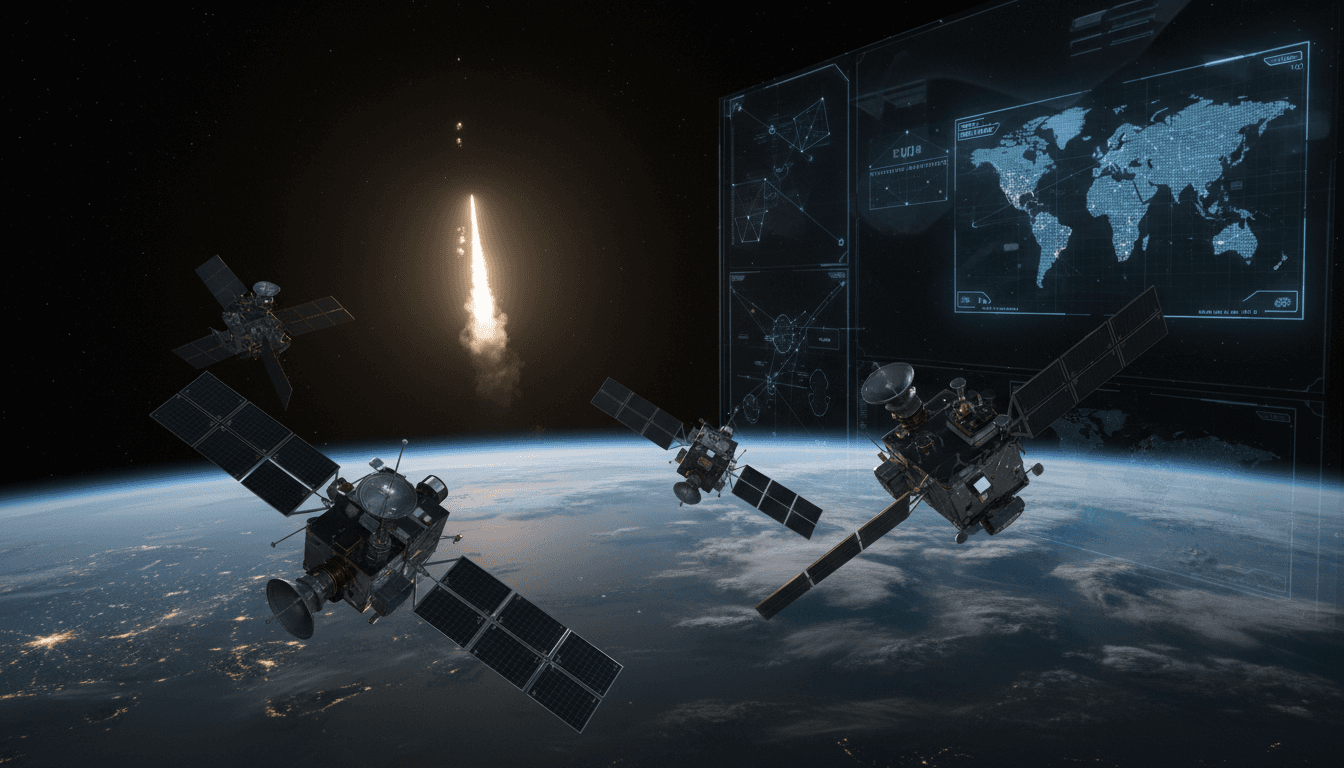
Golden Dome Missile Defense: The AI Reality Check
On a pair of autumn dates that didn’t get enough attention outside policy circles, Russia didn’t just show off weapons — it sent a message. A claimed test of the nuclear-powered cruise missile Burevestnik, followed days later by publicity around the nuclear-capable autonomous torpedo Poseidon, was theater with a strategic purpose: remind Washington that ambitious missile defense plans can trigger equally ambitious workarounds.
That’s the core risk baked into the “Golden Dome” debate. If the United States pursues space-based interceptors at scale, adversaries won’t sit still. They’ll re-route deterrence into places your architecture can’t easily touch: low-altitude cruise missiles, hypersonic glide vehicles, undersea delivery systems, and potentially offensive space capabilities. The technology story matters, but the action–reaction loop is the real plot.
Here’s where the AI in Defense & National Security lens sharpens the picture. Most public debate treats missile defense as hardware: satellites, interceptors, radars. In practice, it’s a data and decision problem under extreme time pressure. AI-enabled sensing, tracking, and command-and-control can raise the odds that defenses work where they’re most plausible — and reduce the strategic instability risks where they’re not.
Golden Dome’s biggest risk isn’t technical — it’s strategic
Answer first: Even a partially credible space-based interceptor layer can push rivals toward more destabilizing weapons, because deterrence doesn’t disappear; it mutates.
The United States has been here before. The promise of strategic defense has a recurring downside: if a peer competitor believes you’re aiming for “escape” from mutual vulnerability, they’ll invest in systems that bypass your shield rather than compete symmetrically. That’s how you end up with “weird” systems that are hard to detect, hard to attribute, and hard to interpret in crisis.
Golden Dome’s most contentious ambition — space-based interceptors that could engage missiles during boost phase — is also the part most likely to change nuclear planning overnight. If Moscow or Beijing believes (even incorrectly) that Washington is trying to neutralize a meaningful portion of their intercontinental arsenal, they have powerful incentives to:
- Increase quantity (saturation attacks that exhaust interceptors)
- Increase complexity (decoys, chaff, countermeasures)
- Shift domains (undersea systems, low-altitude cruise missiles)
- Shorten timelines (systems that compress warning and decision time)
The last point is the one that should keep strategists up at night. Stability depends on time to think — time to confirm what’s happening, communicate, and avoid catastrophic misreads.
A defense that looks “strong” on PowerPoint can still be a net loss if it drives adversaries into weapons that reduce warning time and increase ambiguity.
The cost-exchange problem: offense often stays cheaper
Answer first: Strategic missile defense tends to lose the economic race because cheap offensive additions (more missiles, decoys) can force expensive defensive expansions.
Missile defense debates often get stuck on feasibility: “Can we intercept X?” A better question for leaders managing finite budgets is: “What does the other side have to spend to negate our spending?”
Historically, offense frequently wins that math:
- If interceptors are expensive, an adversary can add more missiles.
- If sensors improve, an adversary can add countermeasures.
- If you harden one pathway (ballistic trajectories), an adversary can shift to cruise, hypersonic, or undersea.
Golden Dome’s space layer amplifies this. Space-based interceptors could be extraordinarily costly to deploy and maintain at meaningful coverage, while rivals can respond with comparatively lower-cost steps that complicate detection and interception.
This isn’t an argument for doing nothing. It’s an argument for being ruthless about where missile defense provides real security returns versus where it creates an incentive structure that makes the threat set worse.
Where AI changes the cost curve
AI can’t magically flip offense-defense economics, but it can improve two areas that matter:
- Sensor efficiency: Better tracking and fusion can reduce the number of “wasted” intercept attempts and improve discrimination between real warheads and decoys.
- Operational tempo: Faster, higher-confidence decision support can allow a smaller defensive inventory to be used more intelligently.
In other words, AI can help you spend fewer defensive dollars per unit of deterrence and protection — but only if it’s built for the realities of contested, degraded environments.
Space-based interceptors aren’t where AI helps most
Answer first: AI’s strongest contribution to homeland and theater defense is in sensing, tracking, and decision support — not in making space interceptors “smart.”
Golden Dome discussions often gravitate toward the most cinematic idea: interceptors in orbit. But the operational gaps are obvious:
- Cruise missiles stay in the atmosphere, fly low, and can exploit terrain and stealth.
- Hypersonic glide vehicles can maneuver, complicating prediction.
- Undersea systems bypass air and space defenses entirely.
Even if space-based interceptors improved boost-phase options against some ballistic threats, rivals can redirect investment to threats that are structurally harder for that layer to touch.
So if you want a practical AI strategy aligned with real-world threats, prioritize the pieces that help across many threat types.
The AI stack that actually matters
If I were advising a program office on where AI should be “non-negotiable” in missile and space defense, it would be these four layers:
- Multi-sensor fusion: Combine space-based infrared, radar, over-the-horizon sensors, airborne ISR, and allied feeds into a coherent track picture.
- Target classification and discrimination: Use machine learning to support warhead/decoy discrimination, anomaly detection, and pattern-of-life baselines.
- Decision support for command and control: Provide ranked response options, confidence scores, and “why” explanations that operators can trust.
- Resilient communications and cyber defense: AI-enabled detection of spoofing, data poisoning, and jamming patterns—because a perfect interceptor is useless with corrupted tracks.
This is the unglamorous truth: missile defense is increasingly a software and data advantage contest. That’s exactly where AI can help—if it’s engineered with discipline.
AI also increases risk if governance is sloppy
Answer first: AI-enabled defense can reduce response time, but rushing decisions is exactly how crisis stability breaks.
The temptation with AI in strategic systems is to chase speed: faster detection, faster tracking, faster engagement. Speed is valuable — until it becomes fragile. In nuclear-adjacent scenarios, the worst outcome isn’t “late.” It’s confidently wrong.
Three failure modes deserve serious attention in any AI-enabled Golden Dome ecosystem:
1) False confidence from brittle models
Models trained on clean test data can degrade fast under real countermeasures. An adversary doesn’t need to defeat your interceptor; they can target your model assumptions with:
- novel flight profiles
- decoy behaviors tuned to confuse classification
- electromagnetic environment manipulation
2) Data poisoning and synthetic deception
If an adversary can inject or alter data upstream — even subtly — AI can amplify the error downstream. This is the missile-defense version of “garbage in, garbage out,” except the garbage is adversarial.
3) Automation bias in the chain of command
Operators under time pressure can over-trust algorithmic outputs. The fix isn’t “keep humans in the loop” as a slogan. The fix is human factors engineering:
- clear confidence intervals
- traceable explanations
- rehearsed playbooks for uncertainty
- training that includes “AI is wrong” scenarios
A stable deterrence environment depends on credible defenses and credible decision-making. AI must improve both.
A smarter Golden Dome posture: protect what’s likely, avoid what’s destabilizing
Answer first: The United States should emphasize AI-enabled sensing and integrated defenses while treating space-based interceptors as a bargaining chip, not a default end-state.
The most useful reframing is simple: separate the parts of missile defense that improve real-world security from the parts that intensify strategic instability.
Here’s a practical approach I’d actually bet on.
1) Make the sensing layer the centerpiece
A resilient space sensing architecture improves outcomes across ballistic, hypersonic, and cruise missile scenarios. It also supports attribution, which matters for escalation control.
AI contributions here are tangible:
- track continuity across sensor handoffs
- anomaly detection for novel trajectories
- sensor tasking optimization (where to look next)
2) Integrate homeland and theater defense as one learning system
Threats don’t respect combatant command boundaries. A modern approach treats defense as a continuously updated system where lessons from theater deployments harden homeland assumptions.
That means:
- shared data standards
- shared model evaluation
- red-teaming across services and allies
3) Treat space-based interceptors as conditional
Space interceptors create unique escalation dynamics and debris risks. If pursued, they should come with explicit policy constraints and a diplomatic strategy.
One viable stance: signal willingness to limit or pause space-based interceptors in exchange for reciprocal restraint on the most destabilizing systems (nuclear-powered cruise missiles, exotic autonomous nuclear torpedoes, certain classes of space-based offensive capabilities).
This isn’t idealism. It’s using leverage to prevent an arms race from migrating into the least stable corners of the threat landscape.
4) Build AI assurance like it’s a weapons program
If AI is part of the kill chain, it needs weapons-grade evaluation:
- continuous red-team testing against realistic deception
- secure model supply chains
- audit logs and provenance for training data
- fallback modes that degrade gracefully
If your program can’t explain how it resists spoofing and data poisoning, it’s not “AI-enabled defense.” It’s an expensive demo.
What leaders should ask before funding the next tranche
Answer first: The right questions focus on adversary adaptation, AI assurance, and operational value — not just technical possibility.
Use these questions in acquisition reviews, budget discussions, and strategy offsites:
- What specific threat set are we optimizing for in the next 24–36 months? Cruise missiles and drones are often more operationally plausible than an ICBM salvo.
- How does the architecture behave if adversaries shift to saturation and decoys? Demand cost-exchange analysis, not slogans.
- What’s the AI assurance plan under jamming, spoofing, and cyberattack? Ask for test results, not promises.
- Where does the system increase crisis stability, and where does it compress decision time? Faster isn’t always safer.
- What are we prepared to trade diplomatically to reduce the most destabilizing incentives? If the answer is “nothing,” expect the action–reaction loop to accelerate.
Where this fits in the AI in Defense & National Security series
Golden Dome is a useful case study because it exposes the real role of AI in national security: AI is less about autonomous trigger-pulling and more about making contested, high-stakes decisions with better information.
Missile defense will increasingly be decided by who can:
- see first (sensing)
- understand first (fusion and classification)
- decide well under uncertainty (command and control)
- stay resilient when attacked (cyber and comms)
If the United States wants to compete effectively in U.S.–China strategic competition without stumbling into a more unstable deterrence environment, it should invest where AI offers compounding returns: sensing, integration, and decision advantage.
Golden Dome’s greatest ambition — space-based interceptors that hint at escaping mutual vulnerability — is also the easiest way to motivate rivals to build stranger, riskier deterrents. A defense posture that improves protection against the most likely threats, while using the most destabilizing components as negotiating leverage, is harder politically.
It’s also the approach that keeps more decision time, more credibility, and more strategic options on the table.
What would change in your organization if missile defense planning started with this premise: the goal isn’t perfect protection; it’s maximum security without triggering maximum adaptation?