A CYBERCOM/NSA leadership pick is an AI story. Here’s what to watch—and how AI can strengthen cyber defense, intel fusion, and mission planning.
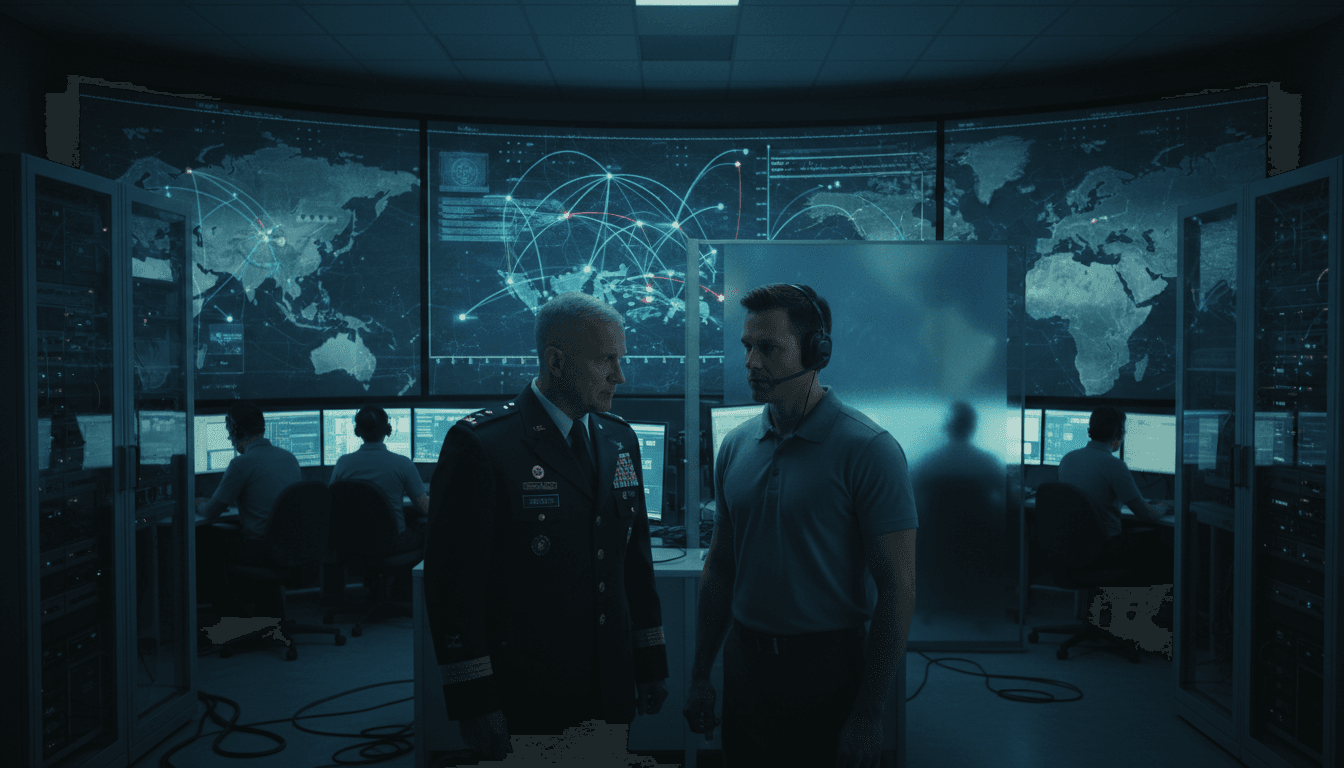
Cyber Command’s Next Chief: The AI Leadership Test
Eight months is a long time to leave the most operationally relevant cyber leadership job in the US government in “acting” status. Yet that’s where the US has been since April, when Gen. Timothy Haugh was abruptly removed from the dual-hatted role leading US Cyber Command (CYBERCOM) and the National Security Agency (NSA).
Now, reporting indicates Lt. Gen. Joshua Rudd—currently a senior Army leader at US Indo-Pacific Command—has been tapped for the job, even as official confirmation has been messy and politically noisy. What matters for practitioners in defense tech, primes, and national security AI isn’t the rumor mill. It’s the strategic signal.
A CYBERCOM/NSA leadership change is an AI story. Not because the new leader needs to “be an AI person,” but because every major cyber mission—defend-forward operations, intelligence fusion, counter-ransomware, supply-chain risk, and critical infrastructure defense—now depends on machine-speed analysis and decision support. The question isn’t whether CYBERCOM uses AI. It’s whether the next leader can operationalize it responsibly, at scale, under pressure.
Why CYBERCOM leadership matters more in 2026 than it did in 2016
CYBERCOM leadership sets operational tempo across the entire defense cyber ecosystem. That includes doctrine, resourcing priorities, authorities, interagency coordination, and what “good” looks like for mission outcomes.
A decade ago, cyber was already important—but you could still separate “network defense” from “intelligence collection” and from “influence operations” as if they were distinct. That world is gone. Today:
- Adversaries blend cyber, intelligence, and information ops into a single campaign.
- Cloud and zero trust architectures change what defending means (identity and policy become the perimeter).
- AI accelerates both attack and defense by lowering the cost of reconnaissance, social engineering, malware iteration, and anomaly detection.
Leadership matters because CYBERCOM isn’t just a technical shop. It’s a combatant command with operational authorities, partnered heavily with NSA’s signals intelligence mission. When that dual-hatted seat is vacant or unstable, you don’t only lose time. You lose coherence.
The eight-month “acting” gap has real operational costs
Acting leaders can keep the lights on, but they rarely get permission to change the building. Large-scale modernization—especially AI-driven modernization—requires budget moves, policy changes, and risk acceptance.
When the top seat is unsettled:
- Program decisions get deferred.
- Cross-agency data-sharing agreements stall.
- Talent and retention suffer (people don’t wait around for clarity).
- Vendors and integrators get whiplash (requirements change, then freeze).
If you’re building AI for national security—threat detection, malware triage, intel analysis, mission planning—leadership continuity is the difference between pilot projects and operational deployment.
The Rudd nomination debate is really about “operator vs. technologist”
The core controversy isn’t personal—it’s structural: should CYBERCOM/NSA be led by a deep cyber specialist, or by a commander with broader operational experience? Reporting around Lt. Gen. Rudd emphasizes a background heavy in special operations, with limited direct cyber portfolio experience.
Some lawmakers and observers argue the job requires deep technical credibility. Others argue leadership is about management, prioritization, and empowering experts—especially given how large and complex NSA/CYBERCOM has become.
Here’s my take: most organizations get this wrong by treating it as a binary choice. The better frame is:
- A CYBERCOM/NSA leader doesn’t need to write detection rules—but they must understand what makes detection real versus aspirational.
- They don’t need to train models—but they must understand what breaks when models hit real networks and real adversaries.
- They don’t need to be the smartest engineer in the room—but they must be able to call out hand-wavy AI claims and demand measurable outcomes.
What “AI-literate leadership” looks like in cyber operations
AI-literate leadership is the ability to make operational decisions about AI under uncertainty. Not to admire AI demos.
In practice, that means the leader can:
- Ask for operational metrics (time-to-detect, time-to-triage, dwell time, false positive cost) rather than generic “accuracy.”
- Demand red-team and adversarial testing for models used in mission environments.
- Understand data lineage (what data trained the system, what it can’t see, where it drifts).
- Tie AI deployment to authorities and rules of engagement (especially for automated response).
If Lt. Gen. Rudd becomes the nominee and is confirmed, the confirmation hearings should test for this kind of literacy. Not trivia. Not buzzwords.
AI at CYBERCOM: where it helps, where it hurts, and what to prioritize
AI already helps cyber defenders, but only when it’s attached to clean data, defined workflows, and accountable decisions. In national security environments, that’s harder than in commercial SOCs because networks are heterogeneous, classified boundaries are real, and mission risk is asymmetric.
Below are the AI priorities that matter most for CYBERCOM/NSA over the next 12–24 months.
1) Machine-speed triage for high-volume signals
The biggest near-term win is decision support, not autonomy. CYBERCOM and NSA sit on oceans of telemetry—network events, endpoint data, SIGINT-derived indicators, malware artifacts.
AI can reduce analyst overload by:
- Clustering alerts into incident narratives (what happened, when, and likely why)
- Enriching events with context graphs (users, assets, privileges, exposures)
- Auto-generating draft assessments that analysts can confirm or reject
The hard part isn’t modeling. It’s integration: identity systems, logging consistency, labeling, and feedback loops.
2) AI-assisted hunt operations (defend-forward, but measurable)
Hunt is where CYBERCOM earns its keep—finding and disrupting adversaries before they hit US targets. AI can support hunt teams by surfacing weak signals that humans miss:
- Rare process trees
- Lateral movement patterns
- Credential abuse sequences
- “Living off the land” behaviors
But hunt AI must be built for adversaries that adapt. That implies:
- Continuous evaluation against current tradecraft
- Model updating processes that don’t take six months
- A clear rule: humans decide disruption actions unless explicitly authorized
3) Cyber deception and environment shaping
Deception is underrated because it doesn’t fit tidy dashboards. Done well, it forces adversaries to waste time, reveal tooling, and expose intent.
AI helps by creating believable variability—hostnames, services, fake data trails—at scale. The risk is also AI-driven: adversaries can use AI to detect deception artifacts faster.
So the priority becomes: deception that’s operationally integrated, not bolt-on.
4) Mission planning with AI—where strategy meets engineering
The “AI mission planning” opportunity is to connect intel, cyber options, and operational constraints into a decision workspace. Commanders don’t need more data. They need:
- Constraints (authorities, collateral risk, timing)
- Options (courses of action)
- Predicted second-order effects (escalation and blowback)
This is where AI should look less like a chatbot and more like a planner’s workbench: structured inputs, confidence bounds, audit trails.
The leadership signal: what could change if the nominee is confirmed
A new CYBERCOM/NSA chief often triggers a strategy refresh—explicitly or implicitly. Even if formal documents don’t change immediately, priorities do.
Here are three strategic shifts to watch in early 2026.
A) Faster operationalization of AI, with stricter accountability
Expect pressure to show results quickly. That can be healthy—if paired with rigorous evaluation.
The best pattern I’ve seen is:
- Start with a mission workflow (not a model).
- Define measurable outcomes (hours saved, dwell time reduced, ops enabled).
- Deploy in bounded environments.
- Expand only after performance holds under red-team stress.
B) A renewed emphasis on Indo-Pacific cyber posture
With Rudd coming from INDOPACOM, stakeholders will read the appointment as a posture signal.
Practically, that could mean:
- More joint cyber planning tied to theater deterrence
- Increased demand for resilient comms and identity systems
- AI-supported fusion across cyber, space, and maritime indicators
C) Talent strategy: AI and cyber are now inseparable
You can’t hire your way out of the cyber talent gap. You also can’t tool your way out without talent. CYBERCOM/NSA will need blended teams:
- Cyber operators who can articulate data needs
- Data/ML engineers who can work inside mission constraints
- Security engineers who can harden AI pipelines
The leadership question is whether the organization builds those teams intentionally—or relies on pockets of excellence.
Practical takeaways for defense tech leaders and program owners
If you sell into defense cyber or build AI for national security, leadership transitions are when requirements harden. You don’t want to be “AI-ready.” You want to be operationally ready.
Here’s what works in practice.
Build for evaluation, not just performance
Bring a measurement plan that includes:
- False positive cost (hours per analyst per day)
- Drift monitoring and retraining triggers
- Adversarial test cases (prompt injection, data poisoning, mimicry)
- Human override and audit logging
Treat data access as a first-class deliverable
If your proposal doesn’t solve for:
- Cross-domain data movement constraints
- Labeling and ground truth scarcity
- Identity resolution across systems
…your model will never see production.
Ship decision support before autonomy
Autonomous response is politically and operationally sensitive. Decision support is how you earn trust.
A strong progression looks like:
- Summarize and prioritize
- Recommend actions with evidence
- Execute low-risk actions with approval
- Automate narrow actions with strict guardrails
What should the Senate actually test in confirmation?
The confirmation process should focus on operational AI governance and cyber readiness—not whether the nominee can name threat actor groups from memory.
If I could write the question set, it would include:
- What metrics will you use to measure CYBERCOM’s AI effectiveness in cyber defense?
- How will you prevent AI-enabled tools from expanding surveillance beyond approved authorities?
- What is your plan for red-teaming AI systems used in intelligence analysis and cyber operations?
- How will you reduce the time from prototype to operational deployment without increasing mission risk?
Those answers would tell the public more than a dozen canned statements.
Where this fits in the “AI in Defense & National Security” series
This story is a reminder that AI adoption in national security is primarily a leadership and governance problem—not a model architecture problem. Cyber is the domain where that’s most obvious: the feedback loops are fast, the adversary is adaptive, and the cost of mistakes can be national.
If CYBERCOM gets a confirmed leader soon, the US has a narrow window to turn AI pilots into operational capability—while setting rules that prevent brittle automation and mission creep. If the process drags on, the gap won’t just be bureaucratic. It’ll be strategic.
If you’re responsible for cyber readiness—inside government or supporting it—now’s the moment to pressure-test your AI roadmap against real operations: data, evaluation, guardrails, and speed. Which part of your cyber AI stack fails first when the adversary changes tactics next week?