Drone-era warfare is stretching medevac timelines. Here’s how connected, AI-ready field hospitals can support prolonged care and resilient operations.
Connected Field Hospitals for Drone-Era Warfare
A 72–96 hour medical evacuation window is no longer a hypothetical edge case—it’s a working reality in parts of Ukraine when drones and contested airspace keep helicopters out. That single operational detail rewrites the playbook for battlefield medicine: if you can’t move the patient fast, you have to move capability forward.
In the AI in Defense & National Security series, we usually talk about autonomous systems, intelligence fusion, and decision advantage. Battlefield medicine belongs in that conversation. The modern medical fight is a data fight: sensing, communications discipline, triage prioritization, and remote expertise delivered under fire.
A startup called Valinor is betting on that idea with Harbor, a containerized “field hospital in a box” designed for the drone era—hardened, rapidly deployable, and built around software, connectivity, and remote care. The deeper story isn’t just a new medical shelter. It’s a blueprint for how AI-enabled, networked edge systems can reshape mission support across defense.
Drone warfare changed casualty care faster than doctrine did
The key point: drones compress response time while stretching evacuation time. That combination forces militaries to treat “prolonged field care” as the default, not the exception.
Why evacuation is slower in high-intensity conflict
In counterinsurgency campaigns, the U.S. could often rely on air evacuation and relatively permissive airspace to reduce mortality. High-intensity conflict flips those assumptions:
- Air superiority isn’t guaranteed, and rotary-wing evacuation becomes high risk.
- Medical units and ambulances can be targeted, changing where and how care can be delivered.
- Casualty volume can spike quickly, stressing staffing, supplies, and bed capacity.
The operational consequence is blunt: if evacuation takes days, field care has to start looking more like hospital care—monitoring, oxygenation support, fluid management, infection control, and clinical decision support.
The doctrine gap: tents and clipboards vs. drones and sensors
Most legacy field medical setups still assume:
- Short dwell times
- Limited monitoring
- Minimal digital integration
That’s not a knock on clinicians; it’s a design inheritance. The problem is structural: care workflows haven’t kept pace with the sensor-and-network reality of modern warfare.
The “field hospital in a box” model is a networked edge system
Harbor’s most important idea is this: a mobile medical unit should be a compute-and-communications platform, not just a physical space.
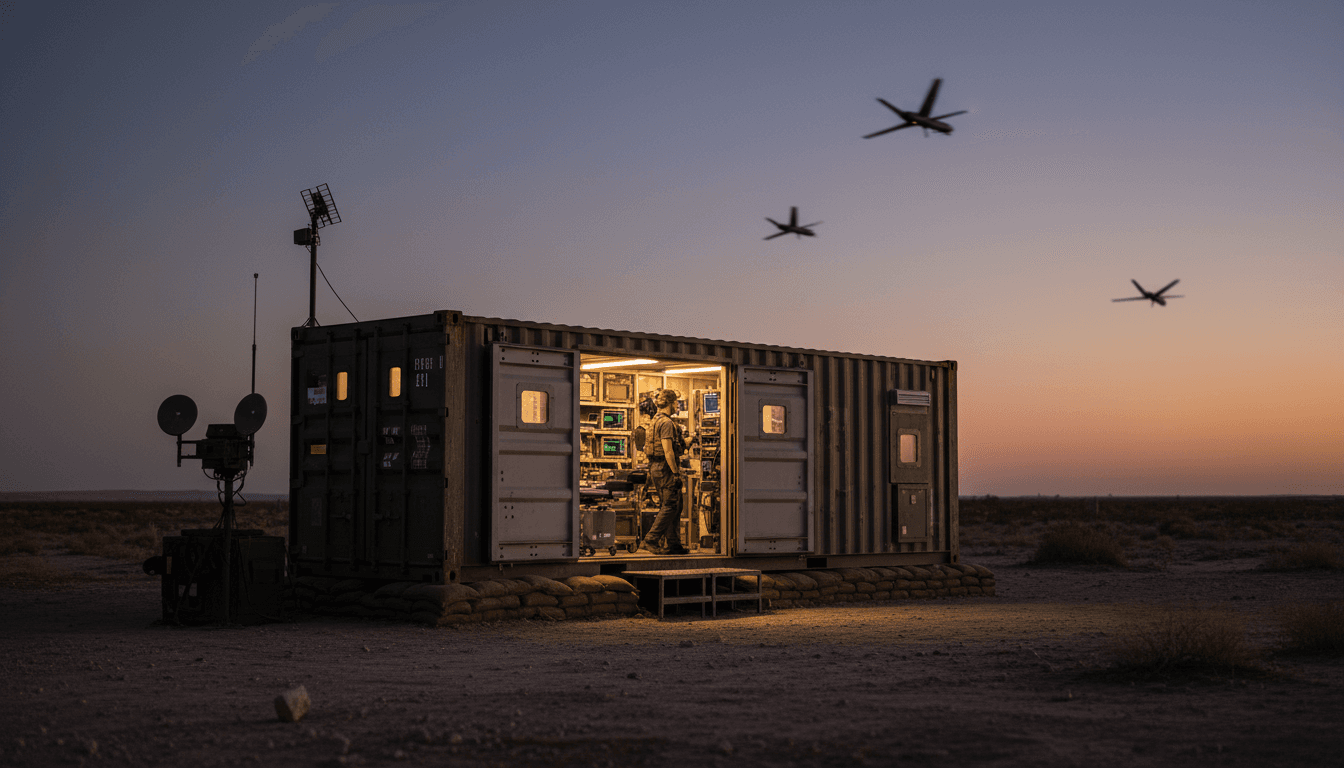
Valinor’s Harbor concept (as described publicly) is a 20-foot shipping container configured for different levels of care—from immediate damage control to prolonged casualty care. It’s also designed to be hardened and adaptable, including options to support anti-drone defenses.
What stands out for defense leaders isn’t the container format by itself. Containers are familiar. It’s the architectural stance:
- Rapid setup (minutes, not days)
- Lower unit cost (starting around $300,000)
- Built-in software and connectivity that treat data as a first-class requirement
For context, published research on past U.S. field-hospital deployments has described operating costs in the millions per month in some theaters, and Army field hospitals have historically required significant time and lift to stand up. Harbor’s pitch is a different trade: smaller, distributable, easier to manufacture at scale.
Why “distributable care” matters under drones
Big medical footprints are easier to find and harder to defend. A distributed approach—more nodes, smaller signatures—fits the drone era better.
In practical terms, that means:
- More locations to stabilize casualties closer to the point of injury
- Less reliance on a single, high-value medical site
- Better resilience if one node is degraded
It’s the same logic driving distributed command posts and resilient comms. Medicine is catching up.
AI’s real role here: triage, monitoring, and decision support at the edge
The key point: battlefield medicine doesn’t need flashy AI— it needs dependable AI that reduces cognitive load, improves triage accuracy, and supports remote clinicians.
Harbor’s described feature set points toward three AI-relevant functions that matter immediately in defense healthcare.
1) Sensor-driven triage that’s consistent under stress
Triage is where small errors cascade into preventable deaths—especially when casualty numbers rise.
Sensor integration (vital signs, oxygen saturation, trends over time) can improve triage decisions by giving medics:
- Objective baselines
- Alerts for deterioration
- Trend data that humans can’t reliably track in chaos
AI can add value by:
- Flagging abnormal patterns early (shock indicators, respiratory decline)
- Suggesting triage categories based on combined signals
- Prioritizing clinician attention when staffing is thin
This isn’t about replacing judgment. It’s about standardizing early warning when fatigue, noise, and time pressure are guaranteed.
2) Remote monitoring and telehealth that works when comms are contested
Valinor’s concept includes embedded telehealth, remote monitoring, and even remote control of devices like ventilators and infusion pumps.
That’s a big deal if you accept a hard truth: the most experienced clinicians often won’t be forward.
Remote care enables:
- Specialist consults without moving the patient
- “One-to-many” expert support across multiple sites
- Continuous oversight for critical patients during prolonged evacuation windows
AI complements telehealth by:
- Summarizing patient timelines (vitals, interventions, responses)
- Highlighting anomalies and medication risks
- Generating structured handoffs between shifts or nodes
3) Offline clinical guidance that matches real battlefield constraints
Connectivity fails. Batteries die. Networks get jammed. The best medical software plans for that.
Offline resources—procedure guides, training videos, checklists, dosing calculators—sound basic, but they address a real gap: task saturation for junior medics doing complex care for longer periods.
AI can make offline guidance more usable by:
- Providing step-by-step workflows tailored to available equipment
- Adapting guidance to patient condition and environment
- Creating quick, standardized documentation for later review
The hidden constraint: electromagnetic signature and cybersecurity
The key point: connected medicine is only useful if it’s survivable—digitally and physically.
A connected medical unit creates two risks that don’t exist in a tent with paper notes:
- Electromagnetic signature: radios, networking gear, and poorly managed emissions can make a site more detectable.
- Cyber and data risk: patient data, device control, and network entry points become targets.
The article notes a partnership approach involving a mesh network and signature management. That’s the right direction. But any “medical node at the edge” needs an explicit survivability design.
What “survivable telehealth” should include
If you’re evaluating connected field medical systems in 2026 procurement cycles, I’d look for these non-negotiables:
- EMCON modes (graded connectivity, burst transmission, low probability of intercept options)
- Zero-trust networking and device authentication
- Role-based access that works offline
- Audit logs that can sync later without breaking chain-of-custody
- Fail-safe device control (remote control never becomes a single point of failure)
A medical container that can’t defend its data or manage emissions becomes a liability fast.
What this signals for defense procurement in 2026
The key point: “software-defined support systems” are entering mission-critical categories, including medical.
Valinor has indicated it delivered prototypes to the Marine Corps and special operations organizations and aims to produce hundreds of units if contracted. Whether Harbor specifically becomes a program of record is less important than the procurement pattern it represents.
The new buying criteria: outcomes, scalability, and integration
Defense buyers are increasingly asking three questions:
- Does it scale manufacturing and sustainment? Containerized, modular systems lend themselves to repeatable production.
- Does it integrate into the operational network? Medical data shouldn’t be a dead-end; it should inform logistics, evacuation prioritization, and operational planning.
- Does it improve outcomes with fewer people? Staff shortages and casualty spikes are predictable in high-intensity conflict.
Medical data is operational data (and that changes everything)
Here’s a stance I’m comfortable taking: treating medical information as separate from mission systems is a mistake.
If commanders can see:
- casualty trends by unit/time/location,
- resource burn rates (blood, oxygen, analgesics),
- evacuation queue lengths,
…they can make better decisions about routing, reinforcement, deception, and risk.
That’s where AI in national security shows up quietly: not just finding targets, but preserving combat power.
Practical takeaways for defense and national security leaders
The key point: you don’t need to copy a startup’s product to copy the right design principles.
If you’re responsible for medical readiness, operational technology, or AI adoption, here are actionable moves worth making now.
A checklist for evaluating drone-era medical systems
Use this as a starting framework:
- Setup time: Can a small team make it operational in under an hour?
- Defensibility: Is the exterior hardened, and can it integrate with base defense?
- Clinical capability: Does it support prolonged casualty care (not just first aid)?
- Sensing and monitoring: Are vitals captured continuously and stored locally?
- Telehealth: Can specialists consult securely with intermittent connectivity?
- Signature management: Are radios and networking designed for EM discipline?
- Cybersecurity: Are devices and networks zero-trust by design?
- Interoperability: Can it exchange data with med-log and evacuation systems?
- Training burden: Can medics learn it fast under rotation and stress?
Where AI fits safely (and where it doesn’t)
AI should be used to:
- Prioritize clinician attention
- Detect deterioration early
- Summarize patient status and produce handoff documentation
AI should not be used to:
- Make unreviewed medication decisions
- Override clinician control of life-support devices
- Require constant connectivity to function
Trust in military medicine is fragile. Deploy AI where it’s transparent, auditable, and easy to override.
What comes next for AI-enabled battlefield medicine
The direction is clear: future field care will be smaller, more connected, and more autonomous in the boring ways that matter—monitoring, documentation, logistics integration, and decision support.
Harbor is a useful case study because it treats the medical unit as an edge node: a protected space, a sensor hub, and a software platform designed for contested conditions. That’s the same design philosophy we’re seeing across the broader AI in Defense & National Security stack—distributed systems, resilient networks, and faster decisions closer to the point of action.
If your team is exploring how to operationalize AI in national security beyond demos, medical modernization is a strong place to start. The mission outcome is measurable, the workflows are well-understood, and the need is immediate.
What would change in your force design if you assumed evacuation is delayed for 72 hours—and you planned your AI-enabled triage and remote care around that constraint from day one?