Army next-gen C2 tests show how AI speeds planning, deconflicts airspace, and tightens DevSecOps. See what it means for 2026 C2 programs.
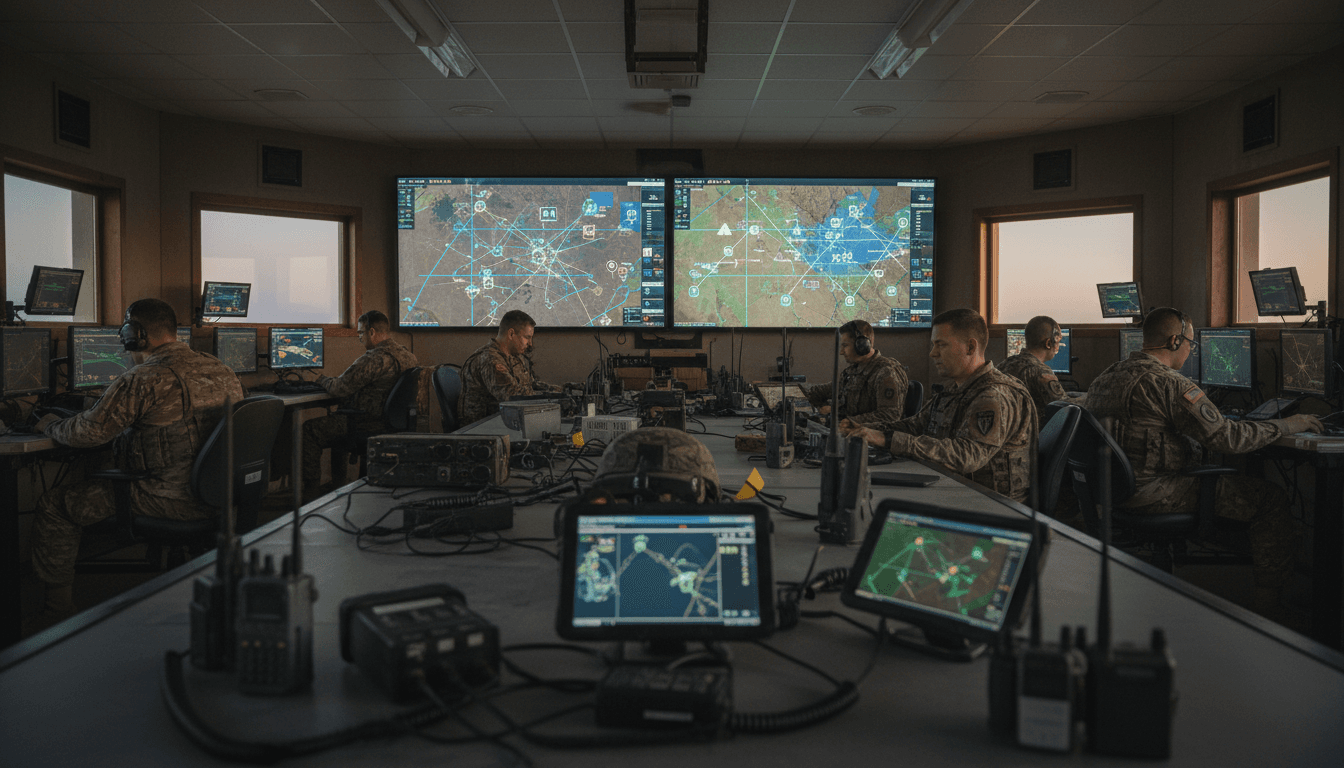
Army Next-Gen C2 Tests: What AI Changes in Combat
A modern fight can generate more data in an hour than a headquarters used to see in a week. Friendly locations update constantly. Airspace is crowded with crewed aircraft, drones, and fires. The “right” decision often isn’t complicated—it’s just buried under a pile of competing updates.
That’s why the U.S. Army’s next-generation command and control (NGC2) prototype matters. Not because it’s one more software program, but because it’s being built and tested like a living system—iterated in field events on a cadence that looks a lot more like commercial software than traditional defense acquisition.
The Army’s second field test of its NGC2 prototype (Ivy Sting 2) is a practical window into what AI-enabled command and control is becoming: faster planning-to-execution cycles, better deconfliction across domains (especially airspace and fires), and a tighter feedback loop between soldiers and developers. If you work in defense tech, national security AI, or operational modernization, this is the kind of effort that will shape requirements and budgets for years.
The real point of next-gen C2: faster decisions, not prettier dashboards
Next-generation C2 succeeds when it reduces time-to-effects. That means shrinking the time between: “we see an opportunity,” “we decide,” and “we act.” A polished interface is nice. A 30–60 minute reduction in fires coordination time is operational advantage.
In the NGC2 field events, the Army is testing workflows like:
- Deconflicting airspace before firing weapons (a surprisingly hard problem when you have drones, rotary-wing, fixed-wing, and indirect fires operating simultaneously)
- Commander’s updates and planning cycles
- Translating plans into executable tasks without losing intent in translation
This matters because the Army’s toughest C2 problem isn’t a lack of radios or maps—it’s coordination under constraint. Airspace control measures, fire support coordination measures, ISR availability, logistics status, and mission priorities all change at once. Humans can manage that—until the tempo spikes.
Where AI fits (and where it shouldn’t)
AI in defense operations is most valuable when it supports decisions, not when it replaces accountability. In practical C2 terms, the best early wins tend to be:
- Prioritizing alerts (what is genuinely time-sensitive)
- Recommending routes or timing windows based on constraints
- Detecting conflicts in airspace and fires plans
- Summarizing the operational picture for different echelons
The trap is using AI to generate plans that commanders don’t trust or can’t explain. In C2, trust is a performance feature.
Ivy Sting and the “sprint-to-field” model: why this is bigger than one prototype
The most consequential change here is process. The Army is pushing toward a rhythm where developers build, soldiers test, feedback returns immediately, and the next version is already underway.
The NGC2 effort is being organized around recurring field events (like Ivy Sting) that resemble a software sprint cycle:
- Plan what to test and what to change
- Build for a short period (weeks, not years)
- Field test with real units
- Capture feedback that actually changes the next build
If you’ve worked enterprise software, that flow sounds normal. In defense acquisition, it’s a culture shift.
Why the traditional model keeps failing C2
C2 systems fail when requirements freeze while the battlefield changes. Historically, programs lock vendors and architectures early, then spend years integrating. By the time it’s delivered, the network, threat, and data environment have moved on.
C2 is particularly vulnerable because it sits at the intersection of:
- Networks and transport (contested, degraded, intermittent)
- Data governance and sharing rules
- User experience across many roles
- Rapidly changing commercial tech (AI models, sensors, edge compute)
An iterative approach doesn’t magically solve those. But it prevents the worst outcome: fielding something obsolete on day one.
The tech stack story: modular partners, continuous onboarding, real constraints
NGC2 is being built using commercial technologies from multiple partners, with an emphasis on onboarding. The prototype effort includes capabilities like logistics awareness and AI integration via partner tools and platforms.
That’s strategically smart—if the Army can make “onboarding a new partner” a repeatable, low-drama process.
The non-negotiable technical requirements for AI-driven C2
If you’re evaluating AI-enabled command and control systems (as a government buyer, integrator, or vendor), the real bar isn’t a demo. It’s whether the system can survive the realities of operations:
- Interoperability by design: Not “we have an API,” but clear data contracts, schemas, and versioning discipline
- Edge tolerance: Graceful degradation when bandwidth collapses or latency spikes
- Role-based access and releasability: Different users, different authorities, different coalition constraints
- Auditability: Who changed what, when, and why—especially for AI-assisted recommendations
- Model and data lifecycle management: Retraining triggers, drift detection, and validation workflows
A blunt opinion: if an AI C2 vendor can’t explain how they handle data governance and authorization boundaries in plain language, they’re not ready for operational use.
“Best tool wins” sounds great—until integration costs show up
The Army’s stated goal of keeping choice in the ecosystem (so better tools can replace older ones) is exactly right. But it only works if integration costs don’t eat the program alive.
To make modularity real, NGC2 and similar efforts need:
- A stable backbone for identity, data cataloging, messaging, and observability
- Clear onboarding tests (security, performance, schema compliance)
- A product owner function that can say “no” to features that bloat complexity
Otherwise, “open ecosystem” becomes “permanent integration project.”
Security and the memo controversy: the risk is cultural, not just technical
Fast iteration increases the chance of miscommunication about security posture. That’s not a moral failing—it’s the predictable cost of speed.
Earlier concerns surfaced publicly via an internal memo criticizing security protocols in early prototyping. The Army and the vendor later stated the issues were already resolved.
Here’s what’s useful for the broader AI in national security conversation: security can’t be a quarterly paperwork event when you’re shipping software every few weeks.
What “secure iteration” looks like in an AI C2 program
If you want speed and operational trust, you need security practices that move at the same tempo as development:
- Continuous compliance artifacts: Evidence generated automatically from pipelines, not assembled manually later
- DevSecOps gates that are real: Automated checks for dependency risk, configuration drift, and access control
- Red-team feedback loops: Findings that feed the next sprint, not the next fiscal year
- Supply chain visibility: A living inventory of libraries, models, containers, and provenance
The Army leadership’s frustration with “memo culture” points to a deeper issue: if teams still treat security as an after-action document, the program will either slow down or break trust. Neither outcome is acceptable for C2.
What this signals for 2026 budgets, requirements, and vendors
NGC2 is a requirements-shaping engine. Field tests don’t just validate a prototype; they teach the Army what it should demand next—and they teach vendors what “good” will look like.
If you’re building or buying in this space, expect increased emphasis on:
1) Time-to-update as a core performance metric
Procurements will increasingly reward the ability to ship improvements quickly and safely. “Delivery” will look like continuous capability drops, not a single fielding event.
2) Decision support over autonomy (for now)
The near-term value is AI that reduces staff burden and highlights conflicts—especially airspace and fires deconfliction—rather than AI that generates full plans. Commanders want help, not a black box.
3) Data governance as a weapon system feature
The unglamorous work—labeling, access rules, data quality, logs—will decide whether AI is useful or ignored. In my experience, this is where most organizations underinvest until the first operational failure.
4) Repeatable partner onboarding
The program’s promise lives or dies on whether new tools can be brought in without months of integration pain. Buyers will start asking for proof: onboarding playbooks, test harnesses, reference architectures.
Practical takeaways for leaders working AI in defense and national security
You don’t have to be the Army to learn from this. Whether you’re in a defense program office, a prime, a startup, or a national security innovation team, the same patterns apply.
If you’re in government acquisition or requirements
- Write requirements around outcomes and cadence (update frequency, time-to-approve changes, time-to-field patches)
- Demand auditability and explainability for AI recommendations
- Treat data governance as part of operational readiness, not IT hygiene
If you’re a vendor or integrator
- Make “integration readiness” a product feature: schemas, SDKs, logs, and onboarding tests
- Design for contested networks from day one—edge-first thinking beats cloud-only optimism
- Assume security scrutiny will be public; build the evidence trail continuously
If you’re responsible for operational adoption
- Focus training on workflows, not features: “Here’s how we deconflict airspace faster” beats “Here’s the new tab”
- Capture feedback in a structured way (what decision got faster? what confusion increased?)
- Push for measurable baselines: time-to-fires, time-to-replan, time-to-share an update across echelons
What to watch next: whether the process sticks
The Army testing the NGC2 prototype again so soon after contract award is a signal: AI-enabled command and control is moving from concept to operational habit. The goal isn’t perfection. It’s momentum—shipping capability, learning in the field, and improving before the next fight demands it.
For this AI in Defense & National Security series, NGC2 is an important example of what “AI adoption” actually looks like when it’s real: messy, iterative, security-sensitive, and driven by mission workflows rather than tech theater.
If 2025 was the year many defense organizations proved they could prototype AI, 2026 will be the year they prove they can operate it—securely, repeatedly, and at scale. The open question is simple: will institutions reward the teams that learn fastest, or the teams that document best?