An allied AI competitive strategy can boost U.S. readiness, industrial capacity, and prosperity—by integrating domestic investment with trusted allied production.
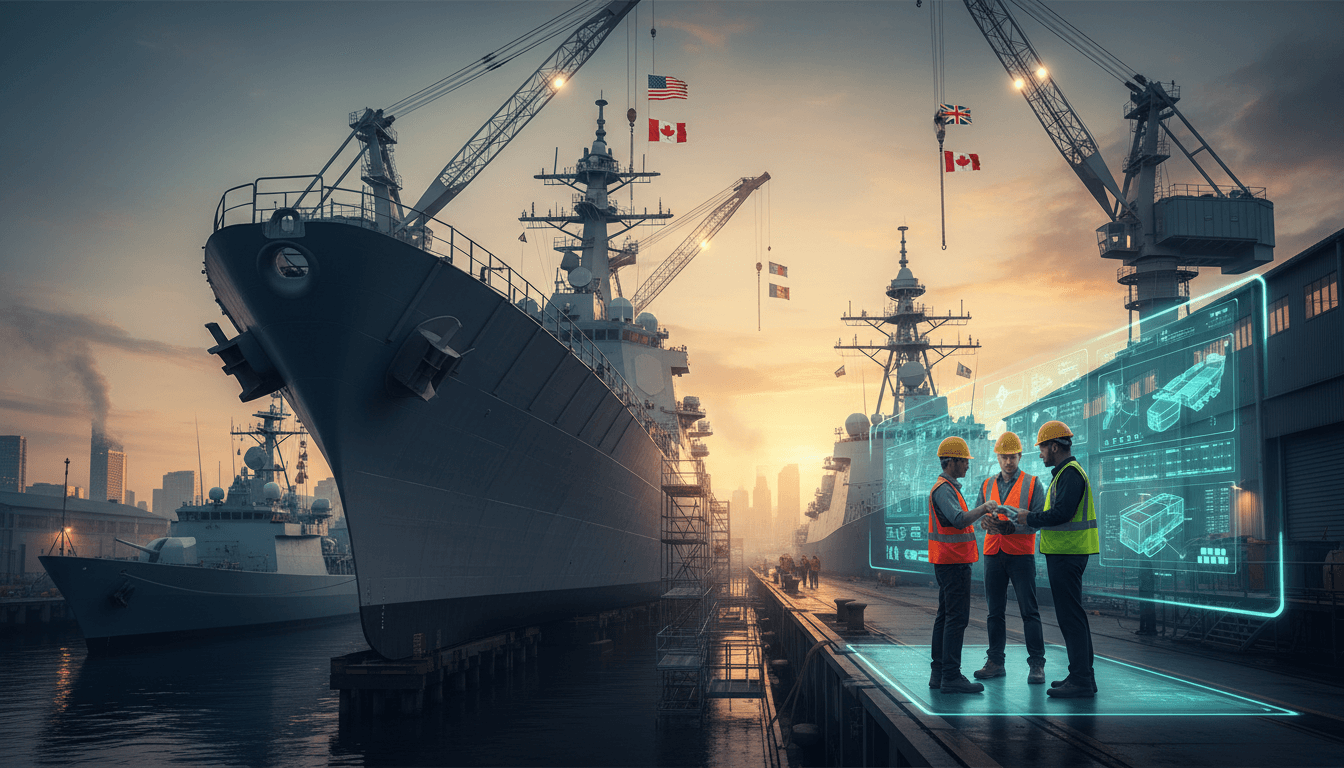
Allied AI Strategy for U.S. Defense and Prosperity
Foreign policy loses the room when it sounds like a scoreboard. “Beat China” may poll well in a cable-news segment, but it doesn’t explain why a machinist in Ohio, a shipyard supervisor in Virginia, or a software engineer in Arizona should buy into another decade of expensive global commitments.
Here’s the more honest framing: Americans care about security, wages, affordability, and a future that feels stable. A national competitive strategy only works if it delivers those outcomes—while also deterring China, managing Russia, and keeping alliances durable.
This is where the argument for an allied competitive strategy gets practical. Not “alliances” as a vague good, and not tariffs as a blunt weapon, but a coordinated plan that treats allies as co-producers of military readiness and industrial strength. For the “AI in Defense & National Security” series, there’s a missing piece that deserves to be said plainly: without an allied AI strategy—shared data, shared models, shared production planning—reindustrialization and readiness will stay slower and more expensive than they need to be.
Competitive strategy: the end state isn’t “winning,” it’s capacity
A competitive strategy is a whole-of-government plan to build national capacity—industrial, military, and economic—over a 10–20 year horizon. That’s the core insight many Washington debates skip. Rival containment is a constraint, not the destination.
When strategy is framed mainly as “stopping China,” it creates three predictable failures:
- Public support erodes. People don’t feel “containment.” They feel housing costs, energy bills, layoffs, and whether their kids can find skilled work.
- Policies get siloed. Defense planning happens over here, domestic investment over there, immigration somewhere else, and technology policy inside separate stovepipes.
- Allies get treated like extras. They’re asked to “contribute” but not truly integrated into planning, production, or shared gains.
An allied competitive strategy flips the incentives. It measures success by operational readiness, supply chain resilience, and middle-class prosperity—the things that keep democratic coalitions intact.
For national security leaders, the implication is uncomfortable but clarifying: industrial base is strategy. And in 2025, AI is one of the most scalable tools for industrial base performance—if it’s deployed across agencies and allied ecosystems rather than as isolated pilots.
The three blockers—and what an AI lens reveals
The fastest way to understand why the U.S. struggles to execute is to look at where planning breaks. The original article identifies three barriers; viewed through an AI-in-national-security lens, each has a specific failure mode you can fix.
1) “Beat China” is not a product requirement
A strategy built around “beating China” tends to optimize for headlines: bans, tariffs, and reactive moves. A strategy built around American prosperity and readiness optimizes for throughput and resilience.
AI helps here by forcing specificity. If your goal is readiness, you can define metrics:
- mean time to repair for key platforms
- munitions production cycle time
- shipyard bottleneck utilization
- recruitment and training throughput
- cyber incident response time
Those metrics are measurable, modelable, and improvable. “Beat China” is not.
2) Siloed planning kills speed (and AI doesn’t tolerate silos)
The U.S. often writes national security strategy separately from domestic investment, workforce policy, and industrial planning. AI projects fail the same way when data is fragmented and authorities are unclear.
If you want AI to improve readiness, you need cross-agency “plumbing”:
- shared data standards for logistics, maintenance, procurement, and workforce pipelines
- common security and model-governance rules (who can train what, on which data)
- acquisition pathways that let models update safely without 3-year recompetitions
This is not a “tech stack” problem. It’s a governance and incentives problem.
3) Going it alone is a self-inflicted constraint
The U.S. has a global network of allies with dominant capabilities in areas the U.S. is struggling to scale—shipbuilding, batteries, memory chips, robotics, critical minerals, and green industrial tech. Treating those capabilities as “nice to have” makes readiness more expensive and slower.
AI makes allied integration even more valuable because data and learning effects compound. A maintenance model trained across multiple allied fleets (with proper governance and partitions) can outperform a single-nation model. A supply chain risk model that sees more nodes and disruptions produces better forecasts. Scale matters.
What an allied AI competitive strategy looks like in practice
A workable allied competitive strategy has two legs: domestic enabling architecture and dual-shoring with allies. AI strengthens both—if you build the right programs.
Domestic enabling architecture: energy, transit, labor—and AI to run it
Domestic investment isn’t “nice.” It’s the enabling architecture for industrial power. Energy abundance, modern transit, and skilled labor are the foundation beneath every ship, missile, satellite, and data center.
Energy: the quiet prerequisite for AI readiness
AI for defense is energy-hungry—training, inference, hardened data centers, edge compute on platforms, and resilient comms. If energy is expensive or unreliable, you get:
- delayed factory expansion
- constrained compute for intelligence analysis
- weaker continuity-of-operations during crises
A serious plan pairs energy buildout with AI-enabled grid reliability: predictive maintenance for generation assets, anomaly detection for ICS/SCADA cyber defense, and demand forecasting that keeps industrial loads stable.
Transit and ports: where readiness gets stuck
Military readiness depends on civilian logistics: ports, rail, trucking, warehousing. AI can remove friction fast:
- computer vision for container inspection and yard management
- predictive models for port congestion and rail dwell time
- optimization for routing scarce components to priority programs
This matters because supply chains don’t fail at the strategic level—they fail at the bottleneck. AI is a bottleneck-finder.
Skilled labor: train people, not just models
The source article cites a hard reality: after major industrial bills, the U.S. still had hundreds of thousands of open manufacturing and construction roles. You can’t surge shipbuilding or munitions output without welders, electricians, CNC operators, QA inspectors, and production engineers.
Here’s what works in practice:
- AI-enabled skills mapping: align community college curricula to real factory demand using labor market and employer data
- Digital twins for training: simulate shipyard processes, welding environments, and inspection workflows
- Retention analytics: identify leading indicators of attrition (shift patterns, commute burden, supervisor ratios)
And yes, immigration is part of it. If allied firms are investing in U.S. plants, visa pathways for “train-the-trainer” talent become an industrial policy tool—not a talking point.
Dual-shoring with allies: build capacity in two places on purpose
Dual-shoring means using allied industrial capacity now while rebuilding selected capacity on U.S. soil—with allies helping to stand it up. It’s a trade: predictable demand, shared standards, and security cooperation in exchange for speed and learning.
Shipbuilding: the best test case for allied scale
Shipbuilding is where slogans meet physics. The U.S. produces about 0.13% of global ship output, while South Korea (~29%) and Japan (~17%) together hold an enormous share of world capacity. That gap shows up directly in fleet readiness and surge ability.
An allied competitive strategy doesn’t just place orders abroad. It creates a structured transfer of capability:
- multi-year procurement commitments that justify allied yard investment
- allied process engineering teams embedded with U.S. yards to fix throughput constraints
- shared QA standards and digital production systems
- joint training academies with U.S. unions and community colleges
AI is the accelerant. Modern shipyards run on data: production scheduling, defect detection, supplier lead times, workforce allocation. A “shipyard AI stack”—forecasting, scheduling optimization, and computer vision QA—can raise throughput faster than buying one more crane.
Semiconductors: stop competing with allies for the same slice
Allies aren’t interchangeable. Korea leads in memory. Japan is strong in materials and precision manufacturing. Europe contributes critical tooling ecosystems. If each runs duplicative subsidy races, everyone pays more and gets less resilience.
An allied approach uses:
- a shared roadmap for which segments get scaled where
- harmonized export-control enforcement (so companies aren’t trapped in conflicting rules)
- joint R&D hubs for packaging, testing, and secure supply chain provenance
AI plays two roles here: process control (yield optimization) and supply chain integrity (component traceability and anomaly detection).
Critical minerals: resilience beats monopoly
Trying to monopolize mining and refining domestically is slow and politically brittle. A smarter model builds resilient allied supply chains where:
- allies with comparative advantage scale extraction/refining
- the U.S. scales downstream defense manufacturing and energy tech
- both sides agree to monitoring, anti-dumping defenses, and crisis prioritization rules
AI makes mineral and materials supply chains more governable: demand forecasting, disruption simulations, and continuous risk scoring across suppliers.
Trade tools: precision beats universal tariffs
Universal tariffs are a political hammer. The problem is that hammers make allies feel like nails.
Allied defensive trade is more precise and more durable:
- shared monitoring of dumping and overcapacity
- coordinated tariff barriers targeted at specific distortions
- aligned investment screening and export controls
From an AI standpoint, the key is a shared “economic early warning system” that detects manipulation and chokepoint pressure in near-real time. That’s not theoretical—many allies already run pieces of it. The missing ingredient is a unified operating picture.
If you want allied scale, you need allied trust. Trust comes from rules, predictability, and shared upside—not coerced deals.
A practical blueprint: 6 moves policymakers can execute in 2026
Strategy fails when it stays abstract. Here are six concrete moves that fit the allied competitive strategy model and directly support AI in defense and national security:
- Create an Allied Readiness Data Compact for logistics, maintenance, and supply chain telemetry (shared schema, shared governance, segmented access).
- Stand up joint “industrial AI sandboxes” where allied firms and U.S. depots/shipyards can test models on controlled datasets without procurement paralysis.
- Fund shipyard digital twins tied to throughput targets (cycle time, rework rate, defect rates), with incentives for measurable gains.
- Build a visa lane for allied industrial trainers tied to verified U.S. job creation and apprenticeship pipelines.
- Adopt allied procurement reciprocity for specific categories (ship components, munitions subassemblies) with transparent security vetting.
- Run quarterly allied wargames for supply chain disruption—not just military scenarios, but “factory-to-foxhole” simulations with AI-driven demand shocks.
These aren’t moonshots. They’re the blocking and tackling that turns alliances into capacity.
Where this fits in “AI in Defense & National Security”
Most AI defense conversations fixate on autonomy, ISR, and cyber—and those matter. But the deciding factor in prolonged competition is often more basic: Can you produce, repair, and sustain at scale?
An allied competitive strategy answers that with a disciplined approach: build the domestic enabling architecture, then integrate allies as co-investors and co-producers. AI is the connective tissue that lets you plan across agencies, coordinate across borders, and spot bottlenecks before they become crises.
If you’re responsible for defense innovation, industrial base, or national security technology, the next step is straightforward: audit where your AI efforts are trapped inside a silo—data, acquisition, classification, or allied sharing—and fix that constraint first.
The next decade won’t be decided by who writes the most strategy documents. It’ll be decided by who can build capacity fastest, with partners who still want to be there when the pressure spikes.