AI-driven winter warfare lessons from Ukraine: drones, EW, and logistics under strike pressure—and what defense leaders should copy now.
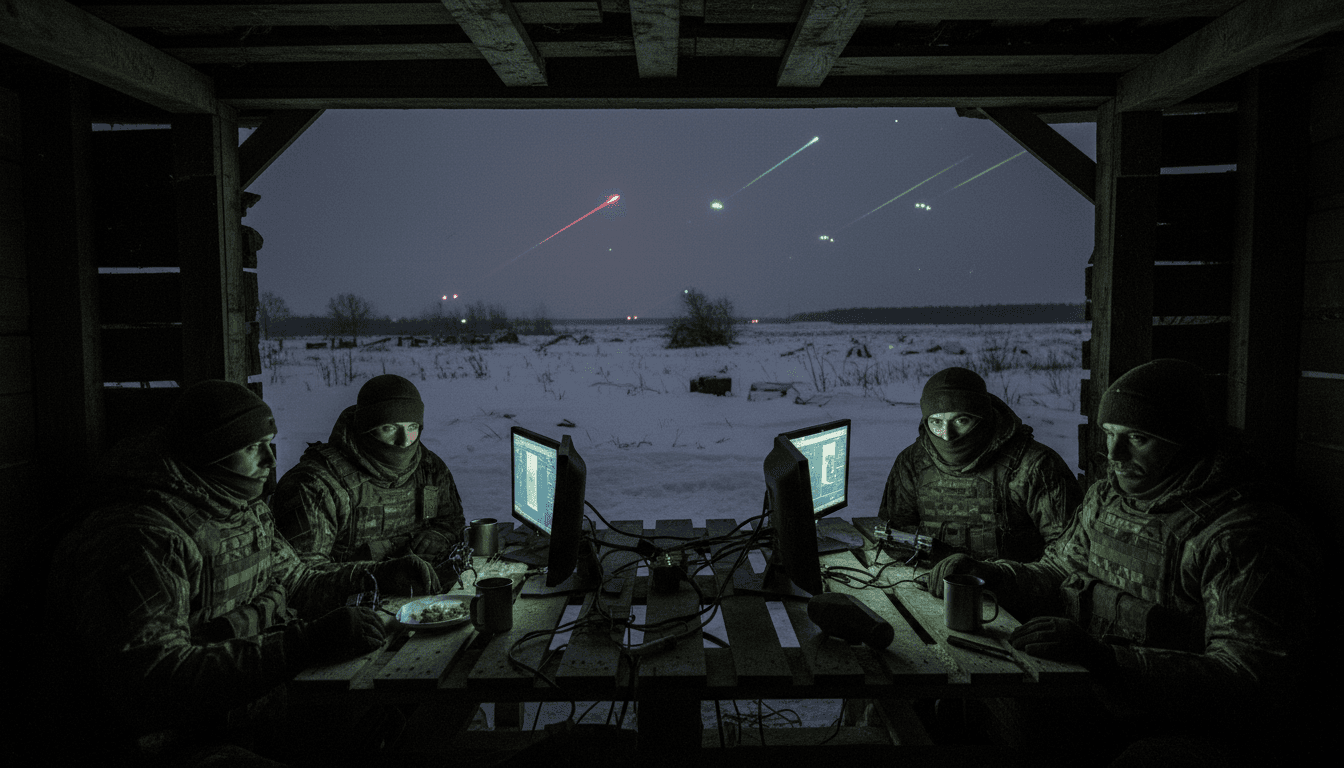
AI-Driven Winter Warfare Lessons from Ukraine
A single night can now bring 84 missiles and 500+ drones into Ukrainian skies—while the front line itself becomes a 20-kilometer “no-go” zone where people are targets and machines do the moving. That’s not a colorful metaphor. It’s a description former senior CIA officers brought back after days on the ground in Ukraine this month.
For leaders tracking defense technology, national security strategy, and procurement, Ukraine’s winter fight is more than a headline. It’s a real-time case study in AI in defense: how data, autonomy, and decision systems keep critical infrastructure alive, keep units supplied, and keep soldiers out of kill zones—especially when political uncertainty threatens the flow of aid.
Here’s what this winter in Ukraine is teaching the rest of us about AI-enabled warfare, alliance risk, and the operational basics that decide outcomes when temperatures drop and drones fill the air.
Ukraine’s “new kind of war” is a data war first
The clearest shift reported from the field is simple: the center of gravity moved from massed maneuver to sensing, targeting, and electronic contest. Drones, FPVs, counter-drone systems, and electronic warfare now dominate. Artillery still matters, but it’s rationed and precision-dependent.
When former CIA executive Ralph Goff describes the battlespace as lethal for humans across tens of kilometers, he’s describing an environment where:
- Persistent ISR (intelligence, surveillance, reconnaissance) compresses time-to-target
- EW duels (jamming, spoofing, emitter-hunting) decide whether sensors “see” reality
- Kill chains are assembled from many small data feeds rather than one exquisite platform
Why AI matters here (and where it doesn’t)
AI helps most when it reduces the friction in three places:
- Sensor fusion: turning drone video, acoustic sensors, radar, SIGINT, and human spot reports into one coherent picture.
- Target triage: ranking what matters now (air defense threats, artillery, logistics, comms nodes) when you’re resource-constrained.
- Edge decision support: enabling local action when comms are degraded or jammed.
AI is less helpful when it’s treated like a magic layer on top of broken plumbing. If a unit can’t move data reliably, can’t label it, can’t trust it, and can’t act on it fast, then “adding AI” becomes a procurement slogan, not a capability.
Snippet-worthy truth: In Ukraine, the winner isn’t the side with the most drones—it’s the side with the fastest loop from detection → decision → effect under jamming.
Winter warfare is now a logistics and infrastructure algorithm
Winter used to be mostly about mobility, exposure, and fuel. It still is. But Ukraine adds another dimension: winter is a targeting season because energy infrastructure is both vital and vulnerable.
The reporting from the ground underscores a brutal rhythm: Russia “husbands” missiles and drones, then unleashes periodic mass strikes designed to overload air defense and wear down the grid. Ukraine keeps the lights on—sometimes at reduced power—but it keeps them on.
Where AI-driven logistics changes the winter equation
Modern winter resilience depends on logistics decisions that are too complex for manual planning at scale, especially during continuous strikes. AI can help by optimizing:
- Spare parts positioning for transformers, generators, and substation components
- Crew routing and repair scheduling under curfews, air raids, and route risk
- Fuel allocation across military, hospitals, comms, and civilian heating
- Convoy planning with dynamic threat updates (drone activity, artillery range changes)
Think of it as “mission planning,” but for national survival.
A practical approach I’ve seen work in other high-tempo environments is building a minimum viable logistics AI: not a fully autonomous supply system, but a planning layer that continuously updates recommendations as conditions change. Ukraine’s challenge is that the data is messy, the threats are adaptive, and the decision window is short.
Actionable lesson for defense orgs
If you’re building AI for contested logistics, test your models against three winter realities:
- Intermittent power and connectivity (your system must degrade gracefully)
- Adversarial disruption (spoofed GPS, false reports, comms blackouts)
- Prioritization under scarcity (you can’t optimize everything; define what you’ll sacrifice)
If your tool can’t answer “What do we do in the next 6 hours?” it won’t matter.
Drones changed the front line—and AI decides who scales
Ukraine’s innovation speed is widely acknowledged, but the more sobering point from the interviews is that Russia is innovating too—and scaling faster due to deeper resources.
That scaling problem is where AI becomes strategic.
The real bottleneck: integration
On the ground, people described a fight where “integration” must be tight: airborne sensors, ground sensors, human observation, emitter tracking, and strike assets have to operate as one system.
This is exactly the domain where AI-enabled command and control earns its keep:
- Automated correlation of detections (same vehicle seen by drone + SIGINT emitter + thermal signature)
- Confidence scoring to reduce friendly-fire and mis-targeting
- Prediction of likely resupply routes, launch sites, and EW patterns
But integration is also organizational. Ukraine is pulling in civilians—bankers, programmers, private-sector operators—into wartime innovation roles. That matters because modern drone warfare is as much software operations as it is tactics.
Snippet-worthy truth: The most valuable “weapons” in drone-heavy warfare are often data engineers, EW specialists, and operators who can iterate weekly.
What “autonomy” really looks like in 2025
There’s a lot of talk about autonomous weapons. The reality in Ukraine is more practical:
- Semi-autonomous navigation when GPS is degraded
- Assisted target recognition (operator confirms)
- Swarm-like saturation tactics using low-cost platforms
- Counter-drone autonomy for detection and cueing
The important design principle is human control at the decision point while pushing computation to the edge so platforms can function under jamming.
Alliance uncertainty is now an operational variable—and AI can model it
The interviews describe something that doesn’t show up on most battlefield maps: strategic anxiety about sustained U.S. support and the knock-on effects on morale, planning, and procurement.
Operationally, uncertainty changes behavior:
- Units conserve ammunition because future deliveries are unclear
- Infrastructure teams ration repairs and replacements
- Defense planners prioritize capabilities that can be produced locally
How AI supports “strategy under uncertainty”
This is where AI-driven intelligence analysis and planning tools can make decision-making more disciplined.
A useful framework is to treat allied support as a set of scenarios with probabilities and lead times:
- Scenario A: steady air defense interceptor flow
- Scenario B: partial interruptions and delayed replenishment
- Scenario C: sharp reduction; Europe attempts to fill gaps
Then run a series of operational simulations and logistics stress tests:
- How long can critical cities maintain power under strike cadence?
- Which regions become untenable without more interceptors?
- What’s the minimum stockpile to prevent cascading failures?
This kind of modeling doesn’t “predict politics.” It prevents wishful thinking from becoming a plan.
One-liner leaders should remember: If your strategy assumes perfect allied continuity, you don’t have a strategy—you have a hope.
What defense leaders should copy from Ukraine (without copying the pain)
Ukraine’s winter posture offers a set of replicable practices for militaries and defense organizations modernizing for contested environments.
1) Build a “combat data product,” not dashboards
Dashboards are nice in headquarters. Combat needs actionable outputs:
- prioritized target lists
- route recommendations
- emitter heat maps
- unit-level risk alerts
If a product doesn’t change a decision inside a single shift, it’s not operational.
2) Design for EW first
Treat electromagnetic contest as a default condition:
- assume GPS problems
- assume comms dropouts
- assume adversarial spoofing
AI systems should include tamper detection, source reliability scoring, and fallbacks.
3) Optimize for cost-imposition, not elegance
Ukraine’s drone ecosystem shows how low-cost systems can force an adversary to spend more to defend. For AI programs, that means:
- models that run on modest hardware
- fast retraining and redeployment
- robust performance with imperfect data
4) Connect logistics AI to infrastructure resilience
Most organizations separate “military supply chain” from “civil infrastructure.” Ukraine can’t. Neither will NATO countries facing missile, drone, or sabotage threats to energy nodes.
A winter resilience plan should integrate:
- grid repair logistics
- fuel and generator distribution
- hospital and comms continuity
- transportation network risk
5) Institutionalize rapid civilian integration
Ukraine’s ability to turn civilian talent into wartime capability is an uncomfortable but necessary lesson. If you want AI in national security to work at speed, you need:
- fast onboarding pathways
- clear classification boundaries
- deployable dev teams that can operate near users
The hard truth: winter war punishes delay, and AI can’t be “later”
Ukraine is demonstrating a new baseline for modern conflict: mass drone attacks, contested spectrum, infrastructure targeting, and politics as a supply-chain risk. Winter amplifies every weakness.
For the broader AI in Defense & National Security conversation, the lesson isn’t that algorithms will replace soldiers. It’s that AI-enabled integration—across sensors, fires, EW, and logistics—decides whether a force can hold, adapt, and endure.
If your organization is investing in defense AI, focus your next planning cycle on three questions:
- What decisions must we make in under 30 minutes, reliably, under jamming?
- Which logistics nodes fail first in winter under sustained strike pressure?
- How do we keep operating if allied support becomes irregular—not absent, but irregular?
Those answers will shape procurement, architecture, and training far more than any vendor pitch.
The forward-looking question worth sitting with: If the next conflict turns a 20-kilometer band into a machine-only zone, is your force building the data systems to fight there—or just buying more platforms?