AI weather forecasting is getting faster and more accurate. Here’s what utilities can learn to improve grid resilience, renewables integration, and security.
AI Weather Forecasting for Grid Resilience in 2026
A single forecasting miss can turn into a national emergency. In October 2024, Hurricane Milton intensified so quickly that many forecasters—and the communities in its path—didn’t get the warning window they needed. The storm contributed to 15 deaths and roughly US $34 billion in damages. When weather changes faster than your models can adapt, every downstream system suffers: emergency response, aviation, ports, and—quietly but critically—energy and utilities.
Here’s the uncomfortable truth most operators already feel in their bones: your grid is only as resilient as your weather intelligence. As winter 2025 pushes peak demand, transmission constraints, and renewable variability into the same tight time window, “good enough” forecasting isn’t good enough.
This post sits in our AI in Defense & National Security series for a reason. Weather is a strategic variable. It shapes mission readiness, humanitarian response, and critical infrastructure stability. And the most interesting development right now isn’t just a smarter model—it’s an end-to-end system that pairs autonomous data collection with AI forecasting, using long-duration weather balloons as a global sensing layer.
The real problem: we’re forecasting with missing observations
Answer first: Forecast accuracy is capped when the atmosphere is under-measured—especially over oceans and remote regions where extreme weather often forms.
Traditional numerical weather prediction (NWP) depends on data from satellites, radar, ground stations, and conventional weather balloons. But conventional balloons typically last only hours and rarely reach the places where the most dangerous uncertainty begins. That’s why hurricane forecast cones can swing dramatically day-to-day: a big part of the atmosphere is still underobserved, and the models are forced to “fill in the blanks.”
During Milton, the missing piece was the kind of in-storm measurement you normally get from crewed “hurricane hunter” aircraft dropping instruments (dropsondes) into developing systems—missions that are expensive, limited in number, and risky.
From an energy perspective, the parallels are direct:
- Utilities also operate with data gaps (behind-the-meter load, feeder-level visibility, DER behavior).
- Grid models also degrade when inputs are stale or sparse.
- The most expensive failures happen at the edges: fast-ramping conditions, compound events, and cascading constraints.
Weather forecasting is showing the infrastructure world a lesson utilities shouldn’t ignore: you don’t fix uncertainty with better math alone—you fix it with better measurement plus better math.
Wind-surfing balloons + AI models: why the combo matters
Answer first: Pairing persistent atmospheric sensing with fast AI forecasting creates a feedback loop: new observations improve forecasts, and forecasts guide where to measure next.
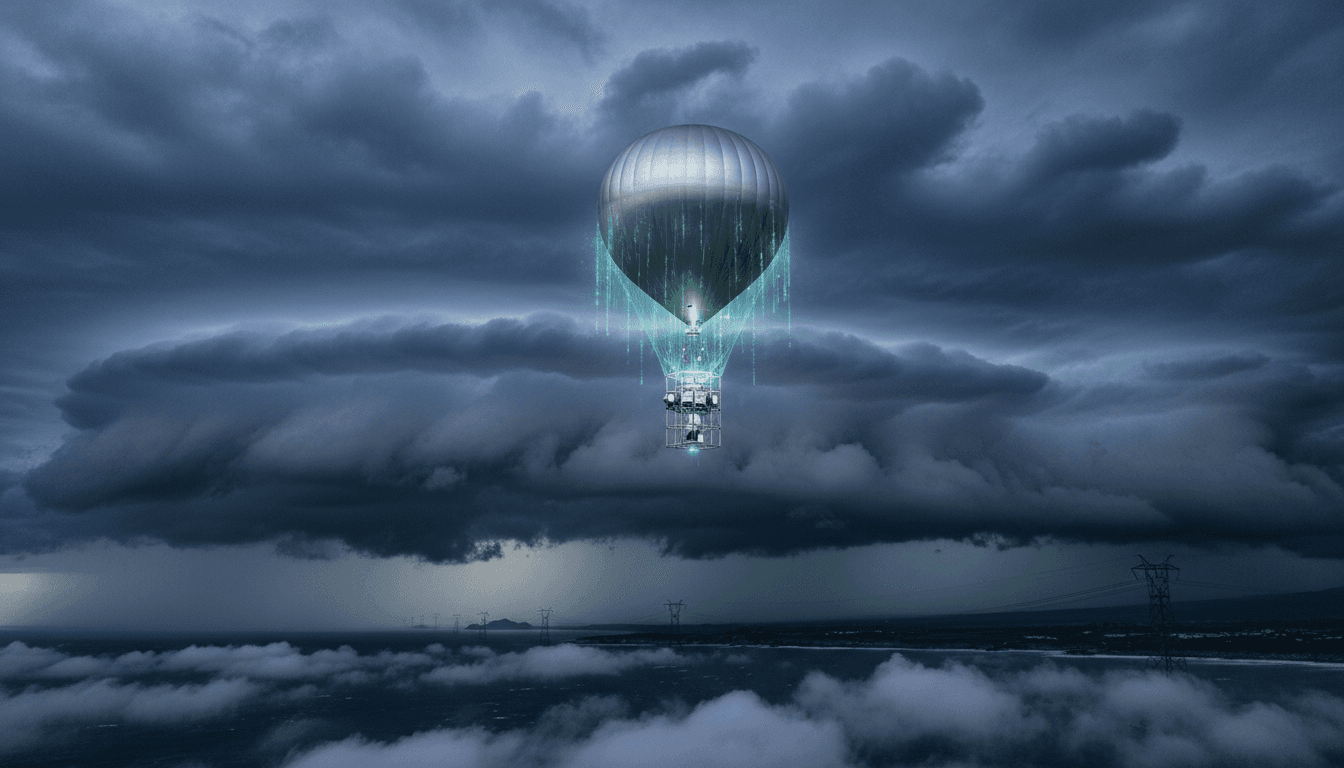
WindBorne Systems has built long-duration, self-navigating weather balloons—Global Sounding Balloons (GSBs)—that can stay aloft for 50+ days at altitudes up to about 24 kilometers. Instead of drifting passively, they change altitude to catch different wind currents, effectively “surfing” the atmosphere to follow planned routes.
The company’s broader idea is a “planetary nervous system”: observations from across the globe feed an AI “brain,” which returns decisions—like where to send the balloons next to close the most valuable gaps.
That closed-loop design is what energy leaders should pay attention to. It’s the same pattern behind high-performing grid AI:
- sensors and telemetry (SCADA, PMUs, AMI, inverter data)
- a predictive layer (load, price, outage, ramp forecasting)
- an optimization layer (dispatch, switching, DER orchestration)
- a control loop that keeps updating as reality changes
In other words, weather balloons aren’t “just weather tech.” They’re a living example of AI operations at infrastructure scale.
The Hurricane Milton moment: measuring danger without putting people in it
Answer first: WindBorne demonstrated balloon-deployed dropsondes into a hurricane—reducing risk and cost while improving forecast accuracy.
Ahead of Milton, WindBorne launched six GSBs from Mobile, Alabama. Within 24 hours, the balloons entered the hurricane and released dropsondes to collect temperature, pressure, humidity, and wind data.
When that experimental data was run through WindBorne’s AI model, WeatherMesh, its predicted storm path reportedly outperformed forecasts from the U.S. National Hurricane Center. The key point isn’t bragging rights—it’s what enabled the gain: fresh in situ measurements taken where traditional networks are weakest.
For utilities, this is the equivalent of placing high-fidelity sensors exactly where your model is blind:
- coastal substations exposed to storm surge
- wildfire corridors where wind shifts drive ignition risk
- constrained transmission paths where icing can cascade into overloads
Why AI weather models are winning—and where they still need physics
Answer first: AI forecasting is faster and often more accurate than physics-only NWP, but physics-based models still matter for training baselines and plausibility.
The last few years have made AI weather forecasting impossible to ignore. Models such as Huawei’s Pangu-Weather, Google DeepMind’s GraphCast and GenCast, and ECMWF’s AIFS showed that machine learning can match—and sometimes beat—traditional approaches while running far more cheaply.
WindBorne’s WeatherMesh uses a transformer-based architecture (similar in spirit to the technology behind large language models) with an encoder–processor–decoder design:
- Encoder: compresses raw weather variables into a latent representation
- Processor: predicts how that latent state evolves over time (iterated for longer forecasts)
- Decoder: converts outputs back into real-world variables
A few details are especially relevant for infrastructure AI teams:
- WeatherMesh was trained with a modest on-prem GPU cluster (reported around $100,000 in hardware), avoiding much higher cloud costs.
- The system was designed to be inexpensive to run and to refresh frequently.
- Newer versions reportedly produce global forecasts every 10 minutes, compared with traditional global model updates every 6 hours.
But AI isn’t magic. Even WindBorne acknowledges that AI models still lean on physics-based systems:
- Training lineage: AI models learn from historical data and prior numerical forecasts.
- Plausibility checks: physics helps keep predictions physically realistic.
- Rare extremes: physics-based reasoning can anchor simulations in unusual conditions.
That hybrid stance is exactly what I recommend for utilities adopting AI. If you try to replace your entire operational model stack overnight, you’ll spend two years arguing about trust instead of improving decisions. A hybrid model strategy—AI for speed and pattern recognition, physics and rules for guardrails—gets you value faster.
What energy and utilities can copy (without buying balloons)
Answer first: The transferable idea is an end-to-end pipeline: close measurement gaps, assimilate in near real time, forecast at the right granularity, then operationalize.
Energy companies don’t need to launch balloons to learn from this approach. The more practical question is: Where are your decision-critical gaps, and how quickly can you close them?
1) Treat “data collection” as an active system, not an IT backlog
WeatherMesh doesn’t just forecast—it helps decide where to sense next. Utilities can do the same with:
- targeted AMI/SCADA upgrades in feeders with high outage cost
- mobile sensors for storm response staging
- vegetation and asset imaging prioritized by risk signals
- inverter telemetry focused on circuits where variability bites hardest
A useful mindset shift: don’t measure everything equally—measure what collapses your uncertainty the most.
2) Move from “daily forecasts” to operational cadence
If you’re still producing renewable ramp expectations once or twice per day, you’re forcing operators to improvise when conditions change.
Borrow the WeatherMesh idea of frequent refresh:
- intraday wind/solar generation forecasts updated every 5–15 minutes
- short-horizon load forecasts aligned to dispatch intervals
- probabilistic outage likelihood updated as weather tracks shift
This matters because the grid is increasingly a real-time balancing act, not a day-ahead scheduling problem.
3) Forecast at the resolution decisions are made
WindBorne describes global outputs around 25 km resolution with the ability to push to about 1 km for selected locations. Energy decision-making often needs a similar tiered approach:
- broad-area forecasts for market operations and fuel planning
- hyperlocal forecasts for feeder switching, DER orchestration, and storm staging
A single “system average” forecast can be dangerously misleading when weather is spatially uneven.
4) Build forecast-to-action playbooks (this is where value shows up)
Better forecasts don’t automatically reduce outages or costs. You need playbooks tied to thresholds.
Here are examples that work in practice:
- Wind ramp probability > X% → reserve margin adjustments + battery dispatch rules
- Extreme cold confidence > Y → gas supply coordination + load shed staging (as last resort)
- Convective storm risk in corridor Z → pre-staging crews + recloser settings review
- High wildfire wind alignment → PSPS decision support + targeted sectionalizing
The defense-and-security lesson is simple: intelligence without doctrine is trivia.
Defense and national security: weather intelligence is infrastructure intelligence
Answer first: AI weather forecasting strengthens national security by improving readiness, protecting critical infrastructure, and accelerating disaster response.
In defense operations, weather affects everything from flight operations to satellite tasking to logistics timing. In homeland security and emergency management, it’s the difference between orderly evacuation and chaos.
Energy and utilities are now inseparable from that picture. A major weather event that knocks out power across regions isn’t just a service disruption—it’s a cascading national security risk affecting:
- communications
- healthcare continuity
- water and wastewater operations
- fuel supply chains
- military base readiness
That’s why AI-driven sensing and forecasting systems should be viewed as part of critical infrastructure protection, not a nice-to-have analytics upgrade.
What to do next: a practical 90-day plan for utilities
Answer first: Start with one operational use case, instrument the biggest uncertainty, and deploy a hybrid forecasting workflow tied to playbooks.
If you want to translate these ideas into a lead-worthy project (not a science fair), here’s a 90-day approach I’ve seen succeed:
- Pick one pain point with a measurable cost curve (renewable ramps, storm outages, peak demand during cold snaps).
- Map the uncertainty chain (what you don’t know → what decisions you delay or get wrong → what it costs).
- Close one data gap (even a small one) that materially improves inputs.
- Deploy a hybrid forecast layer (AI for speed + physics/rules for guardrails).
- Write playbooks with clear triggers, owners, and audit trails.
- Measure outcomes (forecast error reduction, avoided dispatch cost, outage minutes reduced, crew utilization improved).
The most telling signal that you’re doing it right: operators stop saying “the forecast was wrong” and start saying “we knew the risk range and acted early.”
Weather is getting more volatile, not less. AI weather forecasting systems built on persistent sensing—like long-duration balloons feeding fast models—show what “resilience by design” looks like. The forward-looking question for 2026 is blunt: Will your grid decisions be driven by yesterday’s assumptions or by continuously refreshed intelligence?