Track Venezuela’s response to U.S. pressure with AI-driven early warning. Practical indicators across elites, air defenses, maritime patterns, and propaganda.
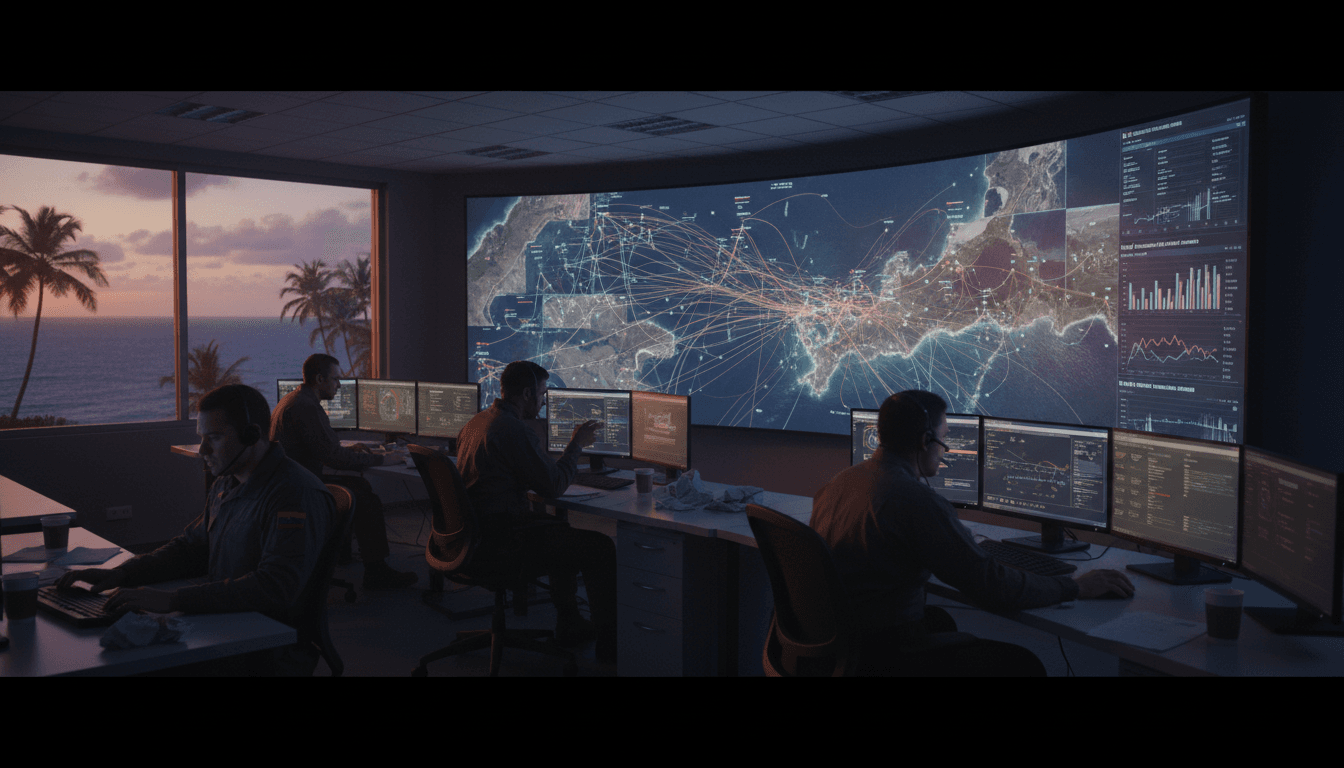
AI Signals to Track Venezuela’s Response to U.S. Pressure
A military buildup is loud. The more revealing moves are often quiet: a sudden purge inside a security service, a wave of “volunteer” militia sign-ups, an air-defense redeployment photographed from a highway, a burst of state media messaging that reframes a domestic shortage as foreign sabotage. Venezuela’s leadership has been signaling—internally and externally—that it’s preparing for a harder line from the United States.
For defense and national security teams, the practical problem isn’t understanding that pressure exists. It’s separating theater from capability, and predicting which actors inside Venezuela will escalate, defect, or double down if the situation sharpens.
This post sits in our AI in Defense & National Security series for one reason: Venezuela is a real-time case study in how AI-enabled intelligence analysis can turn messy, multi-actor political behavior into trackable indicators, decision-grade risk forecasts, and early-warning triggers—without pretending the model can “solve” politics.
What Venezuela’s internal response looks like (and why it’s rational)
Venezuela’s current posture is a blend of repression, mobilization, and cautious diplomacy. That mix can look contradictory until you view it as a single objective: regime survival under external pressure.
A key dynamic highlighted by expert analysis is straightforward: Maduro understands the military balance. If the United States chose a direct removal strategy, Venezuela likely couldn’t win a conventional fight. So the regime’s domestic response focuses on deterring internal fracture and raising the perceived costs of intervention.
Repression: keeping elites aligned, not just silencing citizens
When pressure rises, authoritarian systems often worry less about opposition rallies and more about insiders. Repression becomes targeted and managerial:
- Crackdowns on civil society and dissent reduce information flow, organizing capacity, and international visibility.
- Selective purges and “coup-proofing” (removing or rotating potentially disloyal officers) aim to keep security elites cohesive.
- Narratives of victimization frame hardship as the result of foreign aggression, positioning the regime as the defender of sovereignty.
Here’s what works in practice for analysts: treat repression as a measurable operational pattern, not a moral category. You can track it in personnel movements, arrests, legal actions, and messaging.
Mobilization: militia enlistments as signaling, not readiness
Mass militia enlistment drives matter even if they don’t produce a force that can fight the U.S. military. Their purpose is often political:
- Generate rally-around-the-flag effects domestically.
- Communicate to Washington that escalation could produce prolonged instability.
- Provide a reason to expand internal surveillance and local control.
For AI-driven monitoring, this is prime territory because these campaigns throw off lots of observable data—images, local news mentions, transportation activity around enlistment sites, and coordinated social amplification.
Cautious diplomacy + selective compliance: avoid the tripwire
Even while posturing, the regime may pursue limited actions aligned with U.S. priorities—like strikes against insurgent or cartel camps near the Colombian border—because it wants to reduce the probability of a direct U.S. strike without appearing weak.
This combination—defiance in tone, partial compliance in practice—is common under coercive pressure. It’s also where human judgment often slips: observers over-weight the speeches and under-weight the operational details.
The intelligence challenge: theater vs. capability vs. intent
The hard part of Venezuela analysis isn’t collecting information. It’s assigning meaning across three buckets:
- Theater (meant to be seen)
- Capability changes (what forces can actually do)
- Intent signals (what leaders are preparing to choose)
AI doesn’t replace analysts here; it helps by enforcing consistency and scale.
A practical “three-layer” AI stack for geopolitical early warning
A solid national security analytics approach usually looks like this:
- Collection layer: ingest OSINT (social, broadcast, print), commercial satellite imagery, maritime AIS, flight tracking, and economic proxies.
- Fusion layer: normalize and align time, geography, and entities (people/units/locations) into a common model.
- Inference layer: detect anomalies, forecast likely next moves, and generate alerts tied to specific thresholds.
The win isn’t a flashy prediction. The win is getting the right alert to the right desk early enough to matter.
AI indicators that matter in a Venezuela escalation scenario
If you’re building an AI-enabled early-warning program, you need indicators that are (1) observable, (2) timely, and (3) linked to plausible decision paths. Below are indicators I’d prioritize for Venezuela specifically.
1) Security elite stress: purges, rotations, and quiet detentions
Answer first: Elite instability is the most actionable leading indicator because it directly affects regime control and escalation choices.
Track:
- Senior military rotations that cluster in time (especially in intelligence, counterintelligence, and logistics commands).
- Arrests or “disappearances” of mid-level officers.
- Sudden promotions of previously low-visibility figures.
AI methods that help:
- Entity resolution for names across messy Spanish-language reporting.
- Temporal anomaly detection (e.g., “rotation rate” vs. baseline).
- Relationship mapping (who replaces whom; prior affiliations).
Operational note: you’re not trying to prove a coup plot. You’re trying to detect heightened paranoia and internal risk, which correlates strongly with repression and miscalculation.
2) Air defense and force protection movement
Answer first: Moving air defenses is expensive, visible, and rarely done for pure theater.
The source analysis referenced repositioning Russian-supplied air defense systems. Whether that’s strategic, tactical, or political, it’s a big signal.
Track:
- Construction or preparation of new sites (clearing, berms, vehicle tracks).
- Convoys moving at night; increased activity near known depots.
- Changes in camouflage/netting patterns.
AI methods that help:
- Computer vision change detection on commercial satellite imagery.
- Multisource correlation: imagery changes + local social posts + restricted road patterns.
3) Maritime patterns around interdiction and “drug trafficking” claims
Answer first: Maritime behavior changes faster than land posture and often shows escalation before official announcements.
Given reports of strikes on boats accused of trafficking, watch for:
- AIS “going dark” events that cluster in specific corridors.
- Changes in coastal patrol routes and loitering behavior.
- Insurance/economic proxies: port slowdowns, unusual shipping delays.
AI methods that help:
- Unsupervised clustering of vessel tracks to detect new routes.
- Risk scoring for vessels based on behavior, not identity.
4) Propaganda temperature: the narrative isn’t fluff
Answer first: Propaganda shifts are an early-warning layer because they prepare domestic audiences for pain and justify policy choices.
Track:
- Topic shifts: from “economic war” to “imminent invasion,” for example.
- Calls for militia participation and denunciations of “internal traitors.”
- Increased personalization around Maduro vs. broader “Bolivarian” branding (often a sign of centralization and insecurity).
AI methods that help:
- Topic modeling and stance detection tuned for local idioms.
- Bot/coordination detection to measure whether amplification is organic or directed.
If you only measure volume, you’ll miss the real signal. Measure content change and coordination patterns.
5) Border-zone violence and “selective compliance” operations
Answer first: Limited strikes near the Colombian border can be both compliance signaling and internal consolidation.
Track:
- Event geolocation of clashes, raids, and seizures.
- Shifts in who is targeted (cartels vs. insurgents vs. political figures).
- Displacement indicators (school closures, clinic load, bus route disruption).
AI methods that help:
- Event extraction from local reporting and social posts.
- Geospatial forecasting of likely spillover zones.
Predictive analytics without fantasy: what AI can and can’t forecast
The temptation in geopolitical AI is to promise a clean forecast: “Probability of strike: 73%.” That’s rarely decision-useful unless it’s tied to specific triggers.
A better framing is conditional forecasting:
- If militia mobilization + elite purges + air defense movement rise above baseline within 30 days,
- then expect increased domestic repression and limited external retaliation options (cyber, proxies, maritime harassment) rather than conventional escalation.
This style helps commanders and policymakers because it supports planning:
- Which assets need to be postured?
- What diplomatic channels should be opened?
- What should be communicated publicly vs. privately?
“People also ask” (and what I tell teams)
Can AI predict whether Maduro will fall? AI can estimate stress and instability, but regime collapse is typically driven by private decisions and sudden coalition shifts. Use AI for early warning, not certainty.
Does OSINT matter if the regime controls information? Yes. Control creates distortion, but distortion itself is measurable. Sudden silence, uniform messaging, or disappearing local voices are signals.
How do we avoid mirror-imaging? Build models around observed incentives: elite cohesion, coercive capacity, and cost-imposition strategies. Don’t assume the regime values what we value.
A field-ready workflow: turning Venezuela signals into decision support
If you’re responsible for intelligence analysis, defense innovation, or security operations, here’s a workflow that holds up under pressure.
- Define the decision you’re supporting (interdiction posture? embassy risk? sanctions timing? contingency planning?).
- Choose 12–20 indicators max across elite stability, force posture, maritime behavior, messaging, and border-zone events.
- Baseline each indicator against the past 6–24 months (seasonality matters, especially around holidays and anniversaries).
- Set alert thresholds that trigger review, not panic.
- Run red-team reviews monthly: what would fool the model? What would the regime want you to see?
The discipline here is the point. AI is most valuable when it forces clarity about what you’re measuring and why.
What this means for AI in defense & national security in 2026
Venezuela under U.S. pressure is a reminder that modern security problems are rarely “military-only.” They’re hybrid: domestic control, information operations, selective compliance, and calibrated retaliation.
AI-enabled intelligence analysis shines in exactly these environments because it can:
- Fuse signals across domains (social, satellite, maritime, economic)
- Detect anomalies early
- Produce repeatable, auditable assessments that don’t depend on one analyst’s intuition
If you’re building or buying national security AI, don’t start with a model. Start with a question: Which internal Venezuelan actor behavior would change our decision this week? Then instrument for that.
If your team wants help designing an indicator framework or validating an AI pipeline for geopolitical early warning, we can walk through what “decision-grade” looks like—down to data sources, evaluation metrics, and governance. Where would you want the first alert to land: an analyst queue, a watch floor dashboard, or an ops planning cell?