AI deterrence is becoming essential as the U.S. faces parallel nuclear risks from Iran and North Korea. Learn what AI changes—and what to watch next.
AI Deterrence for a Two-Front Nuclear Crisis
Two numbers should be keeping U.S. planners awake right now: 440.9 kg and 50.
- 440.9 kg is the last confirmed amount of Iranian uranium enriched to 60% reported in September 2025—material that’s uncomfortably close to weapons-grade if further processed.
- 50 is the upper-end open-source estimate often cited for North Korea’s potential warhead inventory, paired with an accelerating set of delivery options.
What changes the picture in late 2025 isn’t simply that both programs are advancing. It’s that Washington is increasingly facing a two-front nuclear deterrence problem—with real risk of parallel crises in the Middle East and Northeast Asia.
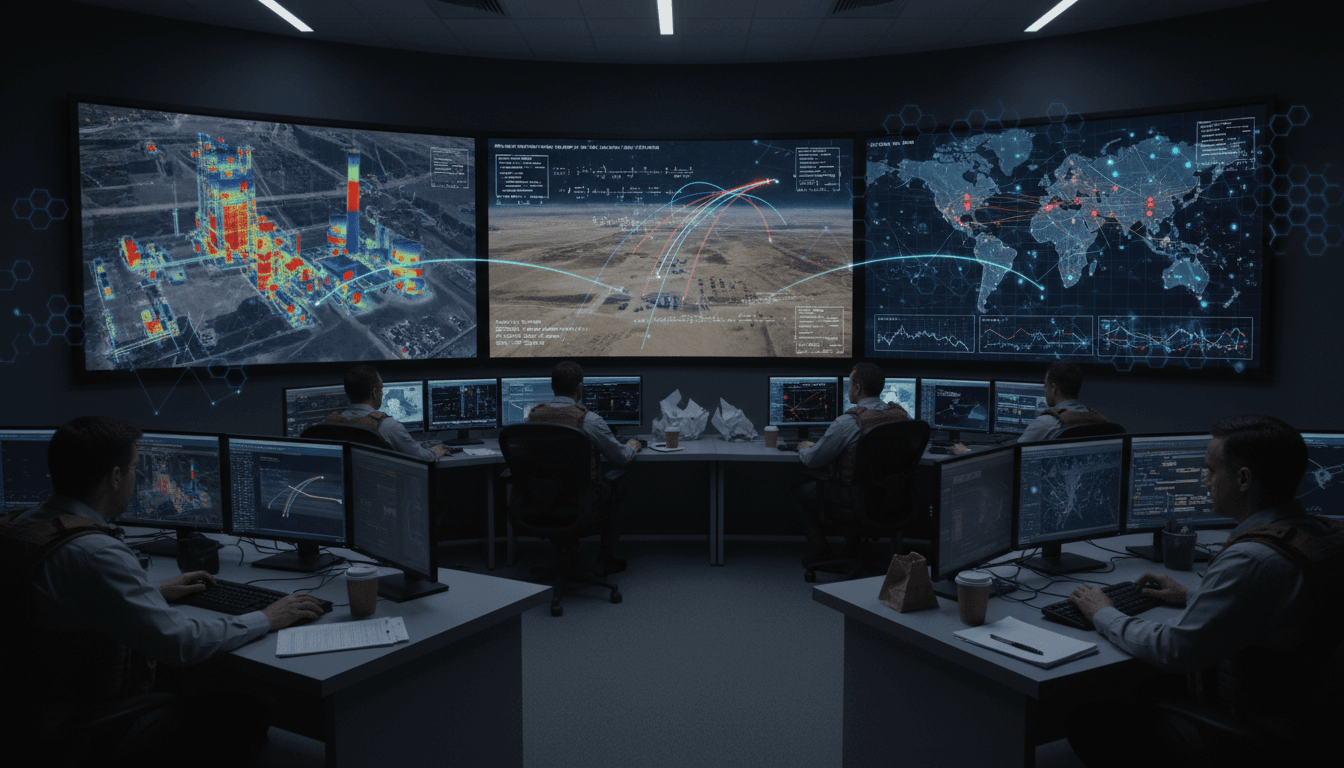
Here’s where the “AI in Defense & National Security” lens matters. Traditional deterrence assumes you can read the adversary, signal clearly, and manage escalation with time to think. A two-front nuclear environment compresses timelines, increases ambiguity, and turns intelligence into the decisive terrain. AI isn’t a nice-to-have add-on here. It’s the only realistic way to keep pace with the volume, velocity, and deception built into modern nuclear brinkmanship.
Why the two-front nuclear problem is harder than “Iran + North Korea”
The core issue is concurrency. Managing one nuclear flashpoint is difficult. Managing two at once risks blowing past the limits of crisis staffing, alliance coordination, and decision speed.
Iran and North Korea aren’t identical threats, but the interaction between them is what raises the stakes:
- Iran sits in a “near-breakout” zone where political decisions—sanctions, strikes, inspections, retaliation—can rapidly change the clock.
- North Korea is already nuclear-armed and is increasingly behaving like a state building a war-fighting nuclear posture, not just a survivable deterrent.
A two-front scenario forces Washington into two decision cycles at the same time:
- An enrichment surge or covert reconstitution in Iran, possibly paired with regional escalation.
- A North Korean missile volley, a seventh nuclear test, or a coercive demonstration timed to distract and split U.S. attention.
Deterrence breaks down fastest when leaders don’t know what’s happening, don’t know what’s next, and don’t trust the timeline. That’s exactly the environment adversaries try to create.
What’s different about North Korea in 2025: survivable forces and escalation options
North Korea’s program is trending toward survivability, penetration, and choice. That combination matters more than raw warhead counts.
Recent assessments highlight several shifts:
Solid fuel, mobility, and “don’t catch me on the pad” dynamics
Solid-fueled road-mobile missiles reduce launch preparation time and expand hiding options. Operationally, that means:
- Less warning
- More false alarms
- Higher pressure to interpret ambiguous indicators correctly
This is where AI-enabled indications and warning (I&W) matters: fusing satellite revisits, signals, telemetry, and transportation patterns quickly enough to be useful.
More delivery modes = more crisis instability
With sea-based options and the pursuit of multiple warheads, North Korea pushes toward the ability to:
- Survive a first strike (or credibly threaten that it could)
- Overwhelm missile defenses through salvos, decoys, or multiple targets
- Create escalation ladders (limited use threats) that test alliance cohesion
A key point from the reporting: U.S. planners have to assume North Korea can target the U.S. homeland. Once that assumption is operationalized, every crisis becomes a high-stakes communications problem—and an intelligence triage problem.
What’s different about Iran in late 2025: continuity of knowledge is collapsing
Iran’s nuclear risk isn’t just enrichment. It’s the shrinking ability to verify where material is and what’s been rebuilt. When inspectors lose “continuity of knowledge,” ambiguity becomes the weapon.
The latest confirmed figure—440.9 kg enriched to 60%—is a headline for a reason. Even if much of it is assessed to be trapped in damaged facilities, the strategic danger is that:
- Iran retains technical expertise and can rebuild.
- Political incentives can shift fast under sanctions, retaliation, or perceived regime threat.
- Covert paths become more plausible when oversight is reduced.
There’s also a historical echo here: analysts warn that the West can “look away” for a while, only to discover the program crossed a threshold—similar to how North Korea moved from persistent concern to nuclear reality.
The silent link: why proliferation networks matter more than single programs
The most dangerous scenario is not Iran acting alone or North Korea acting alone. It’s a form of collaboration that shortens timelines.
Expert commentary in the source reporting raises a blunt possibility: Iran could seek help from North Korea for highly enriched material, weapon components, or support to reconstitute damaged facilities.
Even modest forms of assistance can be decisive:
- Specialty components and machine tools
- Design knowledge transfer
- Testing data and diagnostics
- Procurement networks that evade sanctions
The strategic takeaway: nonproliferation is now a network problem, not a country problem.
And network problems are exactly where AI performs best—if you build the system correctly.
Where AI actually strengthens nuclear deterrence (and where it doesn’t)
AI can improve deterrence by improving one thing: decision advantage under uncertainty.
It does that in three concrete lanes: surveillance and intelligence analysis, mission planning and force posture, and cybersecurity.
1) AI for surveillance and intelligence analysis: faster, broader, more consistent
Answer first: AI helps by turning massive ISR streams into prioritized, explainable alerts that analysts can validate.
In a two-front nuclear crisis, the bottleneck is rarely data collection. It’s analysis throughput and prioritization. AI supports by:
- Detecting anomalies in satellite imagery (new tunneling, unusual vehicle flow, fresh spoil piles)
- Flagging patterns across time (construction cadence, security perimeter changes, heat signatures)
- Correlating signals intelligence and open-source indicators with physical movement
The standard objection is fair: AI can hallucinate or overfit. That’s why the architecture matters:
- Use AI for triage, not verdicts.
- Require human confirmation for high-consequence assessments.
- Track model confidence and data provenance (what sensors, what timestamps).
A line I keep coming back to: AI shouldn’t replace analysts; it should replace the 3 a.m. spreadsheet that decides what analysts never get around to seeing.
2) AI for mission planning and strategic decision-making: compressing the OODA loop responsibly
Answer first: AI can help planners model contingencies and force allocation across theaters—but only if the outputs are constrained, auditable, and tied to doctrine.
A two-front scenario forces ugly tradeoffs:
- Which scarce missile defense assets go where?
- How do you surge ISR without creating blind spots?
- What messages go to allies to prevent panic, freelancing, or misread signals?
AI-enabled decision support can:
- Run wargame variations faster (salvo sizes, escalation branches, defense saturation)
- Identify brittle dependencies (single points of failure in logistics, basing, comms)
- Suggest resilient posture options (dispersal, deception, redundancy)
The mistake to avoid is “auto-pilot deterrence.” If a model’s recommendation can’t be explained clearly to a combatant commander, it doesn’t belong in the chain.
3) AI + cybersecurity: protecting the deterrent itself
Answer first: Cybersecurity is part of deterrence because adversaries will try to blind, spoof, or paralyze U.S. decision-making during a nuclear crisis.
In the two-front context, cyber operations have outsized value for adversaries:
- Attack ISR processing pipelines to slow assessment
- Poison open-source narratives to fracture alliance cohesion
- Probe logistics and readiness indicators for timing windows
AI helps defenders by:
- Detecting anomalies in network traffic at scale
- Prioritizing incident response under time pressure
- Identifying likely lateral movement paths before the attacker completes them
If the U.S. can’t trust its sensors, comms, and data integrity, deterrence messaging becomes incoherent—and that’s a direct escalation risk.
What to watch in 2026: practical indicators that matter
The next year won’t hinge on a single headline test or a single enrichment statistic. It’ll hinge on signals of intent plus capacity—and whether those signals appear in both theaters at once.
Here are indicators I’d treat as decision-relevant (and AI-suitable for continuous monitoring):
North Korea indicators
- Observable preparations consistent with a seventh nuclear test
- Increased activity around submarine basing and sea-launch infrastructure
- Patterns of solid-fuel production and mobile launcher deployment that suggest higher readiness
Iran indicators
- Reconstitution activity around key nuclear sites and storage tunnels
- Shifts in enrichment posture combined with reduced transparency
- Procurement signals consistent with rebuilding conversion or centrifuge capacity
Network indicators (the “two-front multiplier”)
- Trade, shipping, or procurement anomalies linking intermediaries across regions
- Technical personnel movement patterns and unusual diplomatic cover travel
- Converging cyber activity against allied intelligence-sharing systems
A disciplined approach is to treat these as cross-domain clues rather than standalone proof. AI can rank them; humans must adjudicate them.
What organizations should do now (if they support defense, intel, or allied missions)
Leads don’t come from shouting “AI.” They come from showing you understand what breaks during real crises.
If you’re building or buying AI for defense and national security, push your program toward these requirements:
- Multi-theater fusion by design: One dashboard isn’t enough. Build for cross-command data sharing and contested comms.
- Explainability for high-stakes alerts: Every alert needs a “why,” not just a score.
- Red-team your models like adversaries will: Assume spoofing, decoys, and data poisoning.
- Workflow integration: If analysts can’t use it at speed, they won’t use it when it matters.
- Exercise with allies: Deterrence is collective. Your data standards and AI outputs must be shareable and trusted.
Deterrence in 2026 will belong to the side that can see clearly, decide quickly, and prove to allies that its picture of reality is accurate.
Where this is heading for the AI in Defense & National Security series
This two-front nuclear challenge is a stress test for everything modern defense AI claims to do: real-time intelligence analysis, resilient mission planning, and hardened cyber defense.
If Iran’s nuclear posture remains opaque and North Korea continues building survivable, flexible delivery systems, the U.S. won’t get the luxury of sequential crises. It’ll get overlap.
The next practical step is to treat AI as a deterrence enabler—not by automating decisions, but by making intelligence more timely, planning more adaptive, and allied coordination more confident under pressure.
If you’re designing systems for this environment, the question to answer isn’t “Can our model detect something?” It’s simpler and tougher:
When two crises hit in two theaters, will your system help leaders decide—or just give them more noise?