AI makes chips a national security dependency. See how Taiwan’s semiconductors shape deterrence, ISR, autonomy, and defense AI strategy.
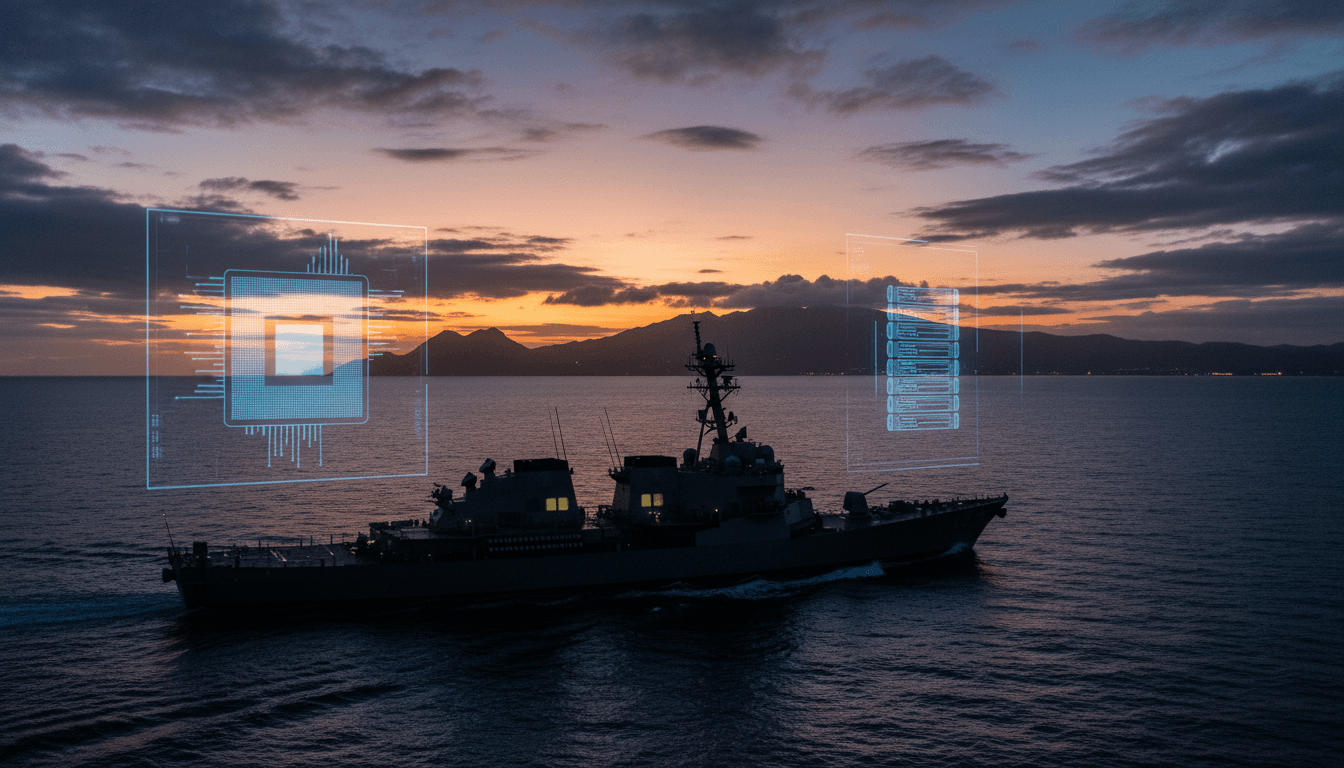
In 2025, the fastest way to understand the Taiwan Strait isn’t by counting ships—it’s by tracing who controls the compute.
That sounds abstract until you look at what Congress has been hearing: predictions that human-level AI could arrive around 2029 are no longer treated as sci-fi. Whether you buy that timeline or not, the security logic has already shifted. Advanced AI systems aren’t powered by speeches or strategy papers. They’re powered by advanced semiconductors, and Taiwan sits at the center of that supply chain.
This post is part of our AI in Defense & National Security series, and I’m going to take a clear stance: AI has turned chips into a front-line national security dependency. If you’re responsible for defense planning, intelligence operations, or mission systems acquisition, you should be treating compute access the way prior generations treated fuel, satellites, and secure comms.
Why AI makes Taiwan strategically “louder” than before
AI compresses timelines. That’s the core shift.
In traditional deterrence math, the most important variables were force posture, mobilization time, and logistics. In an AI-driven security environment, compute availability becomes a limiting factor for:
- Training and updating intelligence models
- Running large-scale ISR (intelligence, surveillance, reconnaissance) processing
- Operating autonomous systems at meaningful scale
- Accelerating cyber operations (defense and offense)
Taiwan’s chip ecosystem—especially advanced manufacturing—matters because it influences who can scale AI faster, not just who can buy more servers.
A congressional hearing highlighted an uncomfortable link: as expectations rise that advanced AI could arrive sooner than previously believed, China’s pressure on Taiwan becomes more than territorial. It becomes industrial strategy with military consequences.
The “global depression” argument is about more than economics
One witness in the hearing warned that a takeover of Taiwan could trigger a global depression, because it could choke supply of advanced chips.
From a national security lens, the more actionable point is this: economic shock can be tolerated if it buys lasting strategic advantage.
If a major power believes control of advanced semiconductor production would:
- Slow competitors’ AI deployment
- Speed its own military AI modernization
- Strengthen coercive leverage over allies and partners
…then the willingness to absorb short-term costs changes.
Deterrence messaging that relies only on “it would hurt the global economy” is thin. You need deterrence that raises the expected military and regime risks, not just the GDP risks.
The AI-to-military pipeline: where chips become capability
AI doesn’t become a defense advantage because a lab publishes a model. It becomes an advantage when it’s integrated into operational systems—under constraints, at scale, with reliable supply.
Here are three direct pathways from chips to military outcomes.
1) Intelligence and surveillance: compute is the bottleneck
Modern ISR isn’t limited by collection. It’s limited by processing.
Sensors across space, air, surface, subsurface, and cyber domains generate torrents of data. The operational edge comes from turning raw data into decisions quickly:
- Multi-sensor fusion
- Change detection over wide areas
- Maritime domain awareness and anomaly spotting
- Real-time targeting support
Those workloads are compute-hungry. If your access to high-end accelerators is constrained, you can still do ISR—but you do it slower, with more manual triage, and with fewer iterations.
Snippet-worthy truth: In high-tempo conflict, the side that processes ISR faster doesn’t just “know more.” It forces the other side to react.
2) Autonomous systems: scaling autonomy means scaling chips
Autonomy isn’t one capability. It’s a stack:
- Perception (detect, classify)
- Planning (pathing, tasking)
- Coordination (swarming, deconfliction)
- Resilience (operate in denied environments)
All of that improves with better models and better onboard/edge compute. And then there’s the training side—massive simulation and reinforcement learning workloads that require reliable, repeated access to advanced chips.
This is where Taiwan’s relevance jumps out: if chip supply becomes a chokepoint, the ability to field autonomy at scale becomes uneven.
3) Cyber and electronic warfare: AI makes both faster
AI is already improving:
- Phishing and social engineering at scale
- Malware analysis and reverse engineering
- Log triage and incident response
- EW signal classification and emitter identification
None of that eliminates the human role—but it changes throughput. Defense organizations with stronger compute can train better models on richer datasets and run more inference across more endpoints.
My take: Many teams talk about AI in cyber as a software procurement problem. It’s increasingly a compute governance and data access problem.
China’s AI strategy isn’t academic—it’s state power
The hearing underscored what defense planners have been watching for years: Beijing treats AI dominance as a national objective.
The strategic concern isn’t simply “China will build smart systems.” It’s that China can connect AI advances to:
- Industrial capacity (factories, supply chains)
- Military modernization (targeting, autonomy, C2)
- Information operations (influence at scale)
One witness framed it bluntly: the U.S. has shifted heavily into service-oriented sectors that AI could disrupt, while China could capture more of the growth benefits by applying advanced AI in manufacturing. Even if you disagree with the economics, the security implication is direct: industrial depth supports sustained conflict.
If AI increases productivity in logistics, maintenance, production planning, and quality control, that’s not “business efficiency.” That’s wartime endurance.
Export controls, “America first” chip access, and the hard tradeoffs
Policy proposals discussed in the broader debate include:
- Expanding domestic chip production incentives (often framed as a “CHIPS Act 2.0” concept)
- Tightening controls to keep advanced accelerators out of Chinese markets
- “Priority access” approaches that require suppliers to offer certain chips to U.S. buyers before selling to strategic competitors
This is where national security leaders should be candid: every option has second-order effects.
The three tradeoffs leaders should plan for
1) Restrictions can reduce near-term corporate revenue Lower revenue can mean less R&D and slower innovation—unless governments offset it or procurement stabilizes it.
2) Domestic manufacturing takes time Even with incentives, new fabs and advanced packaging capacity don’t materialize in a fiscal quarter.
3) Allies matter, but alignment isn’t automatic Export controls and industrial policy have to be coordinated. Otherwise, restrictions become leaky, politically brittle, or both.
If your organization depends on advanced AI capabilities, you should assume policy volatility over the next several years and build resiliency into acquisition and architecture now.
What defense and intelligence organizations should do next
The best response to chip geopolitics is not a single program. It’s a portfolio: technical, operational, and industrial.
Build a “compute readiness” plan like you build a logistics plan
Treat compute as a resource you forecast, allocate, and protect.
A practical compute readiness plan includes:
- Compute inventory: What accelerator types do you have, where are they, and what classification boundaries constrain use?
- Workload prioritization: Which mission workloads must run even during shortages (ISR fusion, cyber defense, targeting support)?
- Model lifecycle discipline: Which models truly need retraining, and how often? Don’t burn compute on vanity refresh cycles.
- Fallback modes: What happens when you lose access to cloud GPUs or supply chains tighten?
Architect for degraded compute, not ideal compute
Most AI programs assume best-case access to high-end accelerators. That’s not a war plan.
Design for:
- Smaller, specialized models where they work
- Edge inference with constrained power
- Hybrid pipelines (classical algorithms + ML)
- Graceful degradation under bandwidth denial
Snippet-worthy truth: Resilient AI beats impressive AI when the network is contested and the supply chain is stressed.
Make data pipelines mission-grade
In national security, data isn’t “big.” It’s messy, classified, time-stamped, and politically sensitive.
If you want AI that helps commanders, analysts, and operators, invest in:
- Labeling and ground-truth programs tied to mission outcomes
- Cross-domain data handling that doesn’t create shadow IT
- Auditable provenance (what trained this model, and when?)
- Continuous evaluation against red-team tactics and adversary deception
FAQ: the questions leaders keep asking
Is the Taiwan chip issue mainly about economics or military power?
It’s both, but the military angle is straightforward: chips determine AI scale, and AI scale determines how quickly you can sense, decide, and act.
Does AI make conflict more likely?
AI increases speed and confidence—sometimes falsely. That can raise escalation risk if leaders trust automated assessments without rigorous validation.
What’s the most realistic near-term defense advantage from AI?
Not sentient machines—better ISR triage, predictive maintenance, cyber defense automation, and decision support that reduces time-to-action.
The real deterrence question: who can sustain AI at scale?
The Taiwan Strait conversation often gets stuck on platforms—ships, missiles, aircraft. Those matter. But the AI era adds a quieter, harder constraint: sustained access to advanced compute.
That’s why Taiwan’s chips are more prized than ever, and why China’s AI ambitions can’t be separated from its posture toward the island. AI isn’t just another technology category inside defense. It’s a force multiplier whose “ammo” is semiconductor supply, energy, data, and talent.
If you’re building strategy for 2026 and beyond, a good final test is simple: If compute access tightens tomorrow, what mission outcomes fail first—and what have you done to prevent that?