AI-enabled integrated systems—not standalone tech—are the path to Pacific deterrence. Learn how to build resilient, interoperable system-of-systems.
AI-Enabled Systems Win in the Pacific, Not Silver Bullets
A single “perfect” technology is the most expensive way to lose in the Indo-Pacific.
That’s the core message Maj. Gen. Jeffrey VanAntwerp, commander of Special Operations Command Pacific (SOCPAC), delivered when he warned against standalone solutions that will inevitably be “cracked, hacked, and eventually overcome.” His point is blunt: victory comes from integrated systems that disrupt an adversary’s ability to target you—not from betting on one dazzling platform.
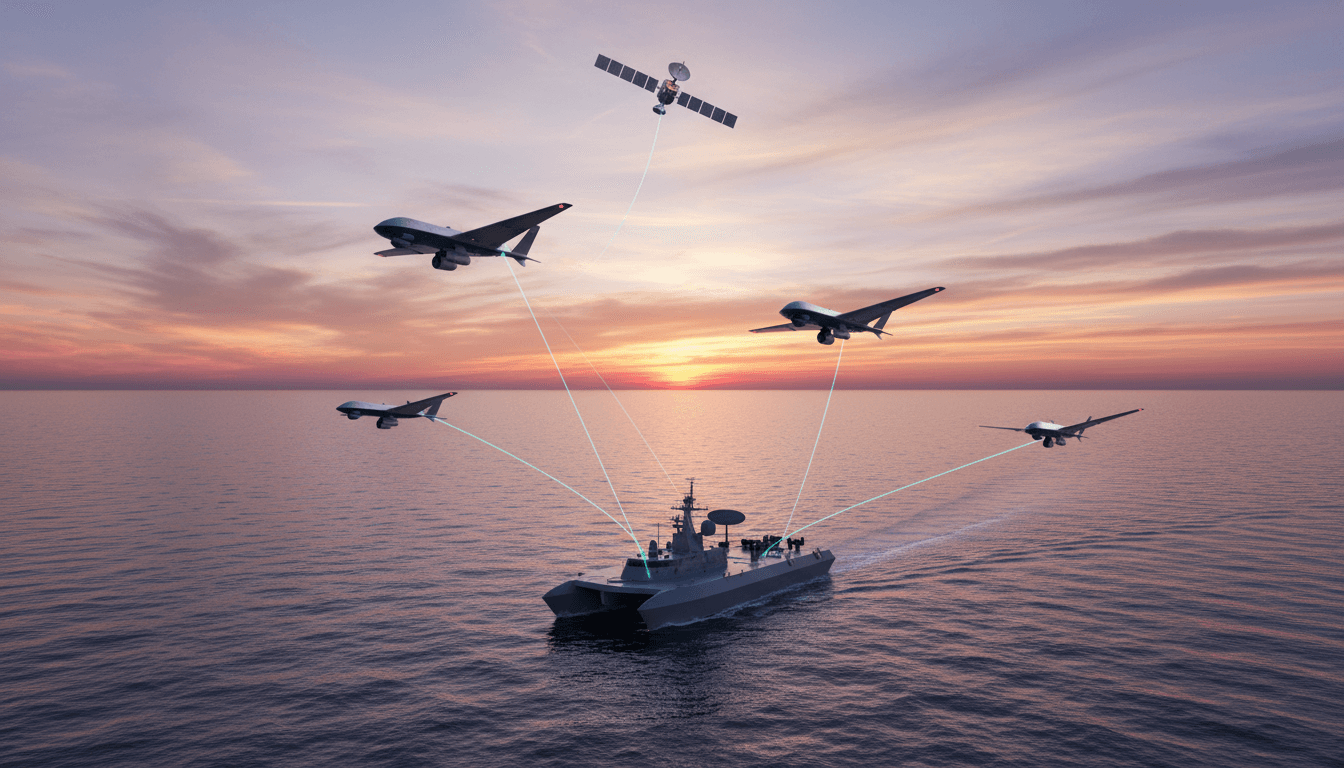
For this AI in Defense & National Security series, I want to take that idea further. Because if “systems” are the answer, AI is the glue—the part that fuses sensors, autonomy, networks, and decision-making into a coherent whole under stress. The Pacific theater is exactly where that matters most: vast distances, contested communications, and an adversary that will pressure every seam—cyber, space, spectrum, logistics, and public narrative.
The Pacific problem: targeting is the real fight
The decisive contest in a Pacific conflict is the kill chain: find, fix, track, target, engage, assess. If your opponent can do that faster, at scale, and with fewer points of failure, they don’t need “silver bullets.” They can grind you down with ordinary munitions because their system gets the first effective shot.
VanAntwerp framed it well: disrupting the adversary’s ability to target you is “the oxygen” required in this theater. That’s not poetry—it's operational math.
Why “standalone” gets punished in the Indo-Pacific
A standalone platform, model, or network looks strong in a demo and fragile in a campaign. In the Indo-Pacific:
- Distances are huge. Data has to travel farther, logistics take longer, and time-to-repair grows.
- Comms will degrade. Jamming and cyber are features, not edge cases.
- Multi-domain pressure is constant. Space ISR, undersea sensing, EW, cyber, and air defense all interact.
- Coalitions are the norm. If systems can’t interoperate, partners can’t contribute at speed.
So the real requirement becomes: keep fighting even when parts fail. That’s a systems problem.
AI’s role in “systems, not silver bullets”: integration under fire
AI adds value in the Pacific when it improves coordination, not when it replaces people or promises magic. The most practical definition of defense AI in this context is:
Defense AI is software that turns many imperfect signals into timely, actionable decisions—despite disruption.
Here are the three integration jobs AI is uniquely positioned to do.
1) Turn sensor sprawl into a coherent picture
SOF units, ships, aircraft, satellites, UAS, unattended ground sensors, cyber telemetry, and partner feeds generate a flood of data. The limiting factor isn’t collection—it’s fusion and prioritization.
AI-enabled fusion can:
- Correlate tracks across sensors with different update rates and errors
- Detect anomalies (decoys, spoofing patterns, inconsistent motion)
- Surface the “few things that matter now” to analysts and operators
This is where machine learning shines: pattern recognition at scale. Not as an oracle, but as a triage engine.
2) Orchestrate autonomy as a team sport
VanAntwerp emphasized robotics and autonomy paired with resilient networks. The missing piece is coordination logic: many unmanned systems are only useful if they cooperate.
AI helps with:
- Swarm tasking (search sectors, deconflict routes, handoffs)
- Adaptive behaviors when links drop (local autonomy, store-and-forward)
- Mission-level optimization (coverage vs. risk vs. battery vs. signatures)
A single exquisite drone is impressive. A mixed fleet—cheap expendables plus a few survivable nodes—changes the adversary’s calculus.
3) Support decisions at the pace of the spectrum
Electronic warfare and cyber effects can unfold faster than traditional command cycles. AI can assist by:
- Recommending spectrum moves and comms paths (frequency, waveform, route)
- Flagging likely jamming/spoofing attempts using learned signatures
- Helping commanders choose between “hide, harden, or strike” responses
The point isn’t to automate authority. It’s to compress observation-to-action so humans can keep up.
The Ukraine lesson isn’t “buy drones”—it’s “build the network”
VanAntwerp referenced how Ukraine denied Russia freedom of action in parts of the Black Sea and contested the air without a traditional navy or air force. The tactical takeaway people repeat is “drones everywhere.” That’s incomplete.
The strategic takeaway is that Ukraine built a system that connected sensing, targeting, and strike options fast enough to matter. They combined:
- Distributed sensors (including partner support)
- Unmanned systems across domains
- Rapid iteration in tactics and hardware
- A feedback loop that updated behaviors based on results
That’s a learning system. And learning systems depend on software, data pathways, and operational experimentation—areas where large organizations often move slowly.
If you’re working Pacific problems, the right question isn’t “what’s our drone program?” It’s:
How quickly can we integrate a new sensor, a new partner feed, or a new autonomous behavior into the kill chain—without breaking everything else?
Open architecture isn’t a buzzword—it’s a wartime requirement
VanAntwerp argued for integrating “disparate systems, with more open architecture.” He’s right, and I’ll be more opinionated: closed ecosystems are peacetime comfort and wartime failure.
Open architecture enables:
- Faster onboarding of partner capabilities
- Swapping components when vendors or supply chains hiccup
- Security improvements without full redesign
- Multiple “good enough” paths instead of one brittle path
What “system-of-systems” should mean in practice
A credible system-of-systems approach has concrete properties:
- Interoperability by default: common data standards, message formats, identity and access controls
- Graceful degradation: operate with partial connectivity; local autonomy when disconnected
- Composable mission packages: plug in sensors/effectors with minimal integration burden
- Cyber resilience baked in: assume compromise attempts; detect and contain fast
AI fits here because integration requires translation, correlation, and decision support across messy inputs.
The cost curve trap: cheap or survivable, don’t drift into “expensive and fragile”
VanAntwerp’s warning about the cost curve is one of the most actionable parts of his talk. Unmanned systems should generally be either (a) low-cost and expendable, or (b) expensive and highly survivable. The middle is where programs go to die.
Here’s the hard truth: a $2M drone that can be shot down like a $200K drone is a budgeting disaster. And in a high-end Pacific fight, attrition isn’t hypothetical.
How AI helps manage the cost curve
AI can reduce costs without reducing capability by:
- Shifting value into software (updating behaviors instead of buying new airframes)
- Optimizing force mix (how many cheap decoys vs. ISR nodes vs. relay nodes)
- Reducing operator burden (one operator supervising multiple assets)
- Improving survivability through tactics (route planning, emission control, deception)
But none of that works if AI is bolted on as a feature. It has to be part of the operational system design.
A practical blueprint for AI-enabled integrated defense systems
If you’re trying to build what SOCPAC is describing, start with integration mechanics, not models. Here’s a field-tested way to structure the effort across defense organizations and industry teams.
Step 1: Define the mission threads that matter
Pick 3–5 mission threads that reflect Pacific realities, such as:
- Counter-targeting (deny adversary ISR, break the kill chain)
- Maritime domain awareness with intermittent connectivity
- Distributed SOF support with autonomous ISR and resupply
- Base defense against mixed drone and cruise missile raids
Mission threads keep AI honest. If it doesn’t improve outcomes on those threads, it’s a science project.
Step 2: Build a shared data layer (and treat it as a weapon system)
A shared data layer should include:
- A track store that can merge and version tracks
- Metadata standards (confidence, provenance, time sync)
- Role-based access and coalition-friendly partitioning
- Auditability so operators can trust recommendations
If your data layer is fragmented, your AI will be fragile and your operators will ignore it.
Step 3: Engineer for degraded operations from day one
Design assumptions should be aggressive:
- Links drop. GPS degrades. Cloud reachback isn’t guaranteed.
- Local compute matters (edge inference, caching, delayed sync).
- Human override is non-negotiable.
The Pacific punishes systems that only work “online.”
Step 4: Measure integration speed as a primary metric
A system-of-systems program should track:
- Time to onboard a new sensor feed
- Time to add a new autonomous behavior
- Time to integrate a partner’s data source
- Time from detection to decision recommendation
If these don’t improve quarter over quarter, you’re not building an integrated system—you’re accumulating parts.
What buyers should demand from AI defense vendors (and what vendors should show)
Leads come from clarity, not hype. If you’re evaluating AI in national security, these are the questions I’d ask in a room with both operators and engineers.
Questions for government and program teams
- What happens when the model is wrong—how is it detected, corrected, and learned from?
- Can this run at the edge with limited power and bandwidth?
- How does it interoperate with existing C2 and ISR systems without a two-year integration effort?
- What is the cyber story: data poisoning, model theft, adversarial inputs?
What credible vendors should be ready to demonstrate
- Interoperability: live integration with at least two dissimilar systems
- Graceful degradation: mission continues with partial comms and partial data
- Human trust features: confidence scores, explanations, provenance
- Cost curve discipline: clear plan for scaling across cheap assets and survivable nodes
If a vendor can’t talk concretely about degraded ops and integration timelines, they’re selling a silver bullet.
Where this goes next for AI in Defense & National Security
The SOCPAC message lands because it’s not theoretical: standalone capabilities get countered; integrated systems keep adapting. In 2026 planning cycles, the winners won’t be the organizations with the flashiest demo. They’ll be the ones that can integrate faster than the adversary can target.
If you’re building, buying, or governing defense AI, a good next step is to inventory your “system friction”: the interfaces, authorities, data partitions, and network assumptions that slow integration. Fixing that is less glamorous than buying a new platform—but it’s the work that changes outcomes.
If you want to pressure-test your current architecture against Pacific realities—degraded comms, coalition sharing, and unmanned scale—I can help map mission threads to concrete AI integration requirements and a phased implementation plan. What part of your kill chain is most brittle right now: sensing, fusion, comms, or decision-making?