Germany’s $2B SAR satellite deal shows where defense ISR is headed: persistent coverage plus AI analytics that turn imagery into actionable alerts.
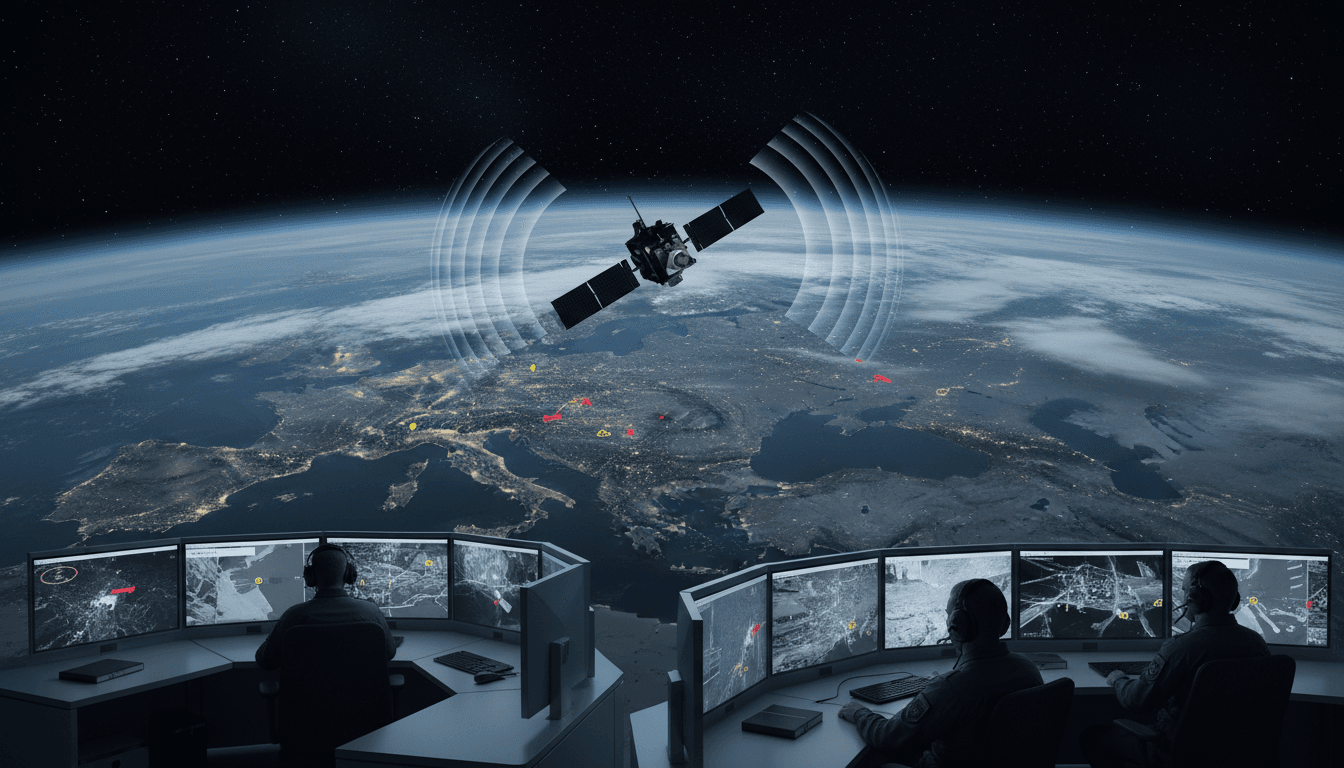
AI-Powered SAR Satellites: Germany’s $2B Signal
€1.7 billion is a loud number in defense procurement—especially when it’s pointed at one capability: persistent, all-weather surveillance from space. Germany’s newly awarded contract to ICEYE and Rheinmetall for a synthetic aperture radar (SAR) satellite network isn’t just another space program line item. It’s a practical admission that modern deterrence on NATO’s eastern flank depends on how fast you can turn raw sensor data into decisions.
Here’s the core shift: SAR is the sensor, but AI is the system. Without AI-driven processing, exploitation, and dissemination, a growing constellation can still drown analysts in images, queues, and false alarms. With the right AI pipeline, SAR becomes a tactical instrument—something commanders can task, trust, and act on in near real time.
Germany’s program (SPOCK 1, running 2025–2030 with options to extend) is designed to deliver volume and persistence. The interesting part is that the joint venture plans to provide not only satellites and ground operations, but also AI-driven image evaluation. That “evaluation” is where military advantage is won or lost.
Why Germany is buying SAR persistence now
Germany is buying time—decision time. The contract is explicitly tied to protecting the Bundeswehr’s Lithuania Brigade (45th Armoured Brigade) and contributing to securing NATO’s eastern flank. Persistent ISR is about reducing surprise: spotting movement, change, staging, and deception faster than an adversary can exploit it.
SAR’s real advantage: it doesn’t care about clouds or darkness
Optical satellites are powerful, but they’re not omnipotent. Weather and lighting matter. SAR satellites “see” through clouds and operate day/night, which is exactly what you want in Northern and Eastern Europe during winter—when darkness is long and cloud cover is common.
If you’re planning for deterrence, you plan for the days when conditions are bad. That’s what SAR is for.
From legacy constellations to operational tempo
Germany already operates SAR systems (SAR-Lupe, and SARah as the follow-on). But the strategic environment has changed: the requirement is no longer “periodic strategic imaging.” It’s persistent operational tracking—and that implies a different tempo:
- More frequent revisits over the same area
- Faster tasking and collection cycles
- Lower latency from collection to exploitation
- Wider distribution to units that need it (not just national-level intel shops)
A larger, commercially influenced constellation model helps on all four—if the data pipeline is built to keep up.
The real story: AI turns SAR imagery into decisions
Most organizations still treat satellite imagery like a product: “collect, store, analyze later.” That mindset breaks under today’s operational demands. Persistent SAR produces too much data to handle with traditional workflows.
AI changes the workflow from “images for analysts” to “alerts for operators.” That’s the leap Germany is paying for.
What “AI-driven image evaluation” should mean (in practice)
Done well, AI-driven SAR exploitation isn’t a black box that spits out labels. It’s a layered system that improves speed and reliability:
- Automated triage: route the right imagery to the right team based on mission, geography, and priority.
- Change detection at scale: flag what’s new since the last pass—new tracks, new earthworks, new vehicles, new bridges, new damage.
- Object and pattern recognition: identify classes of objects and activity patterns (for example: vehicle concentrations, convoy formation, staging behavior).
- Confidence scoring and explainability: provide “why” signals (features, comparisons, reference baselines) so humans can trust outputs.
- Fusion-ready outputs: publish results as machine-readable events that feed command-and-control systems, not just PDFs.
Here’s the standard I use: if the AI output can’t be briefed in 30 seconds and acted on in 3 minutes, it’s not operational.
SAR + AI is especially strong at “what changed?”
SAR imagery can be noisy to the untrained eye, but it’s excellent for detecting structural and surface changes. AI models trained for SAR can highlight change in ways that reduce analyst fatigue.
For operational tracking, “change” is the commodity:
- A new vehicle revetment that wasn’t there yesterday
- Fresh tire tracks into a treeline
- A temporary bridge or pontoon activity
- Alterations to airfield aprons or taxiways
This is where near real-time ISR becomes realistic: not because humans became faster, but because AI reduced the search space.
What Germany’s SPOCK 1 model says about “strategic autonomy”
Europe’s push for strategic autonomy in space often gets discussed as politics. This contract makes it concrete: Europe is building an ecosystem where European militaries procure, task, and exploit European-owned space capabilities—and increasingly, they want that capability packaged as a service.
Public-private defense collaboration is now the default
The Rheinmetall–ICEYE joint venture structure signals a procurement model that’s becoming common across AI in defense:
- A commercial-origin capability (rapid iteration, production scale)
- A prime contractor role (integration, compliance, sustainment, security)
- A service wrapper (operations, ground segment, support)
- AI analytics embedded in delivery (not bolted on)
This matters for leads-focused defense tech companies because it creates a clear buying pattern: ministries don’t just buy sensors; they buy outcomes—persistent coverage and actionable intelligence.
Owning and operating the constellation changes incentives
The announcement indicates the firms will own and operate the low Earth orbit constellation and provide imagery services to the German military. That’s important.
When the provider operates the system, you can optimize end-to-end performance:
- Tasking interfaces that match operational workflows
- Ground station scheduling designed for latency
- Model updates deployed continuously (with governance)
- Service-level metrics measured in minutes, not months
It also raises a hard requirement: governance. If your AI model updates every few weeks, you need disciplined testing, validation, and mission assurance.
The operational risks nobody should ignore
Buying satellites is the easy part. Fielding a trustworthy ISR pipeline is harder. I’d watch four risk areas closely.
1) Data overload becomes decision overload
More collection is not always better. If commanders receive too many alerts, they start ignoring all of them.
A mature AI-enabled ISR stack needs:
- Alert throttling and prioritization
- Role-based dissemination (who sees what)
- Clear escalation logic (what triggers action)
- Feedback loops (operator confirmation improves the model)
2) AI trust is earned, not claimed
Defense teams won’t trust AI outputs because a vendor says “we use AI.” They’ll trust it when it’s consistent under pressure.
Practical trust-builders include:
- Ground-truth benchmarking against known events
- Red-team testing with deception scenarios
- “Explainable” change detection overlays and comparisons
- Audit trails for how an alert was generated
3) Cybersecurity is part of ISR now
Space-based ISR is a networked system: satellites, ground stations, cloud/edge compute, mission apps, and user devices. That makes it a cyber target.
AI increases both capability and risk:
- Model theft and supply-chain tampering are real threats
- Data poisoning can degrade detection quality over time
- Insider risk expands when more users get near real-time access
If you’re designing an AI ISR pipeline, zero trust architecture and secure MLOps aren’t “IT issues.” They’re mission issues.
4) Interoperability determines NATO value
Germany’s constellation is intended to support NATO’s eastern flank. That implies interoperability: common data formats, compatible dissemination, and policy-aligned sharing.
The technical reality: it’s easier to share images than to share machine-generated events (alerts, tracks, changes). If Germany wants coalition-ready value, it should design outputs that partners can consume without custom integration every time.
What leaders should ask before buying AI-enabled SAR services
If you’re a defense, intelligence, or national security leader evaluating SAR + AI, these are the questions that separate demos from deployable systems:
- Latency: What’s the end-to-end time from tasking → collection → delivery → first alert?
- Revisit and coverage: How often can the system cover priority areas at required resolution?
- Model performance: What are the measured false positive/false negative rates for the mission set you care about?
- Human-in-the-loop: Where does a trained operator confirm or override outputs, and how does that feedback improve the model?
- Security: How are the model, training data, and inference pipeline protected? What’s the incident response plan?
- Integration: Can outputs feed existing ISR tools and command systems as events, not just imagery files?
- Governance: How are model updates validated, versioned, and rolled back if performance drops?
A simple procurement truth: if those answers aren’t written down, you’re buying hopes and dashboards.
What this deal signals for AI in Defense & National Security in 2026
Germany’s $2B-class move fits a broader trajectory in the “AI in Defense & National Security” series: AI is shifting from isolated pilots to embedded capability in operational systems—ISR first, then targeting support, mission planning, and force protection.
Expect three second-order effects:
- More “ISR-as-a-service” contracting: Ministries will buy persistent coverage and analytics as an ongoing service, not a one-time platform.
- Faster cycles from collection to action: The benchmark will become minutes, not hours—especially for deterrence missions.
- Competitive pressure on explainability and assurance: Vendors that can prove trust, governance, and resilience will win over vendors that only promise accuracy.
Germany is effectively betting that AI-enhanced satellite surveillance networks are now table stakes for credible defense posture in Europe. I agree with that bet.
The open question for 2026 isn’t whether SAR constellations will proliferate—they will. The question is: who builds the AI pipeline that produces fewer, better alerts that commanders actually act on?
If you’re planning to adopt AI-enabled ISR, focus less on the sensor brochure and more on the decision pipeline. That’s where advantage lives.
Next step: make your ISR pipeline “operator-grade”
If your team is exploring AI for SAR imagery analysis—whether for border security, force protection, maritime awareness, or NATO-aligned deterrence—start by mapping a single operational workflow end to end. Choose one mission (for example: persistent monitoring of a corridor) and define what an actionable alert looks like.
If you’d like help pressure-testing requirements, building an evaluation plan for AI models, or designing a secure MLOps approach for ISR, that’s exactly the kind of work this series is meant to support.
What’s the mission where minutes of latency would change your outcome the most?