Army next-gen C2 testing shows what AI-ready command and control needs: fast iteration, strong security, and measurable decision-speed gains.
Army’s Next-Gen C2 Tests: The AI Readiness Moment
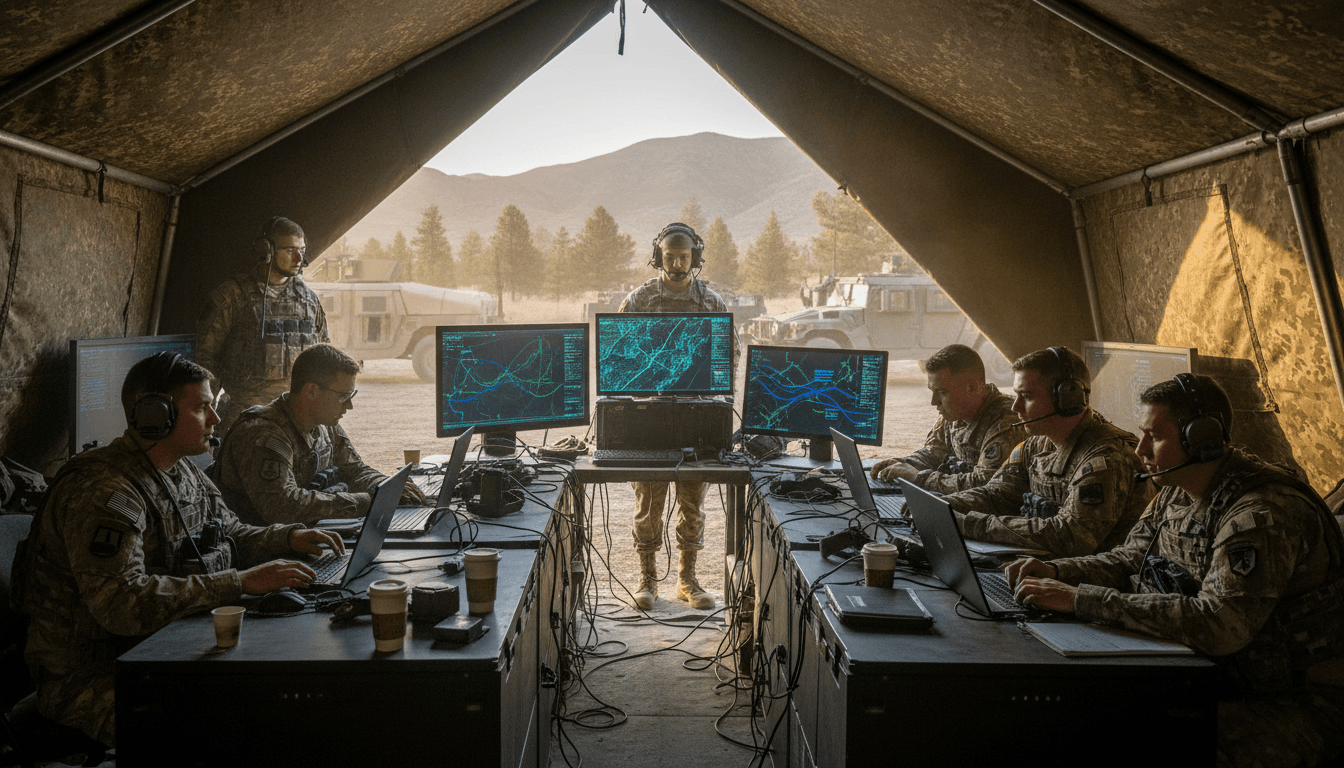
A modern command post can have more screens than people. The hard part isn’t collecting data—it’s turning scattered inputs into decisions fast enough to matter.
That’s why the Army’s second field test of its Next-Generation Command and Control (NGC2) prototype is a bigger signal than it looks. Yes, it’s another exercise at Fort Carson. But the real story is how the Army is trying to build C2 now: short cycles, frequent fielding, constant feedback, and an architecture designed to keep absorbing new AI-enabled capabilities instead of freezing them in place.
In this installment of our AI in Defense & National Security series, I’m going to take a stance: iterative C2 testing is the only realistic path to trustworthy AI in operational command and control. If you want AI that helps commanders, you have to build the system like a living product—then stress it in the field until it either earns trust or gets redesigned.
Why the second NGC2 field test matters
This test matters because it’s aimed at the most expensive failure mode in warfare: slow coordination between “seeing,” “deciding,” and “shooting.” The Army is using the Ivy Sting events to pressure-test whether a new C2 stack can speed up planning, commander updates, and—most importantly—execution.
A key scenario in the latest exercise focuses on deconflicting airspace before fires. That sounds narrow, but it’s a perfect proxy for what AI-enhanced command and control is supposed to do:
- Synchronize many moving pieces (air, ground, fires, logistics)
- Catch conflicts early (routes, timings, authorities, safety constraints)
- Keep updates flowing as conditions change
- Reduce the time between intent and action
If the system can’t handle airspace deconfliction under realistic conditions, it won’t handle the broader mission threads that commanders care about.
The real deliverable isn’t “software”—it’s tempo
Most organizations talk about “modernization” like it’s a feature list. C2 modernization isn’t. It’s operational tempo.
When vendors and program offices discuss “shortening the time to conduct fires,” they’re talking about shaving minutes from a cycle that used to take far longer. Minutes translate into survivability, position advantage, and fewer friendly-force workarounds.
For AI, tempo is also a forcing function: if the system has to operate at speed, it can’t rely on fragile manual processes or hero operators who know every workaround.
AI in C2: what’s actually useful (and what isn’t)
AI in command and control works when it reduces cognitive load without hiding the why. The commanders and staff don’t need “more intelligence.” They need fewer surprises.
In practical terms, the most valuable AI-enabled C2 functions tend to fall into a few buckets.
1) Conflict detection and deconfliction
This is where AI earns its keep early. Not by “deciding” for commanders, but by:
- Flagging airspace, fires, and route conflicts
- Identifying timing collisions (e.g., two units using the same corridor)
- Monitoring constraint violations (ROE, FSCMs, restricted zones)
- Suggesting candidate resolutions (not forcing one)
A good pattern is: AI proposes, humans dispose—with a clear audit trail.
2) Data fusion that doesn’t melt down in the real world
Field environments punish assumptions:
- Networks degrade.
- Feeds go stale.
- Units report late, differently, or not at all.
So the AI problem isn’t “can we fuse data?” It’s can we fuse data with known uncertainty and show that uncertainty to users.
If the system acts confident when it’s actually guessing, trust collapses—and operators go back to whiteboards and chat threads.
3) Predictive logistics and readiness insights
The RSS source notes logistics awareness components being brought in through partners. That’s not a side quest; it’s central.
Here’s what tends to matter in real C2:
- Which platforms will be down in 24–72 hours without parts
- Which resupply routes are likely to fail due to terrain, threat, or congestion
- Which units will hit fuel/ammo limits first given current tempo
If you’re working leads in defense tech, this is a real opportunity area: AI that is boring, dependable, and measurable tends to get adopted.
The shift: from “big bang” acquisitions to sprint-driven field learning
The NGC2 approach signals a deliberate move away from “build it perfectly, field it once” toward continuous delivery. That’s not a Silicon Valley cosplay. It’s a practical response to two realities:
- The threat environment evolves faster than traditional multi-year software baselines.
- AI models, data pipelines, and user workflows need iteration to become reliable.
The plan to align field events with something like a software sprint is the right instinct. It increases the odds that the system reflects how units actually operate.
What iterative development fixes (that documents never will)
I’ve found that software programs fail less from bad intentions and more from unexamined assumptions. Iteration exposes assumptions fast:
- Workflow assumptions: “The staff will update X every hour.” Will they, under load?
- Data assumptions: “We’ll always have feed Y.” What happens when Y drops?
- Interface assumptions: “Users will navigate three menus.” Not during contact.
- Authority assumptions: “Approvals happen in sequence.” Reality is parallel and messy.
When you field early and often, you stop arguing in conference rooms and start learning from behavior.
Security, governance, and the uncomfortable truth about AI-enabled C2
AI-ready C2 systems live and die on data governance and cybersecurity.
A recent controversy around early security concerns (raised in a memo and later described as resolved) highlights a dynamic you should expect to repeat across DoD AI programs:
- Rapid prototyping pushes capability forward.
- Security teams see new attack surfaces and missing controls.
- Program teams feel pressure to keep momentum.
- Leadership has to force tight collaboration instead of paperwork ping-pong.
“Ship fast” doesn’t excuse weak cyber—so build cyber into the sprint
For AI-enabled command and control, a realistic security posture includes:
- Zero trust principles applied to users, services, and devices
- Role-based access controls aligned to operational roles (not org charts)
- Provenance and logging for data and model outputs
- Model/input hardening against data poisoning and prompt-style manipulation
- Continuous vulnerability testing because the system is continuously changing
The hard part is cultural: cybersecurity can’t be the team that shows up at the end and says “no.” In iterative C2, cyber has to be a first-class participant in each increment.
Data governance is the make-or-break layer
C2 isn’t a single dataset. It’s a federation of feeds, reports, plans, overlays, permissions, and historical traces.
If you’re integrating AI, you need crisp answers to questions like:
- Who owns each data stream?
- What’s the policy for retaining and sharing?
- How do we label confidence and timeliness?
- How do we prevent “shadow truth” where different cells see different versions?
When data governance is sloppy, AI becomes a very expensive way to amplify inconsistencies.
Designing NGC2 for an ecosystem (not a single prime)
One of the most forward-leaning ideas in the RSS source is the push to onboard many partners over time—and not assume the same solution is best forever.
This is exactly right for AI in defense:
- Models improve rapidly.
- Sensors change.
- Compute options shift (edge vs. cloud vs. tactical servers).
- New mission threads appear.
A C2 architecture that can’t adopt new components becomes obsolete long before the hardware wears out.
What “open” should mean in practice
In defense procurement, “open” can become a slogan. For AI-enabled C2, it should mean measurable engineering traits:
- Well-defined APIs for data ingest, tasking, and dissemination
- Modular services so one capability can be swapped without breaking everything
- Portable deployment patterns (tactical, disconnected, degraded)
- Clear evaluation gates so new AI tools prove value before scaling
This creates a competitive pressure that helps the Army: vendors have to keep earning their place.
What leaders should measure during field tests
Field tests can produce a lot of anecdotes and not enough evidence. If you want AI-enhanced command and control to mature, measure outcomes that map to operations.
Here are metrics that translate well from exercise to acquisition decisions:
- Time-to-deconflict: from initial plan to conflict-free, approved coordination
- Time-to-update: how long it takes for a change in the field to reflect in the common operating picture
- Decision latency: time between cue and commander-approved action
- Error rate under stress: wrong overlays, stale tracks, misrouted messages
- User trust signals: how often humans accept, modify, or reject AI suggestions
- Degraded-mode performance: what still works when bandwidth drops or a data feed disappears
If the Army and industry partners align around these, iteration becomes disciplined rather than chaotic.
Actionable takeaways for defense AI teams (and buyers)
If you’re building, integrating, or buying AI for military command and control, the NGC2 approach offers a few clear lessons.
- Build for “messy truth,” not perfect data. Confidence, timeliness, and provenance should be visible in the UI.
- Treat deconfliction as a flagship AI use case. It’s concrete, measurable, and operationally meaningful.
- Make cybersecurity a sprint deliverable. Security controls must ship alongside features.
- Design for partner churn. Assume components will be replaced; make that safe and routine.
- Instrument everything. If you can’t measure improvements in tempo and error rates, you can’t defend scaling decisions.
Where this heads next for AI in Defense & National Security
The deeper pattern is hard to miss: C2 is becoming a software-defined battlefield layer, and AI is the mechanism that keeps it usable as complexity rises. The Army’s repeated, rapid field tests aren’t a side detail—they’re the only way to make AI credible in command posts where operators are rightly skeptical.
If you’re evaluating AI for defense operations, here’s the question I’d keep on the table: Can this system keep improving in the field without breaking trust, security, or interoperability? That’s what NGC2 is really testing.
If you want help translating these lessons into an acquisition-ready AI roadmap—use cases, metrics, security gates, and an integration plan that survives real operational constraints—reach out. The teams that win in 2026 won’t be the ones with the flashiest demo. They’ll be the ones who can ship, learn, harden, and repeat.