Ukraine’s drone war shows why US AI readiness depends on contested testing, cheap autonomy, and faster update loops. See what to do in 2026.
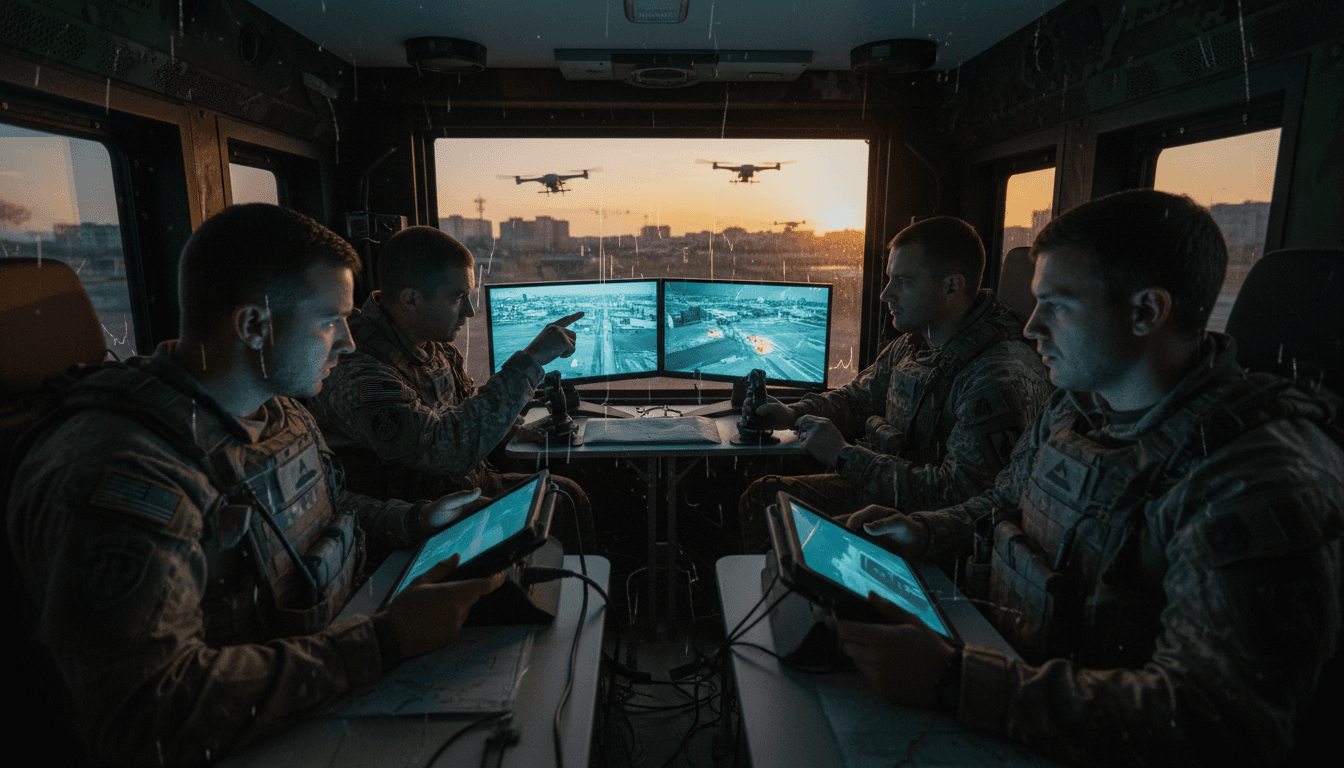
Ukraine’s Drone Lessons Are Forcing US AI Readiness
A modern combat drone isn’t “advanced” because it has stealth shaping or a long range. It’s advanced because it keeps working when the spectrum is hostile, navigation is denied, comms are intermittent, and the target picture changes every minute.
That’s the uncomfortable lesson Ukraine has been teaching—sometimes directly, sometimes by necessity as U.S. systems show up and struggle under Russian electronic warfare. The U.S. military is responding. You can see it in the Pentagon’s renewed appetite for cheap, testable, disposable systems and the growing acceptance that failures in training and exercises aren’t embarrassing—they’re data.
This post is part of our AI in Defense & National Security series, and the AI angle is straightforward: autonomy and AI-enabled ISR only matter if they’re trained, tested, and updated in conditions that look like the real fight. Ukraine is providing the closest thing the U.S. has to a live catalog of modern warfare problems—and a fast feedback loop for fixing them.
The real lesson from Ukraine: mass beats exquisite
The core takeaway is simple: scale wins when air defenses, jamming, and attrition are the default. A drone that costs tens of thousands and can be produced by the thousands changes planning math in a way a handful of exquisite platforms can’t.
Defense reporting in early December highlighted U.S. fielding and testing of the Low-Cost Unmanned Combat Attack System (LUCAS)—a one-way attack drone modeled on recovered Shahed-136 wreckage. The point isn’t that the U.S. “copied” a design. The point is what that design represents: a weapon class where volume, iteration speed, and operational learning matter as much as raw performance.
A U.S. Army air and missile defense commander recently noted how quickly this threat evolved—citing the plausibility of hundreds of one-way attack drones in a 24-hour period. Whether the exact number is 500 or 600 in a day, the implication is the same: defense can’t rely exclusively on expensive interceptors and carefully scheduled sorties. The force needs repeatable, affordable effects.
Why this is also an AI story
Mass drone warfare turns into an AI problem the moment humans can’t keep up with:
- Target prioritization across swarms, decoys, and mixed payloads
- Sensor fusion from noisy ISR feeds (EO/IR, RF, acoustic) in cluttered environments
- Autonomous navigation when GPS is degraded or spoofed
- Dynamic mission re-tasking when comms are intermittent
If your concept of operations assumes pristine links and clean GPS, your AI roadmap is fantasy.
“Fail fast and cheap” is only useful if you’re capturing the right data
Cheap drones enable experiments. That’s the upside. The downside is that experimentation becomes theater if failures don’t translate into design changes, software updates, and training revisions.
Reporting around LUCAS testing and deployments suggests something important culturally: a willingness to accept crashes, misfires, and off-course events as part of learning. That’s healthier than the old model—where systems were “validated” through scripted tests and then surprised in theater.
Here’s what works in practice (and what I’ve seen teams get wrong): the value isn’t the test—it’s the pipeline behind the test.
A practical “learning loop” the U.S. needs to institutionalize
For autonomy-heavy systems, modernization should look like an operational ML loop:
- Instrument everything (flight logs, EW conditions, GNSS status, packet loss, operator actions)
- Tag events fast (what failed, where, under what conditions)
- Retrain or re-tune models and autonomy logic based on real-world distributions
- Red-team the update against realistic jamming and deception
- Re-field quickly with a controlled software update process
When people say “AI in defense,” they often mean algorithms. In the field, it’s mostly data engineering, test realism, and release discipline.
Snippet-worthy truth: AI-enabled autonomy is a supply chain—data in, updates out—not a one-time procurement.
Electronic warfare is the gatekeeper for AI-driven ISR and autonomy
One of the sharpest points in the source reporting is that the U.S. lacks enough places to test drones against Russian-level electronic warfare because jamming can interfere with civilian communications. That constraint sounds mundane. It’s actually foundational.
If you can’t realistically simulate spectrum denial, you can’t validate:
- Visual navigation and terrain-relative positioning when GNSS fails
- Resilient mesh networking across small UAVs
- Onboard perception when video links degrade
- RF sensing and geolocation under active deception
The result is predictable: drones that fly well at a permissive U.S. range become unreliable where it counts.
The Ukraine “duds” problem isn’t a Ukraine problem
The article referenced a pattern Ukrainian operators have complained about: some Western drones arrive and don’t perform under jamming. A well-publicized example involved small UAS that struggled in contested EW, pushing vendors to pursue improvements for disconnected or contested environments.
That’s not a condemnation of U.S. industry. It’s a condemnation of unrealistic test environments and acquisition processes that reward powerpoint readiness over operational readiness.
If the U.S. wants AI-driven ISR to matter in peer conflict, it needs to build (or designate) pathways for:
- Licensed spectrum-denial testing at scale
- GNSS spoofing and meaconing ranges with safety guardrails
- Repeatable EW “profiles” so results are comparable across vendors
Without those, autonomy claims are marketing.
Ukraine is prototyping the future: low-cost interceptors and frontline manufacturing
Ukraine isn’t just producing one-way attack drones. It’s also demonstrating the shape of the defense:
- Interceptor drones built to down incoming one-way threats
- Frontline-adjacent 3D printing and rapid assembly
- Continuous battle damage assessment (BDA) feeding design iteration
This is what “modern air defense” is drifting toward: layered, cheap, plentiful, with expensive missiles reserved for the threats that truly require them.
Where AI fits in counter-drone defense
Counter-UAS at scale becomes impossible without automation. Not because humans aren’t capable, but because the timeline is compressed.
AI helps most in three places:
- Detection and classification: distinguishing birds, decoys, quadcopters, and one-way munitions
- Track correlation: keeping a coherent picture when sensors disagree
- Engagement optimization: choosing the cheapest effective interceptor (EW, net, gun, drone-on-drone)
The best counter-drone AI systems aren’t mysterious. They’re disciplined engineering: clear thresholds, robust sensor inputs, careful human-on-the-loop controls, and constant retraining from field data.
The partnership gap: Ukraine as a test partner, not a free lab
One of the most damning observations in the reporting is the claim that some U.S. companies ask Ukrainian frontline units to test systems, without offering much in return—treating them like unpaid interns.
That’s not just ethically questionable. It’s strategically stupid.
If Ukraine is the proving ground for contested autonomy, the U.S. should treat collaboration like a real program:
- Paid test support for Ukrainian units providing operational evaluation
- Shared data standards for BDA, EW conditions, and failure modes
- Joint iteration cells (U.S. engineers + Ukrainian operators) to shorten fix cycles
- Clear IP and security frameworks so companies aren’t paralyzed by legal risk
The reporting suggests some European partners have been more active in recognizing this value. The U.S. can’t afford to be the slow learner—especially when drone warfare lessons are immediately transferable to other theaters.
The political reality: trust is a capability
The article also points to shifting political winds and how that uncertainty can chill deeper cooperation. That matters in a very operational way.
Modern autonomy depends on:
- Data sharing (performance, failures, EW signatures)
- Rapid software updates across borders
- Long-term commitments to co-production and sustainment
If partners don’t trust the relationship, the learning loop breaks. And without the learning loop, AI readiness becomes a slide deck.
What defense leaders should do in 2026 to operationalize these lessons
If you’re responsible for AI in defense—whether in a program office, an operational unit, or a defense tech company—here’s a concrete checklist worth stealing.
1) Define “AI-ready” as resilient in denied conditions
Write it down in requirements: degraded GPS, intermittent comms, active jamming, and deceptive targets. If it’s not a contractual requirement, it won’t be built.
2) Fund test ranges that look like peer conflict
The U.S. needs more than occasional exercises. It needs persistent contested-spectrum environments with repeatable EW profiles and safe governance.
3) Treat software updates as operational sustainment
For autonomous systems, the sustainment model is:
- continuous retraining and tuning
- frequent, controlled field updates
- telemetry-driven QA
Procurement that assumes “field it and forget it” will fail.
4) Build “operator-to-engineer” feedback into the program
Ukraine’s advantage is often organizational, not just technical: operators talk to builders quickly. U.S. programs should force that connection through embedded teams and incentives.
5) Buy for numbers—and train for attrition
Stockpiles, spares, and manufacturing capacity matter. Training should assume losses and teach units to reconstitute quickly.
One-liner to remember: If your drone program can’t survive jamming and attrition, it’s not modern—no matter how smart the AI is.
Where this goes next for AI in Defense & National Security
Ukraine’s ongoing fight has become a harsh benchmark for what works in modern warfare: cheap autonomy, rapid iteration, realistic testing, and resilient operations under EW.
The U.S. is catching up in pockets—through field experiments, new low-cost platforms, and more tolerance for failure during testing. But catching up “for now” depends on whether the U.S. turns Ukraine’s lessons into a durable modernization engine: contested test infrastructure, real co-development partnerships, and acquisition rules that reward learning speed.
If you’re building or buying AI-enabled ISR, autonomy, or counter-drone systems, the next step is simple: pressure-test your assumptions against the Ukraine benchmark. Where does your system break—GPS, comms, perception, or ops workflows—and how fast can you push an update?
The next year will separate teams that treat AI as a feature from teams that treat it as a combat-ready capability. Which side is your program on?