AI-powered OSINT scales collection and triage, but tradecraft keeps it trustworthy. Learn how defense teams manage attribution, provenance, and verification.
AI-Powered OSINT Tradecraft for Defense Teams
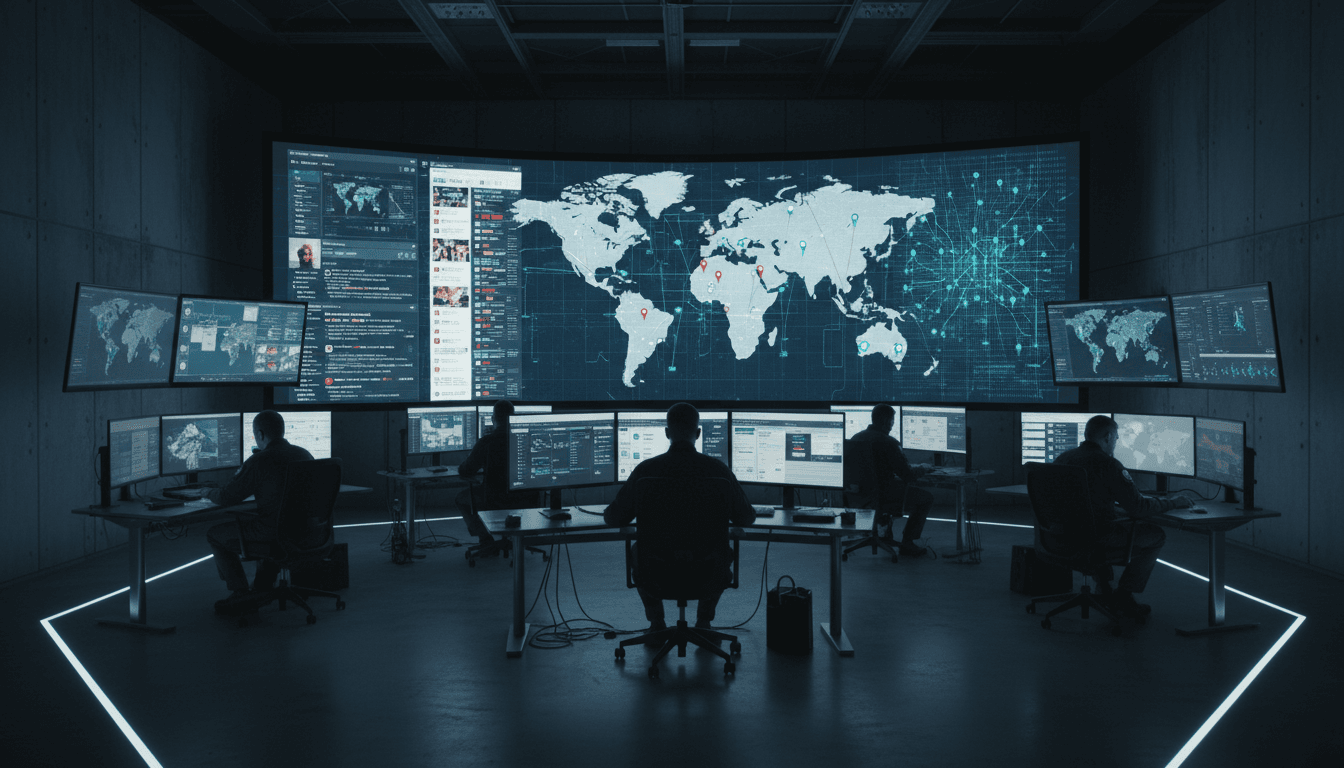
The OSINT teams doing real work in 2025 aren’t “searching the internet.” They’re running collection pipelines that behave more like ISR tasking than casual research: they collect at scale, manage risk and attribution, preserve provenance, and still insist on one thing that tech can’t replace—human judgment.
That shift matters for defense and national security leaders because open-source intelligence now feeds decisions that used to rely on classified channels: early warning, targeting support, force protection, influence analysis, sanctions enforcement, and mission planning. If your OSINT program isn’t built to handle speed, volume, and deception, it won’t just be slow—it’ll be wrong.
What follows is a practical look at the tech and tradecraft behind modern OSINT, with a clear throughline: AI helps you scale and triage, but tradecraft keeps you accurate, attributable, and operationally safe.
OSINT in 2025: surveillance-grade scale, courtroom-grade rigor
Modern OSINT is defined by a simple tension: you need to move fast enough to matter and be rigorous enough to trust. The fastest way to lose credibility in a national security environment is to show up with a screenshot and a story—without provenance, without collection notes, and without a defensible chain of custody.
The more OSINT informs real operations, the more it has to look like “serious intelligence,” including:
- Repeatable collection (not one-off browsing)
- Attribution control (protecting the collector and the organization)
- Provenance and integrity (what was collected, when, how, and from where)
- Analytic transparency (what the model did vs. what the analyst concluded)
Here’s the stance I take: OSINT should be treated as a production system, not a research hobby. That doesn’t mean every team needs a massive platform. It means your process needs guardrails.
Why this matters now (and why December is a trap)
By late December, many organizations run lean due to leave schedules—yet adversaries don’t pause campaigns for the holidays. That creates a predictable gap: fewer analysts monitoring, slower approvals, and more reliance on automation. If you’re using AI for triage or alerting, this is the time of year when false positives and silent misses do the most damage.
A resilient OSINT capability anticipates that operational rhythm:
- Automate collection and first-pass triage
- Preserve evidence automatically
- Keep escalation paths simple
- Ensure an on-call analyst can verify quickly
The tradecraft problem: attribution, access, and adversarial deception
The “open” in open-source intelligence is misleading. The data may be publicly accessible, but the environment is hostile:
- Platforms fingerprint users and throttle suspicious behavior
- Adversaries plant decoys and contaminated narratives
- Communities detect observers and retaliate
- Synthetic media and coordinated inauthentic behavior muddy signals
Attribution management isn’t paranoia—it’s table stakes
If your analysts are collecting sensitive OSINT from personal browsers, on corporate networks, or with leaky browser profiles, you’re creating operational risk. Attribution isn’t just about “being anonymous.” It’s about controlling what a target can infer:
- Who you are (org affiliation, location, patterns)
- What you care about (queries, watchlists, repeated visits)
- What you can reach (network characteristics, installed fonts/plugins)
Good tradecraft assumes the other side is watching. Great tradecraft assumes they’re learning.
Access has become its own capability
A growing portion of high-value OSINT is:
- Behind logins
- Behind paywalls
- In ephemeral stories/live streams
- In niche forums or invite-only communities
- In regions where access varies by geography
That means OSINT programs need policies for legal and ethical access, and technical approaches that reduce the temptation for analysts to “just use their personal account.” If leadership doesn’t provide safe ways to access data, people will improvise. Improvisation is how breaches happen.
AI’s real role in OSINT: scale, triage, and patterning
AI doesn’t replace OSINT analysts. It replaces the parts of OSINT that waste analyst time.
Used well, AI turns OSINT into something closer to a modern sensor system:
- Collect continuously
- Detect anomalies
- Cluster related events
- Prioritize what humans should review
Where AI performs well
1) Entity extraction and resolution AI can pull names, units, equipment types, locations, and organizations from messy text—and then help resolve duplicates (the same actor using multiple aliases). This is especially useful for sanctions, counter-proliferation, and transnational threat finance.
2) Multilingual processing at speed Machine translation plus language models can triage across many languages quickly. The win isn’t “perfect translation.” The win is routing: sending the right items to the right regional analyst before the window closes.
3) Computer vision for geospatial and imagery OSINT Vision models can spot recurring objects (vehicles, aircraft silhouettes, uniforms, insignia), detect scene changes, and help tag imagery for later retrieval. Pair that with satellite imagery workflows and you get faster leads—if you verify correctly.
4) Network and narrative analysis Graph approaches—assisted by AI—help identify amplification networks and coordinated behavior. For influence operations, this is often more valuable than individual posts.
Where AI fails (and will keep failing)
1) Truth determination Models generate plausible narratives. They don’t “know” what happened. In OSINT, plausibility is the enemy. You need corroboration, not coherence.
2) Adversarial contamination If your workflow doesn’t separate collection from analysis, you’ll end up training analysts to trust model outputs that were shaped by manipulation. This is a human-factors failure as much as a technical one.
3) Citation and provenance gaps If a model summarizes without preserving exact sources, timestamps, and captures, you can’t defend the assessment later—internally, legally, or operationally.
Snippet-worthy rule: AI is great at finding needles. Tradecraft is what keeps you from grabbing a thumbtack.
Provenance and integrity: the difference between “found online” and “usable intel”
If OSINT informs mission planning, you need to treat evidence like it might be scrutinized later by:
- commanders and staff
- lawyers and oversight bodies
- partner nations
- incident response teams
That scrutiny is where many OSINT programs fall apart.
What “preserve provenance” actually means
At minimum, every collected item should be captured with:
- Timestamp (collection time, not just post time)
- Source context (platform, channel, thread, surrounding content)
- Collector context (method used, access path)
- Integrity controls (hashing, immutable storage, audit trail)
For volatile content (deleted posts, edited pages, disappearing stories), teams should prioritize immediate capture. If you can’t prove what you saw and when you saw it, your “intel” becomes a rumor with nicer formatting.
A practical workflow that holds up under pressure
A defensible OSINT workflow looks like this:
- Tasking: define the intelligence question and decision deadline
- Collection: automated + manual, with attribution-safe access
- Preservation: capture, hash, store, and log metadata
- Triage: AI-assisted clustering, deduping, prioritization
- Verification: cross-source corroboration, geolocation checks, timeline sanity
- Assessment: analyst judgment, confidence level, and alternatives
- Dissemination: decision-ready brief + supporting evidence package
If you’re missing steps 3 or 5, you’re not doing OSINT—you’re doing content monitoring.
Human judgment stays central—here’s how to protect it
The best OSINT teams build systems that amplify analysts without dulling their instincts. That requires deliberate design.
Build “human-in-the-loop” where it counts
Not every step needs a human. Verification does. The trick is choosing the handoffs:
- Let AI score and cluster incoming items
- Require human verification before escalation to leadership
- Require a second set of eyes for high-impact assessments
This approach reduces analyst burnout (constant noise) while preserving accuracy (no model-only conclusions).
Train analysts to argue with the machine
I’ve found the healthiest OSINT cultures treat model output as a junior analyst who’s fast, confident, and sometimes wrong.
Make it normal to ask:
- What would falsify this?
- What’s the simplest alternative explanation?
- Is this source known for manipulation?
- Does this timeline make physical sense?
Reduce “model hallucination risk” with structured outputs
If you use generative AI for summaries, require:
- quoted excerpts from sources
- clear separation between “observed” and “inferred”
- confidence ratings tied to corroboration count (for example: 1 source vs. 3+ independent sources)
The goal isn’t perfection. The goal is traceability.
What defense leaders should ask before funding (or trusting) OSINT + AI
If you’re a director, commander, PM, or security leader evaluating OSINT capabilities, these questions reveal maturity fast:
- Attribution: How do analysts access sensitive spaces without exposing identity, org, or mission interest?
- Scale: What’s the daily ingest volume, and what portion is automated vs. manual?
- Provenance: Can you produce an evidence package with timestamps, context, and integrity logs?
- Verification: What are your corroboration standards and escalation thresholds?
- AI governance: Where is AI allowed to summarize or prioritize, and where is it prohibited from making judgments?
- Auditability: Can you reconstruct who saw what and why a conclusion was made?
- Resilience: What happens during surge events, platform outages, or holiday staffing gaps?
These aren’t “nice-to-haves.” They’re the difference between OSINT that informs operations and OSINT that creates risk.
People also ask: OSINT, AI, and mission planning
Can open-source intelligence support mission planning?
Yes—when it’s collected and verified with discipline. OSINT often provides context and patterning (routes, schedules, local sentiment, infrastructure changes) that complements classified sources and reduces surprise.
What’s the biggest OSINT risk in military and defense environments?
Two risks dominate: attribution exposure (putting people and missions at risk) and unverified claims (driving decisions from manipulated content). Both are preventable with process and tooling.
How does AI help with OSINT analysis?
AI helps most with triage, translation, clustering, entity extraction, and anomaly detection. It helps least with truth and intent, which depend on verification and context.
Where OSINT is heading in 2026: more automation, more deception, higher standards
OSINT is becoming a first-class input to national security decision-making, which means standards will rise. Expect three changes:
- Automation becomes default: continuous collection and alerting will be expected, not admired.
- Deception becomes ambient: synthetic personas, AI-generated imagery, and coordinated campaigns will be routine.
- Provenance becomes non-negotiable: leadership will demand evidence packages that can survive internal scrutiny.
The organizations that win won’t be the ones with the flashiest AI demos. They’ll be the ones that treat AI as part of a disciplined OSINT tradecraft stack—safe access, scalable collection, preserved provenance, and analysts who know when to trust and when to challenge.
If you’re building your AI in Defense & National Security roadmap for 2026, OSINT is the practical place to start because it forces the hard questions early: how you collect, how you verify, and how you prove it.
If your OSINT program had to brief a commander tomorrow with evidence attached, what part of your pipeline would you worry about most?