AI can’t create peace, but it can verify it. See how AI supports monitoring, compliance, and security in a Ukraine–Russia settlement framework.
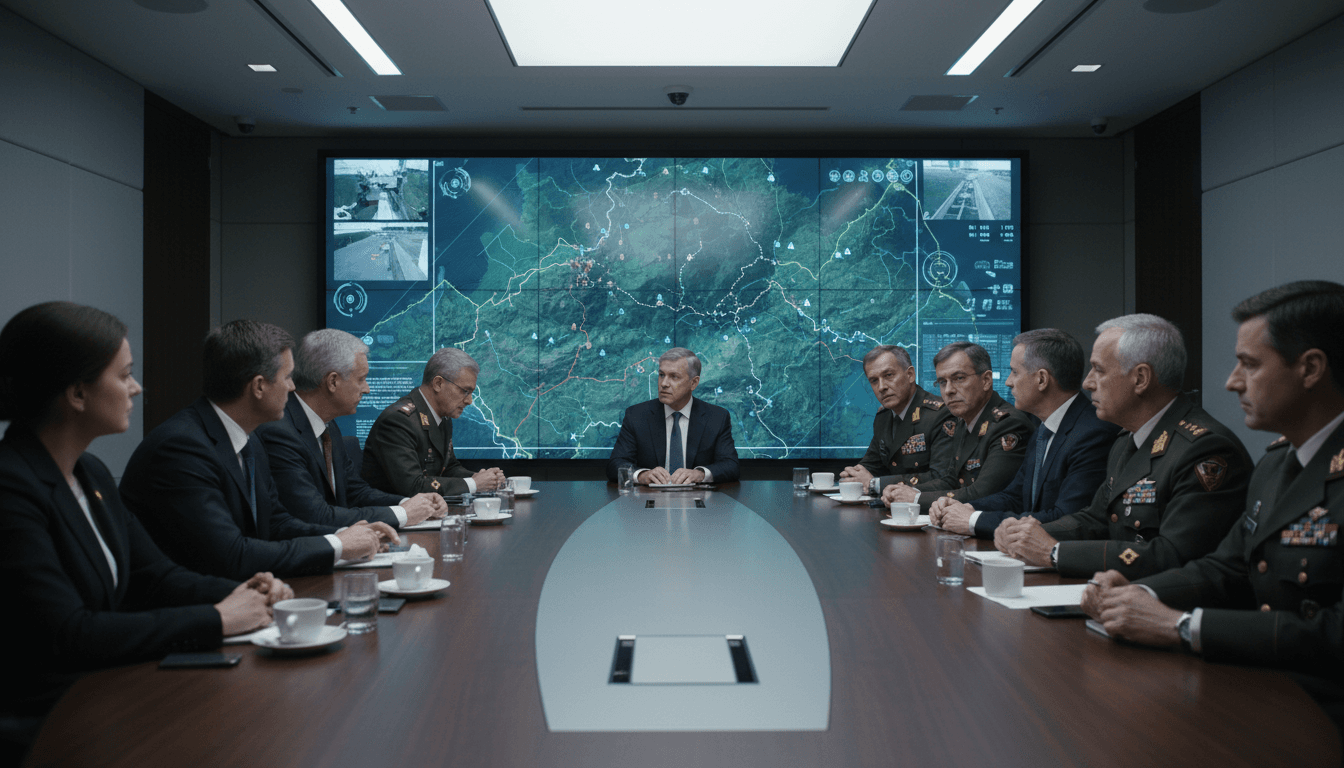
AI for Verifying a Ukraine–Russia Peace Settlement
A ceasefire isn’t a peace deal. It’s a systems problem: who moves what, where, when, and how anyone proves it happened. The more fragile the truce, the more every ambiguity becomes a pretext for escalation.
That’s why Ryan Evans’ proposed 15-point framework for a Ukraine–Russia settlement is useful even if you disagree with parts of it. It treats peace as something you implement, not just announce. And from the perspective of our “AI in Defense & National Security” series, it points to a practical question policymakers and defense leaders should be asking right now: What would it take to monitor, verify, and enforce a settlement at scale—without betting everything on trust?
My view: if a negotiated settlement ever becomes real, AI won’t create peace. But it can make peace harder to fake, cheaper to verify, and faster to stabilize—especially in the first 90 days when ceasefires typically break.
The hard truth: peace plans fail at the “proof” layer
Most peace proposals spend their political capital on outcomes—borders, sovereignty language, security guarantees. Then they bolt on implementation with vague phrases like “international monitors” and “verification mechanisms.” That’s backward.
Evans’ 15 points focus heavily on structure: demilitarized zones, reciprocal force ceilings, monitoring missions, dispute commissions, and phased sanctions relief tied to compliance. That’s the right direction because the real failure mode of ceasefires is predictable:
- Small violations get denied.
- Attribution becomes contested (“it wasn’t us”).
- Retaliation follows.
- Hardliners claim diplomacy is naïve.
AI is most valuable in this “proof” layer—where you need persistent sensing, rapid triage, and defensible reporting that multiple parties can accept.
What AI adds (and what it doesn’t)
AI doesn’t replace political judgment. It reduces uncertainty by:
- Fusing messy data (satellite imagery, ISR feeds, acoustic sensors, open-source reporting)
- Flagging anomalies (unexpected armor concentration, new fortifications)
- Producing time-stamped, auditable incident narratives for monitors
But AI can’t solve the core political choice Evans emphasizes: negotiations only start when the alternative looks worse. AI supports compellence and compliance; it doesn’t substitute for them.
Mapping the 15-point framework to AI-enabled enforcement
Evans’ plan clusters into four areas: security framework, territorial/political resolution, humanitarian/legal issues, and economics/verification. Here’s how AI can support each—specifically and realistically.
Security architecture: AI makes “demilitarized” measurable
A settlement that includes demilitarized zones, force ceilings, and withdrawals lives or dies on monitoring. The fastest way to collapse a ceasefire is to argue about whether a unit crossed a line or whether heavy weapons were actually pulled back.
AI-enabled monitoring for demilitarized zones
An effective monitoring stack blends multiple modalities:
- Satellite imagery analysis (change detection for trenches, revetments, vehicle parks)
- Ground-based radar and acoustic arrays (detecting artillery launches or drone swarms)
- UAS patrol patterns (high-frequency local verification)
- Open-source intelligence triage (geo-locating footage and correlating claims)
AI’s role is to prioritize human attention: flag the 2% of signals that matter and produce explainable evidence packets.
Verification that both sides can’t easily dismiss
If a settlement relies on a UN/OSCE-style mission, credibility depends on repeatability and chain of custody. AI systems should be designed around:
- Tamper-evident logs for sensor inputs and analytic outputs
- Model transparency (why the system flagged this site)
- Red-team testing against deception (decoys, spoofed metadata)
A useful one-liner for negotiators: “If it can’t be audited, it can’t be enforced.”
Ceasefire lines vs. sovereignty: AI can stabilize the “freeze” without legitimizing it
One of Evans’ most operationally smart points is separating the line of contact from legal sovereignty—freezing violence now while deferring final territorial status to a longer track.
That approach creates a technical requirement: you need to track the frozen line precisely, and you need a shared picture of incidents near it.
The “common operating picture” problem
In practice, a ceasefire produces competing maps:
- Each side’s military map
- The monitors’ map
- Public-facing maps used for messaging
AI can help generate a neutral, monitor-owned common operating picture by:
- Automatically extracting features from imagery (roads, berms, checkpoints)
- Detecting new construction in the buffer zone
- Estimating order-of-battle changes when units rotate
The key is governance: monitors must control the baseline data and publish standardized incident reports that are machine-assisted but human-signed.
Humanitarian commitments: AI can speed up reunification and POW exchange
Evans calls for all-for-all POW exchange and return of civilian detainees, plus a working group on reunifying families and children. That’s not just moral language; it’s a high-volume logistics and identity challenge.
AI can support humanitarian mechanisms through:
- Entity resolution across fragmented records (misspelled names, missing documents)
- De-duplication of registries to reduce fraud and confusion
- Prioritization models for urgent cases (medical risk, minors, separated families)
The risk is obvious: these datasets are sensitive and exploitable. Any AI used here must be paired with strict access controls, data minimization, and independent oversight. Peace processes are information wars too.
Sanctions relief and compliance: AI turns “phased” into enforceable
Evans argues sanctions relief should be phased and conditional. That’s exactly right, because instant relief removes leverage—and leverage is what keeps talks honest.
AI can make conditionality workable by translating treaty obligations into measurable signals:
- Has heavy equipment moved outside the agreed zone?
- Are prohibited missile types being staged?
- Are specific export-controlled components reappearing in supply chains?
What “AI sanctions compliance” looks like
In practice it’s not a single model; it’s a pipeline:
- Trade anomaly detection (unusual routing, shell entities)
- Network analysis on shipping/insurance/finance nodes
- Parts-forensics and pattern matching against recovered weapons components
This matters during a settlement because cheating is often gradual. AI is good at spotting slow shifts humans normalize over time.
Critical infrastructure and the Black Sea: cybersecurity is part of the ceasefire
Evans includes freedom of navigation in the Black Sea and protection of energy sites (including nuclear safety protocols). Those commitments collapse fast if ports, rail, power grids, or maritime systems are degraded.
A peace process creates a paradox: as kinetic fighting slows, cyber and sabotage become more attractive tools for shaping facts on the ground.
Where AI helps most: detection and resilience
- AI-assisted SOC operations for national infrastructure (faster detection of lateral movement)
- Automated correlation of OT/ICS anomalies (substations, rail signaling)
- Maritime domain awareness (AIS anomalies, spoofing detection, vessel intent modeling)
If you’re negotiating “freedom of navigation,” you also need to negotiate who investigates incidents and what digital evidence is admissible.
The biggest risk: AI becomes another contested weapon
Here’s the part many proposals miss: verification itself becomes a battlefield.
If one side claims the monitoring system is biased—or worse, compromised—then every finding becomes propaganda fuel. AI can intensify that risk because models can be opaque, and disinformation campaigns can target them.
Three design rules I’d insist on
- Human accountability is non-negotiable. AI flags; accredited monitors decide.
- Multi-source corroboration beats “one perfect sensor.” Redundancy reduces spoofing.
- Publish methodology, not just conclusions. If parties can’t understand the process, they won’t accept the outcome.
And a fourth, more political rule: verification must be structured so it doesn’t require either side to admit wrongdoing to de-escalate. That’s where Evans’ point about a standing dispute commission matters—AI can feed it, but the commission prevents escalation spirals.
A practical implementation plan for the first 90 days
If negotiations produced a ceasefire tomorrow, the window that matters most is the first three months. This is what an AI-supported implementation sprint should look like.
Day 0–30: establish baselines
- Create a monitor-owned baseline map of lines of contact and proposed buffer zones
- Register fixed sites: artillery storage, logistics hubs, air defense positions (as permitted)
- Stand up an incident taxonomy (what counts as a violation and how it’s scored)
Day 31–60: operationalize verification
- Deploy automated change detection on priority corridors
- Implement evidence packaging: timestamps, sensor provenance, analyst notes
- Create “rapid investigation cells” that combine imagery analysts, EW specialists, and legal advisors
Day 61–90: connect compliance to incentives
- Tie verified milestones to pre-agreed sanctions relief steps
- Publish routine compliance dashboards to reduce rumor-driven escalation
- Run adversarial testing against deception (decoys, spoofing, manipulated media)
This is where AI earns its keep: not by predicting peace, but by shrinking the space for bad-faith ambiguity.
What leaders should ask before they buy an “AI peace monitoring” pitch
If you’re evaluating vendors or internal programs, these questions cut through buzzwords fast:
- What’s the ground truth process? Who labels data and how is disagreement resolved?
- How does the system handle deception? Show tests with decoys and spoofed inputs.
- What’s the audit trail? Can an independent body reproduce the result?
- What happens when the model is wrong? What’s the escalation policy and fix cycle?
- Who owns the data? Especially humanitarian and critical infrastructure datasets.
If a proposal can’t answer these crisply, it’s not ready for a live ceasefire.
Where this leaves the 15-point approach
Evans is right about the sequencing: stop trying to impose final outcomes before you have a negotiation structure both sides can live with. He’s also right that compellence must be systemic, not episodic.
From the AI in defense and national security angle, the message is blunt: a settlement that can’t be monitored will be violated, and a settlement that can’t be verified will be argued into collapse. AI won’t fix political will, but it can make commitments measurable and disputes arbitrable.
If 2026 brings another reset in talks after winter realities set in, the teams that show up with an implementation-grade verification plan—not just talking points—will have the advantage. What would change if the next peace proposal came with a credible, auditable “proof layer” on day one?