Ukraine’s drone war is teaching the US how AI-ready modern warfare really is—data, EW realism, and fast iteration matter more than prototypes.
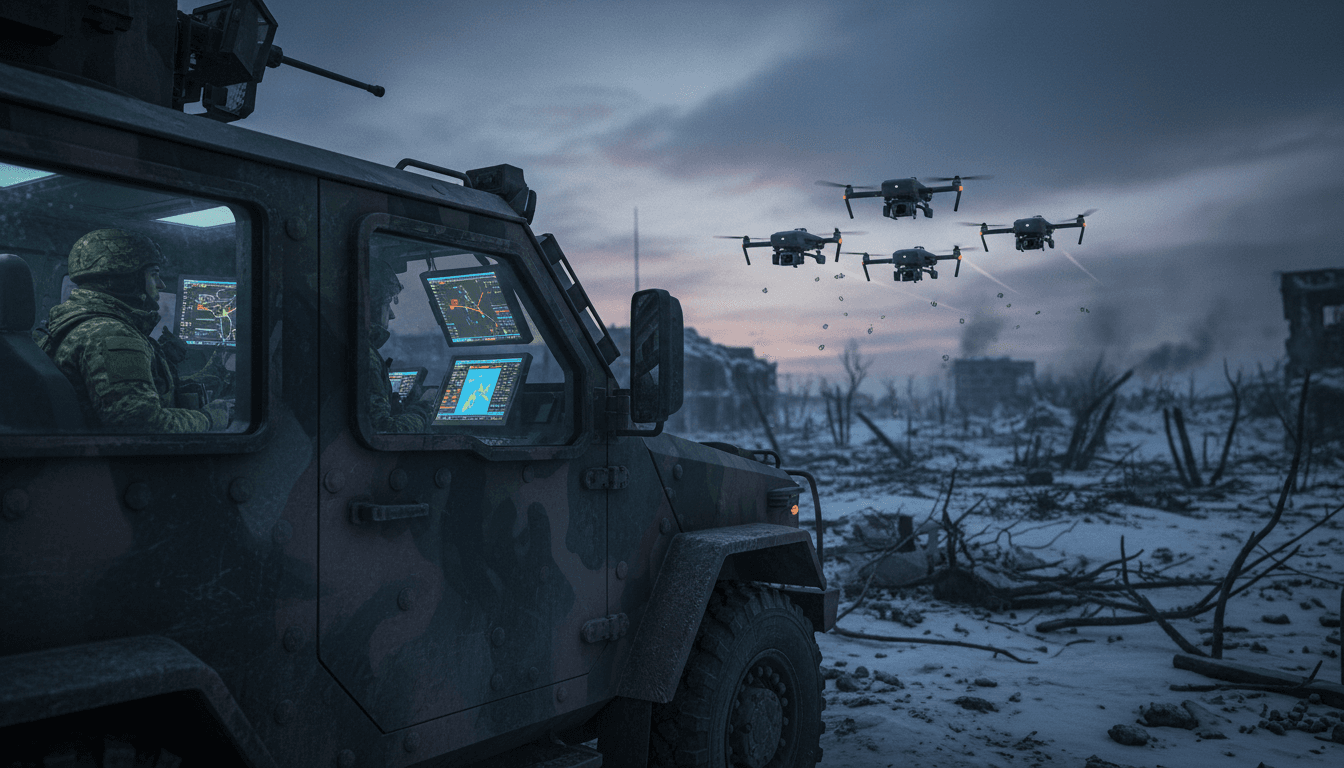
Ukraine’s Drone War Is Forcing US AI Readiness
A few years ago, the idea of launching 500–600 one-way attack drones in a single day sounded like a tabletop exercise. Now it’s a real operational benchmark—one that’s shaping how the U.S. military thinks about autonomy, electronic warfare, and the gritty logistics of building and replacing systems at scale.
Ukraine has become a live-fire lab for modern warfare, and not in a metaphorical way. It’s where drone swarms meet GPS jamming, where cheap interceptors compete with expensive missiles, and where iteration speed matters as much as exquisite performance. For the U.S., the uncomfortable truth is that Ukraine isn’t just receiving capability—it’s exporting lessons. The question is whether the U.S. can turn those lessons into repeatable, policy-backed modernization.
This post sits inside our “AI in Defense & National Security” series, and I’m going to take a clear stance: the U.S. doesn’t have an AI problem as much as it has a data-and-feedback problem. Ukraine shows what happens when feedback loops are tight, failures are tolerated, and battlefield data becomes an engineering input—not an after-action footnote.
Ukraine is a battlefield feedback engine—and AI thrives on it
Modern military AI improves when it’s fed real, messy operational data quickly. Ukraine’s advantage isn’t that it has “more AI.” It’s that the war forces rapid measurement: what flew, what broke, what got jammed, what target set changed, and what operators actually did under stress.
That feedback loop is exactly what AI systems need, whether you’re talking about:
- Perception models (detecting vehicles, artillery flashes, launch sites)
- Electronic warfare (EW) classification (what jammers are active, how patterns shift)
- Decision support (route planning, risk scoring for missions, target prioritization)
- Autonomy tuning (navigation, terminal guidance, swarm behaviors)
Ukraine’s drone ecosystem functions like a high-tempo product team: ship, test, break, patch, repeat. The U.S. tends to treat “test” as something you schedule and “fielding” as something you protect. That mismatch is why U.S. modernization often looks great in PowerPoint and shaky in contested environments.
The most valuable output isn’t the drone—it’s the telemetry
One overlooked detail from recent U.S. efforts modeled on Ukraine: systems like the Low-Cost Unmanned Combat Attack System (LUCAS) highlight a shift toward in-theater testing and iteration. Even when a platform is essentially a “threat emulator,” it’s still useful because it generates what the Pentagon often lacks: at-scale evidence.
For AI teams, evidence means:
- link drop rates
- inertial drift under jamming
- launch reliability stats
- failure modes by temperature, storage, handling
- operator workload and error patterns
If you can’t get that data—or you can’t move it from the edge back to engineering—you’re not “behind on drones.” You’re behind on learning.
The U.S. is learning fast—but the wrong bottleneck keeps showing up
The U.S. can build prototypes. The bottleneck is proving them in Russian-level electronic warfare and then turning results into procurement decisions. Ukraine is saturated with jamming, spoofing, and adaptation. That environment punishes systems built for permissive skies.
Reports from Ukraine have already shown what happens when you send capable drones into a contested spectrum without the right resilience: they become unreliable, expensive, and ultimately unused. One high-profile example was the struggle of some commercial-style drones amid heavy GPS jamming—an issue that forced vendors to revisit assumptions about connectivity and navigation.
Here’s what’s really going on: EW resilience isn’t a feature; it’s a design premise. If you assume GPS is available and comms are stable, you’ve already lost the fight you’re preparing for.
Why U.S. test culture clashes with AI-driven warfare
AI-enabled systems demand iteration. Iteration demands permission to fail. And failure demands ranges and policies that let you simulate real conditions.
The U.S. runs into a practical constraint that sounds mundane but is brutally decisive: you can’t freely jam like Russia does on many domestic test ranges because it interferes with civilian communications. That single constraint distorts everything downstream—what gets tested, what gets believed, and what gets bought.
Ukraine doesn’t have that luxury. Their “range” is the fight.
My opinion: until the U.S. creates lawful, realistic EW test corridors (and the governance to use them frequently), American autonomy programs will keep showing up late to the wrong exam.
Cheap drones changed the cost curve—AI changes the decision curve
Low-cost mass is now a core combat variable. Ukraine and Russia have turned one-way attack drones into a consumable. That changes both procurement math and operational math.
But here’s the AI angle that too many teams miss: when drones become consumables, the decision system becomes the scarce resource.
If you can launch thousands of systems, you still need to answer:
- Which targets matter right now?
- Which routes are survivable given current EW?
- Which strikes will produce second-order effects (air defense depletion, logistics disruption)?
- Which failures indicate adversary adaptation vs. simple hardware defects?
That’s where AI in defense strategy stops being an R&D topic and becomes a staff advantage. The winning organizations will be the ones that can convert ISR, EW sensing, battle damage assessment, and logistics signals into fast, defensible decisions.
“Fail fast and cheap” only works if you can measure fast
The phrase gets tossed around, but the operational version is specific:
- You deploy a new behavior or component.
- You see failure modes within days, not quarters.
- You capture and label the data.
- You push a fix into the next build cycle.
AI accelerates steps 2–4 when it’s designed into the pipeline:
- automated anomaly detection on telemetry
- model-based root cause suggestions (EW vs. nav vs. power)
- rapid simulation updates using field observations
If your drone program doesn’t have a data pipeline, you don’t have a learning system. You have hardware.
Ukraine’s counter-drone approach is a warning to U.S. acquisition
Ukraine is proving that cost-effective defense often beats exquisite defense. When an adversary sends waves of inexpensive drones, shooting them down with costly missiles can become a losing economic exchange—even if the intercept rate is high.
Ukraine’s experimentation with cheap interceptor drones points toward a defense model that looks more like:
- distributed sensors
- low-cost interceptors
- layered EW and kinetic effects
- rapid retasking based on real-time intelligence
This is exactly where AI and data analytics belong:
- sensor fusion to detect and track small drones in clutter
- automated target handoff from radar/acoustics/EO to interceptors
- predictive routing to place intercept assets where they’ll matter
- adversary pattern modeling to anticipate launch windows
Here’s the uncomfortable procurement message: if your defensive concept depends on limited inventories of premium interceptors, you’re betting against the cost curve.
The partnership problem: Ukraine can’t be your “unpaid test team”
Real cooperation requires mutual benefit, not opportunistic field testing. There’s a difference between learning from Ukraine and extracting from Ukraine.
Multiple observers have argued that broader U.S.-Ukraine defense industrial cooperation could enable faster sharing of:
- battle damage assessments
- EW signatures and adaptation patterns
- operator feedback on usability
- reliability data under field handling
That kind of sharing is gold for AI-driven modernization because it supports continuous improvement. But it’s also sensitive: it involves trust, governance, and predictable policy.
The trust gap has operational consequences
When political signals wobble, technical collaboration suffers. That’s not abstract. It affects whether Ukrainian units will take the risk of testing a foreign system, whether data will be shared promptly, and whether joint development plans survive leadership changes.
If the U.S. wants to learn at Ukraine’s tempo, it has to offer a real exchange:
- paid testing support and replacement stocks
- co-development pathways, not one-off pilots
- shared reference architectures (interfaces, data standards)
- clear export and IP frameworks
Otherwise, the U.S. will keep repeating a pattern: send gear, discover it underperforms in contested environments, and treat the lesson as a vendor problem instead of a systems problem.
What defense leaders can do in 90 days (practical steps)
AI adoption in national security improves fastest when organizations change their feedback loop mechanics. Here are concrete moves that don’t require a multi-year program rewrite.
-
Stand up a “contested environment scorecard” for drones and autonomy
- Minimum metrics: mission completion rate under jamming, nav drift, link recovery time, launch reliability, operator workload.
-
Treat EW realism as a requirement, not a nice-to-have
- If your test plan can’t represent GPS denial and comms degradation, the results shouldn’t be used for go/no-go procurement.
-
Build a battlefield-data-to-engineering pipeline
- Standardize how flight logs, video, EW observations, and maintenance notes are captured and labeled.
-
Adopt “open architecture” for autonomy where it matters
- Focus on swappable components: nav modules, comms, autonomy behaviors, sensor packages.
-
Create incentives for measured failure
- Reward teams for learning speed (time-to-fix, time-to-retest), not just “successful demos.”
These steps sound managerial because they are. Modern warfare is starting to look like software operations, and AI accelerates the organizations that already know how to operate.
People also ask: does AI make drone warfare autonomous?
Not in the way the internet argues about it. The most impactful AI in drone warfare right now often sits in three places:
- analysis (finding targets, spotting patterns, estimating damage)
- resilience (navigating uncertainty, adapting to degraded signals)
- coordination (tasking, deconfliction, routing, prioritization)
Full autonomy is less important than reliable performance in degraded conditions and faster decision cycles. Ukraine’s battlefield shows that humans still steer strategy—but machines increasingly shape what’s possible minute to minute.
Where this goes next for AI in Defense & National Security
The Ukraine conflict is forcing clarity: the future fight rewards learning speed, EW realism, and production-at-scale more than perfect prototypes. The U.S. is responding—testing cheaper drones, experimenting in theater, and paying more attention to open architectures—but the gap remains in turning those experiments into consistent capability.
If your organization is working on AI in defense—whether that’s mission planning, intelligence analysis, autonomous systems, or cybersecurity—this is the bar to measure against: Can your system learn under pressure, in the spectrum, at scale?
The next 12 months will likely bring even more emphasis on massed autonomous systems and counter-drone defenses across multiple theaters. The forward-looking question isn’t whether the U.S. can build drones. It’s whether the U.S. can build the learning machine that keeps them relevant once the adversary adapts.