AI mission planning can reduce the risk of strategic miscalculation by stress-testing assumptions, modeling coalition support, and tracking sustainability in long wars.
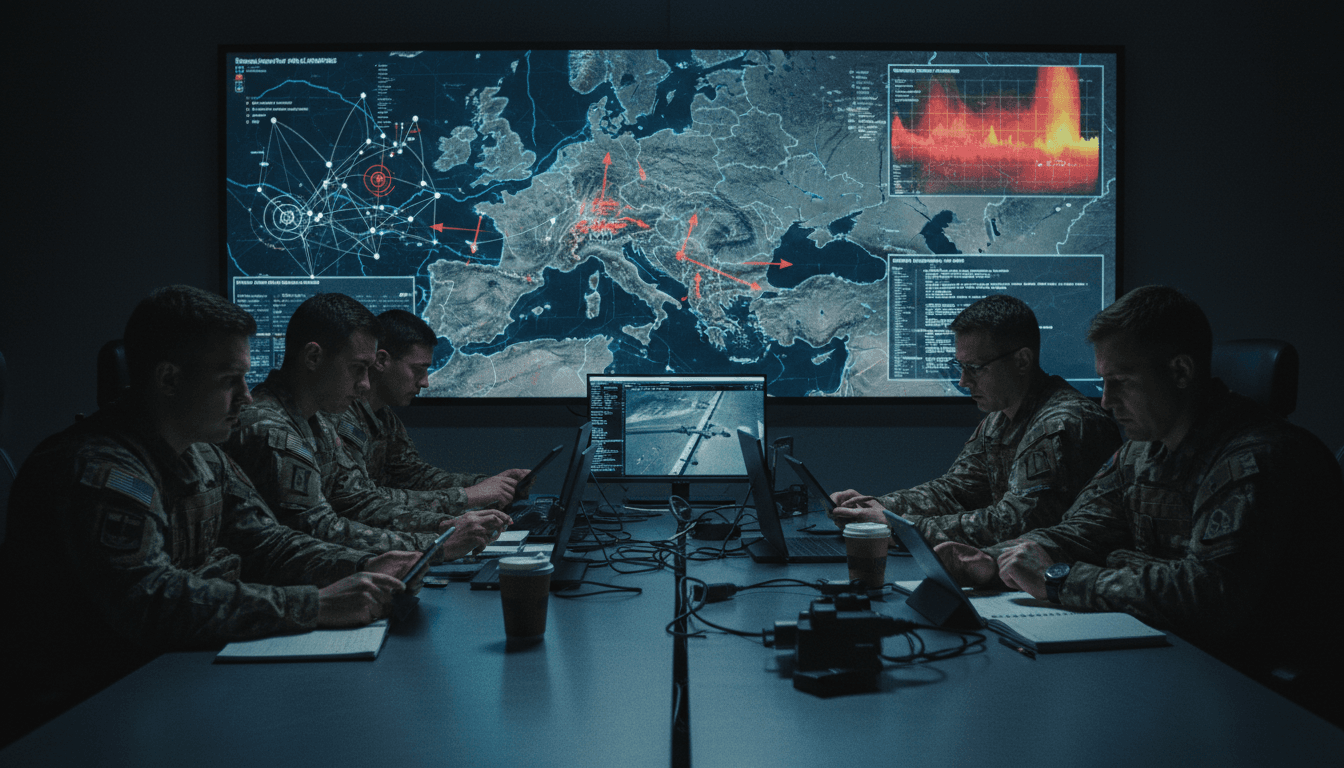
AI Mission Planning Lessons from Russia’s Ukraine War
Russia’s full-scale invasion of Ukraine is often described as a test of will, manpower, and industrial output. That’s real—but it misses the quieter driver of failure: bad assumptions that survived first contact with reality. The longer the war has run, the more those assumptions have compounded into costs that are hard to unwind: personnel losses, fiscal strain, elite friction, and deeper dependence on external partners.
Jeffrey Mankoff’s “imperial trap” framing is the right mental model for defense leaders: wars of choice built on hubris don’t usually end with a clean battlefield decision. They end with a grinding mismatch between political objectives and state capacity. For the “AI in Defense & National Security” series, that’s not a history lesson—it’s a product requirement. If your planning stack can’t challenge assumptions, stress-test logistics, and quantify second-order risks, you’re building tools for slide decks, not war.
The “imperial trap” is a planning failure before it’s a battlefield failure
The core point: imperial wars fail when leaders underestimate the opponent, misread outside intervention, and overrate their own ability to sustain time and costs. Russia has a long pattern here—Crimea (1853–56), Russo-Japanese War (1904–05), World War I, Afghanistan (1979–88). The rhyme isn’t tactical. It’s institutional.
Mankoff’s argument maps neatly onto modern mission planning:
- Underestimating the defender’s cohesion and adaptation (Ukraine’s resilience, mobilization, and learning curve)
- Discounting external support (weapons, intelligence, sanctions endurance, coalition politics)
- Overconfidence in domestic staying power (economy, recruitment pipeline, social stability)
Here’s the uncomfortable truth: most strategic planning processes still treat these as narrative judgments, not modeled variables. You get “assessments,” not decision-grade forecasts with uncertainty bounds.
What AI changes (and what it doesn’t)
AI won’t “predict wars.” But it can do something far more useful: turn the assumptions you’re already making into explicit, testable inputs. That means:
- Red-teaming leadership narratives with alternative hypotheses
- Running counterfactual simulations (“What if coalition support holds for 36 months?”)
- Quantifying “soft” constraints like recruitment elasticity and economic fragility
If your planning process can’t surface the assumptions that drive the plan, you’re already in the trap.
Four failure patterns Russia repeats—and how AI can flag them early
Russia’s campaign in Ukraine shows how strategic failure often starts as an analytics failure. Not because analysts lacked data, but because institutions chose comforting interpretations.
1) Misreading the enemy’s will and capacity
Answer first: AI can help detect when your model of the adversary is stale.
Russia appears to have expected fast political collapse in Kyiv. Instead, it encountered sustained resistance and rapid learning. That kind of misread is usually visible early through indicators: territorial defense participation, governance continuity, messaging coherence, mobilization patterns, and industrial improvisation.
AI-enabled intelligence analysis can help by:
- Fusing open-source signals (mobilization, procurement, logistics movements) into trend deviations
- Identifying adaptation cycles (how quickly units change TTPs after losses)
- Producing “confidence heatmaps” that show where assumptions are weakest
The goal isn’t omniscience. It’s forcing decision-makers to confront: “We’re guessing here.”
2) Discounting foreign intervention and coalition endurance
Answer first: AI can model external support as a dynamic system, not a footnote.
Mankoff highlights a recurring Russian blind spot: outside powers extend wars and raise costs. Crimea brought British and French forces; Japan benefited from intelligence support; WWI expanded Russia’s fronts; Afghanistan became a U.S.-backed grinding campaign.
Ukraine has been shaped by partner support in weapons, financing, training, and intelligence—as well as sanctions coordination. Russia planned for “sanctions,” but not necessarily for sanctions plus coalition durability plus supply chain re-routing.
Where AI helps:
- Sanctions impact modeling tied to commodity flows, shipping patterns, and substitution rates
- Coalition behavior forecasting using political, industrial, and budget signals
- Supply network analytics that estimate how fast a partner can ramp production and deliveries
If you’re planning a campaign and you treat external support as static, you’re planning in a fantasy world.
3) Believing your manpower model is unlimited
Answer first: AI can expose the hidden constraints in recruitment, rotation, and social tolerance.
Mankoff notes Russia’s adaptation: heavy use of contract soldiers, convicts, and mercenaries with high bonuses—reducing immediate political blowback compared to mass conscription. That’s smart in the short term. It’s also a trap door.
Why? Because it creates a price-based manpower pipeline. When budgets tighten, recruitment drops—or you shift to conscription and absorb political shock. AI can support force generation planning by:
- Estimating recruitment sensitivity to bonuses, benefits, and casualty publicity
- Modeling regional and demographic impacts (including disproportionate burdens on minorities)
- Forecasting readiness decay under sustained casualty replacement
Good mission planning doesn’t just ask “How many troops can we raise?” It asks “At what political and fiscal price, for how long?”
4) Confusing tactical adaptation with strategic sustainability
Answer first: AI can measure whether adaptation is buying time or solving the underlying problem.
Russia has adapted in drones, missiles, communications, and wartime production. It also diversified trade routes and accessed dual-use inputs despite export controls. But adaptation can mask deeper weaknesses: demographic decline, fiscal deficits, inflation risks, elite patronage strain, and long-term de-modernization.
A mature AI decision-support stack can help leaders distinguish:
- Operational gains (kilometers advanced, sorties, drone attrition ratios)
- from strategic viability (fiscal runway, industrial resilience, societal tolerance)
That requires multi-domain analytics: economic signals, industrial capacity, logistics throughput, and political stability indicators—treated as first-class variables, not “context.”
What “AI mission planning” should look like in real defense organizations
Most defense teams say they want AI for mission planning. Many end up buying dashboards that summarize yesterday.
A better approach: treat AI as an assumption management system for campaigns.
A practical blueprint: the 5-layer planning stack
-
Collection & provenance layer
- Track source reliability, time lag, and adversary deception risk.
-
Fusion layer (multi-intelligence + operational data)
- Combine ISR, logistics, readiness, cyber, economic, and OSINT signals.
-
Model layer (forecast + simulation)
- Run wargame-style simulations with explicit uncertainty ranges.
-
Decision layer (courses of action + constraints)
- Show how COAs perform under worst-case and most-likely conditions.
-
Learning layer (post-action feedback)
- Update models based on outcomes to prevent institutional “memory loss.”
The point is simple: if the model doesn’t learn, the organization doesn’t learn.
“People also ask” questions your planning team should be able to answer
-
Could AI have changed Russia’s initial invasion plan?
It could have made failure harder to ignore by stress-testing assumptions (Ukrainian collapse timelines, coalition response durability, logistics fragility). The political decision might not change, but the operational plan and risk posture should. -
Is AI more valuable for offense or defense?
Defense often benefits more because it can use AI for early warning, resource allocation, and attrition management—turning time into an ally. -
What’s the biggest AI risk in national security planning?
Over-trusting outputs without auditing inputs. The enemy gets a vote, and deception is part of the battlefield.
The postwar problem Russia is heading toward is also an AI-relevant problem
Mankoff’s analysis doesn’t stop at the battlefield. He points to what follows: economic strain, elite conflict, reintegration of traumatized veterans, and persistent sanctions. Those dynamics matter for planners because they shape escalation risk and future force regeneration.
Two specifics stand out:
- Casualty scale and veteran reintegration: the larger the veteran population—especially with convicts and coerced recruits—the bigger the internal security burden after active fighting slows.
- Fiscal runway: if defense spending runs above sustainable levels while investment risk rises, the state has fewer non-coercive tools to maintain stability.
AI doesn’t “solve” these political problems. But it can help security institutions quantify trajectories: crime risk indicators, budget stress tests, industrial contraction signals, and regional grievance patterns.
If you’re building AI for defense, optimize for humility
The most useful lesson from the imperial trap isn’t “Russia is doomed” or “Ukraine will win.” It’s this: strategies built on underestimated costs eventually collide with arithmetic.
For anyone working in AI in defense & national security—planners, intelligence teams, capability developers, and defense tech leaders—this is the bar:
- Can your AI identify which assumptions are doing the most work in the plan?
- Can it run adversarial scenarios that leaders don’t want to hear?
- Can it show what changes when allies stay in (or step out)?
- Can it estimate the fiscal and manpower runway with numbers, not vibes?
If you’re trying to reduce the odds of repeating history’s most common mistakes, build AI that argues back.
A war plan that can’t survive a hostile model probably won’t survive a hostile world.
If your team is evaluating AI mission planning tools, start by mapping the assumptions you currently treat as “background.” Those are usually the ones that break first. What would it take for your system to surface them, quantify them, and update them weekly—without waiting for a crisis briefing?