AI market correction risk can weaken export controls and Taiwan policy. Learn how to protect defense readiness and AI governance before downturn pressure hits.
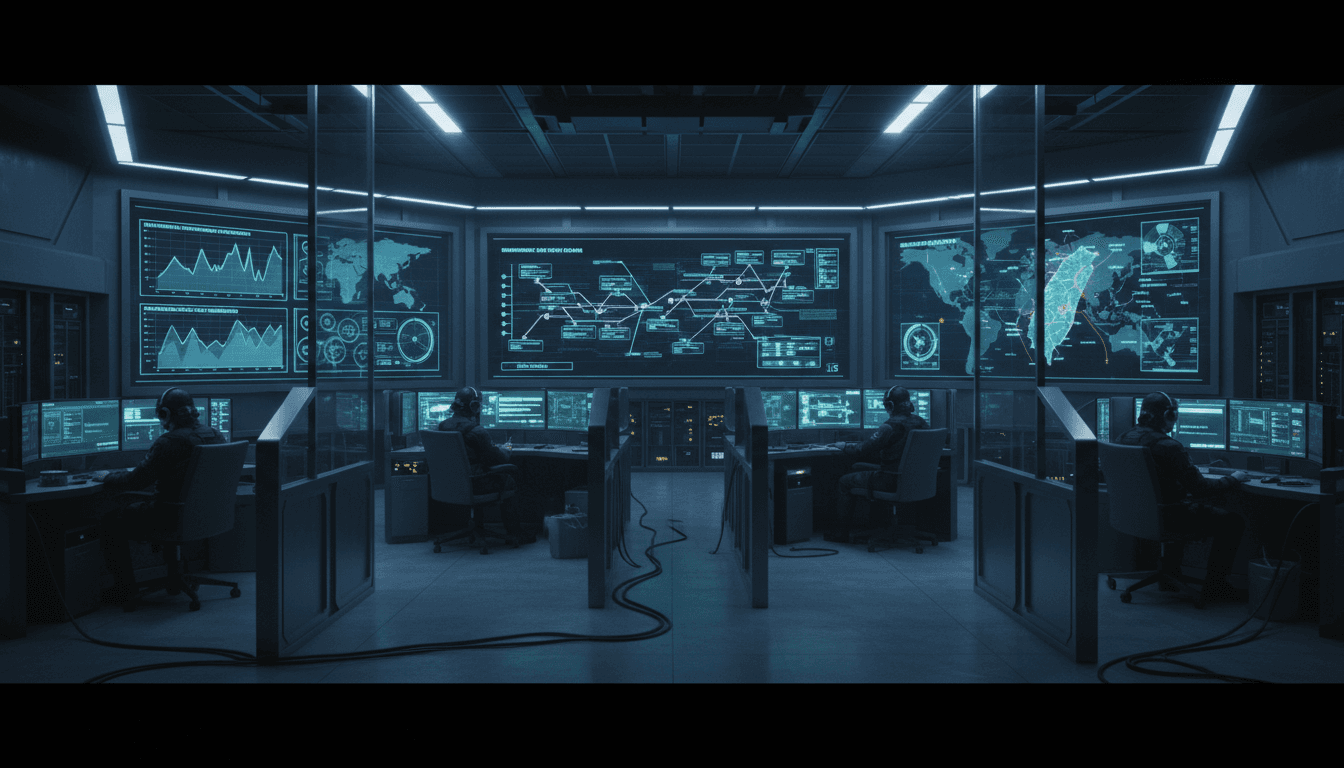
AI Market Corrections Can Break Defense Readiness
AI “bubble” talk isn’t just a Silicon Valley parlor game. It’s a national security scenario planning problem.
If the AI market hits a correction in 2026—whether it looks like a classic bubble pop or a slower “J-curve” adoption slump—the first-order impact won’t be model benchmarks. It’ll be political pressure: pressure to juice growth, protect jobs, and stabilize markets. And when that pressure arrives, export controls and Taiwan policy become tempting knobs to turn.
Here’s my stance: treat an AI market correction like a predictable stress test for U.S. defense and intelligence. The danger isn’t that AI stops working. The danger is that Washington “solves” the wrong problem—loosening chip controls or trading away strategic leverage—because the economic pain gets loud.
An AI correction is a security event, not a tech headline
A market correction changes incentives fast. When valuations fall and debt looks shaky, lobbying gets sharper, timelines get shorter, and long-term strategy starts losing arguments.
The U.S. national security community should assume three things will happen during a correction:
- Industry will push hard to expand sales to China (especially “inference” chips) to recover revenue.
- Some policymakers will frame export controls as self-inflicted economic harm rather than as a defense measure.
- Taiwan will be discussed in more transactional terms if Washington searches for big, symbolic “deals” to stabilize economic expectations.
This matters because AI isn’t a consumer gadget race. AI is now a defense production input: it drives intelligence analysis, targeting workflows, cyber defense, logistics optimization, electronic warfare support, and autonomous systems R&D.
A useful way to think about it: chips aren’t just a supply chain issue; they’re the ammunition for AI capability. If you let your competitor restock cheaply during your downturn, don’t be surprised when you face sharper threats during your recovery.
The “sprinters, marathoners, skeptics” frame—what it means for defense planners
People argue about whether AI is overhyped, underhyped, or just early. For defense and national security, the right question is simpler: what procurement and policy decisions fail safely across outcomes?
Sprinters: rapid capability growth, high strategic volatility
Sprinters believe AI capability gains will keep accelerating. Even if you think they’re too optimistic, their worldview creates a real policy risk: panic moves if markets wobble.
When investors and executives expect exponential growth, any slowdown can look like betrayal by regulators, “overreach,” or missed opportunity. That’s when you hear arguments like:
- “Export controls are killing American competitiveness.”
- “Selling ‘less advanced’ chips is harmless.”
- “China will build it anyway, so we might as well profit.”
From a defense perspective, that’s backward. If capability growth is fast, then marginal compute matters more, not less. Export controls become more strategically valuable, not more negotiable.
Skeptics: low ROI headlines, political overcorrection
Skeptics point to ugly numbers: large spending commitments versus much smaller annual revenue, and widely cited findings that many organizations still can’t measure returns from generative AI. Add higher interest rates and bond-market nerves, and it’s easy to see how “AI was a fad” becomes a campaign-friendly soundbite.
The national security risk here isn’t skepticism. It’s overcorrection:
- Underfunding AI infrastructure for defense use cases
- Cutting talent pipelines because private markets cooled
- Treating export controls as expendable because “AI isn’t real anyway”
Even if commercial ROI is uneven, the security value of AI is already tangible. Intelligence workflows, cyber operations, and ISR processing don’t require mythical “AGI” to matter. They require reliable compute, data governance, integration, and trained people.
Marathoners: the scenario policymakers should plan for
Marathoners accept a near-term correction but expect long-term productivity gains. This is the most practical view for defense and national security because it matches how militaries adopt technology: slowly, unevenly, and with integration pain.
The “J-curve” idea is especially relevant. New tools often lower productivity at first because they:
- introduce new training burdens
- create process friction
- require data cleanup
- add security controls
- expose interoperability gaps
Defense organizations should treat the J-curve as normal. The wrong response is to declare AI “failed” and start selling strategic inputs to an adversary to patch quarterly revenue holes.
Why “just inference chips” is still a national security problem
The popular compromise pitch during a downturn will be: keep limits on training chips, but loosen rules on inference chips.
That sounds tidy. It isn’t.
Inference compute is operational power. It’s what turns models into deployed capability—running perception for drones, routing logistics, triaging cyber alerts, translating intercepted communications, and enabling robotics at scale.
Three specific security concerns make inference chips sensitive:
1. Inference hardware can be repurposed
In the real world, organizations don’t keep “training” and “inference” perfectly separated. Inference-capable accelerators can be used for fine-tuning and for forms of distributed training. Even partial capability increases can shorten development cycles and raise model performance.
2. “Physical AI” depends on inference at scale
Autonomous and semi-autonomous systems—air, land, sea—need robust inference capacity. If a rival can field more inference compute, it can iterate faster on:
- unmanned surface and underwater vehicles
- loitering munitions autonomy and swarming behaviors
- robotics for logistics and base operations
- real-time sensor fusion for contested environments
You don’t need the most advanced model in the world to gain advantage. You need enough compute to deploy good models everywhere.
3. Export controls are about time, not perfection
No control regime is airtight. The goal is to slow and shape an adversary’s capability development. Selling large volumes of inference chips during a correction does the opposite: it accelerates operational deployment while domestic politics are distracted.
A sentence worth keeping handy in internal briefings:
If a chip sale increases an adversary’s deployed AI capacity faster than it increases U.S. readiness, it’s a strategic loss—no matter what it does for next quarter’s earnings.
Taiwan becomes more vulnerable when chips look less scarce
During an AI boom, Taiwan’s semiconductor centrality is obvious. During a glut, it’s easier for short-term thinkers to say: “If chips aren’t scarce, why are we risking so much?”
That’s the trap.
Taiwan is valuable to the United States for reasons that don’t fluctuate with chip pricing:
- Geography: it anchors the first island chain and shapes Indo-Pacific force posture.
- Signal to allies: U.S. reliability isn’t abstract; it’s observed through choices.
- Industrial and technical expertise: not just fabs, but ecosystem depth—process engineering, yield learning, packaging, and supplier networks.
A correction can also squeeze Taiwan domestically because semiconductors are a meaningful share of its economy and employment. Economic stress increases political noise, and political noise is exactly what coercive rivals exploit.
For leaders in defense and intelligence, the planning implication is blunt: don’t let “chip glut” narratives downgrade Taiwan support in the policy stack. Deterrence isn’t a function of quarterly semiconductor margins.
What Congress should lock in before the downturn hits
If a correction is a stress test, then pre-committing to smart policy is how you pass it.
1. Prioritize U.S. access to advanced AI chips
The fastest way to lose defense AI momentum is to let domestic programs compete with the highest-bidder dynamics of commercial markets during supply stress.
A strong policy posture ensures:
- assured access for defense-critical and intelligence-critical workloads
- predictable planning for secure data centers and classified compute
- reduced dependence on ad hoc emergency measures
2. Create a statutory floor for export controls
Export controls that can be loosened quietly in response to recession headlines aren’t durable. A statutory floor forces the conversation into daylight and makes major reversals a deliberate choice.
That’s not bureaucratic theater. It’s governance. And governance is what keeps short-term market pain from turning into long-term strategic decline.
3. Fund enforcement like you mean it
Rules without enforcement are suggestions. Export controls require a capable enforcement apparatus that can:
- investigate evasive procurement networks
- coordinate with allies on end-use monitoring
- respond to re-export risks and gray-market transshipment
If you want a practical benchmark: when enforcement agencies are under-resourced, compliance becomes optional for the most sophisticated actors.
What defense and intelligence leaders can do inside their own orgs
National policy is only half the story. Defense readiness also depends on whether agencies treat AI as a real operational program—or as a series of pilots.
Here’s what I’ve found works when organizations want resilience through market cycles.
Build a “compute readiness” plan
Treat compute like fuel planning. Know what you have, what you need, and what you can surge.
- inventory GPU/accelerator capacity across classification levels
- pre-negotiate surge clauses with approved providers
- define priority mission workloads for constrained periods
Design for the J-curve
If you assume productivity will dip before it rises, you’ll invest in the boring parts early:
- data labeling and data quality pipelines
- model evaluation and red-teaming
- integration into existing mission systems
- operator training and TTP updates
This reduces the political risk that “AI didn’t work” becomes an excuse to cut critical programs.
Push hard on AI governance for national security
During a correction, scandals and failures get amplified. Strong AI governance lowers the chance that a single incident becomes a reason to freeze modernization.
Focus areas that pay off quickly:
- model risk management standards (including for vendors)
- incident reporting pathways for AI failures
- procurement language that prevents vendor lock-in
- security reviews for training data and inference telemetry
The hidden cost of an AI market correction: strategic shortcuts
A correction won’t change one core reality: AI capability is tightly coupled to advanced semiconductors, energy, and industrial scale. Those aren’t things you can rebuild quickly after you’ve traded them away.
If you’re building in the AI in Defense & National Security space, plan for the correction now:
- Keep export controls aligned to defense realities, not market mood
- Protect Taiwan policy from “deal logic” during recession politics
- Institutionalize chip access and enforcement capacity before crisis narratives harden
Organizations that prepare early don’t just ride out downturns—they avoid making irreversible decisions under pressure.
If an AI market correction hits next year, the countries that stay disciplined on compute, controls, and alliances will be the ones that set the security balance for the 2030s. What would your strategy look like if you assumed the downturn headlines start tomorrow?