Russia’s sabotage shadow war tests Europe’s response speed. Here’s how AI improves detection, attribution, and resilience across critical infrastructure.
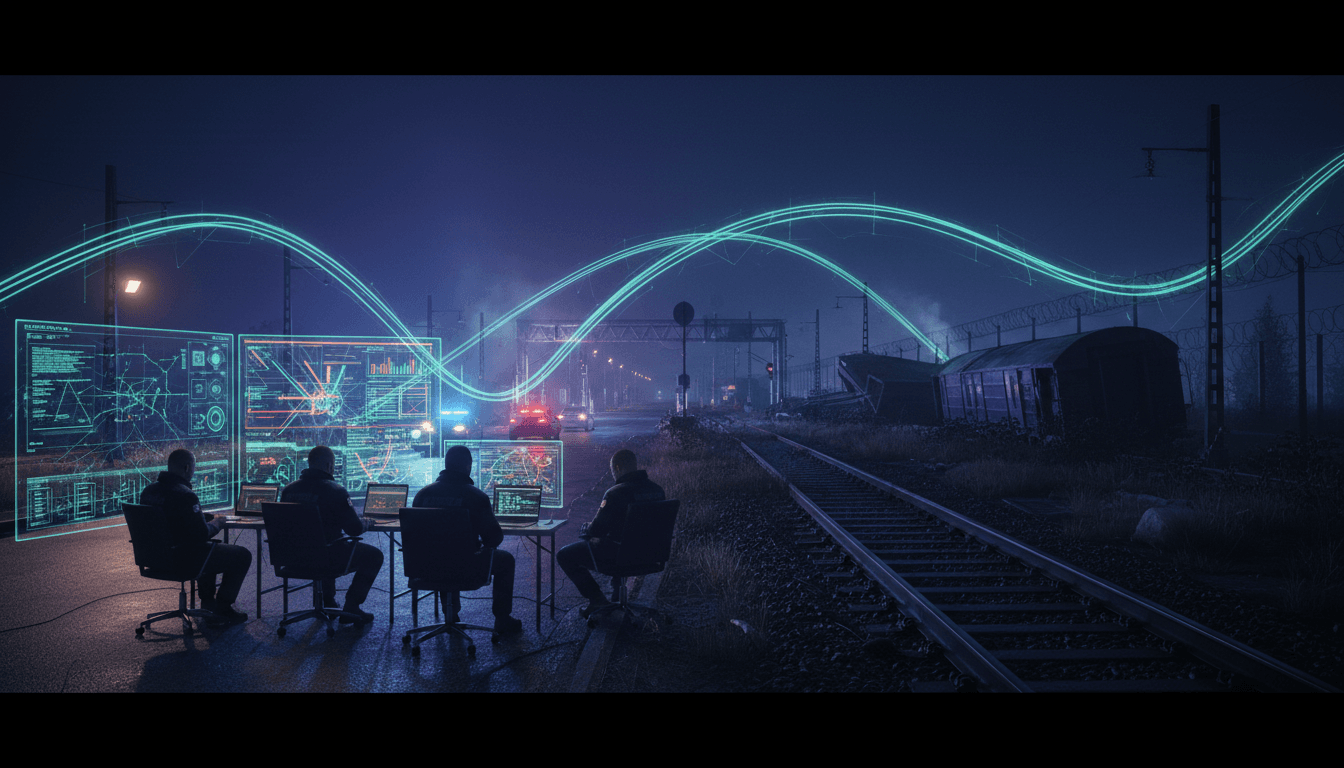
AI vs. Russia’s Shadow Sabotage War in Europe
A rail line near Mika, Poland, didn’t “mysteriously” fail this fall. It was blasted with a C-4 device, severing a logistics route used to move military aid toward Ukraine—an incident Polish authorities treated as sabotage and tied to Russian direction.
That single event is a clean illustration of a broader problem Europe is wrestling with in late 2025: hybrid warfare that’s designed to feel like bad luck. A warehouse fire here, an undersea fiber cut there, persistent GPS jamming that disrupts civilian aviation, a drone incursion that forces a temporary airport closure. Each one can be argued down as “unclear,” “not escalatory,” or “not worth a major response.” The strategic effect comes from the accumulation.
For leaders responsible for critical infrastructure protection, defense readiness, or intelligence analysis, the real question isn’t whether sabotage is happening. It’s how you detect it early, attribute it fast, and respond proportionally—without waiting for the “one big attack” that finally makes the pattern undeniable. This is where AI in defense & national security stops being abstract and becomes operationally necessary.
What Russia’s “shadow war” looks like in practice
Russia’s hybrid sabotage model is a volume business. It favors repeated, low-to-mid intensity actions that create uncertainty, consume security bandwidth, and aim to erode public confidence.
Across Europe, the pattern described in recent reporting includes:
- Rail disruptions affecting routes used for eastbound military support
- Incendiary parcels and logistics hub fires that stress supply chains and insurance markets
- Undersea fiber cable damage under ambiguous circumstances
- GPS and navigation jamming disrupting flights and maritime operations
- Drone overflights and airspace incursions that force NATO consultations and local shutdowns
The point isn’t that any single rail blast or cable cut “wins” a war. The point is that democracies argue about ambiguity, and ambiguity is being used as a weapon.
The deniability stack: proxies + noise + timing
A recurring feature in this campaign is the use of proxies—including vulnerable recruits targeted through encrypted messaging and “small task” workflows that escalate from reconnaissance to action.
This structure creates a deniability stack:
- Recruitment happens in the gray (encrypted apps, quick payments, low-stakes tasks)
- Operations create investigative overload (many incidents, dispersed geography)
- Attribution becomes slow (jurisdiction boundaries, limited shared data)
- Political response gets delayed (debate over thresholds, fear of escalation)
If you’re defending a port, a rail corridor, a data center, or an undersea cable route, this matters because the attacker is optimizing for your decision latency.
Why traditional detection keeps losing time
Hybrid threats exploit seams: between agencies, between countries, and between data systems. Sabotage investigations often start as local crime scenes. Cable cuts can begin as technical outages. GPS jamming can get treated as “interference” until it becomes a safety issue.
Here’s the operational gap I see most organizations struggling with: they have data, but not shared, fused understanding.
- Security teams hold badge logs, CCTV, patrol notes
- Telecom teams hold outage telemetry, repair tickets
- Aviation authorities hold incident and interference logs
- Intelligence services hold fragmented threat reporting
- Law enforcement holds casework and human-source leads
The problem isn’t collection. It’s correlation.
The Article 5 “threshold problem” is also a data problem
NATO’s collective-defense clause carries a deliberately high bar, and hybrid tactics are calibrated to stay below it. But it’s not only a legal or political question. It’s also an evidentiary one: can you show a coherent, attributable pattern quickly enough to support collective action?
If the alliance needs consensus, then speed and clarity of attribution becomes strategic. And attribution at speed requires better fusion than spreadsheet-driven coordination.
Where AI actually helps: detection, attribution, and resilience
AI doesn’t “solve” sabotage. It reduces the attacker’s advantage in time and ambiguity. Properly deployed, AI systems compress the detect-to-decide loop.
Below are the use cases that map directly to the incidents Europe has been confronting.
1) AI to detect pre-attack behaviors (not just the blast)
Most sabotage operations have a pre-attack phase: reconnaissance, route planning, dry runs, procurement, communications, and travel patterns.
AI-driven anomaly detection can help surface those precursors across disparate signals:
- Repeated night-time presence near rail junctions or cable landing sites
- Unusual vehicle dwell time near restricted areas
- Abnormal access patterns in facilities (badge in/out mismatches, tailgating clusters)
- OSINT shifts (sudden local chatter, recruitment narratives in target geographies)
The practical point: you want to catch the recon, not just investigate the crater.
2) Computer vision for perimeter and infrastructure monitoring
Cameras are everywhere; attention is not. Computer vision can triage video at scale by flagging events that matter:
- Object detection for abandoned packages and tools
- Behavior detection for climbing, cutting, digging, loitering
- Vehicle re-identification across multiple camera zones
- Tracking near “no-stop” corridors along rail and pipeline rights-of-way
This works best when paired with strong governance: defined retention windows, audit logs, and clear escalation rules so the system supports decision-making rather than creating a privacy backlash.
3) AI for GPS jamming and spoofing awareness
Europe’s surge in GPS interference isn’t only a military problem; it’s civil aviation and economic continuity.
AI models can fuse signals from:
- ADS-B and flight path deviations
- Aircraft navigation integrity alerts
- Ground sensor networks (spectrum monitoring)
- Maritime AIS anomalies
Done right, you get jamming heatmaps, likely emitter zones, and predictive warnings that allow rerouting, altitude changes, or temporary procedural controls.
A blunt truth: when interference becomes routine, people normalize it. AI helps prevent normalization by making the pattern visible and measurable.
4) AI-assisted attribution: from “incident” to “campaign”
Single-incident forensics is necessary, but hybrid warfare is fought at the campaign level. AI can cluster events into coherent threat activity:
- Similar device signatures and material sourcing patterns
- Shared tradecraft (timers, clamps, concealment methods)
- Travel and communications link analysis (even with partial data)
- Temporal coordination with political moments (aid votes, NATO meetings, sanctions decisions)
This is where graph analytics and entity resolution matter. If one suspect uses three phones, two spellings, and four accounts across platforms, you need systems that reconcile identities with confidence scoring.
5) Planning for resilience: AI as a logistics “stress test” engine
Even when attacks don’t stop aid flows, they impose delays, reroutes, and political friction. AI can help planners model:
- Alternative routing for rail and road corridors
- Single points of failure in ports and warehouses
- Time-to-repair scenarios for fiber cuts
- Inventory positioning to reduce chokepoint exposure
The goal is simple: make sabotage expensive by making it ineffective.
A practical blueprint for AI-powered counter–hybrid warfare
You don’t start by buying a model. You start by choosing decisions you want to make faster. In my experience, the highest-impact programs begin with three operational outputs: early warning, triage, and campaign attribution.
Step 1: Define the “minimum viable decisions”
Pick 5–10 decisions you want to accelerate, such as:
- “Is this outage likely accidental or malicious within 30 minutes?”
- “Do we raise facility posture from normal to heightened today?”
- “Are these three incidents connected strongly enough to brief leadership?”
If you can’t name the decision, you can’t measure the benefit.
Step 2: Build a fusion layer before you build fancy AI
Most organizations need a secure data backbone that supports:
- Cross-agency metadata sharing (even if raw data stays local)
- Event schemas for incidents (time, location, modality, confidence)
- Deconfliction workflows (who owns what, when)
AI is only as effective as the system around it.
Step 3: Use human-centered automation (triage, not autopilot)
Hybrid warfare is adversarial. Models will be probed and deceived.
What works:
- AI flags anomalies; humans decide response
- Transparent confidence scores and explainability hooks
- Red-team testing for deception and bias
- Feedback loops (investigator outcomes retrain prioritization)
Step 4: Harden against proxy recruitment pipelines
The proxy model described in Europe includes recruitment via encrypted apps and “tasking” that escalates.
AI-supported countermeasures can include:
- Detection of recruitment narratives and patterns across platforms (where legally permitted)
- Rapid sharing of indicators between schools, NGOs, and law enforcement
- Automated tip triage to prioritize credible recruitment reports
This is not only counterintelligence. It’s protection of vulnerable populations from coercion and blackmail.
Common questions leaders ask (and the straight answers)
“Can AI replace human intelligence here?”
No. AI scales pattern detection; HUMINT explains intent. The winning approach pairs them.
“What’s the biggest failure mode?”
Treating AI like a product instead of a capability. If the program doesn’t change how incidents are triaged, shared, and acted on, it becomes an expensive dashboard.
“How do we avoid overreaction to false positives?”
Design for graded responses: advisory → heightened monitoring → targeted patrols → investigative escalation. Binary alerts create binary politics.
What to do next if you’re responsible for security or resilience
Russia’s sabotage shadow war in Europe is a stress test of coordination as much as it’s a test of defenses. Hybrid actors win when each incident is handled in isolation, when attribution takes months, and when responses are trapped in threshold debates.
AI shifts that balance when it’s used to fuse signals, surface patterns, and shorten the time between “something weird happened” and “here’s what it means.” In the AI in Defense & National Security series, this is the broader theme that keeps repeating: the advantage goes to the side that can sense, interpret, and decide faster—especially in gray-zone conflict.
If you’re building an AI roadmap for national security, start with one concrete pilot: campaign-level incident clustering for a single infrastructure domain (rail, ports, aviation GPS integrity, or undersea cable monitoring). Make it measurable. Then expand.
What would Europe’s response look like if hybrid sabotage no longer produced ambiguity—only fast, credible attribution and a menu of coordinated options?