Greece’s expected PULS rocket artillery deal shows why AI-enabled targeting, deconfliction, and logistics now define modern fires. See what to plan next.
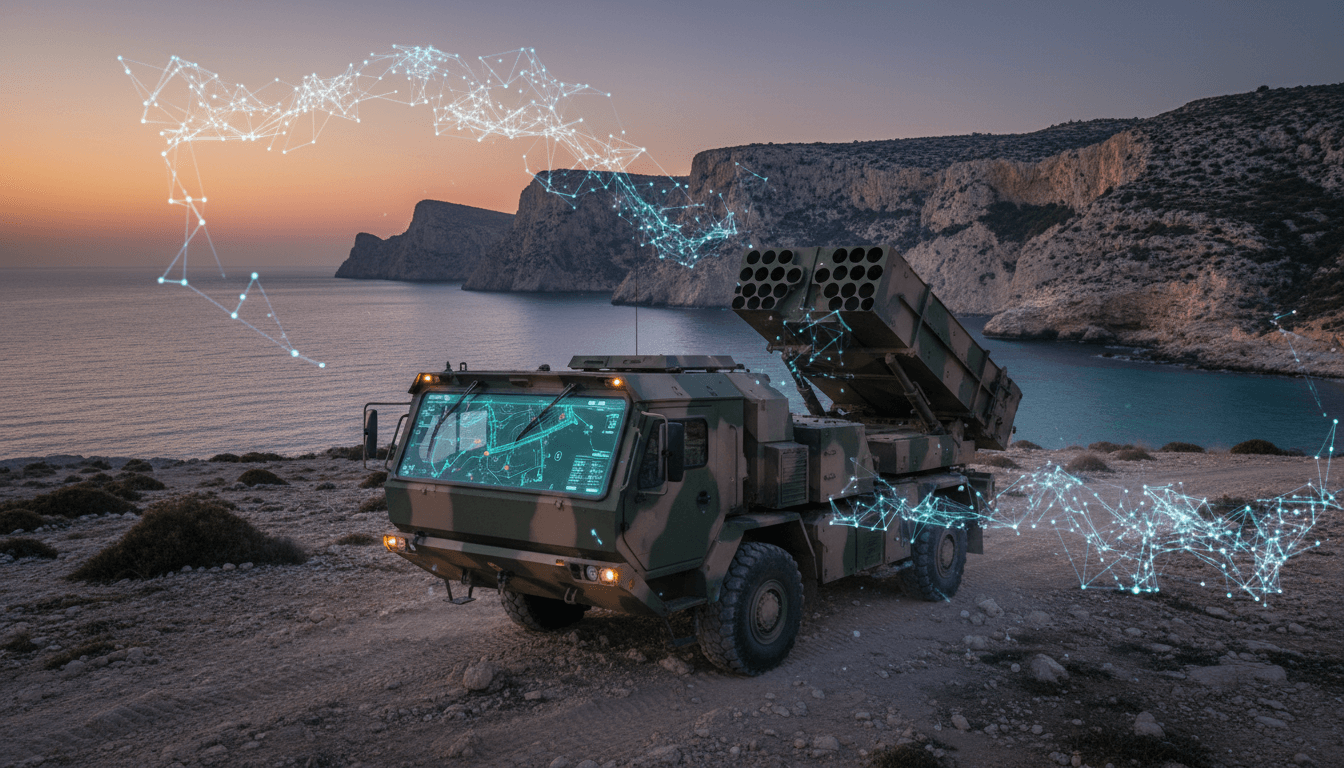
AI-Enabled Rocket Artillery: What Greece’s PULS Deal Signals
A $757 million artillery buy doesn’t sound like an “AI story” at first. But Greece’s expected purchase of 36 PULS rocket artillery systems from Israel’s Elbit Systems is exactly the kind of modernization move where AI quietly becomes decisive—because rockets and missiles are only as effective as the targeting, coordination, sustainment, and deconfliction wrapped around them.
The timing matters. With Greece’s 2026 budget approved and regional security pressures still high, Athens is building a layered force that reportedly includes an “Achilles’ Shield” air defense concept alongside longer-range fires. That combination—defend, sense, strike—creates a perfect environment for AI in defense and national security, especially in mission planning, sensor fusion, and logistics.
Here’s what this deal signals, what changes when rocket artillery is treated as a networked system (not a standalone launcher), and how defense organizations can plan AI adoption without creating a fragile, black-box kill chain.
What Greece is really buying with PULS (beyond launchers)
Greece isn’t just shopping for launch vehicles. It’s buying into a flexible fires architecture: a launcher designed to support multiple munition types (unguided rockets, precision-guided munitions, and missiles) and to be adaptable to wheeled or tracked platforms. That modular approach is increasingly popular in Europe because it reduces training burden and simplifies sustainment.
From a capability standpoint, modern rocket artillery is about options:
- Option 1: Massed fires with cheaper rockets for area effects.
- Option 2: Precision fires when collateral risk or scarce munitions drive tighter aimpoints.
- Option 3: Longer-range missiles when you want to hold targets at risk deeper.
The common mistake is to treat those options as “ammo choices.” In practice, they’re decision problems: which effect, which target, which time window, which risk tolerance, which resupply plan. That’s where AI earns its keep.
Why European buyers keep choosing the same rocket artillery family
PULS has already landed with multiple European customers (including Germany’s February 2025 selection through an industry collaboration, plus deals in the Netherlands and Denmark). The pattern reflects a broader European trend: standardize launchers, diversify munitions, and integrate fires into digital command-and-control.
That trend creates demand for:
- Interoperable data (target coordinates, no-strike lists, airspace control measures)
- Common mission planning workflows
- Reliable sustainment under surge conditions
AI doesn’t replace those fundamentals. It makes them faster and less error-prone—if the data plumbing is sound.
AI’s role in rocket artillery: it’s not “auto-targeting,” it’s decision advantage
AI-enabled artillery is often described as “smarter targeting.” That’s oversimplified. The real gain is compressing the sensor-to-shooter timeline while reducing human error in a high-tempo environment.
A practical way to think about AI here is: recommendation engines for fires, not autonomous triggers.
1) Precision without paralysis: AI-assisted target vetting
Precision fires increase the demand for target validation and rules of engagement compliance. Humans remain accountable, but AI can accelerate the supporting work:
- Correlating sensor reports (ISR feeds, radar tracks, EW cues)
- Flagging inconsistencies (coordinate drift, duplicate targets)
- Estimating collateral risk based on terrain, structures, and known civilian patterns
This matters because precision can create a new bottleneck: you can “see” more targets than you can responsibly clear. AI helps prioritize.
2) Counter-battery and shoot-and-scoot: optimization under time pressure
Rocket artillery survivability depends on rapid displacement and disciplined emissions. AI can support:
- Route optimization (speed, concealment, bridge limits)
- Firing position selection using terrain and threat models
- Radar/EW threat prediction for counter-battery risk
If you’ve ever watched a staff try to do this with spreadsheets and radio calls, the value is obvious: AI reduces friction where seconds matter.
3) Deconfliction with air and maritime: the overlooked “AI tax”
Greece operates in a dense environment—air activity, maritime traffic, islands, and allied exercises. Fires units must deconflict with:
- Friendly aircraft corridors
- Air defense engagement zones
- Naval movements and coastal constraints
AI can help by continuously checking planned fires against dynamic airspace and air defense control measures. That’s not glamorous, but it prevents the kind of coordination failures that cause operational pauses—or worse.
Snippet-worthy truth: “Modern artillery isn’t a launcher problem; it’s a coordination problem.”
Greece’s ‘Achilles’ Shield’ context: why air defense makes AI for fires more urgent
Layered air defense concepts like “Achilles’ Shield” (as publicly discussed in recent months) typically drive investment in:
- Sensors (radars, EO/IR, passive detection)
- Battle management / C2
- Interceptors and point-defense
Once that infrastructure exists, it becomes a natural backbone for AI-enabled operations—because air defense already lives on track quality, classification confidence, and time-sensitive decisions.
That’s the connection to rocket artillery: if Greece is building a defend-and-strike posture, it needs shared situational awareness across air defense, ISR, and land fires. AI helps fuse those layers into something commanders can act on.
The big shift: “platform upgrades” to “decision system upgrades”
Buying PULS is a platform upgrade. Building the targeting, logistics, and battle management around it is a decision system upgrade.
Countries that stop at the platform step often end up with:
- Great hardware
- Slow kill chains
- Manual workarounds
- Fragile interoperability with allies
Countries that treat modernization as an information problem tend to get faster operational tempo with fewer mistakes.
A practical AI roadmap for rocket artillery modernization
Defense leaders regularly ask the wrong first question: “Which AI model should we use?” The right first question is: Which decision are we trying to speed up or improve—and what data do we trust?
Here’s a pragmatic roadmap I’ve seen work across defense organizations modernizing fires.
Step 1: Start with three high-value decisions
Pick decisions that are frequent, time-sensitive, and currently manual:
- Target nomination and prioritization (what matters most in the next 30–120 minutes)
- Munition-to-target matching (effect vs. cost vs. inventory)
- Resupply and surge planning (how many missions can we sustain at tempo)
Each of these can be improved with decision-support AI without handing lethal authority to software.
Step 2: Build a “minimum viable data layer” before models
AI in national security fails more often from data chaos than from model weakness. For rocket artillery, the minimum viable data layer includes:
- Standard coordinate formats and validation rules
- Timestamped sensor provenance (who/what produced this track, when)
- Inventory visibility (munitions by location, lot, transport constraints)
- Friendly force locations and restricted fire areas
If those aren’t solid, AI will just produce confident-looking errors.
Step 3: Put humans at the center with auditable recommendations
For fires, AI outputs should be:
- Explainable enough for a commander to defend the decision
- Auditable (why did the system recommend Target A over Target B?)
- Robust to deception (what happens if the enemy spoofs inputs?)
Design pattern that works: show AI recommendations with confidence scores, key assumptions, and “what would change my mind” indicators (e.g., new ISR confirmation, no-strike update, air corridor change).
Step 4: Train like you’ll fight—under EW, comms loss, and bad data
If the AI only works with perfect connectivity and clean sensor feeds, it won’t matter on a bad day. Modern forces should test:
- Operation under degraded GPS
- Intermittent links between sensors and shooters
- Corrupted or delayed track data
- Adversarial deception (false targets, decoys)
That training requirement is one reason procurement decisions increasingly consider the digital ecosystem, not just the launcher.
People also ask: common questions about AI-enabled artillery
Will AI make rocket artillery autonomous?
No—responsible doctrine keeps humans in charge of lethal decisions. The near-term impact is AI-assisted planning and coordination: faster target vetting, better deconfliction, improved logistics forecasting.
Where does AI deliver the biggest accuracy improvement?
Usually not in the physics of the rocket. The biggest gains come from better target location quality, faster confirmation, and reduced human error in coordinate handling and deconfliction.
What’s the biggest risk of adding AI to the fires chain?
Bad inputs at speed. AI can amplify errors if sensor provenance, coordinate validation, and governance aren’t rigorous. That’s why auditability and data discipline matter as much as model performance.
What this deal signals for AI in defense partnerships
Greece and Israel have expanded defense ties in recent years, and this expected PULS contract sits alongside broader cooperation and prior government-to-government arrangements. The strategic signal is bigger than one system: regional security partnerships are increasingly data-and-software partnerships.
When multiple countries buy related systems across air defense, missiles, drones, and rocket artillery, the next competitive edge is integration:
- common operating picture
- shared standards for targeting data
- rapid coalition deconfliction
- resilient networks under cyber and EW pressure
That’s the real AI story behind a rocket launcher purchase.
If you’re responsible for modernization—whether in a ministry, a prime contractor team, or a security-focused tech firm—treat deals like Greece’s PULS buy as a prompt to ask: Do we have the data, governance, and decision workflows to make the hardware matter?
The forces that answer “yes” will be faster, safer, and more credible in deterrence. The ones that answer “not yet” will own impressive platforms that can’t consistently capitalize on the information they collect.
If you’re building an AI roadmap for fires, air defense, or mission planning, where is your biggest delay today: targeting, deconfliction, or sustainment?