Intent-aware AI drones are the Army’s next autonomy push. See what “commander’s intent” means for training, interoperability, and mission planning.
AI Drones That Understand Commander’s Intent
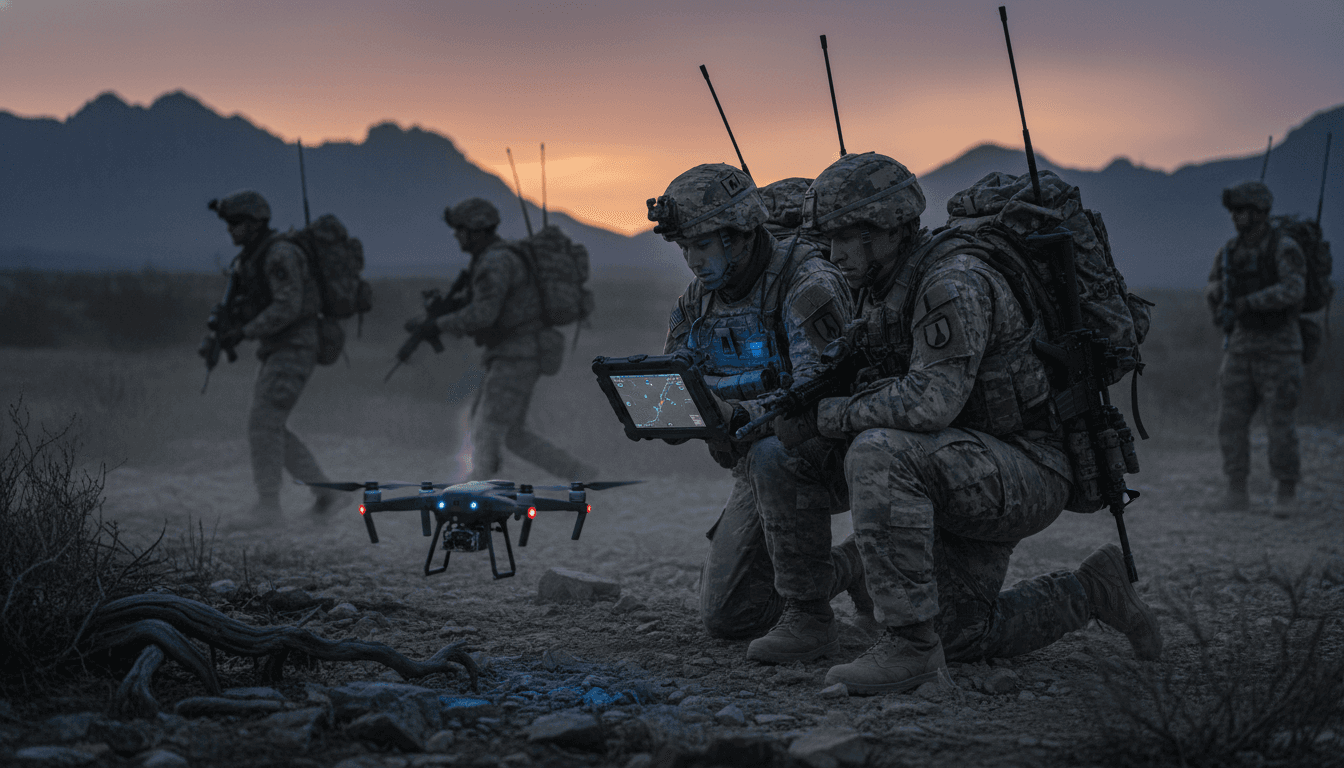
Four soldiers. That’s what it can take today to run a single small-drone “ambush”: one to fly, one to pull security, one to lug gear, one to set up antennas. Brig. Gen. Travis McIntosh put it bluntly: that’s the wrong math.
The Army’s emerging direction—spelled out in a draft unmanned aircraft system (UAS) strategy and reinforced by senior aviation leaders—is a shift from piloting drones to commanding outcomes. Instead of white-knuckle joystick control, the goal is drones that can interpret commander’s intent and execute tasks with disciplined autonomy.
This post is part of our AI in Defense & National Security series, where we track how AI is moving from analysis to operations. The idea of “intent-aware” drones is a practical test of whether AI can be trusted to do something the military actually needs: turn orders into results under real battlefield constraints—limited time, limited bandwidth, and high consequences.
“Commander’s intent” is the real autonomy threshold
The most meaningful measure of battlefield autonomy isn’t how well a drone flies—it’s whether it can act on intent when humans can’t micromanage. That’s the threshold McIntosh described: drones that respond to command, not continuous piloting.
In military doctrine, commander’s intent is the concise statement of the desired end state and purpose of an operation. Humans use it because plans break. Radios fail. Terrain changes. Enemy tactics adapt. Intent helps teams improvise without waiting for permission.
Why intent beats “smart autopilot”
A drone that can hold altitude, avoid obstacles, or follow waypoints is helpful. A drone that can:
- understand the mission’s priority (e.g., “protect the breach force”)
- choose among actions when the environment changes
- keep operating under degraded communications
- report what it did and why
…is operating at a fundamentally different level.
This matters because future fights don’t reward perfect joystick skills. They reward tempo and distributed execution—small units making fast decisions with machines that can keep up.
What “intent-aware” really implies technically
To be clear, intent-aware autonomy doesn’t mean “free-roaming robots.” It usually means:
- Tasking over teleoperation (humans issue goals and constraints)
- Policy-based behavior (the drone follows rules of engagement, geofences, and safety constraints)
- Local decision-making (onboard compute for navigation, perception, and target-related decisions)
- Explainability and traceability (logs, video, and decision rationale for accountability)
Large language models (LLMs) show up here as a translation layer—turning human instructions into machine tasking—while the actual execution still relies on deterministic control, verification checks, and mission-planning logic.
From “hands on the sticks” to “fly drones by command”
Maj. Gen. Clair Gill, the Army’s top aviator, described the coming shift directly: drone operators shouldn’t have to be pilots all the time. The Army wants software that enables drones to take orders, then execute via disciplined algorithms.
That statement signals two big changes in the AI autonomy conversation:
1) Autonomy is a manpower strategy, not just a tech upgrade
Reducing the “four-soldier drone stack” isn’t a nice-to-have—it’s a force design issue. If a squad or platoon needs to carry more drones (and counter more enemy drones), the Army can’t afford an operator tail that grows linearly with every airframe.
If intent-based tasking works, you can:
- compress crew requirements (one soldier can supervise multiple assets)
- expand UAS availability across maneuver elements
- increase persistence (drones keep working even when the operator is moving, firing, treating casualties, or taking cover)
2) Command-and-control becomes the product
Most people still talk about drones like the aircraft is the product. In practice, the control software, interfaces, and integration are what decide whether a unit can scale.
Brig. Gen. David Phillips highlighted a core enabler: common control across UAS types—common interface, common view, common control.
That’s not an IT housekeeping detail. It’s the difference between:
- a battlefield full of stovepiped drone gadgets, each with its own training pipeline
and
- a cohesive autonomous system where mission tasking, deconfliction, and reporting work the same way across platforms.
Cheap drones are easy; trustworthy autonomy is hard
McIntosh’s 101st Airborne soldiers built their own drone—Attritable Battle Field Enabler 101 (ABE)—and drove cost down from roughly $2,500 for common commercial options to about $740 per unit.
That price drop is a strategic signal. Attritable drones change procurement math, logistics planning, and risk tolerance. Commanders can afford to lose drones. They can’t afford to lose time.
The real bottleneck: software that can execute, not just observe
The article hints at a next step: software that can fly the drone and help decide where to drop grenades.
This is the point where autonomy stops being “efficient” and becomes “operationally and ethically loaded.” It forces hard questions that acquisition teams and operational leaders can’t dodge:
- What’s the human-in-the-loop requirement for lethal action?
- How do you validate performance across environments (urban, forest, desert) and enemy countermeasures?
- What’s the fallback behavior when GPS is jammed or video is degraded?
- How do you log and audit actions for accountability?
My view: the fastest path to fieldable intent-aware UAS is to constrain autonomy tightly at first, then expand. Start with missions like reconnaissance, route scanning, perimeter overwatch, comms relay, resupply spotting, or decoy behavior—missions that create real value while keeping risk manageable.
“Universal interoperability” is the quiet make-or-break requirement
The draft strategy’s emphasis on universal interoperability should be read as: the Army wants to avoid building a thousand small drone “apps” that don’t talk to each other.
Interoperability includes:
- identity and access controls (who can task what)
- data formats for sensor feeds and detections
- shared mission tasking standards
- integration into tactical networks and mission command systems
In other words, autonomy isn’t just an AI model. It’s an architecture.
Training and culture: the Army is rebuilding the human side
Autonomy fails when organizations treat it as a gadget, then bolt it onto yesterday’s training. The Army seems to recognize that.
Two changes from the draft strategy stand out:
A new UAS career field: 15X
The new military occupational specialty (MOS) 15X combines the 15W operator and 15E maintainer roles.
This is more than efficiency. It’s a bet that small units need UAS soldiers who can:
- operate under maneuver conditions (moving with infantry/armor)
- troubleshoot hardware in the field
- manage batteries, payloads, spares, and rapid swaps
- understand enough software behavior to diagnose failures and limitations
The cultural shift Gill referenced is real: if UAS soldiers are embedded in maneuver elements, they can’t be treated like a separate “aviation attachment.” They need to fight, move, and communicate like everyone else.
An advanced course that standardizes drone lethality training
Fort Rucker’s UAS Advanced Lethality Course aims to bring soldiers from infantry, artillery, cyber, Special Forces, armor, and more into common training aligned to current doctrine.
That approach mirrors what works in modern AI programs: multi-disciplinary teams. Autonomy isn’t just an aviation function. It’s doctrine, intelligence, cyber/electronic warfare, and mission command.
How intent-aware drones reshape mission planning and execution
Intent-aware drones change the planning cycle by shifting effort from “how to fly” to “how to employ.” That’s a big deal for staffs and commanders.
The new planning primitives: tasks, constraints, and proofs
As autonomy grows, mission planning starts to look like this:
- Task: “screen the left flank from Phase Line Red to Phase Line Blue”
- Constraints: “do not cross Route X; maintain altitude below Y; avoid populated areas; return-to-home on lost link”
- Coordination: “deconflict with artillery airspace and friendly UAS corridors”
- Proof: “report detections with confidence score; attach imagery; log flight path and decision triggers”
The “proof” piece is underappreciated. Commanders will trust autonomy faster when the system can show its work in a way that fits existing operational rhythms.
What this means in contested comms and EW
Battlefield networks will be jammed, spoofed, and overloaded. Intent-based autonomy is a direct answer to that reality:
- If the link drops, the drone can continue the last authorized task.
- If GPS is degraded, it can switch to alternative navigation modes.
- If the operator is forced to move or fight, supervision can remain light-touch.
Autonomy, done correctly, is an electronic-warfare resilience strategy.
Practical checklist: what leaders should demand from “intent-based” UAS
If you’re evaluating AI-enabled drone autonomy—whether as a defense leader, program manager, integrator, or industry partner—push for specifics. Here’s a checklist I’ve found separates demos from deployable capability:
- Clear autonomy modes: manual, supervised autonomy, and constrained autonomy—with unambiguous transition rules.
- Mission constraints you can verify: geofences, no-fly zones, altitude limits, timing windows.
- Robust lost-link behaviors: continue, hold, return, or land—based on mission risk.
- Human authorization points: explicit gates for lethal force and sensitive actions.
- Auditable logs: time-stamped decisions, sensor inputs, and operator tasking.
- Common control interface: one operator workflow across multiple UAS types.
- Training that matches reality: EW, degraded video, misidentification drills, and rapid re-tasking.
If a vendor can’t answer these cleanly, the “commander’s intent” language is probably marketing, not engineering.
Where this is heading in 2026 planning cycles
As the Pentagon and Congress debate budgets and modernization priorities going into 2026, autonomous systems are no longer a science project. The Army’s draft UAS strategy points to a procurement and doctrine shift: scale drones by reducing operator burden, standardizing control, and embedding UAS capability into maneuver units.
The organizations that win in this environment—units, program offices, and industry teams—will be the ones that treat autonomy as a system of systems problem: software, training, networking, doctrine, and accountability.
If you’re building or buying in this space, the most productive question isn’t “Can it fly itself?” It’s: “Can it execute intent safely, repeatedly, and under pressure—and can we prove it?”