Army units tested 75 technologies in island war games. Here’s what it reveals about AI-enabled training, next-gen C2, and readiness in contested environments.
AI-Driven War Games: Lessons from Army Tech Units
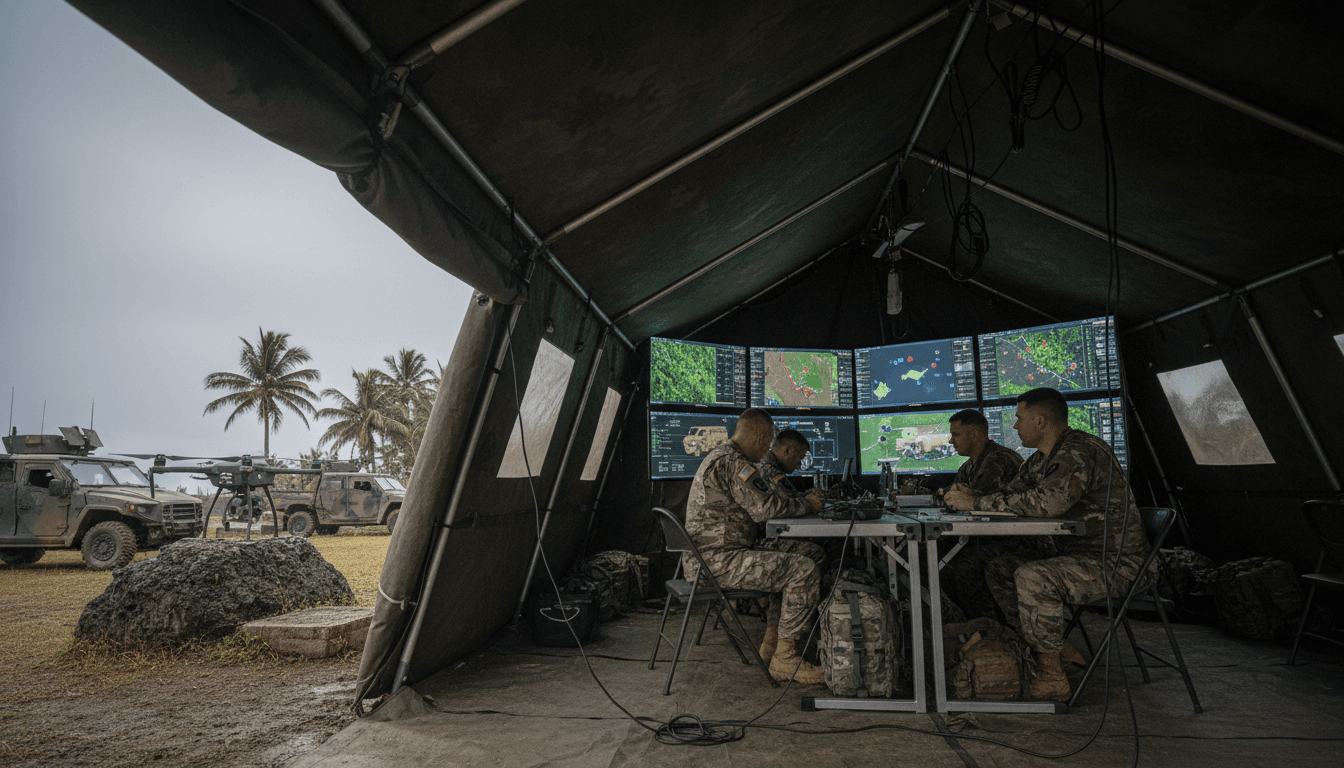
A two-week Army exercise in Hawaii ran 75 technology experiments while simulating island defense and counter-assault operations across an archipelago. That number matters less than where the experiments happened: not in a lab, not in a slide deck, but in a full-up readiness rotation where units had to move, shoot, communicate, and sustain themselves under pressure.
For anyone tracking AI in defense and national security, this is the signal: the U.S. Army is treating modern warfare as a data-and-decision problem as much as a fires-and-maneuver problem. Drones, loitering munitions, electronic warfare, and next-generation command and control (C2) are forcing the Army to practice something many organizations still resist—changing the process, not just adding tools.
The reality? Most modernization efforts fail at the handoff between a promising prototype and a unit that has to live with it. What happened at the Joint Pacific Multinational Readiness Center (JPMRC) points to a better pattern: rapid experimentation, real operator feedback, and faster iteration cycles that look a lot like modern software delivery—only with much higher stakes.
Why AI-enabled training is now a readiness requirement
AI-enabled military training isn’t about flashy autonomy demos; it’s about compressing the time between sensing, deciding, and acting in messy conditions.
At JPMRC, the 25th Infantry Division and partner forces ran scenarios that included amphibious threats, long-range fires, and multi-domain effects. That environment is exactly where AI can make or break outcomes—not by “replacing humans,” but by enabling them to keep shared understanding when everything is moving.
Here’s the key readiness gap the Army is openly trying to close: traditional networks and C2 tools often work before the mission starts. Then units cross the line of departure, move into complex terrain, and shared understanding degrades—because connectivity, interoperability, and data flow degrade.
AI can help, but only if it’s paired with:
- Resilient communications (so data gets through)
- Common data standards (so systems can talk)
- Human-centered interfaces (so leaders can actually use the insights)
- Updated decision authorities (so speed doesn’t die in approval chains)
One line from the exercise captures the whole problem: new tech sped up targeting transmissions, but approval still took around an hour in some cases because units hadn’t updated the process. That’s a classic failure mode in AI adoption: the model is fast, the workflow is not.
What this tells us about AI adoption in the military
If you’re building, buying, or integrating AI for defense, this is the non-negotiable lesson: AI is a system-of-systems problem, not an app.
A model that detects drones faster doesn’t matter if:
- the sensor feed can’t be trusted,
- the data can’t be shared,
- the UI overwhelms the operator,
- or the commander can’t legally/organizationally act on the output.
Modern war games are becoming the place where the Army validates the entire chain from sensing to decision to effects.
The real story behind 75 experiments: continuous transformation
“Try new gear” is easy. Restructure a division while training for war is not.
The Army’s broader push—often described as transformation in contact—is about shortening modernization loops. Instead of multi-year requirements cycles, units test capabilities in realistic exercises, report what breaks, and fix it in weeks where possible.
At JPMRC, that translated into practical, sometimes unglamorous experiments that reveal what actually drives combat effectiveness:
- power generation and charging at the edge
- mobile networks under movement
- drone employment under electronic warfare pressure
- permissioning and authorities for fires
- integration of partners across services and nations
One of the most telling details from the rotation: a unit reported operating for two weeks without outside sustainment for certain mission systems because their vehicle could generate enough power to keep laptops, drones, and satellite receivers running. That’s not a “nice-to-have.” In the Indo-Pacific, where distances are vast and logistics can be contested, power is combat endurance.
AI and autonomy: the mix matters more than any single tool
During the exercise, the Army emphasized that future fires won’t be just traditional artillery. The emerging structure is layered:
- rockets (long-range, fast effects)
- tubed artillery (volume and sustained fires)
- launched effects and drones (reconnaissance, decoys, one-way attack)
- electronic warfare payloads (spoofing, jamming, sensing)
This is where AI shows up in practical form:
- sensor fusion to make drone feeds useful at scale
- target recognition and prioritization to reduce analyst burden
- route planning for unmanned logistics or recon platforms
- electromagnetic spectrum awareness to survive jamming
The question leaders are now asking—out loud—is the right one: traditional artillery still matters (real-world conflicts show massive monthly round expenditures), but how much, and in what combination with rockets and autonomous systems?
That’s not a theoretical debate. It drives procurement, training pipelines, logistics demand, and the industrial base.
Next-gen command and control: where AI either pays off or fails
Next-generation C2 is the backbone for AI in national security. Without it, AI becomes scattered pilots that never scale.
The Army is now putting next-gen C2 into full divisions (including the 25th and 4th Infantry Divisions) rather than limiting it to showcase events. That move is significant because division-level operations are where:
- data volume spikes,
- organizations become complex,
- and coordination becomes fragile.
AI-enabled C2 should do three things consistently:
- Preserve shared understanding while units move
- Reduce time-to-decision without hiding uncertainty
- Support mission command, not micromanagement
The hidden constraint: trust and decision authority
The exercise highlighted a painful truth: even if digital targeting data moves quickly, leaders may hesitate because they don’t trust the chain—inputs, models, or policy constraints.
If you want AI to accelerate decisions, you need to engineer trust deliberately:
- Provenance: Where did the data come from?
- Confidence: How sure is the system, and what drives uncertainty?
- Explainability (practical, not academic): What’s the reason for the recommendation?
- Controls: What can humans override, and how?
Trust isn’t a slogan. It’s measurable in how quickly teams act under pressure.
Cognitive overload is the next readiness crisis
One commander described seeing cognitive overload as new technologies pile up. That’s exactly what happens when organizations adopt AI and autonomy without consolidating workflows.
A simple field truth remains undefeated: when power fails, maps and basics win. The goal isn’t to bury soldiers under screens—it’s to ensure AI reduces mental load.
If your AI tool adds steps, adds dashboards, and adds alerts, you’ve built the wrong thing.
Practical takeaways for defense leaders and solution providers
This rotation offers a blueprint for anyone working in AI for defense and national security—program offices, primes, startups, systems integrators, and operational units.
1) Optimize for the kill chain and the “care chain”
AI discussions fixate on targeting. Exercises like JPMRC show that sustainment and power are just as decisive.
Actionable question: Can your solution operate for 14 days with intermittent comms and limited charging? If not, it’s not Indo-Pacific-ready.
2) Treat workflow redesign as part of the product
If approvals still take an hour, you don’t have an AI problem—you have a governance problem.
Actionable step: ship a concept of operations package alongside the software:
- roles and responsibilities
- decision thresholds
- escalation paths
- training drills under degraded comms
3) Design for “degraded, denied, disrupted” by default
Modern war games assume jamming, intermittent connectivity, and sensor loss.
Actionable requirement checklist:
- offline modes and local caching
- bandwidth-aware data compression
- graceful degradation (less data, still useful)
- robust logging for after-action learning
4) Reduce cognitive load with consolidation, not features
The best AI-enabled C2 products act like a calm staff officer: they summarize, prioritize, and flag what matters.
Actionable design target: one operational picture, fewer clicks, fewer alerts, clearer confidence.
5) Make after-action reviews data-rich and fast
The biggest advantage in AI-enabled training is learning speed. If it takes months to translate observations into fixes, the loop is broken.
Actionable step: instrument systems for:
- decision timelines
- network uptime and latency
- false positives/negatives for detection tools
- operator overrides and why they happened
That’s how you get to “fail fast” without failing repeatedly.
What AI-driven war simulations reveal about tomorrow’s battlefield
War simulations are turning into integration tests for the joint force. They’re where autonomy, networks, electronic warfare, and long-range fires collide with human decision-making.
The biggest myth I still hear is that AI success in defense is mostly about model performance. It isn’t. Model quality matters, but the decisive edge comes from how the force adapts—doctrine, authorities, training, sustainment, and the ability to keep a coherent picture while moving.
That’s why the Army’s experimentation culture matters as much as any individual drone or launcher. The services that learn fastest—while staying disciplined about safety and control—will be the ones that keep initiative in a multi-domain fight.
If your organization is building or buying AI for mission planning, intelligence analysis, autonomous systems, or cyber and surveillance, take a hard look at how you’ll prove it in realistic training—under time pressure, contested comms, and messy human factors. That’s where AI in national security stops being a concept and starts being an advantage.
What part of your AI stack would still work on day 10—when the network is unreliable, operators are tired, and the adversary is actively trying to confuse your sensors?