Europe’s new defense lines aren’t Maginot 2.0—they’re AI-enabled sensor and autonomy networks built for deterrence by denial on NATO’s eastern flank.
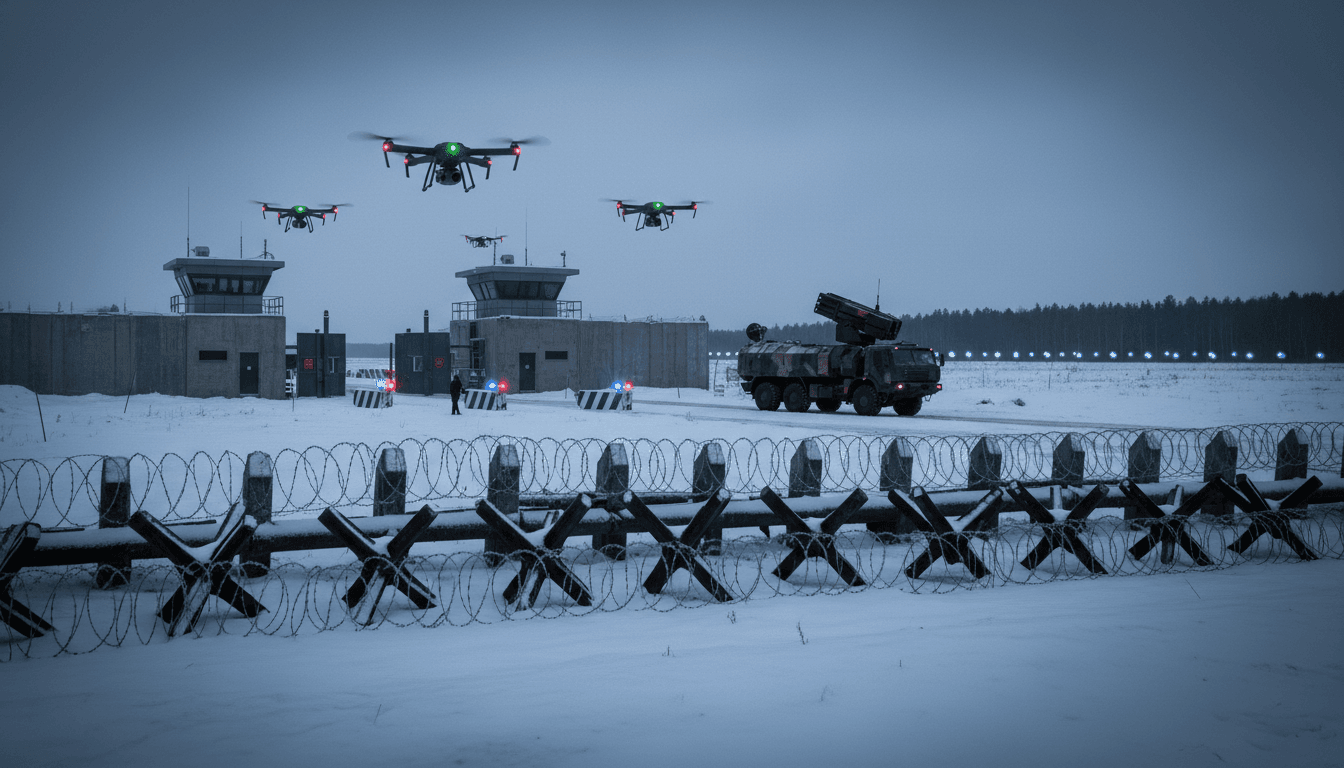
AI-Powered Defense Lines: NATO’s New Deterrence Model
Europe is pouring concrete again—ditches, obstacles, bunkers, hardened positions. But the real story isn’t the concrete. It’s the software.
Since 2022, NATO has shifted toward deterrence by denial: the idea that an aggressor shouldn’t be able to grab territory quickly and then dare the alliance to take it back. That sounds obvious. The hard part is making it real when Europe faces a manpower crunch and Russia keeps testing airspace, borders, and political nerves.
Here’s the stance I’ll defend in this post: Europe’s new defense lines aren’t “Maginot 2.0.” They’re an AI-enabled sensing-and-strike architecture meant to buy time, expose attackers, and let limited forces fight smarter. If you work in defense, national security tech, or procurement, the lesson is practical: infrastructure now includes algorithms, data pipelines, cyber resilience, and autonomous systems—not just barriers.
Why Europe is hardening borders (and why it’s not Maginot)
Europe is building defensive lines because time is the scarcest resource in a Baltic or Polish contingency. Modern conflict compresses decision windows to minutes, and Russia’s operational approach prizes speed, shock, and probing for weak seams.
The Maginot analogy is catchy and mostly wrong. The historical failure wasn’t “fortifications exist.” It was that command and maneuver couldn’t adapt fast enough when the situation changed. A static line becomes a trap if your command structure is slow, your sensors are blind, and your mobile forces are committed in the wrong place.
Today’s defensive lines, at their best, are built for the opposite:
- They’re designed to be porous filters, not a single “do-not-cross” wall.
- They assume constant probing, including drones, electronic warfare, and hybrid activity.
- They’re tied to theater plans, reinforcement corridors, and pre-coordinated fires.
This matters because deterrence by denial isn’t a slogan; it’s a systems problem. If an enemy believes they can move 30–50 km in the first 24–72 hours before NATO coheres, deterrence weakens. Defensive lines are meant to make that early momentum expensive and visible.
The real “line” is a decision loop
A modern border defense is less about where the trench is and more about how quickly the alliance can detect, classify, decide, and act.
That’s an AI problem as much as an engineering problem.
AI doesn’t replace commanders. It reduces latency:
- Detecting anomalies in drone tracks and radar returns
- Correlating reports across nations and sensors
- Prioritizing targets for air defense and counter-UAS
- Predicting where an attacker is shaping for a breach
A memorable way to put it: Concrete slows vehicles; AI speeds decisions. You need both.
NATO’s readiness gap: AI as an “economy of force” multiplier
Europe’s manpower shortage is now a strategic constraint, not a back-office recruiting issue. Several major militaries are struggling to staff full-strength formations, while Ukraine’s war has shown the brutal density needed to hold ground.
When forward presence is limited, you have two options:
- Spread forces thin and accept brittleness, or
- Use technology and terrain shaping to concentrate forces where they matter
Europe’s new defensive lines are the second option—an economy of force approach that tries to preserve scarce, highly trained personnel for mobile counterattack and decisive action.
What “economy of force” looks like in 2025
In practical terms, economy of force on the eastern flank means:
- Unmanned systems doing persistent observation in dangerous areas
- Remote and optionally crewed platforms covering gaps
- Counter-mobility obstacles channeling vehicles into pre-planned engagement zones
- Distributed air defense and counter-UAS protecting nodes and corridors
- Pre-coordinated fires tied to sensor triggers
AI sits in the middle as the traffic controller—helping fuse sensor data, suggest courses of action, and manage scarce interceptors or munitions.
If you’re thinking “this sounds expensive,” you’re right. But it’s often cheaper than the alternative. A network of sensors and attritable drones can cost less than maintaining additional heavy brigades at full readiness year after year—especially in democracies facing aging populations and volatile budgets.
From trenches to networks: what AI changes on a fortified frontier
AI makes fortifications useful by turning them into instrumented terrain. Without that, you just have obstacles. With it, you have a kill chain.
The Ukrainian battlefield has offered a harsh demo of what works: cheap drones, rapid targeting, electronic warfare, dispersed command posts, and constant adaptation. Europe’s defense projects are essentially trying to industrialize those lessons across a continent.
AI-enabled surveillance: persistent detection at scale
Border defense isn’t one sensor; it’s a mosaic:
- Ground radar, acoustic arrays, EO/IR cameras
- Signals collection and spectrum monitoring
- Drone reconnaissance (from commercial quadcopters to longer-range systems)
- Reports from patrols, police, and civilians
AI’s value is in fusion and triage:
- Reduce false alarms
- Detect patterns (reconnaissance, staging, rehearsal behavior)
- Flag high-risk anomalies early
- Create a shared operational picture across units and nations
A line that “sees” is a line that can’t be cheaply surprised.
Autonomous and counter-autonomous systems: the drone wall debate
Skeptics hear “drone wall” and imagine science fiction swarms. The more realistic version is more boring—and more achievable:
- Large numbers of affordable drones
- Redundant comms paths when GPS is jammed
- Automated cueing from radar to interceptor
- AI-assisted classification so operators aren’t drowning in video feeds
Counter-UAS is where AI becomes unavoidable. If hostile drones arrive in waves, humans can’t manually track and prosecute everything fast enough. Automation becomes the difference between a saturated defense and a stable one.
AI-driven logistics and mission planning: the unglamorous advantage
Border defenses don’t run on buzzwords; they run on batteries, spares, munitions, and repair cycles.
AI in defense logistics is one of the highest-ROI areas on the eastern flank because it supports readiness without adding troops:
- Predictive maintenance for sensors, vehicles, and generators
- Inventory optimization for high-consumption items (interceptors, drone parts)
- Route planning under threat (bridges, rail nodes, choke points)
- Rapid reallocation of scarce assets when probing spikes in one sector
If your sensors are down for 72 hours waiting on parts, your “line” is theater. Operational availability is the real metric.
The three failure modes that matter (and how to design around them)
Europe’s new defense lines will succeed or fail on networks, industry, and governance—not on whether the obstacles look intimidating.
1) Network resilience under jamming and cyberattack
Every AI-enabled architecture depends on communications and compute. Russia will contest both.
Design priorities that hold up in real operations:
- Degraded-mode operations (units must fight when the cloud is gone)
- Multi-path communications (fiber, radio, SATCOM alternatives)
- Edge processing so sensors can classify locally and share summaries
- Cyber-hardening and rapid patching as a standing capability, not an annual event
A simple rule: If the system can’t function while jammed, it’s a demo—not a defense.
2) Industrial scale and sustainment, not prototypes
Modern deterrence burns through consumables: drones, batteries, antennas, barrels, interceptors. Europe has expanded munitions production since 2022, but the long-term challenge is steady output and fast replenishment.
For AI-enabled defenses, “industrial base” also includes:
- Sensor manufacturing capacity
- Compute hardware supply chains
- Secure software development and updates
- Test ranges and evaluation pipelines
If the procurement system can’t buy, refresh, and iterate quickly, the adversary adapts faster than you can field fixes.
3) Budget endurance and democratic accountability
Digital defense lines have recurring costs: subscriptions, updates, replacements, training cycles, red-teaming. Democracies tend to prefer big one-time buys.
The practical move is to treat this like critical infrastructure:
- Multi-year sustainment contracts
- Auditable performance metrics
- Clear interoperability standards across nations
- Independent testing for AI model drift and bias
If taxpayers can’t see what they’re paying for, funding becomes fragile.
“People also ask” (and the straight answers)
Will AI replace soldiers on NATO’s eastern flank? No. AI will reduce workload and speed decisions, but soldiers still have to hold terrain, operate under uncertainty, and make judgment calls when data is incomplete.
Are fixed defenses obsolete because they can be bypassed? No. Fixed obstacles matter when they’re integrated with sensors, fires, and maneuver. Their job is to slow, channel, and expose—not to stop everything by themselves.
What’s the biggest AI risk in fortified defense lines? Over-trust. If commanders treat algorithmic outputs as truth rather than inputs, they’ll get surprised. The right approach is human-led decisions with machine-speed support, plus routine red-teaming.
What leaders should do next: a practical checklist
If you’re responsible for modernization, procurement, or capability development, here’s what I’d prioritize in 2026 planning cycles:
- Define the minimum viable kill chain (detect → decide → engage) for each border sector.
- Standardize data formats and interfaces so sensors and shooters can talk across nations.
- Procure for scale and attrition, not boutique performance.
- Fund sustainment first: spares, batteries, repair depots, and training pipelines.
- Build degraded-mode playbooks for jamming, cyber disruption, and GPS denial.
- Measure readiness by availability and latency (uptime, false alarm rates, time-to-intercept), not by slide decks.
One line worth repeating in budget meetings: Deterrence fails when the first 72 hours look easy to the attacker. Your architecture should be built to make those hours look painful.
Where this fits in the “AI in Defense & National Security” series
This post is part of our AI in Defense & National Security series because Europe’s new defense lines show the clearest trend in modern readiness: AI isn’t an add-on capability; it’s the connective tissue between sensors, autonomous systems, cyber defense, and mission planning.
Europe is betting that layered obstacles plus AI-enabled ISR and command-and-control can make deterrence by denial credible even under manpower constraints. I think that’s the right bet—provided NATO treats networks and sustainment as seriously as it treats concrete and brigades.
The next question is the one procurement teams and operational commanders will actually live with: Can the alliance build an AI-enabled defensive network that still functions on the worst day—jammed, degraded, and under attack?