How AI supports ceasefire verification, air defense, and maritime targeting as talks continue and violence persists in the Russo-Ukrainian War.
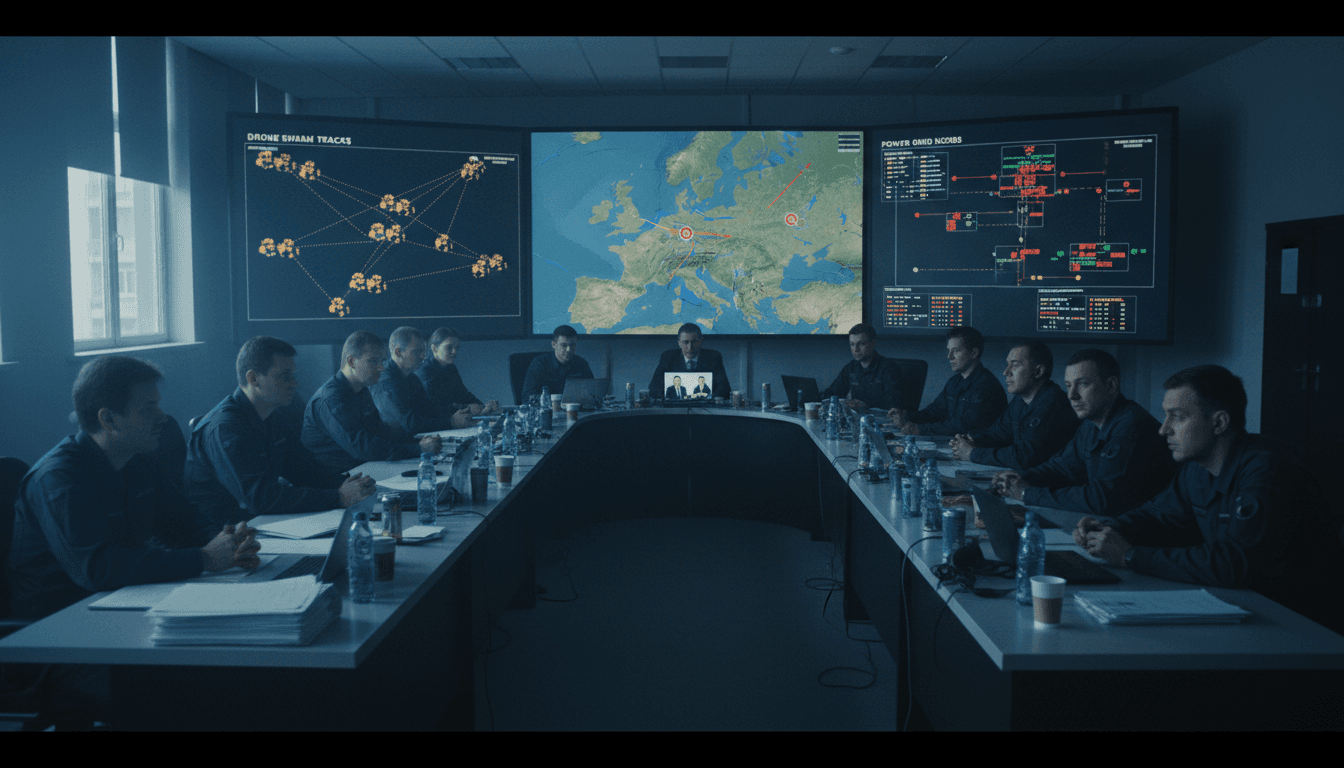
AI for War and Peace: From Ceasefires to Drones
December 2025 has a grim symmetry: negotiators keep meeting while the battlefield keeps moving. Reports out of Europe describe a near-complete outline for ending the Russo-Ukrainian War—security guarantees, a demilitarized zone, arrangements around the Zaporizhzhia nuclear plant, and reconstruction funding tied to frozen Russian assets. At the same time, Russia is pressing winter strikes meant to exhaust air defenses and break Ukraine’s power grid, while Ukraine uses naval drones to hit targets in the Black Sea and disrupt oil exports.
Here’s the part most companies and agencies get wrong: they treat diplomacy and combat as separate lanes. They aren’t. They’re a single system where timelines, perceptions, and logistics feed each other minute-by-minute. That’s why this moment is also a test case for the “AI in Defense & National Security” conversation: not because algorithms replace strategy, but because AI can compress the time from signal → insight → decision across both the negotiating room and the operations center.
This post uses the current talks-and-violence dynamic as a practical backdrop to answer a real operational question: where can AI reduce risk, improve intelligence analysis, and support mission planning without creating new strategic liabilities?
What the current talks reveal: peace plans fail at the seams
The fastest way to understand why ceasefire frameworks break is to look at the seams—verification, enforcement, and ambiguity.
In the reported outlines circulating after meetings among U.S., European, and Ukrainian representatives, familiar pillars show up: a demilitarized zone along a ceasefire line, security guarantees, and a contested set of issues around territory and force posture (including Russia’s demands regarding parts of Donbas). Those aren’t just political problems; they’re information problems.
A demilitarized zone, for example, isn’t a line on a map. It’s a living monitoring challenge:
- Are artillery systems being repositioned just outside the zone?
- Are “police” units actually military units in different uniforms?
- Are drones being launched from civilian infrastructure?
- Are logistics convoys “aid” or ammunition?
AI-enabled intelligence analysis can help here by fusing high-volume signals—commercial satellite imagery, open-source video, ISR feeds, radar tracks, electronic emissions—into a consistent picture. The key isn’t flashy prediction; it’s persistent, defensible attribution.
The negotiator’s blind spot: winter changes the bargaining power
The winter strike campaign highlights a basic reality: infrastructure targeting isn’t just tactical—it shapes diplomatic leverage. When Russia launches large volumes of drones and missiles in short periods, it’s not only trying to hit substations. It’s also trying to force hard choices:
- Do you spend scarce interceptors now or hold them for a worse wave later?
- Do you protect cities, power generation, rail, or air bases?
- Do you accept local outages to preserve national resilience?
AI in mission planning can assist with these tradeoffs through resource allocation models that simulate outcomes across competing priorities (civilian protection, military mobility, industrial continuity). Done right, this produces something negotiators and commanders both need: a shared view of what time buys you.
AI on the modern battlefield: drones turned “tempo” into a weapon
This war has been a running demonstration that drones don’t just add a new platform—they change the pace of war. Russia’s evolving drone tactics, and Ukraine’s use of naval drones in the Black Sea, show how quickly adaptation happens when systems are cheap, numerous, and software-driven.
The operational problem is no longer “Do we have ISR?” It’s “Can we keep up with the ISR we already have?”
The real bottleneck is triage, not collection
When thousands of drones are launched over weeks, and when both sides run constant reconnaissance, you get a flood of observations: launches, routes, decoys, impact points, repairs, redeployments. Humans can’t watch it all.
AI can help by automating the unglamorous parts:
- Event detection: flagging likely launches, impacts, and secondary explosions
- Change detection: spotting new earthworks, damaged transformers, repaired bridges
- Object classification: distinguishing decoys from real systems, or civilian trucks from logistics convoys
- Pattern-of-life analysis: identifying shifts in air defense posture or drone launch rhythms
This matters because air defense and counter-drone operations are dominated by minutes. If your analysis cycle is hours, your adversary’s learning loop wins.
Naval drones and the “shadow fleet”: targeting is an intelligence workflow
Ukraine’s reported naval drone strikes on naval targets and vessels tied to sanctions evasion underscore an under-discussed fact: modern targeting is less about a single “tip” and more about network understanding—ownership structures, AIS behavior, port calls, routing anomalies, insurance patterns, and logistics dependencies.
AI can support maritime domain awareness by:
- Detecting AIS spoofing and suspicious track discontinuities
- Clustering vessels by behavior to identify likely “shadow fleet” patterns
- Linking open-source data with classified indicators to build higher-confidence targeting packages
The risk is obvious too: if the model is wrong, escalation risk rises. So the standard can’t be “pretty accurate.” It has to be auditable and explainable enough to brief decision-makers under pressure.
Can AI make peace talks more effective? Yes—if it’s used for verification and risk
AI doesn’t negotiate. People do. But AI can improve the conditions that make negotiations stick by making three things clearer: compliance, intent, and consequence.
1) Compliance: verifying a demilitarized zone at scale
A demilitarized zone across a long front is essentially a sensor-and-analysis problem. AI can help monitor:
- Vehicle movement counts near key corridors
- Growth of fortifications over time
- Reappearance of banned systems after declared withdrawals
A practical approach I’ve seen work in other contexts is “confidence bands” rather than binary calls. Instead of “violation/no violation,” you report: high-confidence anomaly, medium-confidence anomaly, low-confidence anomaly—paired with what evidence would raise confidence.
That structure reduces the chance that one disputed incident collapses the entire diplomatic process.
2) Intent: separating deception from adaptation
Both sides adapt. Some adaptations are defensive; others are preparations for offensives. AI can help analysts distinguish the two by correlating multiple indicators:
- Logistics throughput + fuel movements + maintenance activity
- New EW emissions + drone attrition patterns
- Air defense redeployments + strike timing
Intent analysis will never be perfect, but it can be more disciplined—less vibes, more measured inference.
3) Consequence: making “what happens next” harder to ignore
Diplomacy often fails because parties don’t internalize downstream consequences.
AI-enabled scenario modeling can quantify second-order effects in ways that are harder to wave away:
- How many days of grid disruption would cut rail throughput by X%?
- How many interceptors are required to sustain a specific protection posture through February?
- What does a ceasefire line imply for humanitarian access times and medical evacuation routes?
Models won’t end arguments. They will force arguments to be about assumptions, which is a healthier place to be.
The risks: AI can speed up mistakes as easily as it speeds up decisions
If you’re evaluating AI for defense and national security, the uncomfortable truth is that failure modes are strategic, not merely technical.
Model risk becomes escalation risk
A misclassified target in a sanctions-evasion network, a false-positive “violation” in a demilitarized zone, or an overconfident prediction about an adversary’s next strike wave can all drive real-world moves.
AI systems need built-in friction:
- Mandatory human validation gates for lethal or escalatory actions
- Provenance tracking for every data source used in an assessment
- Clear rules for what the system is not allowed to infer
Adversaries will attack the model, not just the network
As AI becomes part of intelligence analysis and mission planning, adversaries will target:
- Training data poisoning (feeding bad “ground truth”)
- Deception via decoys designed to trigger specific classifications
- Prompt injection and workflow manipulation in analyst tools
If your AI program doesn’t include red-teaming against deception from day one, you’re building a system that will perform great in demos and fail in conflict.
A practical playbook: where to start with AI in defense planning
The most productive path is to start with decisions that are frequent, time-bound, and measurable—then build upward.
High-impact use cases that fit the current war pattern
- Air defense triage support
- Prioritize tracks, estimate decoy likelihood, recommend sensor-tasking
- Critical infrastructure risk scoring
- Predict restoration bottlenecks and pre-position repair assets
- Ceasefire verification analytics
- Change detection, anomaly reporting, and evidence packaging
- Maritime domain awareness automation
- Shadow fleet patterning, spoofing detection, network mapping
The minimum governance that keeps AI usable under pressure
If you want AI systems that commanders and analysts will actually trust, require these basics:
- Audit logs of data, prompts, outputs, and analyst edits
- Calibration reporting (how often confidence levels match reality)
- Drift monitoring (when performance changes as tactics evolve)
- Clear escalation thresholds (when to hand off to human-only review)
The goal isn’t to slow decisions. It’s to ensure speed doesn’t become recklessness.
Where this leaves leaders in December 2025
Negotiations that occur alongside escalating winter strikes aren’t a contradiction—they’re the normal shape of modern conflict. The parties are bargaining in real time over a moving set of facts: territory, capabilities, infrastructure damage, and public endurance.
For the “AI in Defense & National Security” series, the lesson is straightforward: AI is most valuable where uncertainty is high and time is short—air defense, infrastructure resilience, maritime tracking, and verification of contested claims. But that value only shows up if systems are designed for accountability, not just accuracy.
If you’re responsible for defense innovation, procurement, or national security analytics, the next step is to map your highest-stakes decisions and ask a blunt question: which of these decisions would improve if your team could trust a machine-produced evidence packet in under five minutes?
That’s the line between AI as a buzzword and AI as an operational advantage.