AI-driven defense biotech can speed biosurveillance, readiness, and biomanufacturing. Here’s how leaders can close the China gap and field capabilities faster.
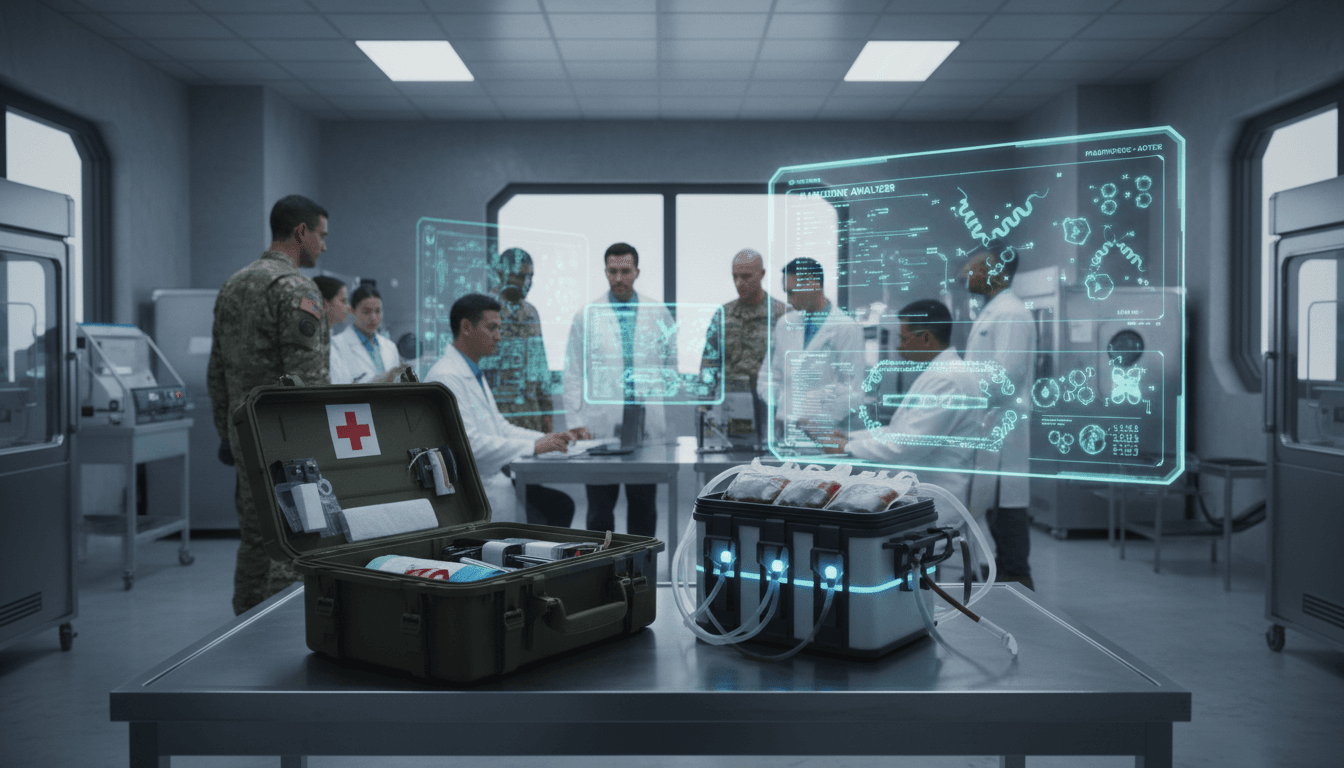
AI-Driven Defense Biotech: Closing the China Gap
A unit takes casualties in a contested area. The medic has minutes, not hours—and the resupply drone is delayed. In that moment, shelf-stable blood isn’t a nice-to-have. It’s the difference between holding ground and losing people.
That’s why the renewed push in Congress for defense biotech research matters—and why it shouldn’t be treated as a niche science project. Lawmakers are warning that the U.S. is falling behind as China accelerates biotech for military and industrial advantage. But the real story for this series—AI in Defense & National Security—is what happens when AI meets biotechnology: faster discovery, better biosurveillance, and systems that can adapt at the edge.
I’m opinionated on this: if the Pentagon writes “biotech strategy” and stops there, it’ll fail. The winning approach is a combined AI + biotech strategy that funds the data, infrastructure, and deployment pathways—not just labs and white papers.
Why defense biotech suddenly looks like a readiness issue
Defense biotech is a readiness issue because it targets three things commanders actually measure: survivability, detection time, and logistics burden.
Sen. Todd Young and other lawmakers have been explicit about the stakes: China is pushing hard on biotechnology, including areas that can translate to military advantage. The U.S., meanwhile, is debating cuts to basic research funding and trying to reconcile “do more with less” realities across government science.
Here’s the practical defense frame:
- Survivability: shelf-stable blood, faster clotting agents, infection countermeasures, and field diagnostics.
- Detection and decision speed: biosensors that flag pathogens or chemical threats in real time.
- Stealth and endurance: bio-inspired materials and “dynamic” camouflage concepts.
- Industrial resilience: biomanufacturing that reduces dependence on fragile global supply chains.
Biotech is moving from “medical support” to operational advantage. The problem is that advantage won’t come from one breakthrough; it comes from a pipeline—discovery to prototyping to validation to fielding.
Where AI fits: the fastest path from lab concept to field capability
AI fits into defense biotech because biology is a data problem before it’s a hardware problem.
Biotech R&D generates massive datasets: genomic sequences, proteomics, metabolomics, microscopy imagery, sensor streams, clinical outcomes, environmental sampling, manufacturing telemetry. Humans can’t meaningfully connect all those dots at speed. Machine learning can.
AI accelerates discovery (and lowers the cost of failure)
The most valuable role of AI in defense biotech is compressing the time between hypothesis and result.
AI methods can:
- Prioritize candidates for therapeutics, vaccines, and countermeasures by predicting binding, toxicity, or stability.
- Improve protein engineering and enzyme design for biomanufacturing.
- Optimize formulations (like heat-stable blood substitutes and plasma components) by exploring combinations humans wouldn’t test fast enough.
- Drive “active learning” loops where the model selects the next best experiments to run.
The defense angle is simple: when the threat changes, you need the ability to respond on a timeline closer to software than traditional pharma.
AI makes biosurveillance operational, not academic
Biosurveillance fails when it’s treated as a reporting function instead of a decision function.
An effective AI-driven biosurveillance stack looks like this:
- Collection: wearable biosensors, wastewater sampling, air samplers, clinical diagnostics, veterinary and agricultural data.
- Fusion: normalize and combine data across bases, allies, and civilian partners.
- Detection: anomaly detection and classification (pathogen signatures, exposure indicators).
- Action: alerts tied to playbooks—PPE changes, ventilation controls, prophylaxis distribution, movement restrictions, or targeted decon.
This is where AI earns its keep: not by “predicting pandemics,” but by shortening time-to-alert and reducing false positives so leaders trust the system.
AI helps field biotech at the edge
Biotech often dies in the “deployment gap.” AI can help by enabling edge decision support:
- Wearable biosensors that don’t just collect vitals, but flag meaningful risk (heat injury, fatigue collapse, altitude effects) with mission-aware thresholds.
- Bio-detection systems that run models locally when comms are denied.
- Predictive maintenance for biomanufacturing equipment in austere environments (yes, manufacturing is a warfighting function if it keeps your force supplied).
Edge AI is a force multiplier only if the models are trained on relevant data and evaluated under realistic conditions.
China, biomanufacturing, and the part most people miss
The most underestimated battlefield in defense biotech is biomanufacturing.
Sen. Young’s comments point to an uncomfortable reality: industrial biotech isn’t just about medicines. It’s about materials, chemicals, and scalable production that can be distributed and hardened.
Why that matters for national security:
- Supply chains snap under stress. Biomanufacturing can localize production of critical inputs.
- Dual-use is the default. The same capability that makes polymers or specialty chemicals can support defense applications.
- Scale wins wars. If a countermeasure works but can’t be produced fast, it’s not a capability.
If China outpaces the U.S. in biomanufacturing scale and speed, the U.S. doesn’t just lose innovation bragging rights—it loses the ability to surge.
AI makes biomanufacturing more competitive by improving yield, stability, and process control. Think of it as quality assurance and optimization at machine speed.
What the NDAA “biotech strategy” should include (so it’s not performative)
A Pentagon biotech strategy only matters if it drives funding decisions, data standards, and acquisition pathways.
Lawmakers have pushed for measures in the National Defense Authorization Act to require an official strategy. Good. But the content of that strategy determines whether it’s a living plan or a binder on a shelf.
Here’s what I’d want to see in a credible AI + defense biotech strategy.
1) A defense-grade data foundation
Biology is noisy. If the data is fragmented, biased, or inaccessible, AI won’t deliver.
A serious plan should mandate:
- Shared data standards for biosensor outputs, lab results, and environmental sampling.
- Secure data environments that support classified and unclassified workflows.
- Clear rules for data rights with academia and industry.
- De-identification and privacy controls for service member health data.
This is where many programs stumble: they fund algorithms but starve the data.
2) Evaluation that mirrors real operational conditions
Biotech prototypes can look great in controlled settings and fail in heat, dust, humidity, vibration, and comms denial.
Strategy should require:
- Test and evaluation plans that include contested logistics scenarios.
- Red-teaming of biosurveillance models (adversarial contamination, spoofing, false signal injection).
- Human factors validation for medics and operators (alerts must be usable under stress).
If you can’t test it like a fight, you can’t trust it in a fight.
3) Fielding pathways that aren’t stuck in medical-only lanes
Many biotech capabilities get trapped in medical acquisition channels even when they have operational relevance.
A workable strategy should:
- Define which capabilities are medical devices vs operational sensors vs platform subsystems.
- Create fast lanes for non-traditional vendors and dual-use startups.
- Align incentives so program offices can adopt biotech without owning all the risk.
Biotech needs a path to units, not just clinics.
4) Workforce and partnerships that acknowledge reality
The U.S. government won’t out-hire the private sector. It can out-organize.
That means:
- Rotational programs between DoD labs, combatant commands, and industry.
- Funding that supports university pipelines without whiplash.
- Regional manufacturing hubs tied to workforce development—something lawmakers explicitly frame as an economic opportunity for “farm country” and industrial states.
This isn’t charity. It’s strategic capacity.
Practical use cases: what AI-enabled defense biotech looks like in 12–36 months
Near-term wins matter because they build trust and budgets.
Here are realistic use cases that align with the congressional concerns and the AI opportunity.
Wearable biosensors for readiness (done the disciplined way)
The goal isn’t “quantified soldier” hype. The goal is fewer preventable losses.
An AI-enabled program should focus on:
- Heat injury prediction using individual baselines plus environment data.
- Fatigue and overtraining detection tied to training schedules.
- Early infection signals in high-density settings (ships, barracks) to reduce mission impact.
If leaders see fewer evacuations and fewer training stand-downs, they’ll keep funding it.
Real-time base biosurveillance that triggers action
A base-level system that fuses sampling, clinic data, and sensor inputs can provide early warning.
The key is governance: who owns the alert, who decides the response, and how you avoid panic.
Shelf-stable blood and logistics-aware casualty care
Shelf-stable blood products are a biotech challenge—but also a planning and optimization challenge.
AI can support:
- Demand forecasting by theater and unit type.
- Inventory placement and rotation strategies.
- Resupply route optimization under threat.
You don’t need perfect autonomy. You need better-than-manual decisions at speed.
Bio-inspired materials and “camouflage” as a sensing problem
Dynamic biological camouflage gets attention because it sounds futuristic. Treat it like a systems engineering problem:
- What signatures matter (thermal, IR, multispectral)?
- What environments (urban, jungle, arctic)?
- What durability and maintenance constraints?
AI helps by modeling detection risk and optimizing materials against real sensor suites.
What leaders can do now (without waiting for a perfect strategy)
If you’re in a defense agency, prime, or venture-backed dual-use company, you can move this forward immediately.
- Pick one operational bottleneck (heat injuries, slow detection, blood logistics) and map it to measurable outcomes.
- Build the data pipeline first. If you can’t collect, label, and share data securely, pause and fix that.
- Design for contested environments. Assume intermittent connectivity and adversarial interference.
- Plan the acquisition path early. Decide whether you’re selling a device, a service, or a system.
- Treat ethics and privacy as engineering constraints. You can protect service member data and still build effective models—if you design for it from day one.
The real choice: lead in AI-enabled biotech or import the consequences
The most direct takeaway from the congressional push is that defense biotech is now strategic competition, not a side project. China’s pursuit of biotech breakthroughs is forcing a decision: invest seriously or accept a widening capability gap.
For this AI in Defense & National Security series, the sharper point is this: AI is the accelerator that turns biotech from slow science into deployable defense capability. If the U.S. wants shelf-stable blood, reliable biosensors, and resilient biomanufacturing, it also needs the AI infrastructure—data, models, testing, and edge deployment—that makes those capabilities real.
If you’re planning 2026 programs right now, here’s the question worth sitting with: Which mission-critical biological risk are you treating like an analytics problem today—and which one are you still hoping someone else will solve in time?