Additive manufacturing isn’t a universal fix for defense production. Here’s how AI makes 3D printing practical—faster qualification, better triage, real readiness gains.
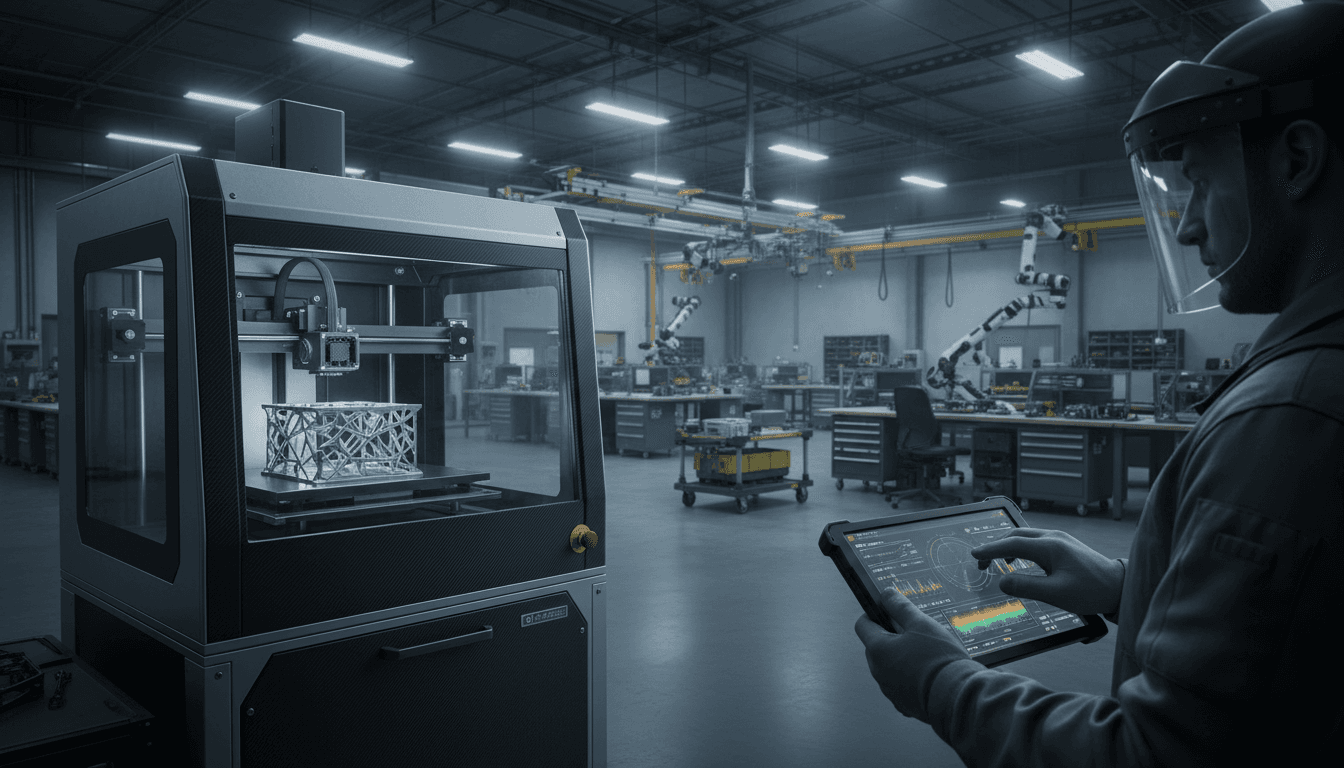
AI + 3D Printing: Fixing Defense’s Production Reality
A lot of defense teams are treating additive manufacturing like a shortcut to industrial surge: buy printers, ship them to depots, and wait for readiness to improve. The money signal is loud. The Department of Defense put roughly $800 million into additive manufacturing in FY2024—a 166% jump year over year—and projects tied to 3D printing rise toward $3.3 billion by FY2026. That’s not a science fair. It’s a strategy bet.
The problem is that many additive programs are being asked to do a job they’re not built for: cheap, high-throughput, repeatable production at scale. Additive can absolutely help the force—especially for hard-to-source spares, low-volume parts, and complex geometries. But if you push it into the wrong lanes, costs spike, schedules slip, and qualification drags.
Here’s the stance I’ll defend: the “mirage” isn’t additive manufacturing itself—it’s thinking additive alone fixes defense production. The practical path is additive plus AI-driven manufacturing intelligence: smarter part selection, faster qualification, tighter process control, and better demand forecasting so the printer is used where it wins.
The additive manufacturing “mirage” is a targeting problem
Answer first: Additive manufacturing looks like a universal solution when it’s really a specialized production method that needs disciplined part selection.
Additive’s promise is easy to sell inside a readiness conversation:
- On-demand spares to reduce long lead times and backorders
- Less dependence on fragile suppliers and overseas sourcing
- Rapid design iteration when threats change or platforms age
- Design freedom for internal channels, consolidated assemblies, and weight reduction
Those aren’t marketing claims—they’re real. The U.S. Army has used depot printing to fabricate obsolete parts to keep vehicles moving. The Navy’s “Print the Fleet” vision has long pointed toward broader afloat and expeditionary production.
But the mirage appears when organizations skip the hard question: Which parts actually benefit from additive versus machining, casting, forging, or sheet forming? One experienced additive expert’s rule of thumb captures it cleanly:
If you can manufacture something any other way, you probably should.
In defense terms, additive is often treated like a readiness accelerant, when it should be treated like a capability within a manufacturing system—with constraints, tradeoffs, and a need for data discipline.
Where additive reliably wins in defense
Answer first: Additive is strongest when tooling is expensive, volumes are low, geometry is complex, or supply chains are brittle.
Additive tends to win when at least two of these are true:
- Low volume / high mix: You need dozens, not tens of thousands.
- High complexity: Internal cooling channels, lattice structures, part consolidation.
- Tooling avoidance: A cast tool or die would take months and cost heavily.
- Obsolescence: The supplier base is gone, drawings are incomplete, or material specs are out of date.
- Operational urgency: The value of time beats the cost premium.
That’s a pretty common defense profile—especially for legacy platforms and sustainment.
The hard truths: cost, throughput, and qualification friction
Answer first: Additive struggles when programs need fast cycle times, low unit costs, consistent properties, and straightforward certification pathways.
Even advocates inside aerospace and defense have started to say the quiet part out loud: additive is a powerful tool, and a costly mistake when misapplied. The recurring limitations show up across services and primes.
1) Cost per part is still a major limiter
Answer first: For many metal parts, additive’s economics lose to conventional processes once you account for machine time, powder cost, and post-processing.
Industrial metal printers are slow, and machine time is expensive—often a dominant share of unit cost. Feedstock powders can be far more expensive than bar stock or sheet metal. Add post-processing (heat treatment, HIP where required, machining, surface finishing), and the “print” becomes the smallest part of the job.
If you’re printing simple brackets because it feels modern, you’re paying extra for no operational benefit.
2) Throughput doesn’t match surge fantasies
Answer first: Additive can surge availability of specific parts, but it doesn’t surge mass production the way forging lines, casting, or CNC cells can.
Defense surge is usually measured in rates: missiles per month, airframes per year, engines per quarter. Additive can help unblock bottlenecks, but it isn’t automatically the answer for high-rate production—especially in metal.
A printer farm can produce meaningful volume, but only if you plan around:
- Build queue scheduling
- Powder handling and reuse constraints
- Maintenance cycles
- Operator staffing
- Post-process capacity (often the real bottleneck)
3) Qualification and material variability slow adoption
Answer first: Printed parts can meet many requirements, but achieving consistent wrought-like properties and certifying repeatability remains difficult for critical applications.
Many defense programs correctly limit additive usage to non-critical components or require long parallel test campaigns for flight- or safety-critical hardware. Printed material behavior can vary by machine, parameter set, orientation, and lot—meaning your “process” is as important as your “design.”
This is why many public “success stories” are pilots or demos rather than sustained serialized production. The work is real; the scaling is hard.
Why AI is the missing layer for defense additive programs
Answer first: AI improves additive outcomes by selecting the right parts, controlling process variation, predicting failures, and optimizing the end-to-end production system.
Most additive programs are still judged like a technology rollout (“Did we buy printers?”). That’s the wrong metric. The metric should be: Did we improve readiness per dollar and per day?
AI is most useful when it’s applied to the manufacturing system around the printer—where the friction actually lives.
AI use case #1: “Should we print this?” part triage at scale
Answer first: Use AI to rank candidate parts based on geometry, demand frequency, lead time risk, certification burden, and cost tradeoffs.
Defense has enormous catalogs of parts, many with incomplete digital threads. The first win is deciding what not to print.
A practical AI-enabled triage model can score parts using features like:
- Historical backorder frequency and lead time variance
- Supplier risk (single-source, foreign dependence, fragile tier-2)
- Tooling lead time and minimum order quantities
- Geometry complexity indicators (thin walls, internal channels, overhangs)
- Safety criticality and certification pathway difficulty
- Total post-processing load (machining steps, NDT requirements)
The output isn’t “AI says print it.” It’s a prioritized queue: print, machine, cast, re-source, redesign, or stock. That’s how additive becomes a readiness tool instead of a science project.
AI use case #2: In-situ monitoring and defect prediction
Answer first: Machine learning can detect print anomalies early, reduce scrap, and support tighter quality assurance.
Additive quality assurance is expensive because programs often rely on heavy inspection and conservative allowables. AI can help by learning signatures from:
- Melt pool sensors
- High-speed camera imagery
- Acoustic emissions
- Thermal profiles
- Layer-by-layer scan data
This matters because defense doesn’t just need parts—it needs trusted parts. Early defect detection shortens cycles and reduces the number of “surprise failures” found during CT scans or destructive testing.
AI use case #3: Digital thread acceleration for qualification
Answer first: AI can help translate legacy drawings, normalize specs, and build traceable manufacturing records that auditors and engineers can trust.
A huge share of sustainment pain comes from messy documentation: outdated drawings, unclear tolerances, missing material callouts, tribal knowledge living in email.
Applied carefully, AI can:
- Extract tolerances and notes from scanned drawings
- Flag inconsistent specs across revisions
- Generate structured bills of process for review
- Assist with controlled, auditable documentation (human-approved)
The payoff is speed. Not “skip safety,” but reduce the administrative drag that keeps printers idle.
AI use case #4: Demand forecasting and distributed production planning
Answer first: AI-driven logistics makes additive more valuable by ensuring you print the right part at the right node before the shortage hits.
Printing a spare part after a vehicle is deadlined is still better than waiting six months—but it’s not the best you can do. Predictive maintenance and demand forecasting can move additive upstream:
- Anticipate failure rates by platform, environment, and usage
- Pre-position powder, fixtures, and inspection capacity
- Decide whether to print at depot, regional hub, shipyard, or vendor
This connects additive manufacturing directly to the broader AI in Defense & National Security theme: smarter sensing, smarter prediction, smarter resourcing.
A pragmatic model: additive as one node in “hybrid manufacturing”
Answer first: Defense readiness improves fastest when additive is integrated with machining, forming, casting, and supplier networks—managed through AI-enabled decision support.
The healthiest manufacturing organizations don’t ask, “How do we print more?” They ask, “How do we ship conforming parts faster at lower risk?” The answer is usually hybrid.
Here’s what that looks like in practice:
Build a “manufacturing options playbook” by part family
Answer first: Group parts by geometry, material, and certification needs, then assign default processes with exception rules.
Example approach:
- Brackets, mounts, simple housings: default to CNC or sheet forming
- Ducts, manifolds, thermal components: evaluate additive first
- Legacy obsolescence spares: additive for bridging, then re-source or redesign
- Safety-critical rotating parts: default conventional unless additive has mature allowables
Then use AI triage to identify exceptions worth reviewing.
Treat post-processing as a first-class constraint
Answer first: If your machining, heat treat, and NDT queues are full, your additive program will look like it “can’t scale.”
Many organizations buy printers and forget the downstream reality. A balanced cell might require investments in:
- Heat treat capacity and recipe control
- HIP (where needed)
- Metrology and NDT staffing
- CNC finishing capacity
- Consumables and powder lifecycle management
AI helps here too: schedule optimization across printers and post-process steps is often where cycle time is won or lost.
Use readiness metrics, not printer metrics
Answer first: The north-star KPI should be readiness impact—like reduced aircraft-on-ground time—not utilization rates.
Printer utilization can be a vanity metric. Better measures include:
- Mean time to deliver a classified list of “pain” spares
- Cost per day of downtime avoided
- Scrap rate and rework hours per build
- Qualification cycle time (idea → approved part)
- Supplier risk reduction for top critical components
People also ask: can AI “solve” additive manufacturing’s limits?
Answer first: AI can’t change physics, but it can dramatically reduce waste, improve repeatability, and ensure additive is used where it wins.
AI won’t make metal printers as fast as stamping presses. It won’t automatically grant wrought-equivalent properties across every alloy and geometry. What it will do is make additive programs more selective, more predictable, and easier to certify—turning additive into a reliable readiness instrument.
If you’re building a 2026–2030 defense manufacturing roadmap, the smart bet is not “additive everywhere.” It’s AI-orchestrated hybrid manufacturing—with additive as a high-value capability inside a larger production and sustainment system.
Next steps for defense leaders who want results (not demos)
Additive manufacturing funding is rising for a reason: the demand signal from sustainment and contested logistics is real. But the fastest path to impact is discipline.
If you’re responsible for readiness, supply chain resilience, or industrial base modernization, here are three moves that pay off quickly:
- Stand up an AI-driven part triage pipeline tied to real backorder and lead-time data.
- Invest in inspection and post-processing capacity as seriously as printers.
- Pilot in-situ monitoring with clear acceptance criteria, then scale only after scrap and rework drop.
The question worth carrying into 2026 planning cycles is simple: Are we buying additive manufacturing capacity, or are we building an AI-enabled production system that happens to include additive?