Europe’s new defense lines pair fortifications with AI-enabled sensing and counter-UAS. Here’s why deterrence by denial now depends on networks and automation.
AI-Powered Defense Lines: NATO’s Deterrence by Denial
Europe is pouring concrete again—and it’s also deploying algorithms.
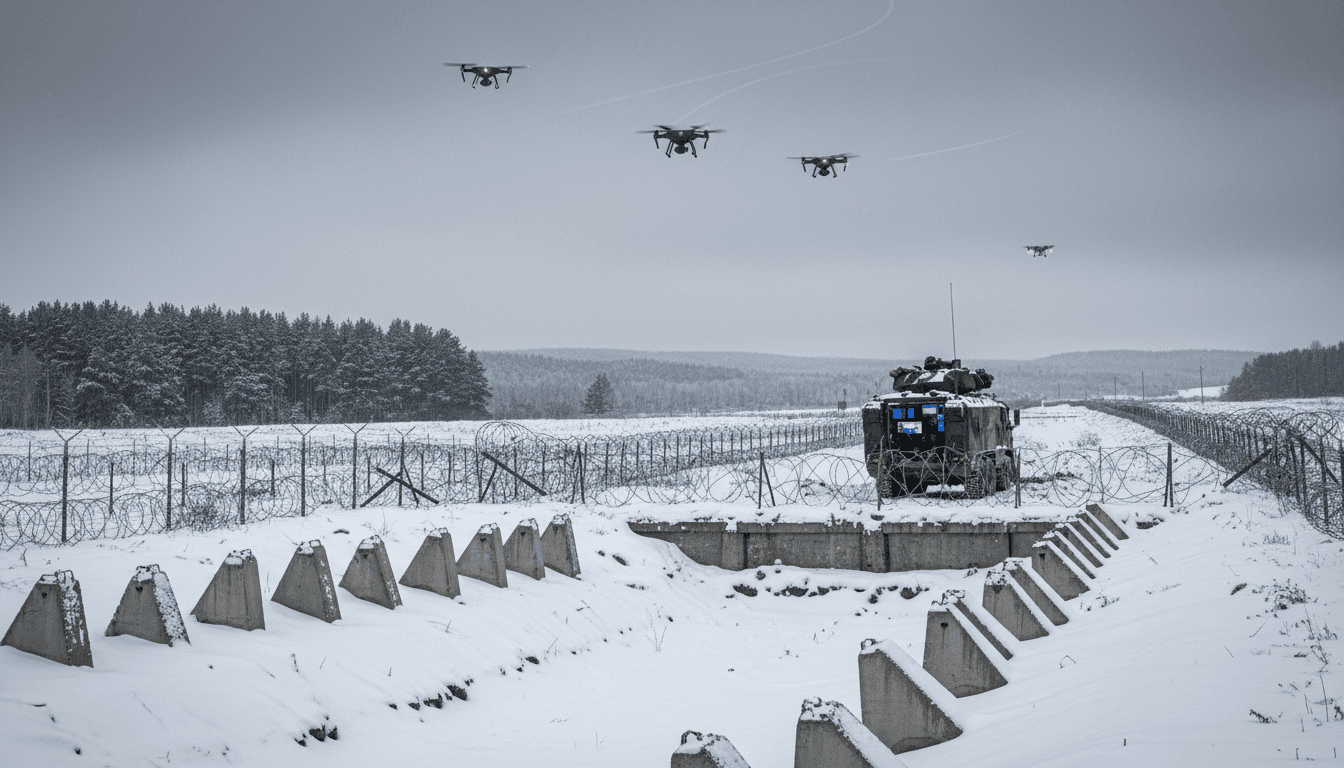
Across the eastern flank, countries are building anti-tank ditches, barriers, and hardened positions while wiring them into a mesh of drones, radars, acoustic sensors, and digital command posts. Critics keep reaching for the same historical punchline: “This is Maginot 2.0.” I don’t buy it. The new lines aren’t designed to sit there looking impressive on a map. They’re designed to sense first, decide fast, and force an attacker to pay immediately.
For anyone following the AI in Defense & National Security space, this is the most important part: Europe’s border defenses are becoming an operational testbed for AI-enabled surveillance, counter-UAS, sensor fusion, and decision support at national and alliance scale. The hardware is visible. The real shift is the software and networks that make the hardware matter.
Deterrence by denial needs machines, not just manpower
Deterrence by denial works when you can stop the first move—not punish the second. NATO’s shift since 2022 has been away from “we’ll take it back later” and toward “you won’t take it in the first place.” That sounds simple until you do the math.
Ukraine has had to field well over 100 brigades to hold against Russia. NATO’s forward presence on the eastern flank has expanded, but forward-deployed multinational units alone can’t match the density modern defense demands—especially when Europe is dealing with a very real manpower shortage in several large militaries.
That gap is exactly why fortified, networked defense lines are back.
Why static obstacles matter in an AI-enabled fight
Obstacles (ditches, dragon’s teeth, wired routes, hardened points) aren’t there to “stop” a mechanized force by themselves. They’re there to do three practical things:
- Slow the attacker enough for defenders to respond.
- Channel movement into predictable lanes.
- Expose formations to precision fires and loitering munitions.
AI enters the picture because slowing and channeling only pays off if you can detect and target fast. The modern “line” isn’t a wall. It’s a kill chain accelerator.
A 1940-style fortification is concrete that waits. A 2025 defense line is concrete that reports.
“Maginot 2.0” misses the real lesson of 1940
The real lesson from the Maginot Line isn’t “fortifications are useless.” It’s that fortifications without a responsive command structure—and without mobile forces positioned to exploit what the defenses create—turn into theater.
Modern planning is explicitly trying to avoid that trap. The new approach treats border defenses as sensors and battle-management infrastructure, not as places to hide. When a sensor trip or drone track indicates a breach attempt, the goal is immediate translation into:
- a recognized track in the common operational picture
- a prioritized target list
- a fire mission or interception plan
- a maneuver decision to counterattack or block
The “digital shield + mobile sword” model
One of the most useful mental models is economy of force with machines, not people.
- Unmanned and optionally crewed systems can hold observation posts, patrol likely routes, and maintain persistent surveillance.
- Manned maneuver units stay concentrated and protected, ready to counterpunch instead of being scattered along hundreds of kilometers.
This is a hard-nosed answer to the personnel problem: keep humans for the decisions and decisive action, and assign the repetitive, high-risk, always-on tasks to systems.
That’s not sci-fi. It’s the same logic driving modern counter-UAS networks, autonomous ISR, and AI-assisted targeting workflows.
The “drone wall” isn’t futurism—it’s systems integration
The most credible version of a “drone wall” is not a magical autonomous swarm. It’s a layered network of affordable drones, passive sensors, radars, EW, and interceptors tied together with resilient communications.
Ukraine proved a blunt reality: inexpensive drones can destroy expensive vehicles, and the side that connects sensors to shooters faster wins more engagements. The main innovation isn’t the airframe. It’s the workflow.
What AI actually does in border defense (and what it shouldn’t)
A lot of hype focuses on “fully autonomous defense.” That’s not where the real value is right now.
AI is most useful when it improves three bottlenecks:
- Detection: filtering false alarms in dense sensor environments (birds, weather, civilian traffic).
- Classification: distinguishing quadcopters, loitering munitions, helicopters, ground vehicles, and decoys.
- Prioritization: ranking threats by proximity, intent indicators, payload likelihood, and mission risk.
Where AI should be constrained is equally important:
- Rules of engagement shouldn’t be outsourced to opaque models.
- Escalation control needs human judgment, especially in “hybrid” probing scenarios.
- Target confirmation still demands redundancy—multiple sensor types and human verification for sensitive engagements.
A practical architecture is human-on-the-loop: AI handles triage and speed, humans retain authority and accountability.
Counter-UAS as the new air defense baseline
The eastern flank is increasingly shaped by drone incursions and probing behavior. That’s not a side show; it’s rehearsal.
Recent NATO activities and deployments highlight the direction: distributed detection, electronic protection, and AI-enabled interceptors that can operate in contested conditions like GPS jamming. The operational point is straightforward: if your border defenses can’t defeat cheap drones at scale, your fortifications and maneuver units get spotted, mapped, and hit.
For defense leaders, this changes procurement priorities. Counter-UAS isn’t a niche capability anymore. It’s baseline force protection.
The real value: buying time in minutes and hours, not weeks
Modern deterrence is measured in minutes. If an attacker can achieve surprise, create chaos, and seize key ground quickly, reinforcement and political decision-making lag behind events. Border defenses are built to deny that tempo.
Well-designed lines create delay, and delay creates choices:
- Time to activate national readiness measures
- Time to move reserves into blocking positions
- Time to disperse high-value assets
- Time to surge counter-UAS and air defense coverage
This is why the most important output of an AI-enabled defense line isn’t “stopping everything.” It’s preventing a fast collapse.
AI-driven logistics and reinforcement corridors
Most conversations fixate on sensors and drones. The overlooked piece is reinforcement.
Deterrence by denial requires that NATO can move forces through specific corridors quickly, repeatedly, and under threat. AI can materially improve this through:
- Predictive maintenance for transport fleets and air defense assets
- Route optimization under dynamic constraints (bridges, weather, threat zones)
- Demand forecasting for fuel, ammunition, and spare parts
- Deconfliction between civilian movement and military mobilization
If you want an “AI in national security” use case that pays off without touching trigger authority, logistics is it. It’s measurable, auditable, and directly tied to readiness.
Three hard problems Europe has to solve (or the lines won’t work)
The defenses only matter if the network, industry, and funding survive contact with reality. Here’s where programs succeed or fail.
1) Resilient networks under cyber and EW attack
Every sensor web depends on communications that will be jammed, spoofed, or attacked.
What works in practice is layered resilience:
- multiple bearers (fiber, microwave, SATCOM, line-of-sight relays)
- degraded-mode operations (local autonomy when disconnected)
- rigorous zero-trust access controls
- continuous red-teaming and cyber hygiene
A defense line that can’t communicate becomes a row of isolated bunkers.
2) Industrial capacity for drones, munitions, and spares
Europe has increased artillery ammunition output dramatically since 2022, but sustaining a sensor-and-drone-heavy posture demands more than surge production.
It requires:
- multi-year contracts that justify factory expansion
- standardized components across allies where possible
- stockpiles of expendables (batteries, rotors, optics, antennas)
- rapid repair pipelines for attritable systems
A “drone wall” is not a one-time purchase. It’s an ongoing consumption model.
3) Budget durability for software-defined defense
Software-defined capability introduces a problem democratic budgeting isn’t great at: recurring costs.
AI models need retraining. Sensors need calibration. Firmware needs patching. Security updates are constant. If funding drops after an election cycle, performance decays quietly until the next crisis.
The countries that succeed will treat digital defense like they treat aircraft readiness: a continuous operating expense, not a capital project.
What defense and security leaders should do now
If you’re responsible for capability, procurement, or strategy, the eastern flank offers a clear checklist. These are the moves that translate “AI-enabled deterrence” into something operational.
- Build the kill chain as a product, not a program. Measure sensor-to-decision and sensor-to-shooter time monthly, then iterate.
- Prioritize interoperability over bespoke perfection. A good system that plugs into allies beats a great one that doesn’t.
- Invest in counter-UAS density. Coverage matters more than exquisite specs.
- Design for degraded operations. Assume GPS denial, comms disruption, and cyber intrusion from day one.
- Treat data like ammunition. Data labeling, model governance, and audit trails aren’t paperwork—they’re readiness.
Where this fits in the AI in Defense & National Security story
Europe’s new defensive lines show what “AI in national security” looks like when it stops being a lab demo and becomes a continent-scale operating concept. The AI isn’t there to replace armies. It’s there to multiply limited forces, compress decision timelines, and deny an adversary the quick-win psychology that modern Russian operations depend on.
The stakes are bigger than Europe. The same patterns—sensor fusion, attritable drones, counter-mobility engineering, resilient networks, and AI-assisted command and control—translate to other theaters and other border security problems. The details change. The logic doesn’t.
If your organization is building or buying AI-enabled surveillance, autonomous systems, mission planning tools, or counter-UAS capabilities, Europe’s eastern flank is the clearest signal of where requirements are heading next. What would it take for your systems to keep working when the network degrades, the drones come in waves, and the decision window shrinks to a few minutes?