AI-driven maritime awareness is becoming essential in the Black Sea. See what 2026 demands for surveillance, mission planning, and coalition coordination.
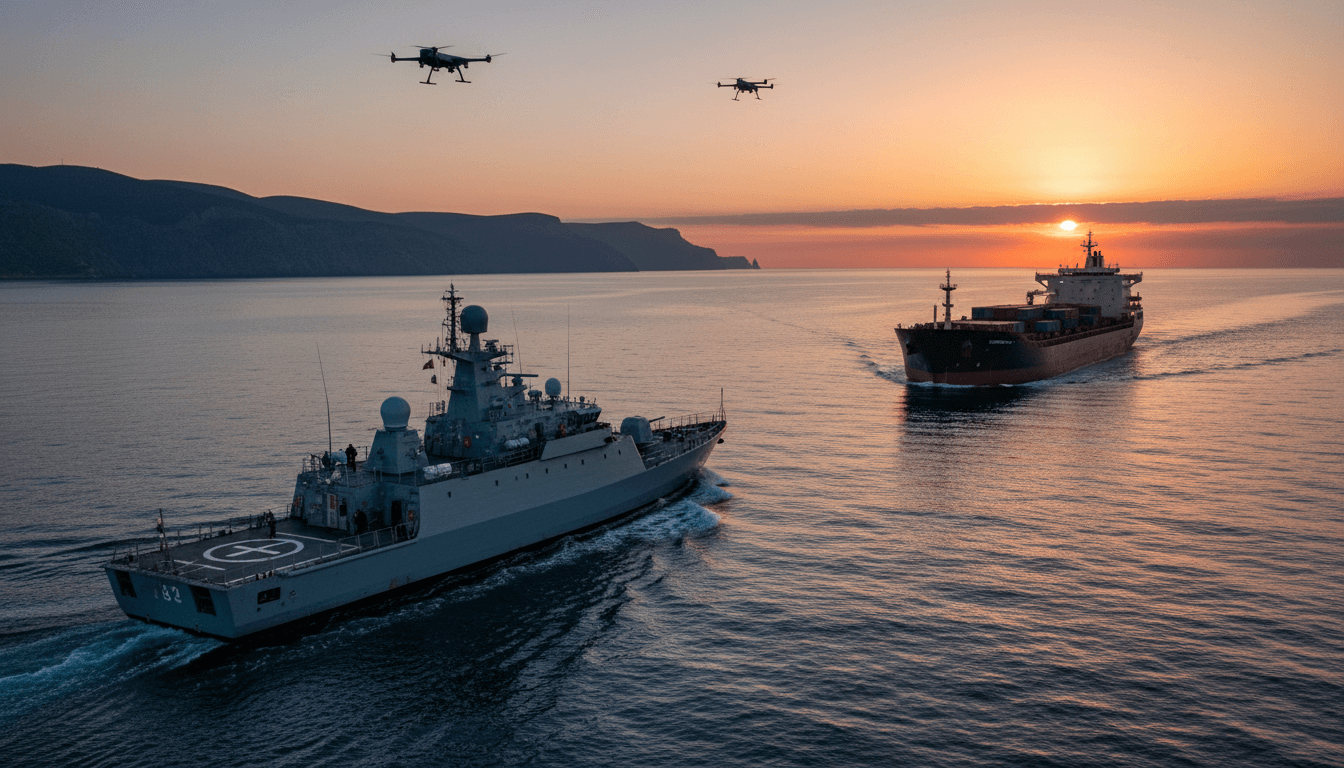
AI and the Black Sea Outlook: What 2026 Demands
A single drone strike on the wrong ship in the Black Sea can ripple into higher insurance rates, delayed grain shipments, and political pressure in NATO capitals within days. That’s not a metaphor—2025 already showed how quickly maritime incidents can jump from “regional” to “global.”
The Black Sea outlook for 2026 is still anchored to one variable: the trajectory of Russia’s war against Ukraine and the political push around it. But the underappreciated story is how the region’s security competition is changing shape. It’s becoming more data-driven, more automated, and faster than traditional command-and-control processes were built to handle.
This post is part of our “AI in Defense & National Security” series, and I’m going to take a clear stance: in 2026, AI-enabled maritime domain awareness and AI-assisted mission planning won’t be “nice to have” for Black Sea stakeholders—they’ll be the price of admission if you want to deter escalation, protect shipping, and coordinate coalitions under pressure.
The 2026 Black Sea problem isn’t “more threats”—it’s faster threats
The central challenge in the Black Sea is not a shortage of intelligence or a lack of capable militaries. It’s that the region is now a high-tempo contest across sea, air, cyber, and information, where decisive moments show up with little warning.
We saw the ingredients in late 2025: Ukrainian drones reportedly struck sanctioned, unregistered tankers moving through Turkey’s exclusive economic zone, tied to Russia’s oil revenue pipeline and so-called shadow shipping. Russia, in turn, signaled it could target commercial vessels bound for Ukraine—a threat that directly touches food security and global supply chains.
Here’s the uncomfortable truth: when escalation can be triggered by small, ambiguous events—an unmanned surface vehicle track, spoofed AIS data, a drone launch near a shipping lane—human-only workflows break down.
Why speed changes everything
In maritime security, time is a weapon. The side that can:
- detect anomalies first,
- classify them correctly,
- share the picture with partners,
- and decide proportionate action
…gets to shape the narrative and the tactical outcome.
AI doesn’t replace commanders. It changes the clock speed of command by automating triage and improving confidence under uncertainty.
A useful way to phrase it:
Deterrence in the Black Sea increasingly depends on who can turn raw sensor data into trusted decisions fastest.
AI-driven maritime domain awareness: the foundation coalition partners keep underbuilding
If you want one practical priority for 2026, it’s this: build a common, AI-assisted maritime picture that coalition partners actually trust.
Maritime domain awareness (MDA) in the Black Sea is hard for three reasons:
- Dense commercial traffic makes it easy to hide.
- Electronic warfare and spoofing undermine “what you see.”
- Jurisdiction and alliance politics complicate “who can share what.”
AI helps most when it’s used for pattern-of-life analysis rather than “magic object detection.” In this environment, the decisive signal is often behavioral:
- A tanker that routinely goes dark when approaching certain corridors
- AIS tracks that don’t match radar or satellite cues
- Unusual rendezvous patterns consistent with sanctions evasion
- Port approach behaviors that correlate with past hostile activity
What “good” AI-enabled MDA looks like in 2026
A credible Black Sea MDA stack typically combines:
- Multi-source fusion: satellite imagery, coastal radar, EO/IR feeds, AIS, acoustic sensors, open-source reporting
- Anomaly detection models tuned to local patterns (Black Sea behavior differs from the Gulf or Baltic)
- Confidence scoring and explainability that let watch officers justify alerts
- Human feedback loops so models improve as tactics change
The payoff is operational, not theoretical: fewer false alarms, faster classification, and a more stable “shared truth” across partners.
The “shadow fleet” is an AI problem as much as a sanctions problem
Russia’s wartime economy depends heavily on energy revenue. The shadow shipping ecosystem thrives on opacity—false flags, opaque ownership, ship-to-ship transfers, and informational fog.
AI can pressure that ecosystem by identifying network behaviors:
- shipping companies and vessels that cluster around known evasion routes
- repeated port/anchorage patterns tied to high-risk transfers
- timing correlations between sanction announcements and route changes
If you’re serious about maritime security in the Black Sea, you can’t treat this as a paperwork issue. It’s an intelligence production issue—and AI is built for scale.
AI-assisted mission planning: the difference between “presence” and real protection
Coalitions often respond to risk with presence: more patrols, more announcements, more exercises. Presence matters, but in 2026 it won’t be sufficient.
The Black Sea is a constrained operating environment with:
- long-range precision strike threats,
- unmanned systems,
- mining and demining requirements,
- and politically sensitive rules around naval access.
That combination creates a mission-planning headache: you need to protect shipping and infrastructure while minimizing escalation risk and operating within tight legal frameworks.
AI-assisted mission planning shines here because it can evaluate many options quickly while incorporating constraints humans struggle to juggle in real time.
Where AI actually helps planners (practical use cases)
AI planning tools are most useful when they do four things well:
- Route and timing optimization for escorts and patrols, factoring threat envelopes and weather/sea state
- Risk scoring of ports, corridors, and approaches, updated with new intelligence
- Asset-task matching (manned/unmanned mix) based on availability, endurance, and mission priority
- Course of action comparison with transparent assumptions (so leadership can challenge inputs)
One specific 2026 scenario: protecting seaport infrastructure while managing drone and missile threats. An AI-assisted plan can:
- recommend patrol patterns that maximize detection probability,
- suggest sensor placements for early warning,
- and simulate how quickly forces can respond under different attack sequences.
That’s not “automation for its own sake.” That’s what keeps commercial shipping moving when the strategic temperature rises.
Countering maritime escalation: AI + rules + coordination (not just hardware)
The source outlook highlights a real risk: maritime escalation driven by attacks on tankers and threats to commercial vessels bound to Ukraine.
The common mistake is thinking escalation control is mainly about capability—more drones, more ships, more missiles. Capability matters. But escalation control is also about interpretation and signaling.
AI contributes by improving three things that shape escalation dynamics:
1) Attribution speed
When an incident happens—an explosion near a tanker, GPS interference, a drone sighting—leaders immediately ask: Who did it? Was it intentional? What’s the next likely move?
AI-supported fusion can shorten the time between incident and credible assessment, reducing the odds of:
- retaliating on bad information,
- letting an adversary set the narrative,
- or missing a follow-on strike window.
2) Deception resistance
The Black Sea is a friendly environment for deception: spoofed identity signals, manipulated imagery, coordinated disinformation.
AI can harden defenses when used to cross-check inconsistencies across data types. If AIS says one thing, radar another, and satellite imagery a third, an AI system can flag the mismatch quickly and route it to analysts.
3) Partner coordination under pressure
Ukraine has urged regional actors to expand coordination mechanisms—demining, patrols, broader domain awareness, even a form of “sky shield” to protect seaport infrastructure.
Whether those exact proposals materialize or not, the operational need is clear: shared situational awareness and shared playbooks.
AI helps when it’s deployed as a coalition enabler:
- common data schemas and labeling
- shared alert taxonomies (so “high risk” means the same thing across teams)
- multilingual reporting support
- automated dissemination that respects classification and releasability rules
A blunt line that holds up in practice:
Coalitions don’t fail because they lack data. They fail because they can’t agree on a picture fast enough to act together.
The 2026 capability checklist: what defense teams should build now
If you’re a defense technology leader, an intelligence manager, or a program office supporting Black Sea-related missions, here’s the build list that matters in 2026.
1) AI-ready data pipelines (before new models)
Most teams want to start with models. Start with data.
- Standardize sensor metadata (time, location, uncertainty)
- Create audit trails for how an alert was generated
- Use role-based access controls aligned to coalition sharing realities
If you can’t answer “why did the system flag this vessel?” you’ll lose operator trust fast.
2) Maritime anomaly detection tuned to local reality
Train for local patterns and seasonal shifts. The Black Sea winter operating picture differs sharply from summer traffic flows.
- Build seasonality into baselines
- Validate against known incidents and near-misses
- Keep humans in the loop for label quality
3) Unmanned systems coordination and deconfliction
Unmanned maritime and aerial systems are becoming routine in contested littorals. The risk isn’t only adversary action—it’s friendly interference.
- AI-enabled deconfliction (routes, altitudes, time windows)
- positive identification workflows that reduce fratricide risk
- geofencing policies tied to escalation thresholds
4) “Explainable” operational AI
Black Sea missions will be scrutinized politically. Decision support tools need to justify outputs.
- Confidence levels
- feature attribution (what drove the alert)
- scenario replay for after-action reviews
Explainability isn’t a buzzword here. It’s what makes tools usable in multinational environments.
5) Cyber resilience for AI systems
If AI is central to surveillance and mission planning, adversaries will target:
- training data poisoning,
- sensor spoofing,
- model inversion and leakage,
- and denial of service against inference pipelines.
Security engineering has to be part of AI deployment, not an afterthought.
People also ask: the practical questions leaders are asking about AI in the Black Sea
Can AI prevent incidents at sea?
AI can’t “prevent” escalation by itself, but it reduces surprise. Better anomaly detection, faster attribution, and clearer shared awareness make miscalculation less likely.
Is autonomous defense realistic in such a politically sensitive region?
Full autonomy in lethal decisions is politically and ethically constrained. The near-term value is decision support, surveillance automation, and unmanned ISR coordination—systems that keep humans responsible while accelerating response.
What’s the biggest mistake organizations make when deploying AI for maritime security?
They optimize for demos instead of operations. If a model can’t handle missing data, spoofing, and messy real-world labeling, it won’t survive contact with Black Sea reality.
Where this goes next
The Black Sea regional outlook for 2026 points to a familiar anchor: what happens in Ukraine shapes everything else. But the operational character of the region is shifting toward high-frequency maritime and hybrid competition, where the side that can sense, interpret, and coordinate faster gets disproportionate advantage.
For the “AI in Defense & National Security” community, that’s the opportunity and the warning. AI-driven surveillance and AI-assisted mission planning are becoming core defense infrastructure—as essential as comms, logistics, and air defense integration.
If you’re planning 2026 initiatives, ask yourself one question that cuts through the noise: If a maritime incident unfolds in the next 30 minutes, will our team produce a trusted common operating picture quickly enough to keep it from escalating?