AI-powered intelligence is central to countering Venezuela-style resistance—where networks, narratives, and deception matter more than platforms.
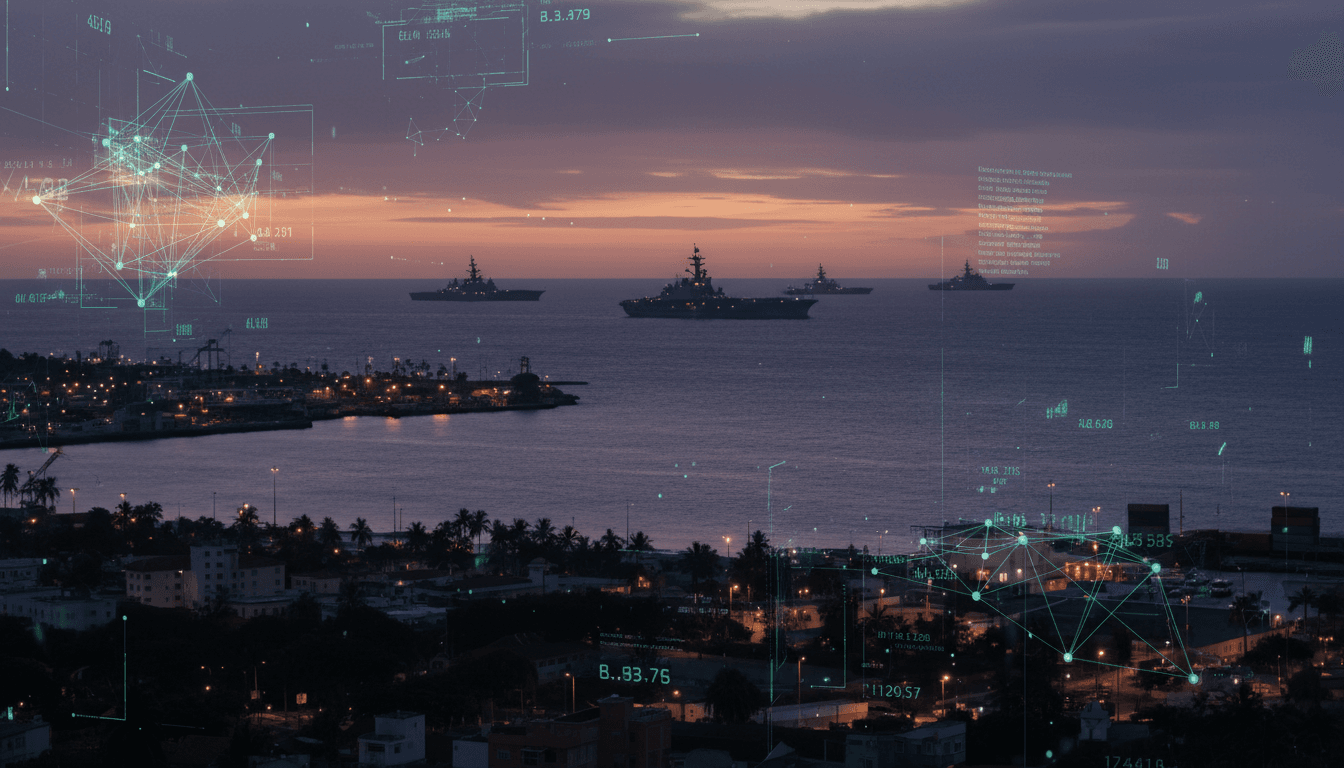
AI vs. Asymmetric Resistance: Lessons from Venezuela
A force can be weak in conventional battle and still be dangerous in resistance. Venezuela is the textbook case—and the details matter if you work in defense, intelligence, or national security technology.
Since August 2025, U.S. force posture in the Caribbean has expanded dramatically: carrier presence, fifth-generation aircraft forward deployed, larger naval patrol patterns, and a declared maritime pressure campaign against sanctioned oil flows. That’s the kind of setup that shifts planning from “signaling” to operational readiness.
Here’s the real problem for any outside power: even if conventional victory is fast, stabilization and counter-resistance can be slow, messy, and politically corrosive. This is where the “AI in Defense & National Security” conversation stops being abstract. AI doesn’t win wars by itself—but it can compress timelines, surface hidden networks, reduce ambiguity, and help commanders decide what not to do.
Venezuela’s core advantage isn’t firepower—it’s internal control
Venezuela’s conventional forces have depth on paper but fragility in practice. The more durable capability is the regime’s security architecture: overlapping intelligence services, politicized command structures, and large pools of armed or semi-armed loyalists embedded in communities.
The numbers tell part of the story. Venezuela fields roughly 123,000 active personnel, distributed across army, navy, air force, and national guard, plus thousands of reservists and an estimated 200,000–300,000 militia members. Add armed pro-regime groups and criminal-political hybrids, and you get a system designed less for maneuver warfare and more for regime survival.
That design has two implications that planners often underestimate:
- You can degrade platforms faster than you can degrade networks. A radar site is targetable. A neighborhood informant chain isn’t.
- Resistance can be “good enough” to succeed politically. The goal isn’t to defeat a superior force. It’s to raise the cost, slow the tempo, and fracture domestic and international support for the intervention.
For AI-enabled national security teams, this is a reminder that the hardest problem isn’t targeting. It’s understanding human terrain at scale without generating self-inflicted strategic damage.
What a U.S. strike campaign would look like—and where AI changes the math
A U.S. air campaign would predictably prioritize air defenses, airbases, command-and-control nodes, and logistics chokepoints. Venezuela’s air defense inventory is meaningful on paper—S-300 and Buk systems plus widely distributed man-portable air defense (MANPADS)—but readiness and integration are uneven.
The “first 72 hours” problem: detection, attribution, and tempo
The initial phase of conflict is where friction spikes:
- Mobile air defenses hide, relocate, and use decoys.
- Urban terrain increases collateral risk and slows target confirmation.
- Dense MANPADS distribution raises risk for low-altitude aircraft and helicopters.
AI’s most immediate advantage here is not autonomous targeting—it’s speed and confidence in pattern recognition:
- Multi-source fusion (imagery, radar, ISR feeds, open-source signals) to flag likely air defense movement corridors.
- Change detection on airfields and hardened sites to identify rapid dispersal.
- Anomaly detection for decoy discrimination (for example, spotting repeated “too-perfect” signatures).
A practical way to think about it: AI can reduce the number of times analysts have to say, “We’re not sure,” and increase the number of times they can say, “We’ve seen this exact behavior before.”
Counterpoint: Venezuela’s best play is to weaponize uncertainty
Venezuela doesn’t need to keep its air defense network intact for weeks. It needs to complicate operations early, force higher standoff ranges, and create windows for propaganda and political maneuver.
That means AI-enabled forces must treat early conflict as a contest over ambiguity. The side that controls the narrative of what happened—especially around civilian harm and alleged covert action—often gains the strategic edge.
This is where AI must be paired with strict governance:
- provenance tracking for ISR-derived claims
- human review gates for high-impact decisions
- auditability for post-strike assessments
If you can’t explain the decision chain, you can’t defend it—legally, politically, or ethically.
“Weak but dangerous” is an AI problem: mapping the resistance ecosystem
Most organizations still model conflict around conventional order-of-battle. That’s not enough in Venezuela’s scenario.
The regime’s resilience comes from overlapping structures:
- military counterintelligence and domestic intelligence agencies
- politically reliable national guard units used for internal control
- militia networks embedded in workplaces and neighborhoods
- pro-regime armed groups that intimidate, surveil, and mobilize quickly
What AI can do well: entity resolution and network inference
Asymmetric resistance depends on connectivity: who talks to whom, who moves money, who controls safe houses, who provides instructions.
AI can help by:
- resolving identities across inconsistent data (aliases, misspellings, partial biometrics)
- clustering events to infer coordination (same tactics, same timing, same logistics)
- predicting likely nodes of influence based on communication and movement patterns
A snippet-worthy truth: the first insurgent network you map is rarely the real one—it’s the one they’re willing to let you see. AI helps identify the hidden “second network” by spotting statistical oddities: gaps, unnatural quiet zones, and mismatches between observed activity and expected logistics.
What AI does poorly if you’re careless: turning the population into a dataset
Resistance environments punish sloppy analytics. If your models over-index on proxies (age, neighborhood, phone ownership patterns), you can generate operationally “useful” outputs that are morally and politically toxic.
The right standard isn’t “Does the model correlate?” It’s:
- Is it lawful?
- Is it explainable to non-technical commanders?
- Is it robust against deception?
- Will it survive public scrutiny six months later?
Covert action vs. counterintelligence: AI accelerates both sides
Venezuela’s counterintelligence posture is less about technical sophistication and more about rapid exposure. The playbook is familiar: arrests, public confessions, and state media amplification to collapse secrecy.
AI-enabled counterintelligence is mostly about workflow
You don’t need futuristic tech to run effective counterintelligence. You need speed:
- triage of tips and reports (including malicious or politically motivated ones)
- face and gait matching across low-quality camera networks
- correlation of travel, financial activity, and communications metadata
That said, there’s a major vulnerability that AI creates for authoritarian counterintelligence: feedback loops. When informant networks and automated scoring drive arrests, the system starts optimizing for what the model “expects” to find, not what’s true. That increases false positives, which increases fear, which increases “reporting,” which increases noise.
For outside forces, that dynamic can be exploited, but it can also backfire. High-noise environments are exactly where misattribution thrives.
The operational takeaway: build an AI “attribution firewall”
If you’re building AI for national security customers, Venezuela is a strong argument for an explicit attribution firewall:
- separate “suspicion scoring” from “actionable intelligence”
- require corroboration across at least two independent collection streams
- log every model output used in a decision
The goal is simple: prevent a model from becoming a machine that converts uncertainty into irreversible action.
The hardest scenario isn’t invasion—it’s the day after
A ground invasion is often described as least likely and most consequential. Conventional resistance would collapse quickly, but the harder part is the transition to control and governance.
Urban density, political polarization, criminal economies, and militia blending make stabilization uniquely hard. Caracas, for example, offers every advantage to small units: concealment, short engagement distances, and plentiful propaganda opportunities.
AI in stabilization: the unglamorous use cases that matter
If you only associate AI with drones and targeting, you miss the part that decides outcomes.
High-value AI applications in stabilization and counter-resistance include:
- Supply chain integrity analytics: detecting fuel diversion, theft patterns, and counterfeit parts in logistics.
- Rumor and narrative tracking: identifying which claims are spreading, where, and through which communities.
- Resource allocation optimization: deciding where to place limited medical aid, power restoration, and policing capacity.
- Noncombatant harm monitoring: fusing incident reports, hospital data, and geospatial cues to detect hotspots quickly.
These are not glamorous. They are decisive.
A stance I’ll defend: If your AI program can’t support governance and harm reduction, it’s not a serious national security capability—it's a demo.
Deception will be constant—design for it
Venezuela’s doctrine emphasizes survival, dispersal, and prolonged resistance. That implies deception as a daily operating mode:
- decoy equipment
- fake mobilization signals
- manufactured “evidence” for information operations
- staged incidents designed to force overreaction
AI systems must be trained and evaluated against adversarial behavior, not clean lab data. That means red-teaming models with:
- synthetic decoys in imagery
- adversarial text campaigns
- spoofed metadata
- coordinated “bot + human” narrative pushes
People also ask: what should defense teams do now?
If you’re a defense leader, technologist, or integrator watching the U.S.–Venezuela tension line, three moves pay off immediately.
- Prioritize fusion over new sensors. Most failures come from stovepipes, not lack of collection.
- Treat narrative as an operational domain. Build AI-enabled monitoring and verification workflows that commanders trust.
- Engineer for auditability. If you can’t reconstruct why a model flagged a target or a person, you’re building future scandal.
And one question teams should ask in every requirements meeting:
“What does misuse look like, and how do we technically prevent it?”
If the answer is “policy will handle it,” the program is already at risk.
Where this fits in the “AI in Defense & National Security” series
Venezuela’s case sits at the intersection of asymmetric warfare, intelligence analysis, and domestic control networks—exactly where AI can help or harm at scale.
The strategic lesson is blunt: conventional superiority doesn’t eliminate resistance; it shifts the fight to networks, legitimacy, and time. AI can shorten the sensing-to-decision loop and expose hidden coordination, but it also raises the stakes for mistakes.
If you’re responsible for AI in defense and national security, now’s the moment to pressure-test your stack against an environment like Venezuela:
- Can it function with noisy data?
- Can it resist deception?
- Can it explain itself?
- Can it support stabilization, not just strikes?
The next time a crisis looks “easy” because one side has better jets and ships, ask a harder question: Are we prepared for the resistance ecosystem that starts after the first wave?