GitHub Actions are a growing supply chain target in 2025. Learn how AI-driven anomaly detection can spot malicious workflows and protect CI/CD secrets.
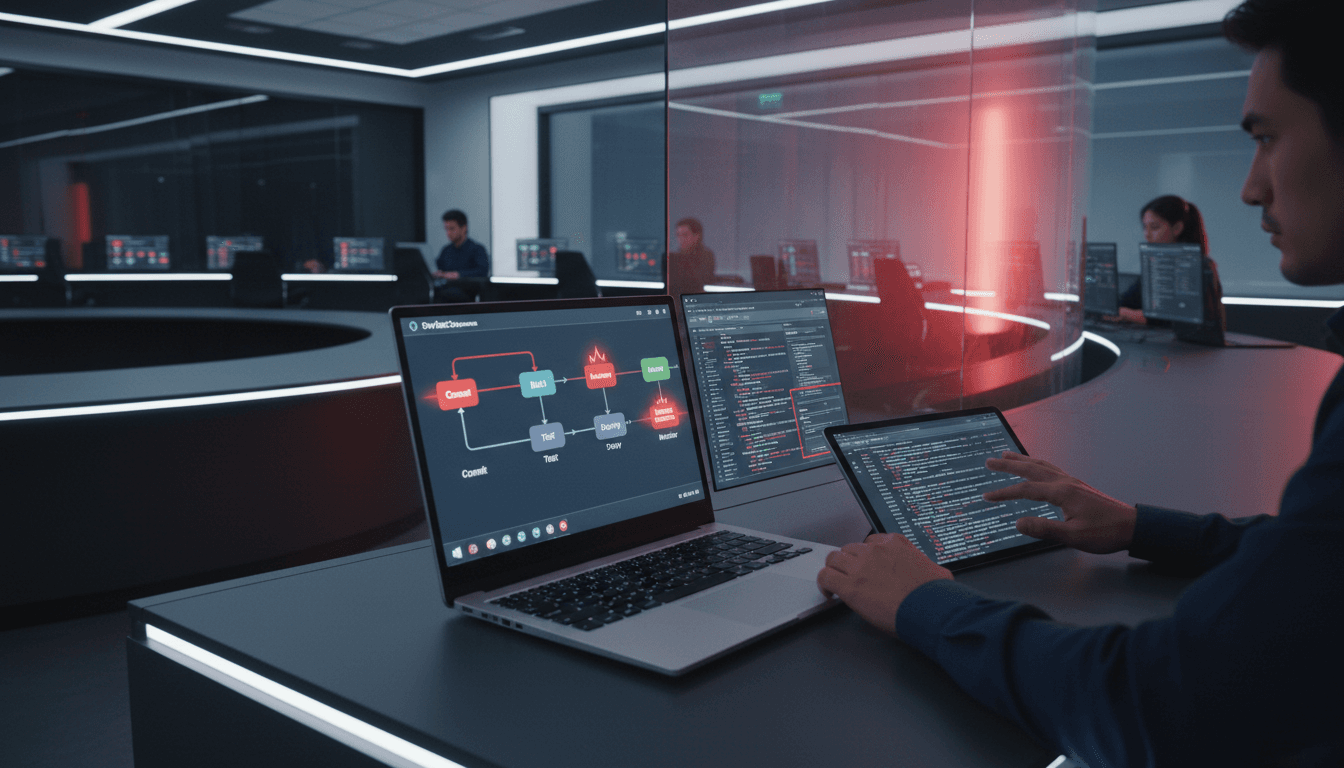
Stop GitHub Actions Supply Chain Attacks With AI
In 2025, supply chain attacks didn’t slow down—they got smarter and more opportunistic. One pattern stands out: attackers are increasingly treating GitHub Actions as a distribution channel, not just a build tool. When a workflow can pull third-party actions, read secrets, and publish artifacts, it’s not “dev plumbing.” It’s a high-trust pathway straight into production.
At Black Hat Europe in London, researchers highlighted what many teams still avoid saying out loud: GitHub can’t secure your CI/CD pipeline for you. If your workflows are misconfigured, if you run unpinned third-party actions, or if secrets are broadly accessible, your pipeline becomes a soft target—no matter how good GitHub’s default controls are.
This post is part of our AI in Cybersecurity series, and I’m taking a clear stance: AI belongs in CI/CD security now. Not as a buzzword, but as a practical layer for detecting workflow abuse, suspicious action behavior, and supply chain anomalies that humans won’t reliably spot in time.
Why GitHub Actions became an attacker’s favorite entry point
GitHub Actions is attractive because it combines three things attackers love: automation, trust, and reach. Compromise one popular action or exploit one misconfiguration and you’re not attacking a single company—you’re riding the same rails thousands of teams use to ship software.
The 2025 incidents referenced in the Dark Reading report—along with the widely discussed compromise of the third-party action tj-actions/changed-files (CVE-2025-30066)—show a consistent theme: CI/CD secrets are the prize. Once an attacker gets access to a GitHub token, cloud keys, an npm token, or a private key exposed via workflow permissions, they can:
- Publish malicious packages
- Access private repositories
- Inject code into release artifacts
- Pivot into cloud environments
- Impersonate developers or automation bots
The “bystander effect” in open source is real
One of the most uncomfortable truths from the research is the community dynamic: enterprises consume open source they don’t help secure. That’s not a moral critique—it’s a structural risk.
If a popular GitHub Action is compromised, the blast radius can include organizations the attacker never planned to hit. A targeted campaign becomes a mass supply chain incident because reuse is the whole point of modern DevOps.
Misconfigured workflows are a repeatable weakness
A large slice of GitHub Actions risk isn’t “zero-days.” It’s decisions teams make every day:
- Overly broad
GITHUB_TOKENpermissions - Secrets available to untrusted contexts
- Workflows triggered by risky events (like
pull_request_target) without guardrails - Third-party actions referenced by mutable tags (like
@v1) instead of pinned SHAs
The common failure mode is simple: your pipeline assumes every dependency behaves.
The shared responsibility model: what GitHub does vs what you must do
GitHub provides important security capabilities—token scoping, environment protections, audit logs, and policy controls—but the platform is designed for flexibility. That means secure-by-default isn’t guaranteed, and optional protections often remain… optional.
Here’s the clean way to think about the shared responsibility split:
- GitHub’s job: platform integrity, vulnerability response, baseline protections, identity controls, logging surfaces
- Your job: workflow design, dependency trust decisions, secret hygiene, permission scoping, runtime monitoring, incident response readiness
If you’re waiting for “the platform” to save you from a compromised third-party action you chose to run, you’re accepting the risk by default.
What attackers actually do after getting a foothold
Once inside a workflow, attackers typically pursue one of two goals:
- Credential harvesting (tokens, keys, SSH material) to gain persistent access
- Artifact tampering (build outputs, release packages, container images) to reach downstream customers
The scary part is how normal it can look. A workflow run that “succeeds” can still be a full compromise.
A practical rule: if your security tooling only checks source code, you’re missing the place where code becomes a deliverable.
Where AI fits: catching CI/CD abuse humans won’t see
AI helps most when the problem is high-volume, high-variation, and time-sensitive. CI/CD activity matches that perfectly. You can’t manually review every workflow change, every dependency update, and every outbound connection made during builds.
AI-driven anomaly detection for GitHub workflows
The most effective AI use case here is behavioral baselining:
- What does “normal” look like for a given repository’s workflow runs?
- Which actions are normally used, and how often do they change?
- What network destinations are typical during builds?
- Which secrets are accessed, and under what triggers?
Then flag deviations that correlate strongly with compromise:
- A workflow that suddenly exfiltrates environment variables
- A new third-party action added in a minor PR
- A build step that starts posting to an unfamiliar domain
- A previously unused secret accessed during a PR-triggered run
This is where AI in cybersecurity earns its keep: it turns “we had logs” into “we had an alert that mattered.”
AI to detect malicious GitHub Actions before they run
A second high-value area is pre-execution scoring of third-party actions and workflow changes. Think of it like “CI/CD reputation and intent analysis,” based on signals such as:
- Action update patterns (sudden ownership changes, bursty commits)
- Dependency graph risk (new transitive downloads)
- Permission requests vs historical needs
- Similarity to known malicious templates (encoded payload patterns, suspicious curl/bash chains)
- Provenance integrity (pinning discipline, signed commits, release hygiene)
Even a simple model that assigns a risk score can change outcomes because it forces a decision: approve, sandbox, or block.
AI-assisted incident response when a workflow is compromised
When a supply chain incident happens, teams often ask:
- Which runs were affected?
- What secrets were exposed?
- What did the workflow execute?
- Where did it connect to?
AI can speed this up by summarizing run logs, correlating events across repos, and producing a timeline that a responder can validate. I’ve found this is where organizations buy back the most time—not replacing analysts, but getting them to the right evidence faster.
A practical hardening checklist (that won’t slow teams down)
You don’t need a perfect program to reduce risk quickly. You need a few non-negotiables.
Lock down dependency trust
- Pin actions by commit SHA (not tags) for critical workflows.
- Maintain an allowlist of approved actions for your org.
- Treat new third-party actions like new production dependencies: review them.
Reduce the value of stolen secrets
- Scope tokens to the minimum permissions needed.
- Use short-lived credentials where possible.
- Rotate CI/CD secrets on a schedule (and after workflow changes).
Fix the workflow foot-guns
- Review triggers like
pull_request_targetand anything that runs with elevated permissions. - Require approval for workflows that access production deploy credentials.
- Separate build and deploy into different trust zones.
Add monitoring where the risk actually is
This is the part most teams skip: runtime visibility for CI/CD.
At minimum, capture and retain:
- Workflow run logs and metadata (who/what triggered them)
- Secret access events
- Outbound network connections during runners
- Artifact integrity checks (hashing/signing)
Then layer AI on top to detect abnormal sequences, not just single suspicious lines.
What to do if you suspect a GitHub Actions supply chain compromise
When you’re reacting to a potential workflow compromise, speed matters—but guessing hurts.
Here’s a response sequence that works in real environments:
- Freeze releases from impacted repositories.
- Disable or restrict the workflow (don’t delete evidence).
- Rotate exposed credentials immediately (PATs, cloud keys, npm tokens).
- Identify the first suspicious run and diff it against the last known-good run.
- Audit outbound network activity and any “curl | bash”-style steps.
- Rebuild artifacts from a clean state and verify integrity.
- Expand the search to other repos using the same third-party action.
If you’ve got AI-based detection running, this is where it pays off: it can quickly answer “where else does this pattern show up?” across your organization.
The 2026 reality: software delivery is a security boundary
CI/CD pipelines used to be “internal.” In practice, they’re part of your external attack surface—because compromising them changes what your customers install.
The increase in supply chain attacks targeting GitHub Actions in 2025 should push one decision to the top of your roadmap: treat workflow security as production security.
AI in cybersecurity fits here naturally because CI/CD generates the kind of data machines are better at watching than people: repetitive events, subtle changes, and multi-step attacker behavior. The teams that win in 2026 won’t be the ones with more dashboards. They’ll be the ones who can spot a malicious workflow run before it ships.
If your organization had to answer this tomorrow—“Which GitHub Actions can access production secrets, and what abnormal behavior would we detect within 5 minutes?”—would you like the answer you’d give?