Threat intelligence is now a board-level tool. Learn how AI-powered threat intelligence turns cyber risk into faster, defensible C-suite decisions.
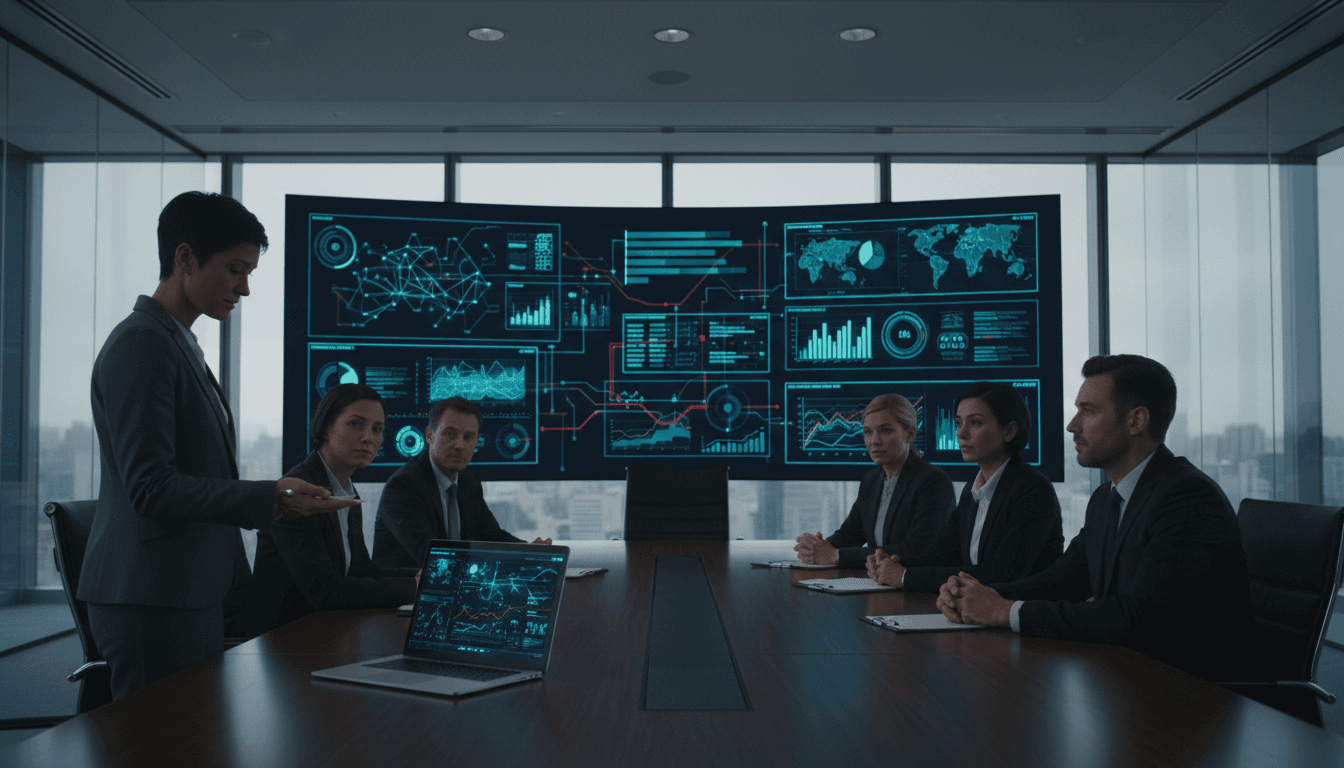
Threat Intelligence for the C-Suite: AI to Action
Cyber risk has become a balance-sheet issue, and threat intelligence is finally catching up. Recorded Future’s 2025 findings put hard numbers behind what many teams already feel: 83% of organizations now run full-time threat intelligence teams, and intelligence is increasingly used outside the SOC to guide decisions that used to be “business only.”
Most companies still get one part wrong: they treat threat intelligence as a reporting function instead of a decision function. A weekly “threat roundup” won’t help a CFO decide whether to fund a segmentation project, or help a COO decide whether a new region is safe to enter, or help a board understand why one vendor is riskier than another.
This post is part of our AI in Cybersecurity series, and it takes a clear stance: AI only matters when it turns threat intelligence into better executive decisions—faster, with fewer surprises. The goal isn’t more data. It’s fewer bad bets.
Threat intelligence isn’t a SOC product anymore
Threat intelligence has shifted from “defensive maneuvering” to strategic operating input. The fastest sign of maturity is simple: intelligence is being asked to answer questions that are not purely technical.
Recorded Future’s 2025 State of Threat Intelligence data shows how broad this has become:
- 73% of surveyed security professionals report using threat intelligence
- 48% of incident response teams use it
- 47% of risk management teams use it
- 46% of vulnerability management teams use it
That spread matters because it changes the output. When your audience includes Legal, Procurement, GRC, and a risk committee—not just a SOC lead—your intelligence program has to translate.
What “strategic threat intelligence” actually means
Strategic threat intelligence is not a longer report. It’s intelligence that connects:
- Adversary behavior → business impact (revenue disruption, downtime, regulatory exposure)
- Exposure → prioritization (what to fix this quarter vs. park)
- Risk appetite → decision options (accept, mitigate, transfer, avoid)
A snippet-worthy way to put it:
Threat intelligence becomes strategic when it changes what the business funds, buys, or avoids.
Why AI accelerates this shift
AI’s real contribution to threat intelligence isn’t “being smart.” It’s speed, scale, and consistency:
- Speed: compresses days of triage into hours (or minutes) by clustering related activity and summarizing what matters.
- Scale: correlates far more signals (telemetry, external reporting, dark web chatter, third-party risk signals) than human analysts can manually reconcile.
- Consistency: reduces the “two analysts, two conclusions” problem by applying repeatable scoring and explanations.
If you’re building an AI-powered cybersecurity program, threat intelligence is one of the best places to demand measurable outcomes—because the downstream decisions are expensive.
The board’s new dashboard: threat intelligence that speaks business
Boards don’t want IOC lists. They want clarity on exposure, likelihood, and impact, delivered in language that supports governance.
Threat intelligence works for the board when it answers questions like:
- “What’s the most plausible way we get hit this quarter?”
- “Which business initiative increases risk—and by how much?”
- “If this incident happens, what’s the operational and financial blast radius?”
The source content highlights a practical split that boards understand immediately:
- High-risk, high-impact threats (ransomware campaigns, geopolitically driven disruption) should trigger strategic investment: contingency planning, redundancy, crisis comms, and sometimes hard choices about markets.
- Persistent but lower-impact risks should shape tolerance thresholds, control baselines, and even insurance posture.
Turning threat intel into decisions (the translation layer)
Here’s what I’ve found works: present threat intelligence as decision options, not “findings.”
A useful executive-ready format is:
- What changed? (new actor focus, new TTPs, new exposure)
- Why it matters? (systems/processes at risk, business services affected)
- So what? (probable outcomes if exploited)
- Now what? (2–3 options with cost, time, risk reduction)
AI can help here by producing first drafts: summarizing activity, mapping it to your asset inventory and controls, and generating a consistent narrative for review. But the human role stays critical: sanity-checking, adding context, and owning the decision framing.
Where AI-powered threat intelligence creates measurable ROI
Threat intelligence earns executive trust when it shows up in budgets, procurement, and planning—not just incident retros.
Recorded Future’s 2025 report numbers align with what many teams are doing already:
- 65% say threat intelligence supports security technology purchasing decisions
- 58% say it guides risk assessment for business initiatives
- 53% say it supports incident response resource allocation
Those are perfect targets for AI augmentation because they’re repeatable processes with lots of inputs.
1) Security tool purchasing: stop buying blind
Buying security tools without intelligence is how companies end up with overlapping platforms and gaps in the places attackers actually exploit.
AI-powered threat intelligence strengthens procurement by:
- Matching threat actor techniques to your defensive coverage (e.g., identity attack paths, endpoint blind spots, SaaS misconfigurations).
- Scoring vendors using external risk signals (breach history, exposed services, supply chain associations).
- Stress-testing “marketing claims” against your observed attack surface and likely adversaries.
A concrete example:
- If intelligence shows credential theft and session hijacking trending in your sector, and your telemetry shows anomalous token use, the better investment might be identity threat detection and response and conditional access hardening—not another generic alerting tool.
2) Third-party and supply chain risk: make vendor decisions defensible
Vendor risk reviews often drown in questionnaires. Threat intelligence (especially when AI is used to normalize external signals) gives you a faster, evidence-based view.
Use intelligence to drive:
- Pre-contract gating: “We won’t onboard vendors with X exposed services or Y risk indicators.”
- Tiered monitoring: continuous monitoring for high-criticality vendors, periodic checks for lower tiers.
- Exit planning: for vendors tied to systemic risk (geopolitical exposure, repeat incidents, suspicious infrastructure associations).
When a board asks why you rejected a vendor, “because our AI risk scoring flagged active exposure and repeated malicious infrastructure overlap” is more defensible than “it felt risky.”
3) Incident response resourcing: staff where the fire will be
Most IR resourcing is reactive: big incident happens, everyone scrambles, budgets appear later. Threat intelligence makes this proactive.
AI helps by:
- Detecting campaign patterns early (clusters of similar intrusions across a sector)
- Forecasting likely next steps based on observed TTPs
- Prioritizing playbooks and tabletop exercises based on probable scenarios
If ransomware affiliates are shifting toward exploiting perimeter identity and remote management tools, your IR investments should move accordingly: access control validation, remote tool inventory, rapid isolation workflows, immutable backups testing.
How to operationalize “SOC-to-C-suite” threat intelligence
The practical problem is not a lack of intelligence. It’s the lack of an operating model that makes intelligence usable across the enterprise.
Here’s a model that works, especially for organizations adopting AI in cybersecurity.
Build a two-speed intelligence program
You need both:
- Tactical intelligence (daily/weekly): detections, prioritization for vulnerability management, active campaign alerts.
- Strategic intelligence (monthly/quarterly): business risk changes, investment guidance, third-party posture, geopolitical exposure.
AI is strongest in the tactical lane (volume + speed). Strategic outputs require more human judgment but benefit from AI-assisted synthesis.
Define three executive metrics that don’t lie
If your threat intelligence program can’t show impact, it will be treated as overhead. Pick metrics tied to outcomes:
- Time to decision: how long it takes to go from “new threat” to “approved action.”
- Exposure reduction: measurable shrinkage in exploitable surface (critical vulns closed, risky services removed, MFA coverage increased).
- Loss avoidance proxies: fewer repeat incidents in the same kill chain stage (e.g., fewer credential-based lateral movements).
These work well with AI because automation can timestamp events, track closure rates, and correlate incident patterns.
Create an “intelligence contract” with the C-suite
This is simple and surprisingly rare: agree on what executives will get, how often, and what decisions it should inform.
A solid contract includes:
- A one-page risk brief before each risk committee meeting
- A third-party risk watchlist for critical vendors
- A quarterly investment recommendation memo tied to observed threat trends
- Clear escalation rules for “drop everything” threats
When that’s in place, threat intelligence becomes part of governance rather than an optional report.
People also ask: what should the C-suite expect from AI threat intelligence?
What’s the difference between threat intelligence and threat detection?
Threat detection finds malicious activity in your environment. Threat intelligence explains adversaries, their methods, and what that means for your risk and decisions. The best programs connect the two.
Does AI replace threat intelligence analysts?
No. AI reduces manual correlation and speeds up summarization, but analysts are still needed to validate signals, add business context, and frame decision options. AI changes the job; it doesn’t eliminate the need.
How do you know the intelligence is “board-ready”?
If you can answer “what decision should we make, by when, and what happens if we don’t” in plain language, it’s board-ready. If it’s mostly technical artifacts, it isn’t.
What to do next (and what to avoid)
Threat intelligence belongs at the executive level because it’s now directly tied to budgets, vendors, and operational resilience. The organizations that win here treat intelligence as a governance input and use AI to keep it timely and scalable.
If you’re building or refreshing an AI-powered cybersecurity roadmap for 2026 planning, start with two moves:
- Tie threat intelligence outputs to three recurring decisions: security spend, third-party approvals, and readiness investments.
- Deploy AI where volume is highest and human attention is scarcest: alert clustering, entity resolution, campaign summarization, and draft executive briefs.
The question worth ending on is the one boards are already asking quietly: If your threat intelligence team stopped operating for 90 days, which business decisions would get worse—and would anyone notice fast enough?