AI-driven supply chain attack mitigation needs continuous monitoring, not annual questionnaires. Learn a practical playbook to reduce vendor risk fast.
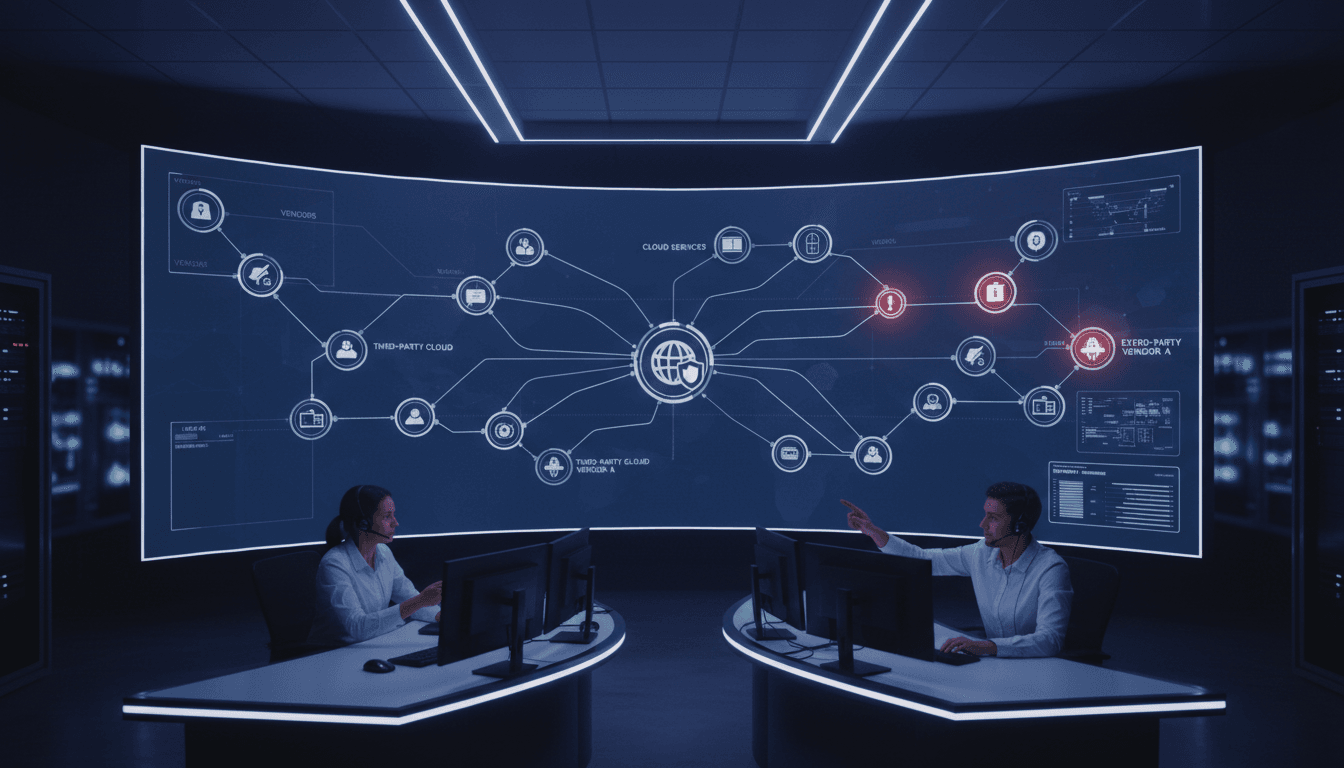
AI-Driven Supply Chain Attack Mitigation That Works
A single vendor compromise can bypass years of internal hardening—and it usually won’t look like a “hack” at first. It looks like a normal software update, a trusted file transfer, a helpdesk login from a familiar managed service provider (MSP), or a new open-source dependency that quietly ships into production.
Supply chain attacks keep working because most organizations still manage third-party risk like it’s 2015: a questionnaire, an annual review, and a lot of hope. Meanwhile, attackers operate on an hourly cycle. That mismatch is the core problem.
This post is part of our AI in Cybersecurity series, and it takes a firm stance: static third-party risk management can’t keep up with modern supply chain attacks. If you want fewer surprises, you need continuous, intelligence-led monitoring—and increasingly, you need AI-assisted threat detection to keep the signal-to-noise ratio sane.
Why supply chain attacks keep slipping past “good” security
Supply chain attacks succeed because they exploit trust paths, not just technical flaws. You can run tight endpoint controls and still get burned if your vendor’s build pipeline is poisoned or your file transfer platform has a remotely exploitable bug.
Here’s the operational reality I see in many organizations: security teams invest heavily in monitoring what they own, but have thin visibility into what they depend on. Yet dependencies are exactly where attackers hide.
The trust problem: “allowed” access becomes the attack lane
Most organizations explicitly permit third-party activity:
- MSPs and contractors with admin tooling access
- SaaS platforms with API keys and OAuth grants
- File transfer products used for regulated data exchange
- CI/CD integrations that sign and distribute releases
Attackers don’t need to defeat your controls if they can reuse legitimate vendor access (or mimic it convincingly). That’s why supply chain attacks so often evade detection: the traffic patterns look “normal” until the damage is done.
The scale problem: modern apps are dependency machines
Modern software routinely pulls in hundreds of third-party components. One compromised library, signing key, update server, or cloud tenant can cascade across thousands of downstream environments.
That cascade is what makes supply chain risk different from standard breach risk: your blast radius can be dictated by someone else’s security debt.
The common supply chain attack methods (and what defenders miss)
Supply chain attacks aren’t one tactic—they’re a family of tactics. Defenders tend to prepare for the last incident they remember, while attackers rotate paths.
Vendor data breaches
Attackers compromise a third-party provider and steal customer data, credentials, or payment details. Since vendors support many customers, one breach can become dozens.
What defenders miss: breach disclosure is often delayed. Customers learn about incidents late, sometimes after data appears in criminal forums.
Exploitation of vendor vulnerabilities
Threat actors scan for unpatched software, exposed services, or weak configurations in vendor environments.
What defenders miss: vulnerability existence isn’t the same as vulnerability urgency. Prioritization needs to reflect active exploitation, not just CVSS scores.
Ransomware and extortion through suppliers
Attackers hit a supplier, exfiltrate data, and use leak sites to pressure payment.
What defenders miss: extortion pressure frequently shows up publicly before formal notification—meaning external monitoring can provide earlier warning than inboxes.
Domain, email, and infrastructure compromise
Hijacked vendor email or domains enable realistic phishing and malware distribution that sails past trust-based checks.
What defenders miss: vendor impersonation often targets procurement, finance, and IT ops—not just “security” teams.
Trusted access abuse (the quiet one)
Stolen vendor credentials or abused remote tooling bypass standard controls. This is especially dangerous with MSPs.
What defenders miss: many programs don’t treat vendor access paths as first-class assets to monitor continuously.
Fourth-party and shared platform incidents
Attackers compromise platforms your vendors rely on (cloud, identity, hosting, shared tooling). This multiplies impact.
What defenders miss: third-party inventories usually stop at the vendor layer; fourth-party mapping is often absent.
Open-source component tampering
Malicious code is inserted into a library or package that becomes widely adopted.
What defenders miss: SBOMs help, but only if they’re kept current and paired with real-time intelligence about malicious packages and suspicious maintainer activity.
SolarWinds and MOVEit: two incidents, one lesson
Big names are useful not because they’re famous, but because they show patterns you can design against.
SolarWinds: poisoned trust at update scale
In the SolarWinds incident (uncovered December 2020), attackers compromised the vendor’s build environment and inserted malicious code into Orion updates, which were then distributed to roughly 18,000 customers. The downstream impact wasn’t “a vendor got breached”—it was a trusted update mechanism became a delivery channel.
The practical lesson: software supply chain security is inseparable from vendor risk management. If your vendor can ship code into your environment, they’re functionally part of your perimeter.
MOVEit: one vulnerability, a global data theft wave
In 2023, a critical SQL injection flaw in MOVEit Transfer (CVE-2023-34362) was exploited at scale. Estimates cited in public reporting put the impact at 2,000+ organizations and 62 million+ individuals affected.
The practical lesson: widely deployed “boring” infrastructure products—file transfer tools, identity components, remote management—create systemic risk because they sit where the data flows.
If your third-party program doesn’t prioritize vendors that sit on your data paths, it’s not a risk program. It’s paperwork.
Why traditional third-party risk management fails (and what to replace it with)
Traditional third-party risk management fails because it’s built on snapshots.
Questionnaires and annual audits can be useful for governance, but they’re not operational security controls. Attackers happily operate in the gap between your Q2 assessment and your Q4 renewal.
The four structural flaws of checklist-based vendor security
- Self-reported confidence. A vendor can be honest and still wrong; security posture changes fast.
- No continuous visibility. You don’t see exposed services, leaked credentials, or active exploitation signals in real time.
- Long detection windows. Quarterly reviews create quarters of blind spots.
- Late breach awareness. Many customers find out after public disclosure—or after data is already circulating.
What to replace it with: intelligence-led monitoring
The replacement isn’t “more questionnaires.” It’s a system that answers these questions continuously:
- Which vendors are showing new exposures this week?
- Which vulnerabilities are being actively exploited in the wild right now?
- Which suppliers are associated with leaked credentials, malicious infrastructure, or extortion chatter?
- Which third parties have privileged access into my environment, and are they behaving normally?
That’s where threat intelligence and AI-driven threat detection fit: they reduce the time between “signal appears” and “team acts.”
How AI improves supply chain security without adding chaos
AI helps most when it does two unglamorous jobs well: triage and correlation. Supply chain defense generates noisy inputs—vulnerability feeds, breach rumors, telemetry, vendor inventories, asset lists, and tickets. Humans can’t reconcile all of it at speed.
AI for anomaly detection across vendor activity
AI models can baseline what “normal” looks like for:
- Vendor logins (geography, time, device, admin tooling)
- API usage patterns (volume spikes, new scopes, unusual endpoints)
- File transfer behavior (new partners, atypical payload sizes, unusual automation)
When something deviates, you get an investigation lead that’s about behavior, not just signatures.
AI for contextual prioritization (the part most teams need)
Security teams drown when every exposure is treated as urgent. AI-assisted workflows can:
- Connect a new CVE to evidence of exploitation
- Tie exposures to your known supplier stack (not the whole internet)
- Suggest response actions based on observed attacker TTPs
A useful one-liner to align teams: “Prioritize what’s exploited, what’s exposed, and what’s connected to critical vendors.”
AI for early warning beyond vendor disclosure timelines
Attack signals often surface in places vendors won’t (or can’t) notify you about quickly—like criminal forums, leak sites, or infrastructure telemetry.
AI can help sift those sources for credible, relevant indicators tied to your supplier list, instead of sending analysts on endless hunts.
Static assessments measure intent. Continuous intelligence measures reality.
A practical enterprise playbook for mitigating supply chain attacks
You don’t need perfection. You need repeatable habits that shrink detection time and reduce blast radius.
1) Build a vendor map that reflects real impact
Start by tiering suppliers based on what they touch:
- Tier 0 (highest): identity providers, cloud providers, MSPs, CI/CD and code distribution, EDR/MDR providers
- Tier 1: SaaS handling sensitive data, payment systems, file transfer platforms
- Tier 2: business tools with limited data and no privileged access
If you can’t explain why a vendor is in a tier, the model will collapse in a crisis.
2) Treat vendor access like production access
For vendors with privileged pathways:
- Enforce least privilege and time-bound access
- Require MFA-resistant approaches where possible (hardware-backed, phishing-resistant)
- Monitor vendor accounts as separate risk entities
- Log and alert on remote tooling actions (RMM, admin consoles, scripting)
3) Move from “CVE lists” to “exploited exposure lists”
Operationally, your vulnerability workflow should separate:
- Known vulnerabilities that are not exploited
- Vulnerabilities with active exploitation evidence
- Vulnerabilities present in vendor-facing or internet-facing services
This is where intelligence plus AI prioritization actually saves time.
4) Monitor for third-party incident indicators—not just confirmations
Set up continuous monitoring for:
- Leaked credentials associated with vendor domains
- New suspicious infrastructure linked to vendor brands
- Public exploit chatter affecting vendor technologies
- Signs of extortion activity involving key suppliers
The goal is earlier awareness, not perfect attribution.
5) Pre-negotiate incident actions with procurement and legal
When an incident hits, the slowest step is often internal alignment. Get ahead of it:
- Define notification timelines and evidence expectations
- Require support for forensics and log sharing when relevant
- Establish conditions for access suspension and credential rotation
- Agree on communication paths (security + procurement + legal + IT)
6) Run a “vendor compromise day” tabletop exercise
Once per year (at least), simulate:
- A vendor update channel compromise
- An MSP credential theft leading to privileged access
- A file transfer product zero-day affecting sensitive data exchange
If the first time you coordinate procurement, IT ops, and security is during a real breach, you’ll lose days.
Where intelligence platforms fit (and how to evaluate them)
Intelligence-led monitoring works when it plugs into how teams already operate: ticketing, SIEM, GRC, vendor management, and incident response.
If you’re evaluating solutions in this space, I’d pressure-test for:
- Coverage breadth: open web, dark web, technical telemetry, curated sources
- Transparent scoring: can you explain why a vendor is flagged?
- Workflow integration: does it create actionable tickets, not dashboards?
- Evidence quality: are alerts backed by indicators, context, and recommended actions?
- Noise control: can it suppress duplicates and track what’s already acknowledged?
For lead-focused teams, the strongest buying signal is simple: does it reduce time-to-awareness and time-to-decision during a vendor incident?
What to do next
AI-driven supply chain attack mitigation comes down to one shift: stop treating vendor risk as an annual compliance task and start running it like a live security program. Continuous monitoring, external threat intelligence, and AI-assisted prioritization are how you keep up with adversaries who don’t wait for your next audit cycle.
If you’re building this capability, pick one high-impact area to improve in the next 30 days—MSP access monitoring, exploited-vulnerability prioritization for key vendors, or early-warning alerting tied to your supplier tiers. Then expand.
The broader question for every security leader heading into 2026 budgeting: which trusted relationships in your environment would hurt the most if they were abused—and do you have a way to know fast?