Fake PoCs and AI slop create false security signals. Learn how to verify exploitability, reduce false positives, and speed remediation with AI.
AI Slop & Fake PoCs: Stop False Security Signals
A CVSS 10.0 vulnerability should create urgency. Instead, it often creates noise.
That’s what the React2Shell episode exposed: the internet filled up with “proof-of-concept” (PoC) exploits that looked real, got copied into scanners, and then… didn’t reliably exploit anything. Some were trivial edge-case demos. Others were plain nonworking AI-generated slop. The result wasn’t just wasted time. It was false security signals—the most expensive kind.
This post is part of our AI in Cybersecurity series, and I’m going to take a firm stance: if your security program treats public PoCs as ground truth, you’re building decision-making on sand. The fix isn’t to ban AI or blame researchers. It’s to train and integrate AI in cybersecurity workflows with verification gates so your automation produces fewer false positives, fewer false negatives, and faster remediation.
Why “fake proof” is a security problem (not just an annoyance)
Bad PoCs don’t merely fail—they actively mislead defenders. When a PoC is wrong, teams often conclude one of three dangerous things:
- “We’re not vulnerable.” (False negative)
- “Exploitation is hard.” (False sense of time)
- “Our WAF rule blocked it, so we’re covered.” (Control overconfidence)
React2Shell was a perfect storm: high severity, widespread interest, and an AI-fueled publishing cycle that rewarded speed over correctness. Security teams chasing validation scripts and GitHub snippets got flooded with exploit attempts that looked plausible but didn’t map cleanly to the real vulnerability conditions.
Here’s the operational impact I see most often:
- Triage gets derailed: Analysts spend hours reproducing someone else’s broken demo.
- Detection gets polluted: Internal scanners get built on shaky assumptions.
- Patch decisions get delayed: Teams wait for “better proof” instead of fixing confirmed exposure.
And the kicker: while defenders debate PoC quality, motivated attackers iterate quietly until they have something reliable.
The hidden cost: false confidence scales faster than true assurance
Automation amplifies whatever you feed it.
If your pipeline ingests “AI slop PoCs” and turns them into tickets, scans, dashboards, and executive updates, you’ve created a multiplier for misinformation. One bad PoC can generate:
- dozens of failed scan runs,
- hundreds of false results across apps,
- and weeks of wrong prioritization.
That’s why this isn’t a social-media problem. It’s a security operations design problem.
How AI changes the PoC ecosystem (and why defenders feel it first)
AI lowers the cost of producing plausible-looking exploit code to near zero. That doesn’t automatically create more real threats, but it absolutely creates more artifacts that look like threats. Defenders have to handle artifacts. Attackers can ignore them.
This is the asymmetry:
- Attackers iterate until it works.
- Defenders must decide quickly whether it works, at scale, across heterogeneous environments.
Security teams also tend to inherit the internet’s incentives:
- Publish fast
- Get credited
- Get shared
But defenders need the opposite:
- Verify
- Reproduce
- Scope impact precisely
When the ecosystem produces 100+ public PoCs for one issue (as Trend Micro observed for React2Shell), the defender’s challenge becomes signal extraction. AI can help there—but only if it’s trained and governed to prefer evidence over appearance.
“Vibe coding” meets vulnerability response
Many organizations are already feeling the downstream effects of AI-generated code in production: inconsistent patterns, missing edge cases, and security debt that accumulates quietly. Now add AI-generated exploit attempts into the mix, and you get the same pattern on the defense side: fast output, uneven quality.
Most companies get this wrong by treating AI as a replacement for expertise rather than a force multiplier with guardrails.
What “good” looks like: AI-assisted validation, not AI-trusting triage
The right goal isn’t “find a PoC.” The goal is “establish exploitability and blast radius with high confidence.”
That means your workflow should treat public PoCs as untrusted input—useful, sometimes, but never authoritative.
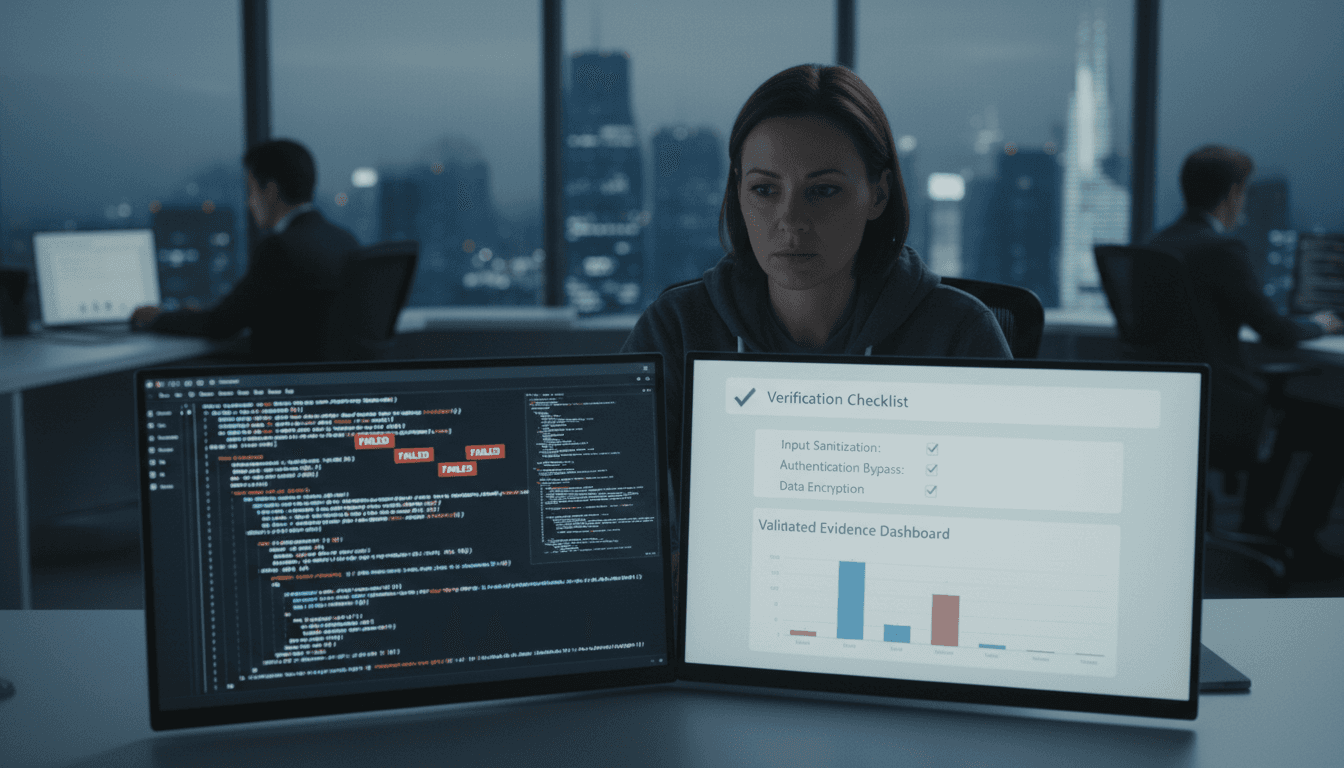
Build a PoC verification gate (use AI, but make it prove its work)
A practical approach I’ve seen work is a simple gating model:
- Claim intake (untrusted): Collect PoCs, exploit writeups, IDS signatures, and social chatter.
- Environment matching: Determine prerequisites (versions, configs, nondefault components, exposed features).
- Reproduction harness: Run in a controlled lab with known vulnerable and known patched baselines.
- Artifact capture: Record logs, stack traces, payload behavior, and network indicators.
- Promotion: Only then do you convert it into scanner logic, detections, or playbooks.
AI can accelerate steps 2–4 dramatically:
- Extract prerequisites from messy code and comments
- Generate reproducible test harnesses
- Summarize why a PoC fails (missing component, wrong endpoint, wrong serialization path)
But here’s the rule: AI output must be testable. If your AI can’t produce a minimal reproduction with observable evidence, it shouldn’t influence priority.
A useful standard: “No exploitability claim without a reproducible trace.”
Stop treating WAF bypass chatter as patch guidance
React2Shell also highlighted a recurring trap: teams see bypass attempts and respond by tuning WAF rules while delaying the patch.
WAF rules are helpful, but they’re not a structural fix for deserialization flaws, auth bypasses, or server-side injection classes. Over-indexing on WAF mitigations creates a cycle:
- PoC appears → WAF rule added → scans go quiet → patch gets delayed → real exploit arrives
Better approach:
- Use WAF as temporary risk reduction
- Patch as the primary control
- Validate exposure as the decision input
Reduce false positives in automated threat detection systems
False positives aren’t just noisy—they’re a budget line item. They consume analyst time, delay response, and train teams to ignore alerts.
If you’re using AI in cybersecurity for detection and triage, you need to design for precision:
1) Train on your reality, not internet averages
Generic models overfit to generic patterns. Your environment isn’t generic.
High-impact improvements often come from feeding your detection/triage model:
- your app stack traces and error taxonomies
- your historical vuln tickets (what was real vs. dismissed)
- your config baselines (what’s actually enabled)
- your patch timelines (what gets stuck and why)
This is where teams win: context beats cleverness.
2) Use “evidence scoring” instead of “string matching”
A lot of scanners and detections still behave like this:
- If payload contains X → mark vulnerable
That approach collapses in the face of fake PoCs.
Instead, score multiple evidence signals:
- server-side exception consistent with the vulnerable code path
- version and dependency confirmation
- required component presence
- behavior change between vulnerable vs. patched baseline
If you’re building AI-assisted detection, train it to ask: “What would I expect to observe if this exploit worked?” Then require those observations.
3) Separate “exploit attempt noise” from “confirmed exploitability”
Security teams often mix these into a single dashboard, which confuses leadership:
- 10,000 exploit attempts seen
- 0 confirmed exploitation
- 1 vulnerable system identified
Those are three different metrics with three different actions.
A clean operational model tracks:
- Threat activity: attempts in the wild
- Exposure: where you’re vulnerable
- Impact: signs of compromise
AI should help classify and route these, not blur them.
Close the detection-to-remediation gap (the only metric that matters)
Finding more vulnerabilities isn’t progress if you can’t fix them. The uncomfortable truth from the React2Shell discussion is that most organizations can detect far more than they can remediate.
Root.io’s survey data put numbers to the pain: an average development team spending 1.31 full-time engineers per month on triage, patching, and testing—and closer to 1.8 FTE in larger organizations. That’s before you account for the time wasted validating broken PoCs.
If you want a measurable outcome from AI in cybersecurity, aim it here:
Make remediation run at the same speed as detection
You can do this without magical autonomy. Focus on these concrete moves:
- Automate dependency and version inventory so “are we exposed?” is answered in minutes.
- Pre-approve patch paths for common libraries (web frameworks, UI stacks, serialization packages).
- Use AI to generate patch PRs and regression test suggestions, but require human approval.
- Create remediation SLAs by exploitability, not CVSS alone (CVSS 10.0 with strong evidence gets a different path than CVSS 10.0 with internet noise).
Add one policy that changes behavior immediately
If you implement only one rule after reading this, make it this:
- No production risk decision is allowed to depend on a public PoC that we haven’t reproduced.
That doesn’t slow you down. It prevents you from moving fast in the wrong direction.
A practical playbook for the next “PoC flood” event
When the next high-profile vulnerability hits (and it will), you need a repeatable response. Here’s a field-tested checklist that keeps teams focused.
- Freeze the narrative: Treat early PoCs as unverified.
- Confirm exposure first: Identify versions, configs, and reachability.
- Stand up a lab: One known-vulnerable instance, one patched instance.
- Validate exploitability: Require logs, traces, and observable behavior.
- Ship compensating controls: WAF/IDS rules as temporary protection.
- Patch with urgency: Don’t wait for a “perfect PoC.”
- Measure cycle time: Track hours from advisory → patch merged → deployment.
If your tooling can’t support steps 2–4 quickly, that’s your roadmap for AI integration: build AI assistants that reduce the time to validated evidence, not assistants that generate more text.
Where AI in cybersecurity should go next
The React2Shell PoC mess is a warning, but it’s also a blueprint.
AI will continue to flood the ecosystem with plausible artifacts: exploit snippets, scanner templates, “bypass” notes, and noisy indicators. Defenders who treat AI output as truth will drown. Defenders who treat AI as a verification engine—one that extracts prerequisites, demands evidence, and accelerates remediation—will get faster and calmer under pressure.
If you want fewer false positives, fewer false negatives, and better automated threat detection systems, focus your AI strategy on one outcome: validated decisions at operational speed.
Your next step is straightforward: audit your vulnerability response workflow and ask where “unverified PoC trust” enters the pipeline. Then put a gate there.
When the next CVSS 10.0 drops and the internet fills with “proof,” will your team be able to tell the difference between noise and exploitability—within hours, not days?