AI-driven cybersecurity helps teams verify breach claims fast, detect misinformation, and reduce extortion pressure when cybercriminals weaponize media.
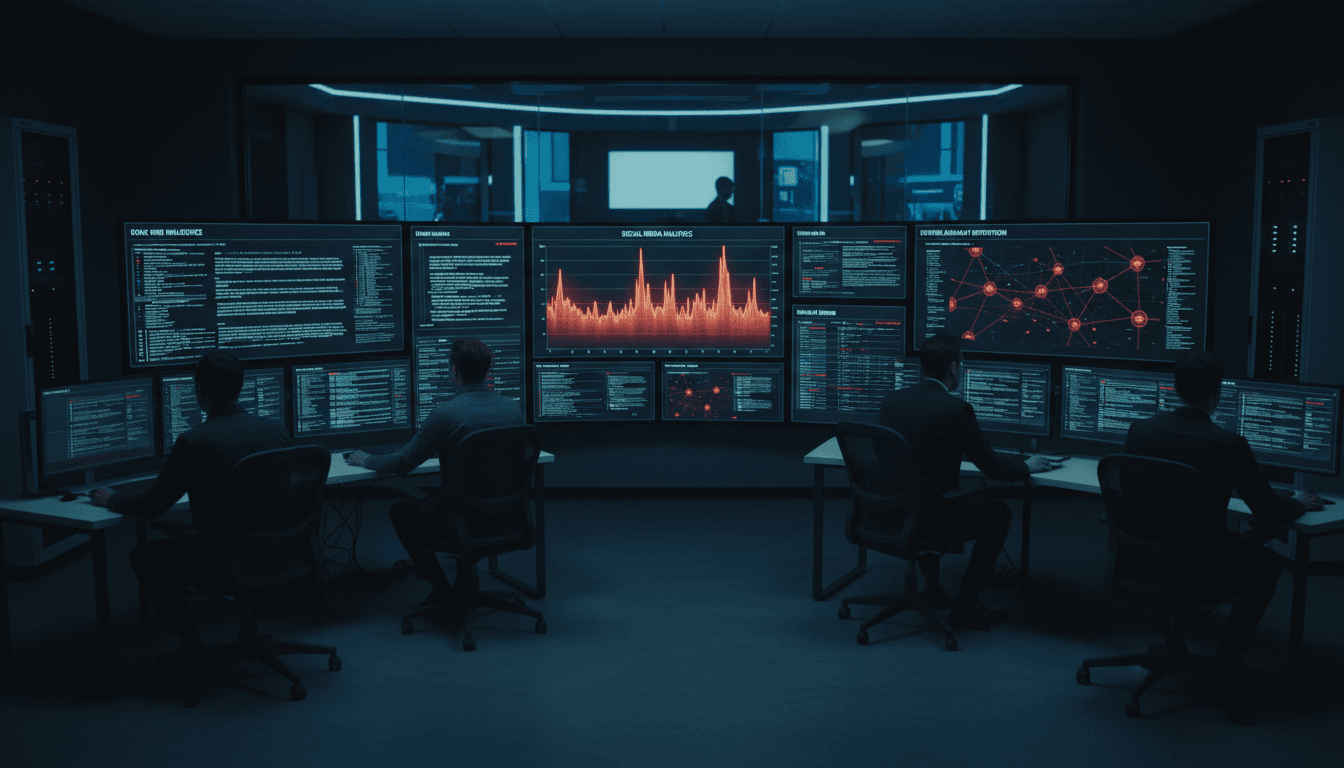
Stop Threat Actor PR: AI Defense for Breach Claims
A single ransomware post on Telegram can now trigger a full-blown corporate crisis before your incident responders even image a server. That’s not an accident. Cybercriminals have learned that media attention is an operational tool, not a side effect—one that boosts their credibility, pressures victims to pay, and widens the blast radius through fear.
Most companies still treat breach communications as a downstream problem: “We’ll deal with PR after security confirms what happened.” The criminals know that delay and uncertainty are exactly where they win. The better posture is to treat information operations—misleading claims, synthetic “proof,” and rapid amplification—as part of the attack chain.
This post is part of our AI in Cybersecurity series, and it focuses on a growing reality: generative AI is making threat actor PR faster, cheaper, and more believable, while AI-driven cybersecurity is becoming the practical counterweight—especially for anomaly detection, real-time threat analysis, and decision support during incident response.
Cybercriminals run PR campaigns because it drives payments
Threat actors publicize attacks for one reason: attention increases leverage. In ransomware and data extortion, the criminal’s goal isn’t “maximum technical damage.” It’s maximum pressure at the decision-maker level—legal exposure, customer churn, regulator scrutiny, board escalation, and reputational harm.
A recognizable criminal “brand” also solves a problem on the attacker’s side: the trust paradox. Victims won’t pay if they don’t believe the attacker will actually decrypt systems or refrain from leaking data. Publicly documented “wins” create the perception that the criminal group is capable and “reliable” (in a perverse way), which increases the likelihood of payment.
There’s also an ego component—status within criminal communities and “trophy” targeting. But operationally, the point is simple:
A breach story that spreads is worth money, even if the breach details are shaky.
That’s why your security program can’t ignore how narratives form and spread.
The two playbooks: direct media outreach and indirect amplification
Threat actors tend to use one (or both) of these approaches.
Direct engagement: criminals acting like press offices
Some ransomware groups and affiliates directly contact journalists or publish “press releases” on extortion sites and messaging apps. They may provide:
- A claim of intrusion (often timed for maximum disruption)
- A teaser dataset (sometimes real, sometimes recycled)
- A countdown timer to increase urgency
- “Media contact” handles to shape the story
In 2025, several widely reported incidents showed how brazen this has become: groups claimed affiliation with ransomware cartels and reached out to major outlets to promote attacks and intimidate victims. It’s marketing, recruitment, and coercion rolled into one.
Indirect engagement: manipulating the researcher-and-reporter feedback loop
Other actors prefer to seed information where they know analysts and journalists are watching: dark web forums, breach marketplaces, and Telegram channels monitored by the security community.
Here’s the pattern:
- A threat actor posts a claim (“We hacked X”) with a dramatic framing
- Niche accounts repost it; “first mover” pressure kicks in
- Headlines repeat the claim with limited verification
- Stakeholders see the story and assume the worst
- The victim faces external pressure—often before internal facts are confirmed
This is how you get “spree” narratives: a series of loosely connected events framed as an unstoppable campaign. Whether the underlying incidents are related matters less than the perception of momentum.
False breach claims still create real legal and brand risk
A frustrating truth: a misleading breach claim can do damage even when it’s wrong.
Why? Because the cost is often incurred upstream of technical verification:
- Executives and boards demand immediate answers
- Customer success teams face inbound panic
- Legal teams prepare for potential litigation
- Regulators and auditors ask for documentation
- Sales cycles stall (“We saw the news…”)
Recent high-profile cases illustrate how this works. Some actors inflated claims (for example, implying access to major institutions when the underlying data came from a smaller entity). Others repackaged old leaks, fabricated “fresh” datasets, or overstated what was stolen (such as presenting configuration data as “source code”).
Even when researchers later debunk the story, the narrative has already landed. Class-action litigation tied to breach exposure has been rising in recent years, and lawsuits sometimes appear before incident facts are fully established. That timing is a gift to extortionists.
Perception is now a parallel attack surface.
How generative AI supercharges cybercriminal PR
Generative AI doesn’t need to create perfect forgeries to be effective. It only needs to produce plausible artifacts quickly enough to outrun verification.
What AI enables attackers to do cheaply
- Synthetic “proof” packs: fake screenshots of admin consoles, ticketing systems, or cloud dashboards
- Convincing sample datasets: realistic-looking rows of customer data that are partially fabricated or stitched from old leaks
- Persona manufacturing: polished announcements, consistent branding, and multilingual posts that read like professional comms
- Deepfake intimidation: voice notes or short videos pretending to be insiders or executives
- High-volume narrative flooding: dozens of posts across platforms to create the illusion of consensus
This changes the defender’s burden. Your team has to answer two questions under pressure:
- Did we have an incident?
- Is the story about the incident true?
Those aren’t the same question—and generative AI widens the gap.
AI in cybersecurity: practical ways to detect narrative attacks early
AI can’t replace forensics. It can, however, buy you time and reduce uncertainty by triaging claims, correlating signals, and flagging anomalies across systems and public channels.
1) AI-driven monitoring for “external-to-internal” correlation
If your organization only monitors internal telemetry, you’ll hear the story late. A modern approach combines:
- Brand and executive impersonation monitoring
- Dark web and criminal channel collection
- Social amplification detection (sudden spikes in mentions)
- Internal SIEM/EDR signals and identity telemetry
AI helps by correlating these feeds and highlighting when external claims align (or don’t align) with internal evidence. If a threat actor claims they exfiltrated a database last night, but you have no matching egress anomalies, no unusual service account activity, and no cloud audit trail signals, that mismatch is decision-useful.
2) Anomaly detection focused on extortion-relevant behavior
Extortion narratives often reference data theft. That means defenders should prioritize analytics for:
- Unusual outbound data transfers (volume, destination, protocol)
- New OAuth grants or suspicious API token use
- Impossible travel and abnormal authentication patterns
- Privilege escalation chains and new admin creation
- Unexpected access to file shares or sensitive SaaS repositories
AI-based anomaly detection is especially valuable in cloud environments where “normal” varies by team and time of year. December is a good example: change windows, year-end reporting exports, and contractor access can create noisy baselines. Good models incorporate seasonality and business context.
3) Detecting synthetic artifacts and tampered “evidence”
Security teams increasingly receive “proof” as images, logs, or snippets shared publicly. AI-assisted analysis can help identify:
- Reused images across unrelated claims (near-duplicate detection)
- Metadata inconsistencies (timestamps, tool versions, formatting artifacts)
- Statistical oddities in datasets (too-clean distributions, repeated templates)
- Signs of AI generation (pattern repetition, unnatural field entropy)
Treat this like phishing analysis: the goal isn’t to prove a deepfake in court within 10 minutes. The goal is to rank credibility and guide escalation.
4) Faster incident response decisions with intelligence-led workflows
The best incident response teams don’t chase every headline. They run a playbook:
- Gather facts fast
- Communicate only what’s verified
- Reduce attacker options
- Avoid reactive moves that increase damage
AI can support this by:
- Summarizing signals across tools into a single incident narrative
- Recommending containment actions based on observed behaviors
- Flagging which claims are likely recycled or historically associated with a specific actor
- Producing stakeholder-ready updates with confidence levels (“confirmed / likely / unverified”)
This is where AI in cybersecurity actually earns its keep: compressing the time from rumor to truth.
A communications-first incident response plan beats panic
When a threat actor story starts spreading, the worst move is improvisation. The second-worst move is letting security operate in isolation.
A resilient approach treats comms as part of incident response, not a separate lane.
Build the “three-team” response muscle: Security + Legal + PR
Run tabletop exercises that include:
- Security/IR leadership
- Legal and privacy counsel
- PR/crisis communications
- Customer support leadership
- Executive decision-maker (someone who can approve actions fast)
Practice responding to scenarios where the public narrative is wrong, partially right, or intentionally misleading.
Use a verification ladder for public breach claims
Here’s a simple ladder I’ve found works under pressure:
- Source quality: Is this coming from the actor directly, or from independent verification?
- Artifact quality: Are there samples? Do they look consistent with your environment?
- Telemetry match: Do internal logs support the claim timeframe and access path?
- Scope confidence: Can you bound what’s affected (system, dataset, identities)?
- Comms stance: What can you say publicly that’s true, useful, and won’t box you in later?
The goal is to avoid two traps: denying too early, or confirming too broadly.
Pre-write stakeholder messages (seriously)
Create templates for:
- “We’re investigating a public claim” (no confirmation)
- “We confirmed unauthorized access” (bounded scope)
- “We have no evidence supporting the claim so far” (careful wording)
- Customer FAQs and support macros
When the pressure hits, having drafts prevents sloppy language that creates legal exposure.
What to do this quarter: a short, realistic action plan
If you want to reduce extortion pressure and narrative risk in 2026, these are high-return moves:
- Add external threat narrative monitoring to your security operations workflow.
- Tune anomaly detection for data exfiltration signals across cloud, identity, and endpoint telemetry.
- Create a joint IR + comms playbook with clear roles, approval paths, and update cadence.
- Train teams on AI-generated deception (synthetic datasets, screenshots, deepfake voice/video).
- Establish a single source of truth for executives so rumors don’t drive decisions.
This isn’t about being “faster than the news.” It’s about being faster than the attacker’s ability to control your stakeholders.
Where this fits in the AI in Cybersecurity story
AI in cybersecurity isn’t only about catching malware. It’s also about handling the messy middle: ambiguous signals, incomplete evidence, and high-stakes decisions under time pressure.
Threat actors will keep running PR campaigns because it works. Generative AI will make those campaigns cheaper and more believable. Your best response is a blend of intelligence-led incident response, AI-driven anomaly detection, and disciplined crisis communications that refuses to be steered by an extortionist’s storyline.
The forward-looking question for security leaders heading into 2026 is straightforward: when the next “we hacked you” headline drops, will your team be arguing on Slack—or executing a plan that turns noise into verified facts?