A $0 card authorization can be an early warning for nation-state activity. Learn how AI spots fraud-to-attack patterns and how to stop them.
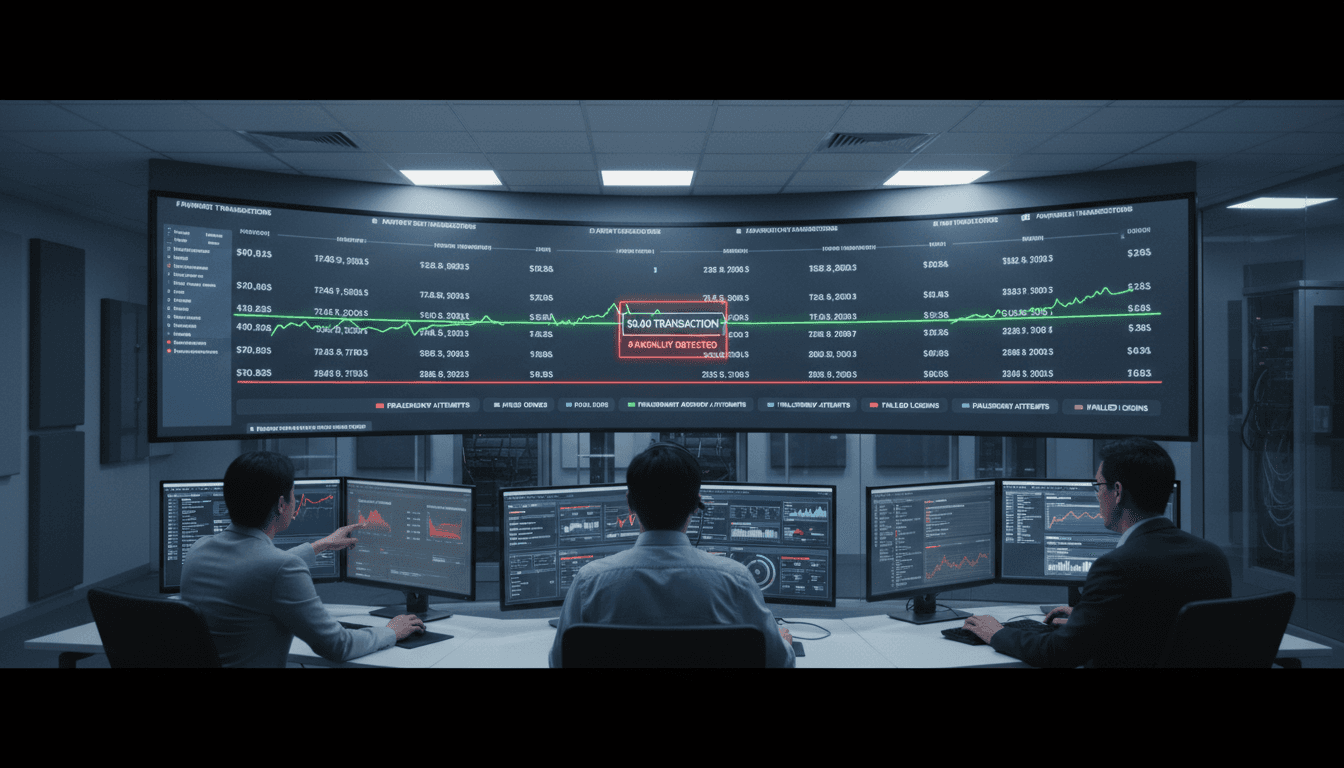
How a $0 Transaction Exposed a Nation-State Attack
A $0 payment authorization doesn’t look like a cyber incident. It looks like noise.
But in late 2025, that kind of “nothing” showed up in fraud telemetry in a pattern that security teams should take seriously: repeated validations at a known card-testing merchant, followed by an attempted paid transaction aimed at a high-value target—an AI platform. Around the same time, a public disclosure described a state-linked espionage campaign targeting that same platform.
Most companies get this wrong: they treat payment fraud and cybersecurity as separate worlds. The reality is that fraud signals can act like an early tripwire for advanced intrusion attempts—especially when adversaries use stolen payment cards to access SaaS and AI services while hiding who they are.
This post is part of our AI in Cybersecurity series, and it uses the $0 transaction story as a practical example of what AI is good at: finding faint, high-signal anomalies across messy data, fast enough to matter.
The $0 transaction wasn’t the attack—it was the warning
A $0 authorization is often used to verify that a payment card is active. On its own, it’s not proof of malice. What makes it valuable is context: where it happened, how often it repeated, and what happened next.
In the incident pattern observed by fraud analysts, the sequence followed a familiar “fraud kill chain”:
- Compromise (a payment card is stolen)
- Validation (small or $0 tests confirm the card works)
- Resale / handoff (card details move through fraud markets)
- Cashout or access (a real purchase is attempted)
The key lesson for security leaders: the validation step happens earlier than the breach attempt you’ll see in your SIEM. If you can detect validation events reliably, you can disrupt the chain before the adversary gets what they came for.
Why adversaries use fraud infrastructure to reach AI platforms
When a threat actor wants to access a Western SaaS product—especially an AI platform—payment is a convenient cover. Stolen cards help them:
- Mask identity (no need to use traceable funding)
- Bypass regional restrictions (buy access from allowed geographies)
- Blend in (a paid account can look more “legitimate” than a free signup)
- Scale activity (many accounts, many cards, rapid iteration)
That’s the part many teams miss: sometimes the “fraud” isn’t about money. It’s about access.
What the observed timeline tells defenders
The reported sequence (dates and ordering matter) looked like this:
- Late September 2025: first authorization at a merchant known to be abused by card-testing services
- Early October 2025: a second test at the same merchant, consistent with “aging” (waiting to see if the card stays active)
- Late October 2025: two more tests, consistent with a handoff where a buyer tests the card after purchase
- Next day: an attempted purchase (~$200) at a targeted AI platform
A clean takeaway: repeated tests at the same tester merchant, separated by days or weeks, often indicate the card changed hands. That’s not random consumer behavior.
The defender’s edge: card testing is repetitive by nature
Attackers can’t skip validation. They need to know the card works before they spend effort (and risk) creating accounts, running workloads, or buying subscriptions.
That requirement creates patterns that are ideal for machine learning and rules working together:
- repeated attempts at a small set of known “tester” merchants n- unusually low dollar amounts or $0 authorizations
- tight bursts across many cards (tester services batch activity)
- re-test after an “aging” interval
Humans can spot this in hindsight. AI can surface it while it’s happening, because it’s good at ranking weak signals that become meaningful in aggregate.
Where AI fits: turning weak signals into high-confidence alerts
AI in cybersecurity is at its best when it’s used for correlation and prioritization, not magical prediction. Fraud telemetry is noisy. Login telemetry is noisy. Support tickets and customer-reported issues are noisy.
The win is when AI connects them.
1) Anomaly detection across billing + identity + security events
A practical model isn’t just “flag $0 transactions.” It’s:
- $0 authorization at a known tester merchant
- followed by new account signup or payment method attachment
- followed by unusual usage patterns (API spikes, automation-like cadence, tool-like user agents)
- combined with geo-IP and device mismatch
You don’t need perfect attribution to act. You need decision-grade confidence that the behavior is inconsistent with real customers.
2) Graph analytics: infrastructure reuse is the tell
Fraud ecosystems reuse infrastructure: merchants, domains, Telegram communities, reseller handles, and service tooling. Nation-state operators also reuse infrastructure, just with more discipline.
Graph-based AI (or even simpler entity resolution) helps you answer:
- Are these payment attempts linked by shared devices, IP ranges, ASN, or email patterns?
- Do signups cluster around certain time windows?
- Do we see the same “testing” merchant appear before multiple attempted purchases?
This matters because a single $0 event is weak. A connected cluster of them is strong.
3) Automated triage that reduces time-to-block
Security teams lose time in handoffs:
- fraud team sees a suspicious payment attempt
- security team sees odd logins
- product team sees odd usage
AI-driven enrichment can push one combined case to the right place with:
- risk score
- linked entities
- recommended action (step-up auth, temporary hold, manual review)
If your process still relies on “someone notices,” you’re giving adversaries free time.
Memorable rule: If you’re only looking for intrusions in security logs, you’re missing the signals that happen before the intrusion.
What to do about it: controls that actually reduce risk
Stopping this category of activity isn’t a single product purchase. It’s a set of decisions about where you want friction—and where you can’t afford to be permissive.
For AI/SaaS platforms: treat payment events as security telemetry
Answer first: Your billing stack is part of your threat detection stack. If you don’t route payment anomalies into security operations, you’re blind to early warning.
Concrete steps that work:
- Step-up verification when tester signals appear
- Require stronger identity checks when a card has interacted with known tester merchants.
- Stricter policies for new paid accounts
- Rate-limit high-risk new accounts (API calls, token creation, project creation) until they age.
- Join fraud + security data
- Correlate payment anomalies with device fingerprinting, signup velocity, and account behavior.
- Abuse-resistant onboarding
- Make it harder to automate account creation (without punishing legitimate users).
For financial institutions: a tester merchant hit is a high-fidelity compromise indicator
Answer first: If a card touches a known tester merchant, assume compromise until proven otherwise.
Recommended playbook:
- Score-up the card immediately in fraud models
- Trigger customer verification (in-app confirmation beats SMS-only flows)
- Reissue or lock if corroborated by other signals (new merchant category, new device, atypical geo)
- Monitor for follow-on behavior within 1–30 days (common “aging” windows)
Banks already do pieces of this. The missed opportunity is treating tester merchants as predictive indicators, not just after-the-fact fraud categories.
For enterprises: third-party risk now includes “platform access abuse”
Answer first: Your employees’ and vendors’ access to AI platforms can be targeted through fraud ecosystems.
If your organization uses AI platforms for development, analytics, or customer operations, build guardrails:
- enforce SSO and conditional access where supported
- restrict API key creation to managed identities
- monitor for new tenant creation or new paid workspaces tied to unusual billing entities
- add detections for automation-like usage from newly created accounts
This isn’t theoretical. Attackers want the same thing your teams want: compute, accounts, and credible access.
“People also ask” (and the practical answers)
Is a $0 transaction always fraud?
No. Many legitimate merchants run $0 or small authorizations. The signal comes from known tester merchants and repeated patterns across time and accounts.
Why would a nation-state actor use stolen cards instead of their own infrastructure?
Because it reduces attribution risk and increases flexibility. A paid subscription account can also look more like a normal user, which helps bypass simplistic abuse controls.
Can AI reliably detect this without causing false positives?
Yes—if you combine AI scoring with clear policy gates. Use AI to rank and correlate, then apply deterministic controls (step-up auth, temporary holds, rate limits) at high-risk thresholds.
The bigger trend for 2026: fraud signals will keep showing up in cyber ops
Here’s what I expect more teams to internalize in 2026: the boundary between fraud and intrusion is getting thinner.
As AI platforms expand globally—and as geopolitical pressure increases—access itself becomes the prize. Adversaries will keep buying it, stealing it, or faking it. And they’ll keep using the same gray-market services that carders and scammers use, because those ecosystems are cheap, scalable, and familiar.
If you’re building an AI-driven security program, start where the signals are strongest. Payment validation patterns, account onboarding anomalies, and infrastructure reuse are all places where AI can spot what humans won’t—especially when the “event” looks like nothing.
If a $0 transaction can foreshadow a serious campaign, what other “small” signals in your environment are you still ignoring?