AI concrete cutting robots bring repeatable precision to tunnels and heavy civil work. See where they deliver ROI and how to adopt them without jobsite chaos.
AI Concrete Cutting Robots: Precision at Tunnel Scale
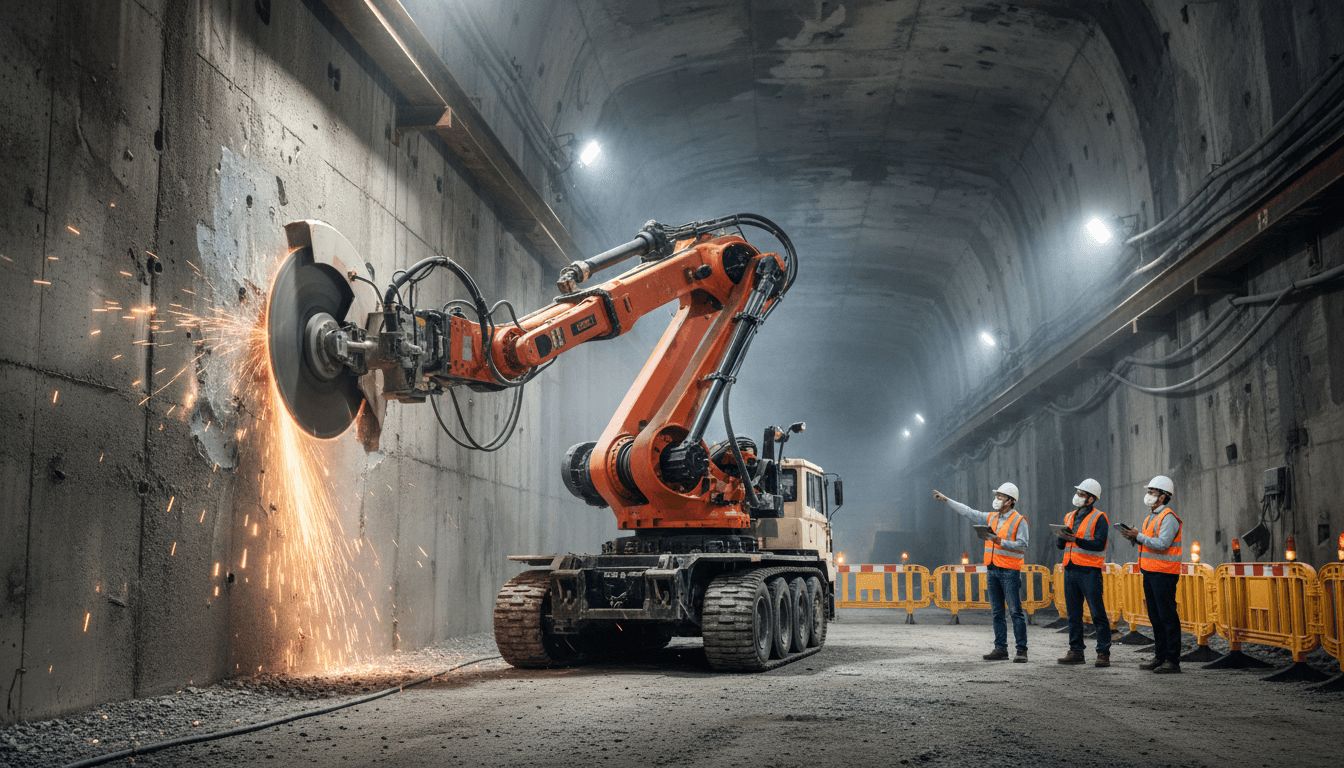
A 2.4-ton robotic arm swinging a six-foot-seven circular saw doesn’t look like “automation.” It looks like a controlled hazard—one that can slice concrete with repeatable accuracy while keeping people out of the blast zone.
That’s the point. In late 2025, labor shortages, tighter safety expectations, and aggressive infrastructure schedules are forcing construction teams to automate work that used to be “too physical, too dangerous, too variable.” Smart Production’s Catonator—built around KUKA’s KR Fortec 480 Ultra and mounted on a truck-hooklift system—captures where the industry is headed: AI-enabled robotic construction that can be deployed like equipment, but behaves like a skilled operator.
This post is part of our “AI in Construction: Building Smarter” series. Here, I’m using the Catonator as a practical anchor to explain what’s really changing: not just bigger robots, but smarter control stacks, better sensing, and jobsite-ready workflows that make heavy automation viable in tunnels, infrastructure rehab, and industrial construction.
What the Catonator signals: automation is moving past “nice-to-have”
Answer first: The Catonator signals that robotics in construction is shifting from pilots to production—especially for high-risk, high-precision tasks like concrete cutting and tunnel works.
A saw with a 12-foot reach mounted to a 2.4-ton arm isn’t about speed alone. It’s about control under load. Concrete cutting isn’t forgiving: blade deflection, vibration, aggregate hardness, rebar strikes, dust, slurry, and uneven surfaces all conspire to turn “simple cutting” into a craft.
Most companies get this wrong by assuming construction automation is mainly a hardware problem. The reality? The hardware is the easy part now. The differentiator is the software stack that turns brute force into repeatable outcomes—path planning, sensing, calibration, and safety logic.
Why tunnels and heavy civil are early winners
Tunnels, retaining walls, bridge decks, and industrial slabs share traits that favor robotics:
- High consequence mistakes (overcutting, damaging rebar, compromising structural elements)
- Awful ergonomics (overhead cuts, awkward edges, confined spaces)
- Safety exposure (silica dust, kickback, pinch points, traffic management)
- Repeatable geometry (segments, liners, trenches, standardized rehab patterns)
When the environment is dangerous and the task is semi-structured, robotic construction makes financial sense sooner.
The jobsite reality: mobility matters as much as precision
The hooklift/truck-mounted approach is more important than it sounds. A robot that can’t move between jobs efficiently becomes a science project. A robot that deploys like a piece of heavy equipment (transport, set down, stabilize, operate) fits existing contractor logistics.
That’s one of the underappreciated requirements for “AI in construction” to create real ROI: deployment friction kills adoption faster than model accuracy.
How AI turns a giant saw into “robotic precision”
Answer first: AI matters here because it helps the robot adapt its cutting plan and cutting parameters to real concrete, not ideal drawings.
A standard industrial robot can follow a programmed path. But concrete cutting demands adjustment. The moment conditions change—material density, rebar, surface irregularities—the robot needs feedback.
Think of the control problem as two layers:
- Geometric precision: Put the blade exactly where it needs to go.
- Process precision: Control force, speed, and stability so the cut quality stays consistent.
AI-enhanced robotics improves both layers when paired with sensors.
The sensing stack that makes this possible
To cut concrete consistently, a system like this typically benefits from:
- 3D perception (LiDAR or structured light) to map surfaces and edges
- Vision to detect markings, cut guides, joints, or forms
- Force/torque sensing to detect binding, chatter, and contact anomalies
- Vibration and acoustic signals to recognize blade behavior changes
- Tool telemetry (RPM, motor current) as a proxy for cutting load
AI doesn’t replace physics; it helps interpret these messy signals quickly.
What “machine learning” is actually doing on a saw robot
Machine learning in robotic construction is most valuable when it does one of these jobs:
- Anomaly detection: Spot the signature of a rebar hit, blade glaze, or unstable cut before it becomes a safety incident.
- Adaptive parameter tuning: Adjust feed rate, blade speed, and depth-of-cut to maintain quality while minimizing wear.
- Perception under noise: Make sense of dusty, wet, low-light conditions where traditional computer vision struggles.
- Automated calibration: Reduce setup time by aligning the robot’s coordinate system to the real-world surface faster.
Here’s a snippet-worthy way to say it:
AI in construction pays off when it reduces “expert-only judgment” to repeatable, auditable decisions.
Precision isn’t just “accuracy”—it’s repeatability at scale
Contractors care about whether the 50th cut looks like the first one—especially when cuts are tied to downstream steps like waterproofing, segment replacement, or embed placement.
A robot can be accurate once. The win is being accurate every time, with the same edge quality, same kerf behavior, and the same tolerance band, regardless of operator fatigue.
Where robots like this create ROI (and where they don’t)
Answer first: Concrete-cutting robots create ROI when they reduce rework, compress critical-path time, and lower safety exposure—not when they’re used as a novelty replacement for hand tools.
If you’re evaluating heavy automation for construction, measure outcomes that finance and operations both care about. I’ve found these categories work best because they map directly to cost drivers.
1) Safety and exposure reduction
Concrete cutting is packed with hazards: silica dust, noise, kickback, pinch points, and unpredictable fractures.
Robotic operation helps by:
- Increasing stand-off distance (operator away from the blade)
- Standardizing safe operating envelopes
- Enforcing interlocks and zone control
- Supporting more consistent dust suppression routines
This isn’t just “safer.” It’s more insurable and more predictable.
2) Schedule reliability on critical-path tasks
When concrete cutting gates other trades (waterproofing, structural repair, MEP installs), variability hurts.
Robotics improves schedule reliability by:
- Delivering consistent throughput per shift
- Running longer with fewer performance drop-offs
- Reducing rework caused by overcut/undercut
A realistic goal isn’t “twice as fast.” It’s fewer surprises.
3) Quality control and documentation
Quality is where AI-enabled robotics can quietly outperform manual work.
If the system captures:
- As-built scan of the surface
- Planned cut paths
- Actual executed path and timestamps
- Deviations beyond tolerance
…you get traceability. On public infrastructure work, that kind of documentation is increasingly valuable.
Where ROI is weaker
Robotics can be a bad fit when:
- The job is extremely small (setup time dominates)
- Access constraints prevent stable placement
- Power/water/dust management can’t be provisioned
- The cutting plan changes constantly without a clean feedback workflow
If your foreman says, “We’ll just figure it out as we go,” you’ll need a different process maturity before a robot pays off.
Implementation playbook: adopting AI robotic construction without chaos
Answer first: The fastest path is to treat the robot like a production cell—with standardized inputs, pre-checks, and acceptance criteria—rather than a fancy tool.
Here’s a pragmatic approach that fits most heavy civil and industrial contractors.
Step 1: Pick a “repeatable pain” use case
Start where variability is manageable:
- Tunnel segment modifications
- Utility trench slab openings with consistent dimensions
- Controlled demolition lines on bridge deck rehab
- Industrial floor openings for equipment installs
Avoid one-off artistic cuts on day one.
Step 2: Define the cut spec like a manufacturing spec
Write down:
- Tolerance band (depth, straightness, allowable overcut)
- Edge finish requirement
- No-go zones (rebar, embeds, post-tensioning)
- Dust/slurry management standard
- Acceptance method (scan, gauge, visual, or all three)
This matters because AI needs targets, not vibes.
Step 3: Build the digital thread (lightweight, not perfect)
You don’t need a full BIM-to-robot pipeline to start, but you do need a clean way to go from plan to execution.
A workable minimum:
- Mark cut boundaries in a digital plan (or site scan)
- Register the robot to the work surface (targets or scan alignment)
- Execute and log actual paths
- Store evidence for QA
Over time, this becomes a compounding advantage: every job improves your templates and parameter sets.
Step 4: Treat safety as a system design problem
For a high-energy tool like a large circular saw, safety can’t be “PPE and a toolbox talk.” It must include:
- Physical exclusion zones and geofencing
- Redundant E-stops and lockout/tagout procedures
- Blade guarding and debris containment where feasible
- Human-robot interaction protocols (spotter roles, hand signals, radio discipline)
If you’re planning to generate leads or internal buy-in, don’t lead with speed. Lead with exposure reduction and controlled risk.
Step 5: Train two roles, not one
Teams often train “the operator” and call it done. Better: train two complementary roles.
- Robot operator: runs the job, monitors telemetry, handles stops/starts
- Process tech: owns calibration, parameter tuning, blade selection, QA checks
This mirrors how manufacturing automation actually succeeds.
People also ask: practical questions contractors raise
Will an AI concrete cutting robot replace a concrete crew? No. It changes the crew mix. You’ll use fewer people in the hazard zone and more people doing setup, QA, and materials handling. That’s a trade most contractors should welcome.
Does AI matter if the robot can follow a programmed path? Yes, because the path is only half the battle. AI helps the robot respond to real-world variability—load changes, surface irregularities, and tool wear—without relying on one expert’s instincts.
What’s the biggest adoption blocker? Process readiness. If you can’t define tolerances, acceptance criteria, and safe work zones, the robot won’t save you. It will amplify the chaos.
Is this only for tunnels? Tunnels are a strong fit, but the same approach applies to industrial plants, ports, airports, and large commercial projects where concrete work repeats across zones.
Where this fits in “AI in Construction: Building Smarter”
Robots like the Catonator are the physical side of a bigger theme in this series: AI improves construction when it reduces uncertainty—in schedule, safety, and quality.
If you’re planning 2026 bids right now, I’d take a hard look at where heavy automation could remove the most risk from your critical path. Not every site needs a 2.4-ton saw robot. But many sites do need the capabilities behind it: better sensing, better process control, and better documentation.
The question worth asking next isn’t “Can a robot cut concrete?” We already know it can. The real question is: Which parts of your workflow are ready to be standardized enough that a robot can outperform your best day—every day?