Hypergrids are emerging to meet AI data center power demand. Learn what it means for logistics AI reliability, cost, and real-time operations.
Hypergrids: The Power Backbone for Logistics AI
Data centers already consume about 4.4% of U.S. electricity, and projections put that figure at roughly 12% by 2030. That isn’t a fun trivia fact—it’s a constraint that will shape what AI can realistically do for transportation and logistics over the next five years.
If your team is counting on real-time route optimization, AI-based supply chain forecasting, computer vision in warehouses, or control towers that rebalance inventory hourly, you’re also counting on the power system that keeps those models trained and those inference workloads running. The uncomfortable truth is that grid timelines (often five-plus years for major interconnections) don’t match AI timelines (quarters).
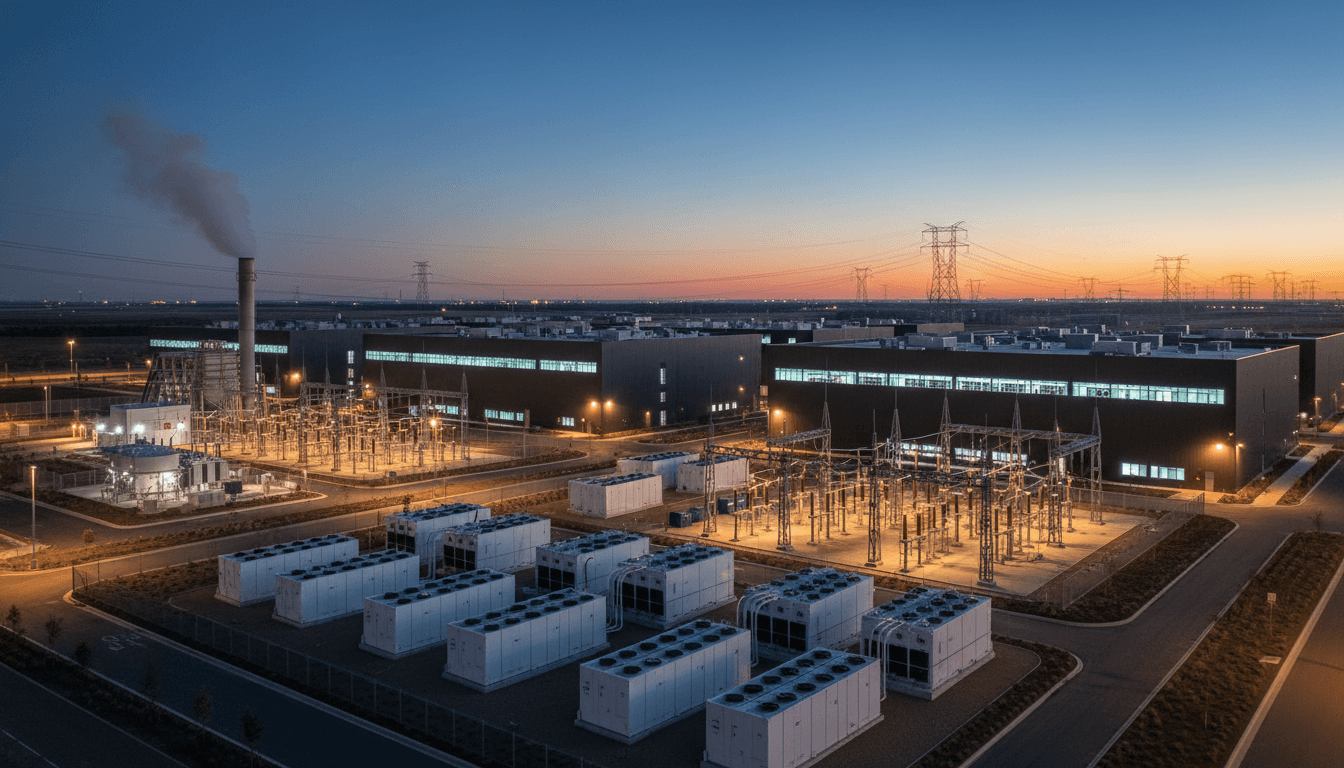
This gap is why we’re seeing the shift from microgrids to something bigger and more consequential: hypergrids—data-center-scale power systems that behave less like “backup generators” and more like private utility infrastructure that can interact with the macrogrid. For logistics leaders, hypergrids aren’t an energy story on the sidelines. They’re quickly becoming part of the infrastructure layer that determines whether AI-driven operations stay reliable, affordable, and compliant.
From microgrids to hypergrids: what actually changed
The core change is simple: AI workloads turned data centers into industrial-scale power users. Training frontier models and operating dense GPU clusters pushes facilities from “large customer” into “regional planning problem.”
Microgrids were historically built for campuses, hospitals, ports, or manufacturing sites to improve resilience and manage energy costs. They’re usually measured in kilowatts to low megawatts. Hypergrids, by contrast, are measured in hundreds of megawatts to gigawatts, and the mission isn’t just resilience—it’s speed to power at massive scale.
A concrete example making the rounds in late 2025: a flagship campus in Abilene, Texas planned to scale to 1.2 GW. That’s not “a big data center.” That’s “a new power plant plus a data center plus a control system.”
Here’s the key implication for AI in transportation and logistics:
- Inference is operationally unforgiving. If your warehouse slotting engine can’t compute, conveyors still run—but less efficiently. If your dispatch and ETA models go dark, your network becomes slower and noisier within hours.
- Training is bursty and power-hungry. Peak training cycles (often aligned to product launches, seasonal demand shifts, or network expansions) can collide with grid constraints.
- The AI roadmap is now tied to energy procurement. More companies will find that their AI initiatives are limited less by data science talent and more by power availability and interconnection schedules.
Hypergrids exist because the market refuses to wait.
Why hyperscalers are acting like utilities (and why logistics should care)
Hyperscalers and large AI infrastructure developers are increasingly building vertically: generation, storage, procurement, and compute in one stack. They’re doing it for one reason—interconnection queues and planning cycles are too slow for the competitive stakes of AI.
Think about what “speed to power” means in practical terms:
- Utilities plan capacity to maintain reliability across a region.
- A new gigawatt-scale load can wipe out a region’s comfort margin fast.
- Even when utilities want the business, permitting, upgrades, transformers, and transmission constraints can drag on.
So the builder brings power on-site first, then integrates with the grid later.
Bridge power is becoming the default
Many hypergrid designs start with on-site natural gas turbines (often aeroderivative turbines) because they can be deployed relatively quickly and provide a controllable baseline.
Is that at odds with public renewable goals? Yes—and it’s not a minor contradiction. But it’s also the predictable result of mismatched timelines: the AI build schedule is measured in months; major grid upgrades are measured in years.
The stance I’ll take: treat “bridge power” as a design phase, not a moral victory lap. If a hypergrid is built with the controls, storage, and interconnection capability to transition to lower-carbon firm power over time, it’s more credible than a glossy pledge with no construction schedule.
What this means for freight, warehouse, and parcel networks
Most logistics organizations won’t build a hypergrid. But many will end up depending on the compute capacity that hypergrids enable—through cloud AI platforms, optimization engines, and real-time visibility systems.
That dependency shows up in three places:
- Cost volatility: Power-constrained regions can translate into higher cloud costs, capacity constraints, or geographic shifts in where workloads run.
- Resilience requirements: Outages or curtailments in a constrained grid region can ripple into model availability.
- Latency and placement: Real-time decisions (routing, robotics control, yard orchestration) increasingly depend on where compute sits relative to your operation.
Logistics leaders should start asking cloud and solution providers hard questions about where critical AI workloads execute, and what happens when the grid is stressed.
The hypergrid interconnection problem: regulation is behind reality
Here’s where it gets messy. Grid rules were built for a world where:
- big customers connected as loads (state jurisdiction), and
- new generators connected as supply (often federal rules and processes).
That split doesn’t fit hypergrids well because a hypergrid can be both:
- a massive load (consuming power for compute), and
- a generator or grid-service provider (exporting power or stabilizing the system).
Recent federal reforms improved generator interconnection processing (including queue reforms and study process changes), but they don’t automatically fix the load interconnection bottleneck that large data centers face.
The practical impact: a developer that can self-supply power gets to build on their timeline, while everyone else waits.
What “grid-interactive” really means
The most useful way to think about hypergrids is as grid-interactive compute plants. Not just “a data center with generators,” but an energy-and-control asset that can provide services when connected to the macrogrid.
When done properly, hypergrids can support the grid instead of destabilizing it. Utilities care about two reliability concepts in particular:
- Planning Reserve Margin (PRM): traditionally targeted around ~15% above peak demand in many regions.
- Spinning reserves: often ~3–7%, rapidly dispatchable capacity for frequency regulation.
A giant new load threatens both. A well-controlled hypergrid can help, but only if it’s engineered and contracted to do so.
The architecture logistics teams should understand (even if you never build one)
Hypergrids are becoming the physical substrate of AI in cloud computing and data centers. If you’re making bets on AI-driven transportation management, warehouse automation, and supply chain analytics, these are the components and capabilities worth understanding.
1) Battery storage is shifting from “UPS” to operational asset
Traditional data center UPS systems were about bridging seconds to minutes.
Hypergrids are deploying industrial-scale battery energy storage systems (BESS) that do more than keep the lights on. They can:
- smooth peaks (reducing demand charges or peak procurement)
- provide fast frequency response
- support voltage regulation
- enable demand response participation
For logistics AI workloads, that matters because batteries can help keep compute stable during grid disturbances—reducing the odds that your planning run fails halfway through a peak day.
2) Advanced inverters and power electronics are now part of reliability
The grid is losing physical inertia as older synchronous generation retires, while wind/solar additions grow. Hypergrids that integrate renewables and batteries need grid-forming inverters and voltage support capabilities that behave more like traditional stabilizing assets.
This is one of the least understood points outside energy circles: the control layer matters as much as the generation source. A sloppy design can create harmonic issues, flicker, or protection headaches. A strong design can provide synthetic inertia and rapid reactive power support.
3) Demand response becomes “compute response”
In logistics, we’re used to demand shaping: shift labor, redirect freight, reslot inventory.
Hypergrids introduce a similar concept for energy: shift compute. Some workloads can pause, move regions, or reduce intensity. Others can’t.
A practical framework I’ve found helpful is to classify AI workloads into three buckets:
- Always-on inference: robotics control loops, ETA services, fraud detection, safety monitoring
- Time-flexible inference: batch scoring, periodic re-optimization, exception triage
- Training and experimentation: ideally schedulable around power price signals and grid stress
If your organization runs private AI infrastructure (or negotiates dedicated capacity), you can design runbooks that reduce cost and improve reliability by shifting the time-flexible portions.
4) The “contract” is part of the architecture
Hypergrids only help the macrogrid when contracts require them to behave that way. Expect to see more agreements that define:
- when the site must curtail load
- when it can export power
- what grid services it must provide (frequency regulation, reactive power support)
- performance penalties and telemetry requirements
For logistics buyers of AI platforms, there’s an analogy: SLAs without operational detail aren’t protection. Ask how uptime is maintained during regional grid stress, not just what the uptime percentage is.
What to do next: a logistics-first checklist
If you’re responsible for AI outcomes in transportation, warehousing, or supply chain planning, the hypergrid trend changes what “due diligence” looks like.
Questions to ask your AI and cloud providers
- Where do our latency-sensitive AI services run geographically, and can they fail over to another region?
- What portion of our bill is exposed to regional power price volatility (directly or indirectly)?
- Do you have dedicated capacity plans for peak seasons (Q4 retail, produce season, severe weather events)?
- What happens when a region triggers demand response or faces curtailment risk?
Moves to make inside your own AI roadmap
- Design for graceful degradation. Identify what your operation can tolerate if optimization refresh rates slow for 2–6 hours.
- Separate “critical inference” from “nice-to-have intelligence.” Put the former on the highest resilience tier.
- Treat energy as a platform dependency. If you’re building private compute, bring energy procurement and interconnection into the project at day one, not after site selection.
- Measure compute elasticity. The more you can shift training and batch inference, the more options you have when grid conditions tighten.
A useful one-liner for planning meetings: “If the power schedule is five years, the AI schedule isn’t six months.” Align them early or you’ll pay later.
Hypergrids are becoming the hidden enabler of AI-driven logistics
Hypergrids aren’t replacing the grid; they’re exposing how badly the grid’s processes fit modern AI demand. Data centers are turning into energy orchestration hubs because the macrogrid can’t always deliver capacity on the timelines hyperscalers need.
For the AI in Cloud Computing & Data Centers series, this is the connective tissue: workload management, resource allocation, and AI infrastructure optimization only work when the underlying power architecture is stable, scalable, and contractually integrated with the local utility reality.
If you’re investing in AI for transportation and logistics, don’t treat hypergrids as someone else’s problem. They’re already shaping where compute gets built, what it costs, and how reliable your “real-time” decisions really are.
What would change in your network if your most important optimization models had to run with power constraints—during peak season, not in a test environment?