Hydrogen power for data centers is moving from pilots to real supply deals. See what the 2028 timeline means and how AI optimizes hydrogen dispatch.
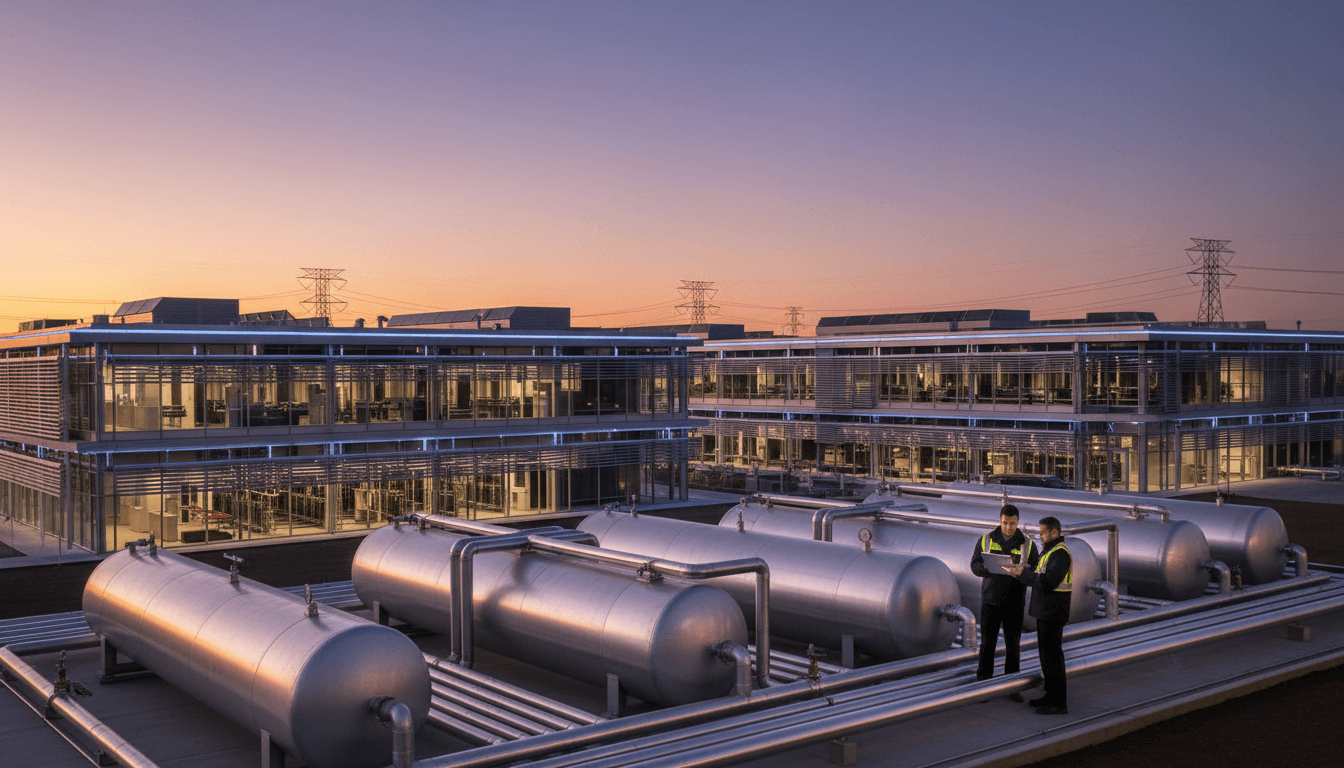
Hydrogen Power for Data Centers: What Changes in 2028
Data centers don’t “sip” electricity. They gulp it—every hour of every day. The part most people miss is that the hardest hours aren’t the average hours; it’s the peaks, the heat waves, the grid events, and the moments when everyone’s AI workloads are spiking at the same time.
That’s why a recent California development deal between Vema Hydrogen and Verne is worth paying attention to. The agreement centers on supplying Engineered Mineral Hydrogen (EMH)—a form of low-carbon hydrogen produced using naturally occurring subsurface reactions—to support on-site power and cooling for data center customers, with operations potentially starting as soon as 2028. The companies also point to the scale of what’s coming: they cite expectations that data center energy consumption could double by 2030, reaching roughly 945 terawatt-hours of demand.
This post is part of our “AI in Cloud Computing & Data Centers” series, where we focus on practical infrastructure decisions—power, cooling, workload management, and grid coordination. Hydrogen-based on-site power isn’t a silver bullet, but it’s quickly becoming a serious option for sites that need high availability, faster interconnection pathways, and a credible decarbonization plan.
Why hydrogen is showing up in data center power plans
Hydrogen is showing up because the grid alone can’t do all the work fast enough for every new campus—and because diesel backup is becoming harder to justify politically, environmentally, and sometimes operationally.
Across North America, many data center builds run into a familiar wall:
- Interconnection queues stretch into years.
- Transmission constraints limit how quickly load can grow.
- Permitting risk rises when communities hear “new gas plant” or “more diesel tanks.”
- Reliability requirements (N+1, 2N, uptime commitments) don’t bend for grid realities.
On-site generation has always been part of the data center story—just usually in the form of diesel generators that sit idle until an outage. What’s changing is that operators increasingly want generation assets that can run more often, support peak shaving, and provide resilience during multi-hour grid events.
Hydrogen fits this niche when it’s paired with technologies like fuel cells or hydrogen-capable turbines/engines—and when the fuel supply is credible at scale.
What’s different about this deal (Vema × Verne)
The headline isn’t “hydrogen for data centers.” We’ve heard that before. The noteworthy parts are the timeline, production commitment, and positioning.
From the source details:
- Verne plans to use Vema’s Engineered Mineral Hydrogen (EMH) to support low-emission power for data center customers.
- Operations could begin as soon as 2028.
- Vema plans to scale to more than 36,000 metric tons per year of EMH during a 10-year agreement.
- Vema was recently recognized as a qualified supplier for California’s First Public Hydrogen Authority (FPH2) network.
The practical implication: this is not a one-off pilot. It’s a bet that hydrogen supply can be made predictable enough to support critical infrastructure customers who don’t tolerate fuel uncertainty.
How “Engineered Mineral Hydrogen” changes the conversation
EMH matters because it tries to address hydrogen’s most persistent obstacle: cost and supply consistency at scale.
Traditional clean hydrogen pathways—especially electrolytic “green hydrogen”—often hit constraints around electricity prices, capacity factors, and project economics. That doesn’t mean electrolysis won’t be important. It will. But data centers are ruthlessly sensitive to total cost of ownership, and they buy reliability as much as they buy energy.
Vema’s pitch is that EMH uses geoscience and subsurface reactions to produce high-purity hydrogen with predictable output. If that predictability holds, it’s valuable for a sector that plans campuses years ahead and needs contracts that behave more like fuel supply agreements than science projects.
What data center operators should ask about any “clean hydrogen” supply
If you’re evaluating hydrogen-based on-site power, don’t get stuck on labels like “green” or “low-carbon” without asking the operational questions that determine whether the project works.
Here are the due-diligence questions I’d put at the top of the list:
- What’s the delivered hydrogen price over time? Not a single number—an indexed structure.
- What’s the guaranteed volume and ramp schedule? Especially important for phased campus builds.
- How is hydrogen transported and stored on-site? Tube trailers, liquid delivery, pipeline, or on-site production.
- What’s the emissions accounting method? Including upstream, compression/liquefaction, and logistics.
- What happens during supply interruptions? Dual-fuel capability, storage buffers, or fallback generation.
Deals like Vema–Verne are interesting because they imply the parties believe those questions can be answered with enough confidence to sign a multi-year agreement.
Where AI fits: optimizing hydrogen-based on-site power for data centers
AI fits here in a very specific way: hydrogen is expensive to waste, and on-site power systems get complicated quickly. AI-driven energy management is what makes complex systems behave predictably.
If you’re building (or operating) a data center campus with hydrogen in the mix, you’re managing a multi-variable problem:
- Variable IT load (especially with AI training bursts)
- Cooling demand that swings with weather and density
- Hydrogen storage constraints
- Generator/fuel cell dispatch limits
- Utility tariffs, demand charges, and curtailment events
- Emissions targets and reporting requirements
This is exactly where AI for data center energy efficiency becomes more than a buzz phrase. You need models that forecast, coordinate, and verify.
Use case 1: Workload-aware dispatch (IT meets power plant)
The best energy strategy starts on the compute side.
A practical approach is to use AI forecasting to classify workloads by flexibility:
- Rigid: latency-sensitive inference, critical transactions
- Semi-flexible: batch analytics with deadlines
- Flexible: training jobs that can shift within a time window
Then tie that to dispatch logic:
- Run flexible workloads harder when hydrogen is available and grid prices/emissions are high.
- Pull back or shift workloads when hydrogen storage hits minimum buffers.
Done right, this reduces both fuel cost volatility and reliability risk.
Use case 2: Predictive control for cooling + on-site generation
Hydrogen power doesn’t exist in isolation; cooling often determines whether you can actually use the power you have.
AI control systems can co-optimize:
- chilled water supply temperatures
- fan speeds
- economizer modes
- rack-level temperature targets
- generator/fuel cell setpoints
The goal isn’t perfection. It’s preventing the common failure mode: you have power, but cooling becomes the bottleneck, forcing you to curtail compute.
Use case 3: Measurement, reporting, and verification (MRV) that survives scrutiny
If you’re using hydrogen to claim “low-emission power,” you will be asked to prove it—by customers, regulators, and eventually auditors.
AI-assisted MRV helps by:
- reconciling sensor drift and missing data
- detecting abnormal consumption patterns
- attributing emissions by hour (not just annual averages)
- producing consistent reports across sites
This matters because the data center sector is moving toward hourly matching and more granular carbon reporting expectations.
What “on-site hydrogen power” really looks like in a campus design
On-site hydrogen power works best when you treat it as part of a portfolio, not a replacement for everything.
Here are common architectures we’re seeing (and why they’re realistic):
Architecture A: Hydrogen for resilience + peak support
Answer first: Use hydrogen to reduce diesel runtime and support peak events without rebuilding the whole power strategy.
- Grid supplies the bulk energy
- Battery energy storage handles short-duration events and ride-through
- Hydrogen generator/fuel cell runs during peak prices, grid stress, or extended outages
- Diesel remains as last-resort backup (or is phased down over time)
This structure tends to be easiest to permit and operate because it doesn’t require hydrogen to be 100% available.
Architecture B: Hydrogen as a firm power block for phased expansion
Answer first: Use hydrogen to power new capacity while you wait for interconnection upgrades.
This is a real-world driver: campuses want to energize new halls now, not in four years.
A staged approach:
- Bring up initial phases with grid + on-site hydrogen generation
- Add additional hydrogen capacity as the campus grows
- Transition some load back to grid as transmission and substations catch up
The business value is speed to revenue.
Architecture C: Hydrogen paired with heat recovery for better economics
Answer first: If you can use the waste heat, hydrogen economics improve.
Fuel cells and generators produce usable heat. In certain climates and campus designs, heat recovery can support:
- absorption chilling
- facility heating needs
- domestic hot water
- neighboring industrial thermal loads
Not every site can use it. But when it’s feasible, it’s one of the few levers that improves the total system efficiency.
Risks and constraints: what could derail hydrogen for data centers
Hydrogen for data centers will succeed in some places and fail in others. Being honest about the constraints is the fastest way to make good decisions.
The four big risks
- Fuel logistics at scale: Moving hydrogen is non-trivial. Storage and delivery need the same seriousness as diesel supply planning—often more.
- Permitting and safety: Hydrogen safety is manageable, but it requires training, detection, ventilation, setbacks, and emergency response alignment.
- Technology choice risk: Fuel cells vs turbines vs engines isn’t a small detail—it determines efficiency, maintenance, ramping, and emissions.
- Economics under real utilization: A system that looks great at 5% runtime can look ugly at 40% runtime if maintenance and fuel costs aren’t modeled correctly.
A realistic stance on “not dependent on incentives”
The source claims EMH-based power can be affordable and “not dependent on state or federal incentives.” I like the ambition, but I wouldn’t buy any on-site generation plan without running:
- base-case economics
- downside fuel price case
- downside utilization case (more runtime than expected)
- upside case (valuable grid services revenue)
If it still works under stress, you’ve got something.
What to do next: a practical checklist for operators and utilities
If you’re a data center operator, utility, or energy partner looking at hydrogen-based on-site power, here’s a clean starting point.
Operator checklist (next 30–60 days)
- Map your campus load into critical vs flexible segments (AI training is often the most flexible).
- Quantify your top 10 “bad hours” from the last year: peak demand, curtailments, high prices, heat waves.
- Decide what hydrogen is for: backup replacement, peak shaving, interconnection bridge, or all three.
- Start an MRV plan now—metering, data retention, and reporting—before procurement.
Utility checklist (how to partner instead of fight)
- Identify feeders and substations where hydrogen-supported campuses could reduce peak stress.
- Offer grid services pathways (demand response, capacity, voltage support) that on-site assets can participate in.
- Align interconnection studies with phased build plans so temporary on-site power doesn’t become permanent grid avoidance.
Hydrogen becomes far more attractive when utilities treat it as a controllable asset rather than a threat.
What this signals for AI-driven power hubs in 2026–2030
Hydrogen power for data centers is ultimately a bet on one thing: firm energy that scales with AI growth without waiting for perfect grid conditions.
The Vema–Verne agreement—targeting potential operations by 2028 and scaling toward 36,000+ metric tons per year—suggests the market is moving from “pilot thinking” to “supply chain thinking.” That’s a meaningful shift.
If you’re building or modernizing data center infrastructure, the smartest move is to evaluate hydrogen alongside the other firming options (grid upgrades, batteries, gas with decarb pathways, long-duration storage, nuclear procurements where applicable). Then use AI not as a marketing layer, but as the control plane that makes the whole energy stack predictable.
The open question heading into 2026 planning cycles: Will hydrogen become the standard interconnection bridge for new AI campuses—or will it remain a site-specific solution for the most constrained regions?