Google Cloud’s December 2025 updates show a clear shift toward agentic ops, schedulable AI capacity, and AI-native security. Here’s what matters and what to do next.
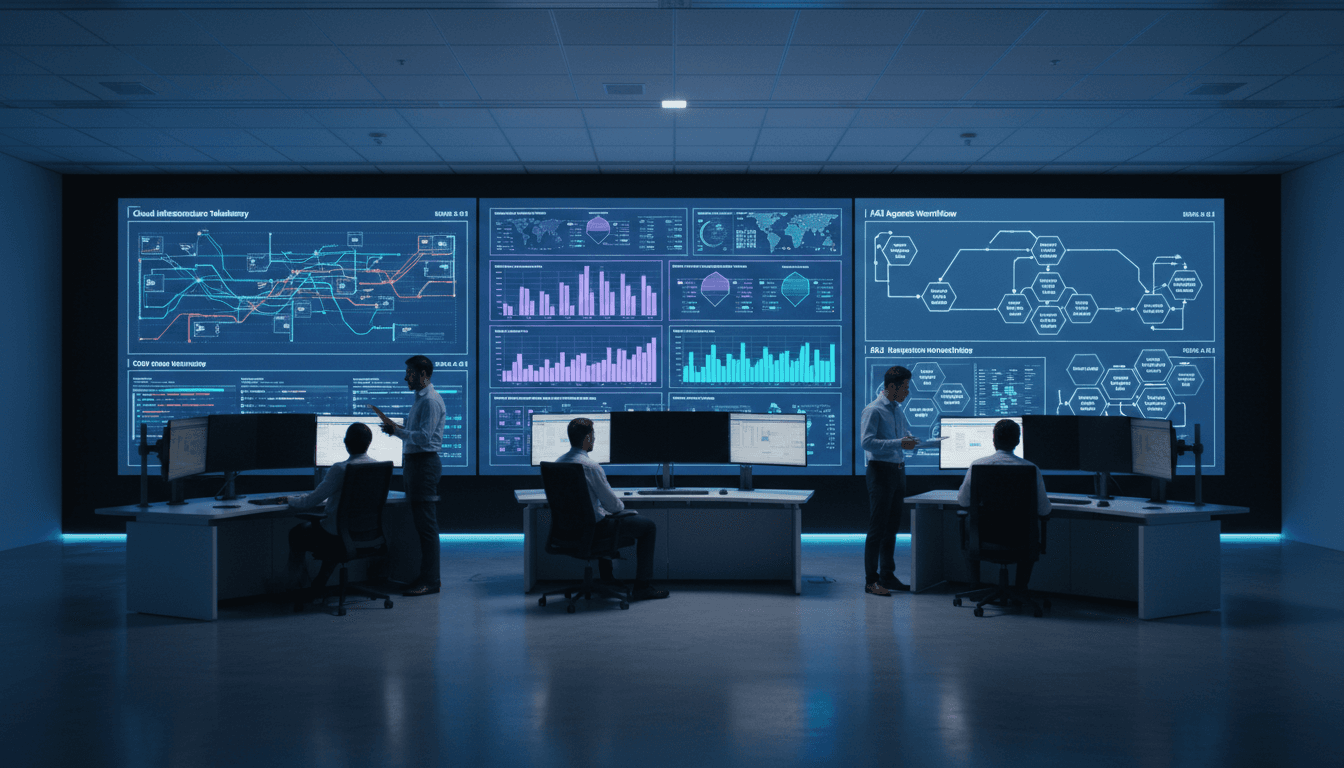
Google Cloud AI Updates: What Matters for Ops Teams
Data center efficiency is starting to look less like “buy more hardware” and more like “run the same hardware smarter.” The December 2025 Google Cloud release notes make that shift unusually clear: agents are moving closer to where the data lives, infrastructure is getting more schedulable and predictable, and security controls are being built around AI workflows instead of bolted on afterward.
If you run cloud infrastructure, platform engineering, data platforms, or AI workloads, these updates aren’t random product tweaks. They’re signals about where cloud operations is going next: AI-assisted operations, agentic data access, and infrastructure that’s optimized for volatility—spiky demand, scarce accelerators, and tighter compliance.
Below are the releases that matter most for the AI in Cloud Computing & Data Centers series, with practical ways to apply them and a few opinionated takes on what to prioritize before 2026 budgets and roadmaps lock.
The big shift: “data agents” are showing up everywhere
The clearest theme in the last 60 days is this: Google is pushing conversational and agentic interfaces into databases and data services, not just into chat tools.
Data agents in databases: AlloyDB, Cloud SQL, Spanner
Google introduced data agents (Preview) across:
- AlloyDB for PostgreSQL
- Cloud SQL for MySQL
- Cloud SQL for PostgreSQL
- Spanner
The intent is obvious: reduce the friction between “a question” and “a query,” and let applications use an agent as a controlled tool to interact with production data.
What I like about this direction: it pushes agentic workflows into systems that already have mature controls—auditing, IAM, and familiar operational boundaries.
What I don’t like: it’s easy to accidentally create “shadow query paths” where an agent becomes the new way to access data, but your governance (logging, approval, data classification) is still tuned for humans and service accounts.
Practical guidance for platform teams:
- Treat data agents like production APIs. You’ll want versioning, role-based permissions, rate limits, and cost controls.
- Force least privilege early. If the agent can see a table, assume it will eventually summarize it.
- Log the right things. Don’t just log queries—log who requested the agent action, what tools were invoked, and what datasets were touched.
Gemini 3 Flash shows up where latency matters
Two notable placements for Gemini 3 Flash (Preview):
- Vertex AI: Gemini 3 Flash is in public preview for complex multimodal and agentic tasks.
- AlloyDB generative AI functions: Gemini 3 Flash can be used when calling functions like
AI.GENERATE.
This matters operationally because Flash-class models tend to be the ones teams actually put in the critical path—customer-facing copilots, real-time incident triage assistants, or “agent in the loop” tools for ops.
If you’re planning agentic workloads, the design question is no longer “can the model reason?” It’s “can it reason fast enough without blowing up costs?” Flash variants are where that conversation gets real.
AI infrastructure is getting more schedulable (and that’s a big deal)
GPU scarcity is still a planning constraint, and the release notes reflect that reality.
Compute Engine: calendar-mode future reservations (GA)
Compute Engine now supports future reservation requests in calendar mode (GA) for GPU/TPU/H4D resources for up to 90 days.
This is one of those features that looks boring until you’ve missed a training window because capacity wasn’t available.
Where this improves data center efficiency (in practice):
- You move from “panic provisioning” to scheduled capacity, which reduces waste.
- Your internal teams can plan around booked windows, improving utilization.
- You can align high-power workloads (training, fine-tuning, HPC) with cost and energy strategies.
How I’d use this in a real org:
- Reserve capacity for predictable peaks (end-of-quarter forecasting runs, retraining cycles).
- Use on-demand or preemptible-style options for experimentation.
- Track reservation utilization as a KPI—unused reserved GPU time is expensive shame.
Compute Engine: sole-tenancy support expands for GPU machine types
Sole-tenant support expanded to include A2, A3 Mega, and A3 High GPU machine types.
This is relevant for regulated environments and for companies that want predictable noisy-neighbor isolation, but it’s also relevant for AI performance consistency. If you’ve ever chased jitter in distributed training, you know why this matters.
AI Hypercomputer: node health prediction (GA)
Node health prediction for AI-optimized GKE clusters is now GA, helping avoid nodes likely to degrade within the next five hours.
This is exactly the kind of “AI for operations” feature that quietly changes reliability economics.
Operational value: fewer interrupted runs, fewer flaky training jobs, fewer “why did this node become weird?” investigations.
My take: If you run large-scale training or interruption-sensitive inference, you should be testing this now. These are the kinds of features that pay off only after you’ve wired them into scheduling and SLO thinking.
Agent platforms are maturing: Vertex AI Agent Engine gets real pricing and GA building blocks
Vertex AI Agent Engine had a big practical update:
- Sessions and Memory Bank are now GA
- Pricing changed: runtime pricing lowered, but starting January 28, 2026, Sessions, Memory Bank, and Code Execution begin charging
- Agent Engine expanded to more regions
This is a classic cloud pattern: free/cheap during adoption, then metered when usage becomes meaningful.
What to do before January 28, 2026
If your team is prototyping agents, you should use the next few weeks to gather the usage data you’ll need for 2026 planning:
- How many sessions per day?
- Average session length?
- Memory usage patterns (how often are you reading/writing memory)?
- Code execution frequency (if used)
Why this matters for leads and decision-makers: agent platforms don’t fail because the model is wrong. They fail because unit economics weren’t modeled early, and suddenly the “helpful agent” becomes an unbudgeted line item.
Security is moving from “API security” to “AI workflow security”
The release notes also show a noticeable security posture shift: AI systems are being treated as first-class citizens in security tooling.
Apigee Advanced API Security adds AI-focused policies (GA)
Risk Assessment v2 is GA, with support for:
- VerifyIAM
- SanitizeUserPrompt
- SanitizeModelResponse
- SemanticCacheLookup
This is important because it acknowledges a truth ops teams already see: prompt injection, unsafe output, and caching risks aren’t “app bugs.” They’re platform risks.
Practical stance: If you’re building AI agents that call tools, you should standardize prompt and response sanitation at the gateway/policy layer wherever possible. Don’t leave it up to each app team to remember.
Model Context Protocol (MCP) becomes a first-class integration surface
Several updates point to MCP becoming a real operational substrate:
- API hub supports MCP as an API style
- Cloud API Registry in Preview for governing MCP servers and tools
- BigQuery remote MCP server in Preview for agent-driven data tasks
This is basically Google saying: “Tools are the new APIs.”
If your org is going to run many agents, you’ll need a registry/governance layer for tools—ownership, versioning, access rules, and observability.
If you do nothing else: inventory your internal tools that agents will call. If you don’t, you’ll end up with an ungoverned toolbox that can reach production.
Data platforms are getting smarter and faster (without you writing glue)
Some “quiet” releases have outsized impact for data center cost and performance.
Cloud SQL enhanced backups (GA) + PITR after deletion
Enhanced backups for Cloud SQL are now GA and integrate with Backup and DR for centralized retention and scheduling. The standout: PITR after instance deletion support.
From a resilience standpoint, this is huge. From an ops standpoint, it changes how you handle “oops” events.
Recommendation: Revisit your database recovery runbooks. If you’re still operating as if deletion equals permanent loss, you’re leaving recoverability on the table.
BigQuery: autonomous embedding generation (Preview)
BigQuery can now maintain an embedding column automatically when you add/modify a source column, and you can use AI.SEARCH for semantic search.
This reduces the need for separate embedding pipelines and lowers the operational burden of keeping vectors in sync.
Why it matters for platform teams: fewer pipelines means fewer scheduled jobs, fewer failure points, and fewer “why is the embedding table stale?” incidents.
Cloud Storage Anywhere Cache integrates with BigQuery
Anywhere Cache can now accelerate object reads issued by BigQuery.
Even if you don’t touch the feature directly, it points to an infrastructure trend: caching is becoming a shared, intelligent layer between storage and analytics rather than an app-level optimization.
The small changes ops teams shouldn’t ignore
A few updates are easy to miss, but they can affect reliability and governance.
- Cloud Load Balancing rejecting non-RFC-compliant HTTP methods at the Google Front End (GFE): you may see a small drop in error rates and different failure behavior.
- Dataform strict act-as mode (GA): better IAM predictability, but can surface permissions gaps you previously “got away with.”
- Cloud KMS single-tenant Cloud HSM (GA): for teams that need dedicated HSM partitions and stronger separation, but note the operational overhead (quorum approvals + external key custody).
A simple action plan for the next 30 days
If you’re trying to translate release notes into decisions, here’s a realistic plan that doesn’t require a re-architecture.
-
Pick one agent surface to standardize
- Either database agents (Cloud SQL/AlloyDB/Spanner) or app agents (Vertex AI Agent Engine).
- Standardize logging + IAM patterns before you scale.
-
Lock in capacity strategy for 2026 AI workloads
- Test calendar-mode future reservations.
- Decide what gets reserved vs. what stays on-demand.
-
Add an “AI gateway” layer for safety policies
- Centralize prompt/response sanitation and identity verification policies (especially if you’re using tool-calling agents).
-
Run a cost and latency baseline
- Measure current inference latency and costs.
- Re-run with Flash-class models where appropriate.
Where this fits in the AI in Cloud Computing & Data Centers series
This release cycle shows cloud providers converging on a specific operating model: AI-driven cloud infrastructure optimization isn’t a single feature—it’s a stack.
- Agents sit closer to data.
- Scheduling becomes more explicit (reservations, health prediction).
- Governance shifts from “who can call the API” to “what can the agent do with tools.”
If you’re building for 2026, the winning move is to treat “agentic workloads” as a platform capability with guardrails, not a side project living in one team’s repo.
If you want to pressure-test your architecture, here’s a good question to end on: What’s your organization’s plan when hundreds of agents—not humans—become the most frequent callers of your data and infrastructure APIs?