EC2 C8gn expands to Ohio and UAE, bringing up to 600 Gbps networking and Graviton4 gains—ideal for CPU AI inference and network-heavy workloads.
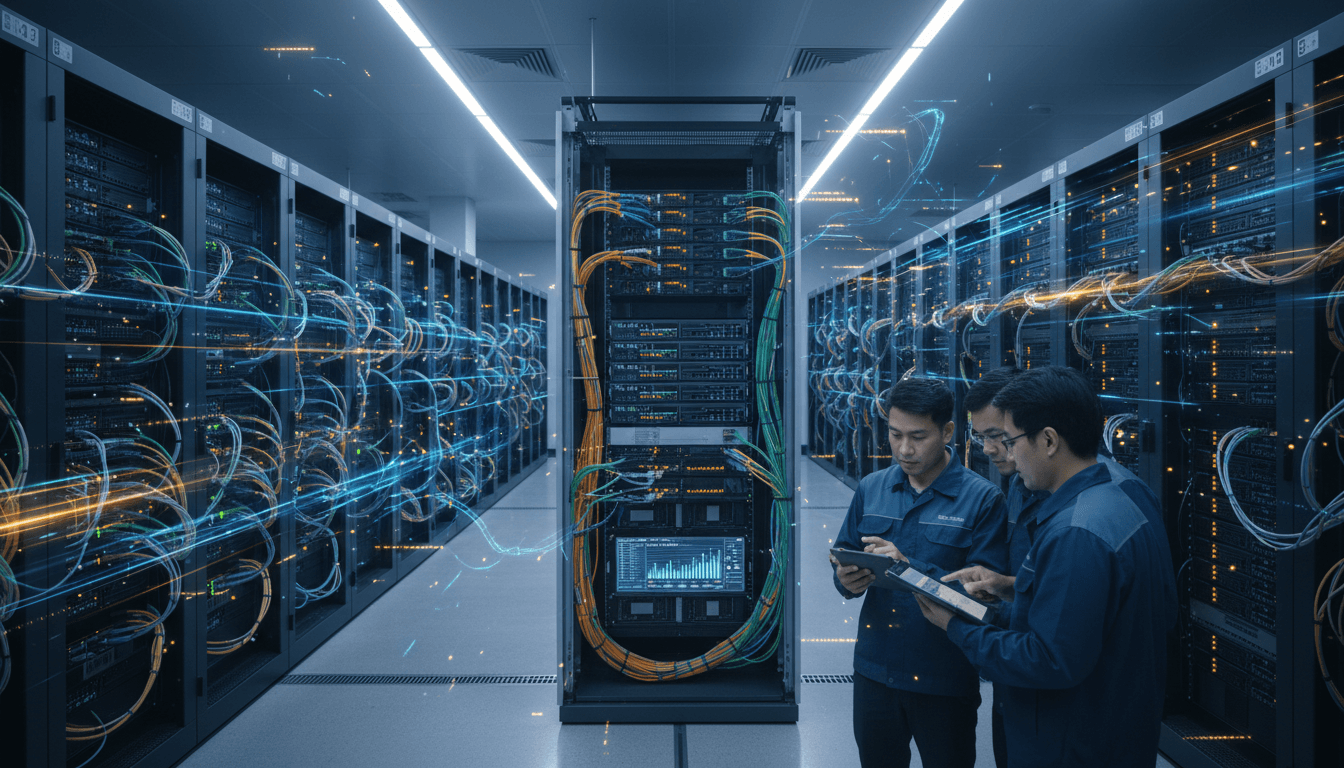
EC2 C8gn Regions: Faster Networking for AI Inference
A 600 Gbps network pipe changes what “CPU-based AI inference at scale” looks like in the real world. Not because everyone suddenly needs that much bandwidth, but because it removes a bottleneck that quietly forces teams to overprovision instances, spread workloads awkwardly across AZs, or accept unpredictable tail latency.
AWS just expanded Amazon EC2 C8gn—its network-optimized Graviton4 compute family—into US East (Ohio) and Middle East (UAE). The headline specs are straightforward: up to 30% better compute performance vs. Graviton3-based C7gn, the latest 6th generation AWS Nitro Cards, and up to 600 Gbps networking. The operational implication is bigger: more places where you can run network-heavy AI and data workloads close to users and data sources, while keeping costs sane.
This post is part of our “AI in Cloud Computing & Data Centers” series, where the real story isn’t just faster chips—it’s intelligent resource allocation, latency-aware placement, and infrastructure choices that reduce wasted spend.
What the C8gn region expansion actually enables
Answer first: More regional availability means you can place network-intensive AI and analytics workloads closer to users and data, lowering latency and improving throughput without redesigning your architecture.
When a new instance family lands in additional regions, most teams treat it as a checkbox item. I think that’s a miss. With C8gn specifically, the combination of high network bandwidth, strong per-core performance, and Graviton cost/performance economics makes it a practical tool for three recurring problems:
- AI inference that’s CPU-bound but network-sensitive (think real-time ranking, embeddings retrieval, moderation pipelines).
- East-west traffic heavy services (service meshes, microservices, API gateways, L7 proxies).
- Network appliances and security stacks (firewalls, IDS/IPS, DLP, NAT, routing).
Expanding into Ohio is meaningful because it’s a common “second US East” footprint for enterprises that want geographic separation from N. Virginia while staying close to major US population centers. Expanding into UAE matters because latency budgets are often non-negotiable in the Middle East for financial services, consumer apps, and regulated workloads that prefer regional processing.
Why region placement is an AI infrastructure decision
AI systems don’t fail gracefully when latency spikes. Even small delays create knock-on effects: request queues build, autoscaling reacts late, and you end up paying for extra capacity just to keep SLOs.
The simplest way to stabilize an AI inference platform is often placing compute closer to the callers and the data plane. C8gn being available in more regions gives architects another option to meet latency targets without defaulting to GPU instances for workloads that don’t truly need GPUs.
C8gn in plain terms: compute + network, tuned for throughput
Answer first: C8gn is designed for workloads where network throughput and predictable CPU matter more than local NVMe or massive memory.
Here’s what AWS is putting on the table with C8gn:
- AWS Graviton4 processors with up to 30% better compute performance than Graviton3-based C7gn
- Up to 600 Gbps network bandwidth (AWS states this is the highest among network optimized EC2 instances)
- Up to 48xlarge, with up to 384 GiB memory
- Up to 60 Gbps bandwidth to Amazon EBS
- Elastic Fabric Adapter (EFA) support on larger sizes (16xlarge, 24xlarge, 48xlarge, metal variants) for lower latency clustering
The important framing for AI in cloud computing is this:
If your model fits in memory and your bottleneck is request volume + network calls, you’ll often get better economics on CPU than you expect.
Teams regularly overspend on accelerators because they’re trying to fix latency variance and throughput ceilings that are actually caused by network congestion, inefficient service-to-service hops, or slow storage paths.
The Nitro Card angle (why you should care)
AWS mentions 6th generation Nitro Cards for a reason. Nitro offloads virtualization and networking tasks, which typically improves isolation and consistency. In practical terms, it can mean:
- Less jitter under load
- More predictable packet processing
- Better scaling for high-connection-count services
That consistency is gold for AI inference gateways and real-time analytics pipelines, where tail latency is what customers notice.
Where C8gn fits for AI/ML: CPU inference and the “boring” parts that matter
Answer first: C8gn is a strong pick for CPU-based AI inference and the infrastructure around models—feature stores, retrieval, streaming, and network-heavy pre/post-processing.
Not every ML workload is GPU-first. A lot of production ML is made of components that are (a) highly parallel, (b) latency-sensitive, and (c) not doing massive matrix multiplications. Examples:
1) Real-time inference that’s I/O heavy
If an inference request triggers multiple network calls (feature retrieval, vector search query, policy checks), the model execution may be only a slice of the total time. More bandwidth and lower contention can improve end-to-end latency more than a faster accelerator.
Good candidates:
- Ranking or recommendation microservices with small/medium models
- Moderation classifiers
- Fraud scoring services that call out to feature stores and rules engines
2) Retrieval-augmented generation (RAG) plumbing
Even if you run the generator model on GPUs, the surrounding services often run on CPUs:
- Document chunking and metadata enrichment
- Embedding generation (sometimes GPU, often CPU depending on scale and SLA)
- Retrieval services and API layers
C8gn is a sensible foundation for the “glue” services because they tend to be network chatty.
3) Batch analytics and streaming pipelines
Data analytics workloads (ETL, stream processing, log pipelines) frequently hit ceilings on network and storage paths rather than raw compute.
With up to 60 Gbps to EBS, you can sustain higher I/O rates to attached storage while keeping compute costs predictable—useful for CPU-heavy transforms and aggregation stages.
Network-intensive workloads: the most underrated cost center
Answer first: If your cloud bill is inflated, there’s a decent chance you’re paying for inefficiencies caused by network bottlenecks—extra instances, bigger sizes, and higher replication just to compensate.
Most companies get this wrong: they treat networking like a background utility, then wonder why they can’t stabilize latency.
Here’s a pattern I see constantly:
- A service experiences latency spikes under peak load.
- The team scales out horizontally.
- Network contention increases (more east-west chatter).
- Tail latency gets worse.
- The team scales more.
At some point you’re spending money to chase a problem that’s structural.
With C8gn, AWS is clearly targeting workloads where the right answer is: scale throughput without turning your architecture into a pinball machine.
Practical examples where C8gn can pay off fast
- Network virtual appliances: firewalls, routers, gateways, IDS/IPS. These live and die by packet throughput.
- API gateways and ingress layers: high TLS termination, high concurrency, lots of short requests.
- Service mesh data planes: sidecars and proxies can burn CPU and network in ways that are easy to underestimate.
If you’re running those components on general-purpose instances because “it’s fine,” you’re likely leaving performance and money on the table.
Scaling strategy: choosing sizes, EFA, and placement for predictable performance
Answer first: Pick C8gn when you need predictable networking, then use EFA (where supported) for tightly coupled clusters, and size based on connection count and throughput—not just vCPU.
AWS notes that C8gn scales up to 48xlarge and supports EFA on larger sizes. That matters for two different scaling modes:
Horizontal scale for stateless, high-concurrency services
For inference gateways, API tiers, and microservices, you usually want more smaller nodes until connection overhead becomes the issue.
What to measure before choosing a size:
- Peak concurrent connections
- P99 latency under load
- Network packets per second and bandwidth
- CPU steal/interrupt time (if you monitor it)
Clustered scale for tightly coupled workloads (EFA)
EFA is relevant when you have many nodes that need fast, low-latency communication (common in HPC and some distributed ML patterns).
A useful rule: if your workload spends noticeable time waiting on inter-node communication, EFA-capable sizes are worth testing.
Treat instance selection as an experiment, not a commitment: benchmark one production-like path end-to-end, then decide.
Regional availability: why Ohio and UAE matter for latency, compliance, and ops
Answer first: These regions reduce latency for local users and help with data residency and operational resilience—three things that directly influence AI service reliability.
C8gn is now available across multiple regions including US East (N. Virginia, Ohio), US West (Oregon, N. California), Europe (Frankfurt, Stockholm), Asia Pacific (Singapore, Malaysia, Sydney, Thailand), and Middle East (UAE).
Here’s how the new additions tend to show up in real architecture decisions:
US East (Ohio): resilience without leaving the “US East orbit”
Ohio is frequently used for:
- DR or active-active deployments paired with N. Virginia
- Enterprise workloads that want separation but similar ecosystem proximity
- Central-ish latency coverage across the US
For AI inference, that can mean lower user latency for parts of the Midwest and better multi-region design options without hopping to a far region.
Middle East (UAE): regional performance plus data control
For organizations serving Gulf markets, hosting inference and analytics locally can reduce latency and simplify governance for workloads that prefer regional processing.
If you’re building AI-driven customer experiences (support automation, personalization, fraud checks), region choice becomes product choice. Users feel it immediately.
“People also ask” (and what I tell teams)
Is C8gn only for networking appliances?
No. It’s great for appliances, but it’s equally relevant for AI inference and data analytics where network throughput and predictable CPU performance drive the outcome.
Should we move from x86 to Graviton4 just for performance?
Performance matters, but I’d decide based on total cost per successful request (or cost per job). If your stack is containerized and your dependencies are ARM-friendly, Graviton migrations are often straightforward. If you’re running legacy binaries, plan time for compatibility testing.
When does CPU inference beat GPU inference?
When models are smaller, latency targets are reasonable, batch sizes are low, or the pipeline is dominated by I/O and orchestration. GPUs shine when the math dominates; CPUs win more often than people admit when the system overhead dominates.
Next steps: how to evaluate C8gn for your AI platform
Answer first: Run one controlled benchmark that includes your network path (not just model execution), then scale the test to peak concurrency and measure cost per request.
Here’s a simple evaluation plan you can execute in a week:
- Pick one representative service path (API → feature retrieval → inference → response).
- Recreate peak-like concurrency (load test with realistic payloads and connection behavior).
- Track these metrics:
- P50/P95/P99 latency
- Throughput (requests/sec)
- Error rate under saturation
- Network bandwidth and packets/sec
- Cost per 1M requests (or per batch job)
- Compare against your current baseline (same software, same tuning, different instance family).
- Decide where C8gn belongs:
- Inference tier
- Ingress/proxy tier
- Data pipeline workers
- Security/network appliance layer
If you’re serious about AI infrastructure optimization, this is the kind of experiment that pays for itself quickly.
The broader theme in this series is that AI in cloud computing isn’t only about models—it’s about the systems that keep models fast, stable, and affordable. C8gn’s expanded availability gives more teams a practical way to build that foundation closer to where their users and data live.
What would you change in your stack if you could assume “network isn’t the bottleneck anymore”—your inference layer, your feature store path, or your cross-region design?