Stargate-style AI infrastructure partnerships reshape cost, latency, and reliability for U.S. digital services. Here’s how to plan for it.
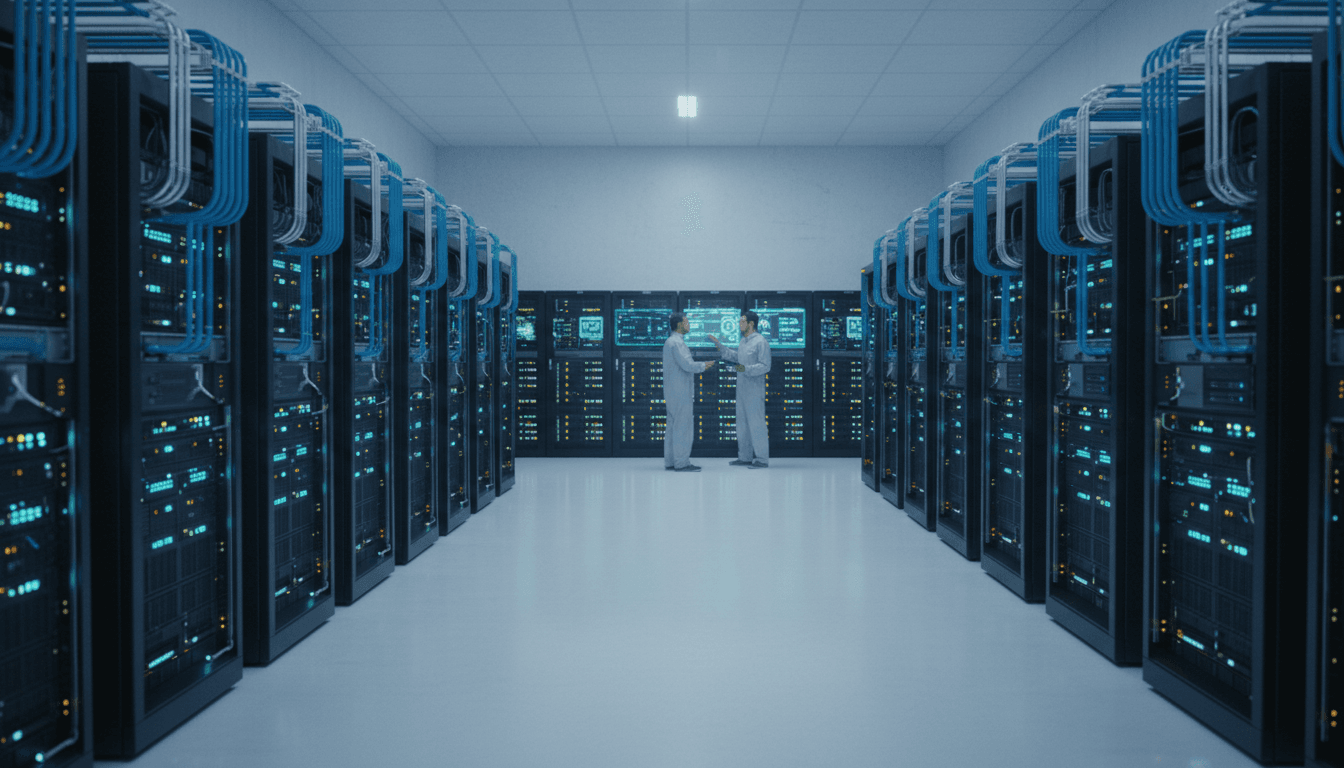
AI Infrastructure Partnerships: What Stargate Means
AI progress isn’t being held back by ideas. It’s being held back by power, cooling, chips, and reliable data center capacity.
That’s why the news that Samsung and SK are joining OpenAI’s Stargate initiative matters—even if you never buy a server, design a chip, or negotiate a colocation contract. When major technology groups commit to shared AI infrastructure, the downstream effect hits the U.S. digital economy fast: cheaper inference over time, more stable capacity for peaks, and a healthier ecosystem for SaaS platforms and startups that depend on AI features customers now expect by default.
This post is part of our “AI in Cloud Computing & Data Centers” series, where the theme is simple: the AI you sell is only as strong as the infrastructure you can run it on. Let’s talk about what a partnership like Stargate signals, what it changes for cloud and digital services in the United States, and how to plan for it if you’re building or buying AI-enabled products.
Stargate is a bet on capacity, not hype
Stargate is best understood as an infrastructure-scale coordination effort: aligning supply chains, deployment capability, and operational know-how so advanced AI systems can be trained and served reliably.
The RSS source itself was blocked at retrieval time, so we don’t have quotable specifics from the original announcement. But we do have enough context to analyze what this kind of coalition typically means in practice, especially when the participants include companies with deep strengths across semiconductors, memory, devices, energy, and industrial operations.
Here’s the stance I’ll take: partnerships like this are less about “who has the smartest model” and more about “who can guarantee compute when it counts.” If you sell digital services in the U.S.—customer support automation, document workflows, personalized recommendations, security monitoring, developer tools—your cost structure and reliability increasingly trace back to global AI infrastructure decisions.
Why big infrastructure alliances are showing up now
Demand is hitting multiple constraints at once:
- GPU scarcity and long lead times for high-demand accelerators
- Power delivery limits (utility interconnect queues can stretch many months)
- Cooling density challenges (AI racks push far beyond traditional enterprise loads)
- Network bottlenecks inside and between data centers
- Operational maturity gaps (running AI clusters at scale is a specialized skill)
A single company can’t fix all of that quickly. A multi-party initiative can.
Why Samsung and SK matter (even for U.S. SaaS teams)
Samsung and SK bring “boring” capabilities that decide whether AI services actually scale: advanced manufacturing, memory supply, energy systems, and global operational execution.
If you’re building AI features, you’re really buying into a stack:
- Model layer (foundation models, fine-tuning)
- Serving layer (inference, batching, caching, guardrails)
- Infrastructure layer (accelerators, memory, networking)
- Facilities layer (power, cooling, reliability engineering)
Samsung’s influence across devices and components and SK’s footprint (notably across energy and advanced industrial capabilities) map to the layers that most AI teams ignore until something breaks. And in the U.S. market—where customer expectations for uptime and latency are unforgiving—that “ignored” layer becomes a competitive edge.
The memory story: the hidden governor of AI performance
Most people fixate on GPUs. But memory bandwidth and capacity are constant limiting factors for both training and inference.
- Larger context windows increase VRAM pressure.
- Multi-tenant inference increases memory fragmentation.
- Retrieval-augmented generation (RAG) adds vector search and cache layers that can thrash poorly designed systems.
When memory supply stabilizes and platform-level engineering improves, you see it downstream as:
- Lower p95 latency
- Better throughput per dollar
- Fewer “capacity” incidents during traffic spikes
For U.S. SaaS teams, that translates into something extremely practical: you can price AI features with more confidence because your unit costs won’t swing as wildly.
What this changes inside data centers: power, cooling, and scheduling
AI infrastructure partnerships push the industry toward data centers built for continuous high-density load, not occasional enterprise bursts.
In the “AI in Cloud Computing & Data Centers” context, this is the shift: traditional cloud optimization focused on elastic scaling and cost controls; AI workloads push toward sustained utilization and strict performance constraints.
High-density racks force different facility design
AI clusters often require:
- Higher rack densities (driving new cooling architectures)
- More stringent power quality management
- Better fault isolation (a single bad link can cascade performance issues)
This matters to digital services because the infrastructure stack influences service-level behavior:
- If a provider can’t cool densely, they can’t deploy as many accelerators.
- If a provider can’t get power fast, they can’t expand capacity.
- If scheduling is weak, your inference jobs compete poorly and latency spikes.
Workload management becomes a product feature
As capacity gets tighter, cloud providers increasingly differentiate on intelligent resource allocation:
- Priority tiers for latency-sensitive inference
- Reservation models for predictable workloads
- Better batching and speculative decoding options
- Isolation for regulated industries
From a buyer’s perspective, this is critical: the same model can feel “fast” or “slow” depending on the provider’s scheduling and infrastructure topology. Partnerships that strengthen the underlying capacity can reduce those swings.
How global AI infrastructure investments benefit the U.S. digital economy
The U.S. market benefits when global suppliers coordinate to expand AI capacity, because the U.S. is a major consumer of AI-enabled digital services.
This isn’t abstract. Think about where AI is showing up in American businesses right now:
- Customer service: agent assist, call summarization, automated email response
- Sales ops: meeting notes, CRM enrichment, proposal drafting
- Security: log triage, alert summarization, phishing analysis
- Software delivery: code review help, test generation, incident postmortems
- Healthcare admin: prior auth support, documentation workflows
These are inference-heavy applications. They need:
- Predictable latency
- Strong uptime
- Cost stability
- Compliance-friendly deployment options
As infrastructure initiatives scale capacity, the flywheel looks like this:
- More capacity reduces extreme price spikes during demand surges
- Lower and steadier inference cost makes AI features easier to bundle
- More AI adoption drives higher demand for digital services
- Higher demand funds further infrastructure build-out
If you’re a U.S. startup or a mid-market SaaS company, the practical effect is that you can design product roadmaps that assume AI is always on, not “available when capacity allows.”
What to do now: practical planning for teams building AI features
The winners won’t be the teams that chase every new model release. They’ll be the teams that manage cost, latency, and reliability like first-class product requirements.
Here are the concrete moves I recommend, based on what infrastructure constraints typically look like during rapid expansion cycles.
1) Design for inference cost volatility
Even if infrastructure partnerships improve supply, pricing can still fluctuate by region, tier, and time.
Practical steps:
- Instrument your unit economics: cost per chat, cost per document, cost per minute of audio
- Add feature flags to dial model size up/down
- Use caching for repeated prompts and common answers
- Batch background tasks (summaries, tagging) to off-peak windows
A useful rule: if you can’t explain your AI cost per customer in one sentence, you’re not ready to scale it.
2) Treat latency as an architecture choice
Latency isn’t just about “a faster model.” It’s driven by:
- Network distance to the serving region
- Batching settings and queue depth
- Token generation speed
- Retrieval pipeline design (RAG)
Actions that pay off:
- Keep retrieval close to inference (same region, low hop count)
- Pre-compute embeddings and store them efficiently
- Use smaller models for routing/classification and larger models only when needed
3) Buy capacity intentionally (and negotiate like you mean it)
As infrastructure becomes a competitive battleground, providers will offer different knobs:
- Reserved throughput or committed spend
- Dedicated endpoints
- Data residency controls
- Higher-SLA tiers
For lead teams (CTOs, Heads of Product, Procurement), the question to ask is:
- “What happens to my p95 latency and throughput during peak demand—and what do you guarantee contractually?”
4) Don’t ignore energy and sustainability metrics
December is when a lot of teams lock budgets and vendor plans for the next year. It’s also when boards ask uncomfortable questions about energy usage.
If your digital service is AI-heavy, start tracking:
- Approximate energy per 1,000 requests (provider-level estimates are fine)
- Model selection policy (why you use a larger model vs a smaller one)
- Idle capacity and waste (especially for always-on endpoints)
Even when customers don’t ask directly, enterprise procurement teams increasingly do.
People also ask: “Does this mean cheaper AI in 2026?”
Over time, yes—but not evenly, and not for every workload. Infrastructure expansion generally reduces the most painful scarcity pricing, but premium tiers (lowest latency, strict compliance, dedicated capacity) often stay expensive.
A better expectation for 2026 is:
- More predictable access to compute
- More productized infrastructure options (reservations, tiered latency)
- A clearer split between commodity inference and premium inference
If you’re selling into the U.S. market, predictability is the bigger deal than raw price. Customers forgive a lot less when your AI feature is slow, inconsistent, or unavailable.
Where Stargate-style partnerships fit in the “AI in Cloud Computing & Data Centers” story
This is the next chapter of AI in cloud computing: infrastructure becomes the differentiator. Models still matter, but the limiting factor for most digital services is whether you can serve reliable inference at scale without cost blowouts.
Samsung and SK joining an OpenAI-led infrastructure effort signals a broader truth: global supply chains are aligning around U.S.-driven AI demand, and that alignment will shape what U.S. businesses can build in 2026.
If you’re planning your next year of product work, the forward-looking question isn’t “Which model should we use?” It’s: “What level of AI reliability can we promise customers—and what infrastructure strategy makes that promise real?”